


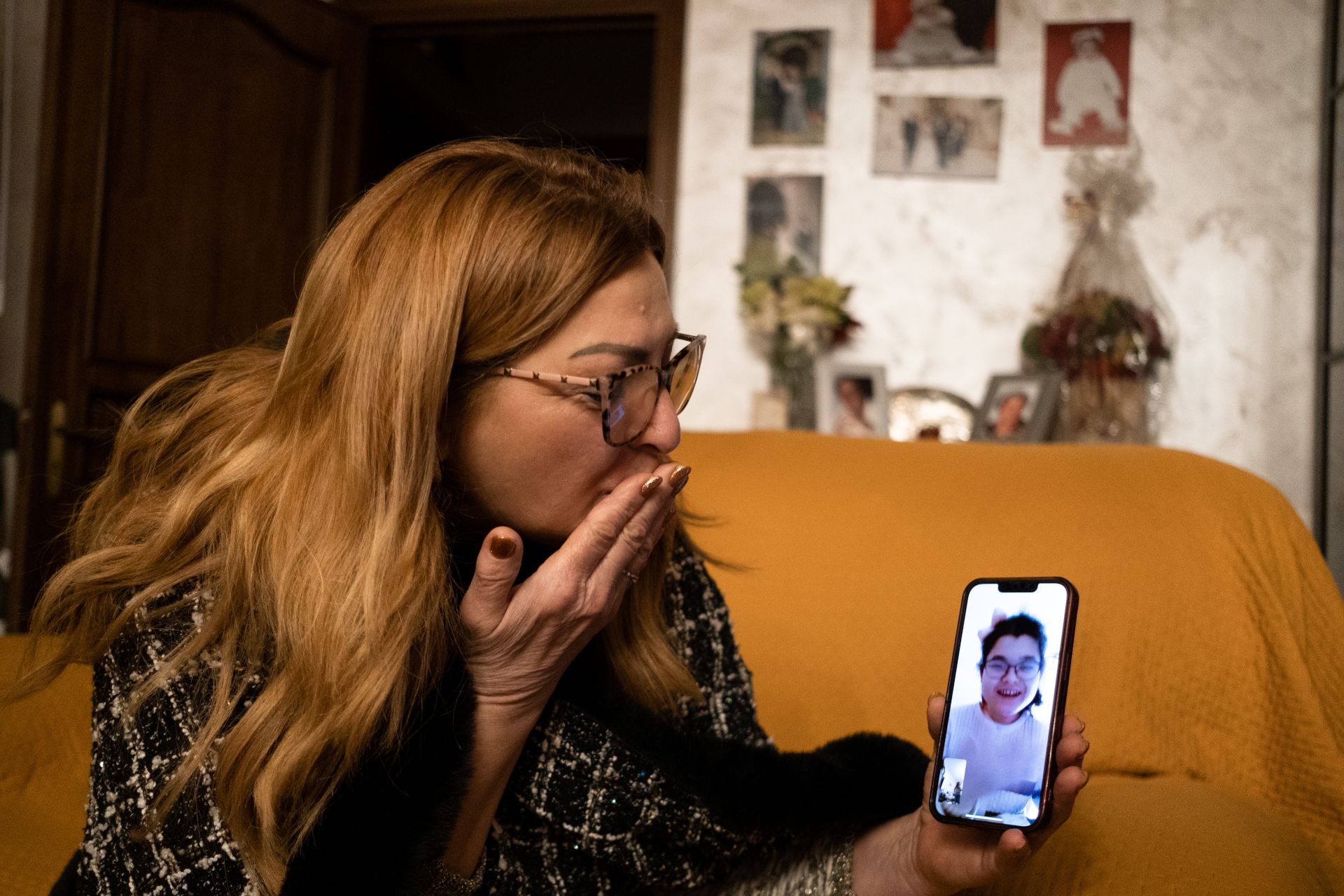
Toward the end of the summer of 2023, Evelina Demeter, then 14 years old, was removed from the care of her doting foster mother in Italy and repatriated to her native Ukraine, from which she had been absent for nearly 18 months. For most of her life, before she was evacuated to a small town in Sicily at the beginning of the full-scale Russian invasion in Feb. 2022, she had lived in a state-run institution. With her foster mother, she found a warm and supportive home, something that she had never known. Now, back in the country of her birth, she felt lonely and helpless. “I missed Mamma Maria and the comfort of her home. There, I was really treated like a daughter,” Evelina told New Lines.
“Mamma Maria” is the name by which Evelina calls 64-year-old Maria Cavallaro, who fostered the Ukrainian girl in Sicily following her arrival in March 2022. In those first panicked weeks after Russia’s full-scale invasion, Ukrainian authorities evacuated children living in state care institutions and placed them with families outside the country. Evelina, then 13 years old, was born with physical and intellectual disabilities and had been living in an orphanage since she was a baby. She arrived in Fleri, a small village in Sicily, along with around 45 children, after a 24-hour journey by bus. No one explained to the children where they were going, or when they would return to Ukraine — if at all.
Evelina was one of four dozen children, many of them living with autism, who were evacuated by bus from the Chednayiv Children’s Home in Mukachevo, a town tucked in the green hills of western Ukraine. In the face of Russia’s invasion, the Ukrainian government decided to evacuate the children from the country’s internats — state facilities for children who have been removed from homes deemed unfit — and send them to safe places either elsewhere in the country or abroad. At the time, nobody in Ukraine knew where the front line was, or where it would be a few weeks later. Against a background of panic, evacuations were carried out in a haphazard, disorganized manner.
In eastern Ukraine, the Russian occupying forces abducted children living in state-run institutions and sent them to Russia. When the international media reported on the abductions, an international uproar ensued; it contributed to the International Criminal Court’s indictment of President Vladimir Putin for the crime of unlawfully deporting children from occupied territory. While the world’s attention was on Russia’s crime against Ukrainian children in the eastern part of the country, the children from state institutions who were sent in the opposite direction, to Ukraine’s allies in the West, were all but forgotten. The Ukrainian authorities paid them little attention while the international media failed to cover their story.
According to the Ukrainian State Service for Children, at the beginning of Russia’s full-scale invasion, 4,811 children in state-run institutions were evacuated to 19 countries in Europe and placed with foster families. The government has since repatriated most of them, but over 1,500 remain with families in Western Europe. Some are in Greece and Spain, others are in Austria, but most are in Italy. Now, the Ukrainian government wants them back.
The Italians who fostered the Ukrainian children have fiercely opposed Kyiv’s demand to repatriate them. They say that Ukraine’s state-run care system is abusive and that the country is unsafe due to the ongoing war. The Ukrainian authorities say that by refusing to return the children, the Italian families are violating the law. This diplomatic wrangling has upended the lives of thousands of Ukrainian children.
Several of the foster families who have contested the order to repatriate the children said they had been frightened and disturbed upon their arrival in Italy, but were now thriving. Many of the children have forgotten how to speak Ukrainian, and associate memories of their native country with war and trauma. The foster parents believe that uprooting the children again to return them to a war zone would impose additional, preventable trauma. They are challenging the Ukrainian government’s repatriation order in court. Ukraine, for its part, believes that allowing the children to forget their origins undermines the country’s demographic future, already battered by the effects of a grinding four-year war.
During the long bus ride from Mukachevo to Sicily in March 2022, Evelina sat next to her friend Yuri (a pseudonym, at the request of his foster parents); the two had spent most of their childhood together at the internat. In Italy, however, their lives would take very different paths. Evelina’s foster mother, Cavallaro, lives in a large house at the foot of Europe’s most active volcano, where she owns and runs a honey factory. Cavallaro, who had been following the news about the war with shock and concern, decided to foster one of the children after hearing about a bus of Ukrainian orphans on their way to Sicily. Through a referral from a neighbor who was active in volunteering with underprivileged children, she contacted Yuliya Donnichenko, president of a Sicily-based association called New Borders; Donnichenko coordinated the evacuation of the children from Mukachevo to Sicily and Calabria.
Donnichenko, 46, is a Ukrainian who settled in Catania, Sicily’s second-largest city, 20 years ago. With Italian and Ukrainian state funding, she founded an association to promote cultural exchanges between the two countries. She told New Lines that Ukrainian authorities asked her to coordinate safe passage to Italy for the children from Mukachevo because she had acquired experience in organizing “health trips” for Ukrainian children who, under the auspices of the state, were for years sent to Italy for summer vacations after the 1985 Chernobyl disaster. The initiative was originally a Soviet one, but the Ukrainian government continued the practice until 2014, many years after the country became independent following the 1991 collapse of the Soviet Union. After she moved to Sicily two decades ago, Donnichenko established a connection with Maksym Kovalenko, Ukraine’s consul in Naples, and gained the trust of Ukrainian authorities in managing the health trips. She continues to derive her income from the government funding provided to run the association.
Donnichenko told New Lines that she used the list of people who had hosted Ukrainian children on health trips to source potential foster families for the wartime evacuees in 2022. Her goal, she said, was “to give [the children] some sense of comfort and peace after what they had been through.” Most of the children from the Chednayiv Home in Mukachevo were placed with families in small villages scattered across the province of Catania in Sicily.
Evelina is Roma, which makes her difficult to place for adoption in Ukraine, where there is widespread prejudice against her ethnic group. She was born with moderate intellectual and physical disabilities and has difficulty walking. She also has a genetic condition that makes her look younger than her age. She was still a baby when social services removed her and her older sister from the home of her alcoholic single mother. Evelina’s story echoes those of many Ukrainian “social orphans,” children of parents whom Ukrainian social services deem unfit because they suffer from chronic addictions, have criminal records or lack the financial means to raise children.
In prewar Ukraine, economically disadvantaged families commonly left their children to be raised in state-run institutions. Before 2022, there were 700 internats that were home to 100,000 children, or over 1% of the entire child population. According to EU data, Ukraine had the highest rate of child institutionalization in continental Europe.
“When she arrived at my door, she didn’t look 13, as it said in her file. She looked like a 9-year-old,” said Cavallaro. She said she decided immediately that, despite the challenges involved in caring for a child living with intellectual and physical limitations, she was committed to caring for Evelina.
Yuri and his sister were fostered by Rosario Corallo and his wife Elenia Giannone, a childless married couple in their 40s who live in Ramacca, a 45-minute drive from Catania. Both siblings had been diagnosed in Ukraine with behavioral issues. Corallo said that the children were “dirty, scared and angry” when they arrived. “It took us a week to clean them up and calm them down,” he said, adding that “something happened to them in that orphanage in Ukraine, it wasn’t just the war. They were probably neglected or mistreated back there; we could tell from the way they interacted with adults.”
In July 2022, the BBC published an investigative report that documented severe abuse of disabled children in Ukrainian state institutions. Staff kept many of the children in restraints all day, in one reported case leaving an older boy with developmental difficulties tied to a bench outdoors in the heat of the summer. The government promised to reform the system, but the war has put the matter on hold, and the internats remain a place where children’s rights are routinely violated.
Corallo and Giannone said there was a lack of transparency in the way Donnichenko managed the evacuations and foster assignments. Some of the other foster parents also claimed that Donnichenko had demanded bribes from those who wanted to keep the children. When New Lines asked her to respond to this accusation, Donnichenko denied it strongly. Petro Dobromilsky, former head of the State Service of Ukraine for Children’s Affairs, told New Lines that the Italian foster families failed to respond to demands from the Ukrainian authorities for updates on the children’s well-being.
In June 2023, the foster families in the Catania area were the first to receive an order from Ukrainian authorities to repatriate the children in their care.
Dobromilsky said that the Italian foster families refused to cooperate. They hid the children and stopped answering Donnichenko’s phone calls. After several weeks of uncertainty, foster families in Catania collectively decided to fight the repatriation order, which they called “forced deportation.” They went to court and contested Donnichenko’s authority as guardian, accusing her of neglect and of physically and psychologically abusing the children. Cavallaro said that on the few occasions Evelina visited Donnichenko, the Ukrainian woman took the child on her Vespa without a helmet and, when Evelina complained, hit her defective leg several times. Other children reported that Donnichenko gave them instructions on how to manipulate the emotions of their foster parents, by alternately claiming they wanted to go back to Ukraine and begging that they be allowed to stay in Italy.
The UNHCR and Save the Children agreed that repatriation was unsafe for the children and amplified their view on the matter in press releases. The foster parents filed a request for international protection. In August 2023, the Juvenile Court of Catania suspended the guardianship of the Ukrainian authorities after hearing the testimony of the children, while they searched for a court-appointed special envoy for this unique situation.
Cavallaro, Corallo and the other foster families breathed a sigh of relief. But surprisingly, given that these events took place during the sleepy month of August, the court, in response to an appeal filed by Donnichenko’s lawyer Rosa Lo Faro, reversed its decision. Italian authorities would not be granted guardianship over most of the Ukrainian children. “Ukrainians didn’t enter the EU as refugees, and hence the children were not technically unaccompanied minors, like the ones who arrive in Sicily via sea,” Lo Faro told New Lines.
In mid-August, a week before her 14th birthday, Evelina was sent back to Ukraine via the same 30-hour bus ride that had brought her in the opposite direction a year and a half earlier. During the days before the journey back to Ukraine, she experienced stress and panic attacks, which were exacerbated by her autism, Cavallaro said. Many other children suffered similar reactions.
When the children arrived in Sicily in 2022, Donnichenko described them as orphans. But many of them had parents, relatives and even siblings back in Ukraine. Ukrainian authorities emphasized this fact to convince the children and their foster parents that repatriation would be in their best interest.
Some children, motivated by the promise of going back to live with their blood relatives, accepted repatriation, despite the initial shock; but many, especially boys approaching the age of 18 who were at risk of being drafted into the military once they were back in Ukraine, wanted to stay with their foster families. In the northern Italian province of Bergamo, where about 95 Ukrainian children from internats were placed with local families, Michela Noris, a foster parent to three children, shared her own concerns about the way the repatriations were managed. “We hosted three siblings. The eldest, a 16-year-old, was promised his own room and a PlayStation if he agreed to return to Ukraine,” she told New Lines. “Others were told that, if they stayed in Italy, they’d end up in migrant reception centers in Sicily, along with dangerous African asylum-seekers. It was mind-boggling how they tried anything to convince them.” The boy was evacuated back to an institution in the western city of Ternopil, which Russia bombed in November. Despite authorities’ promise that the repatriated children would be placed with families rather than in an internat, the boy Noris fostered was once again placed in a state-run institution, where he does not have access to a cellphone. Because Noris has not been able to contact him — messages sent via Instagram went unanswered — she has no way of knowing whether or not the boy is safe after the bombing.
“It was a bit cruel to give them a taste of the freedom of a peaceful country with a thousand opportunities for their future, only to then abruptly pull them away,” Cavallaro said. Discouraged by the potential legal reprisals, she reluctantly let Evelina go. Now she deeply regrets her decision. A week after Evelina was taken away from her, Cavallaro published an open letter in a leading Italian newspaper, asking Italian Prime Minister Giorgia Meloni to intervene with the Ukrainian authorities to bring Evelina back. But Cavallaro did not receive any support from the Italian government, and she heard nothing from Evelina for more than a year. “I thought she had disappeared into the system,” Cavallaro said.
More than a year after she was repatriated to Ukraine, Evelina finally contacted Cavallaro. The Italian woman burst into tears when she read a text on Telegram that said: “It’s me, Evelina, I’m safe. Can I call you?” Since then, they have been speaking three times daily. Evelina told Cavallaro that she was very bored. “She stays at home all day. As far as I understood, she’s not sent to school, just to an English language class in the afternoon twice a week and to church,” Cavallaro told New Lines. “If she had stayed with me, I think we would’ve saved her many sorrows and traumas. I’m still waiting for her.”
Danira Grifò, a child and family relationship therapist, told New Lines that moving vulnerable children to a foreign place can cause trauma that takes time to heal. “But if you also add a fresh abrupt change in a newly established calm routine that took time to build, you risk causing further damage,” she said. “After more than a year of living in a comfortable home setting, telling these kids to pack up again and go back to a place they identify with conflict and lack of freedom means instilling fear and uncertainty in a child that will grow up as a fearful adult unable to trust stability.”
Others fought harder, pressing their legal suit against Donnichenko. A year ago, the Catania court of Cassation recognized the minors’ rights to be protected from war and potential abuse within Ukraine’s inadequate state care system. Yuri managed to stay with the Corallos, as did a few other children with their own foster parents. Ilaria Spoto Puleo, the lawyer who represented the Corallos and one other family, managed to obtain the appointment of a special envoy who invalidated Donnichenko’s guardianship, allowing the children to stay until the war was over.
The Corallos and the other two Catania families who kept their foster children are listed as criminals in Ukraine because they defied the government’s order to repatriate the children. Yuri was separated from his sister, who is among the repatriated children, in a violation of Ukrainian state law that mandates siblings be kept together. According to Ukrainian law, the Italian foster parents are in the same category as child traffickers and kidnappers. The foster parents said the Ukrainians refused to take the children’s wishes into account before ordering them to be repatriated, and that this refusal caused serious emotional harm. The repatriations, say many of the Italian foster parents, were managed inhumanely.
Donnichenko and Dobromilsky told New Lines that they worried the foster parents who managed to keep the children intended to adopt them; transnational adoption, in cases when the state of which the child is a citizen contests the adoption, is a violation of international law. But Corallo told New Lines emphatically that he and his wife had no such intent. “We just want to host him in the safety of our home until he is 18, at which point he can decide independently, as an adult, what he wants,” Corallo said.
Three years after boarding that bus together to Sicily, Evelina and Yuri are today living very different lives. He has a bright future in sunny Sicily, safe and cared for by loving foster parents, while she was forced to return to Ukraine to face instability and an uncertain future.
In 2024, the Ukrainian government passed legislation that made it mandatory for children who were evacuated at the beginning of the full-scale invasion to be placed in foster homes rather than in state institutions. Dobromilsky says that once the children arrive in Ukraine, the authorities will provide reintegration support in a safe environment with trained specialists. But Evelina says that she was offered no such support. When she returned to Ukraine, her new foster family denied her access to a phone, which meant she was unable to contact Cavallaro, even to tell her that she had arrived safely in Ukraine.
Svitlana Sofilkanych, former director of the Chynadiyiv state-run home, was responsible for signing the documents that allowed Evelina and the other children to be evacuated to Europe. She kept in contact with many of them, but with others this proved impossible. Sofilkanych admits that Evelina would probably have been better off in Italy. But the repatriation was a government decision that she could not challenge.
The Ukrainian consulates do not have the resources to wage legal battles across Europe. That’s why the issue has dragged on for years. In Ukraine, internat staff have come under public attack, accused of allowing Western Europeans to “steal” Ukrainian children. Sofilkanych, who has dedicated her life to caring for children, says these accusations have hurt her. But, she said, what truly matters is the safety of the children and preserving Ukraine’s demographic composition.
Dobromilsky says that the full-scale invasion and the threats to the country’s demographics have spurred an increase of 30% in adoptions within Ukraine. But Evelina says she’s not happy with her current life. A few days after her 16th birthday, she said firmly to New Lines: “I cannot wait to turn 18, so I can leave and move back to Italy. There’s never been anything for me here.”
Kseniya Novytska contributed reporting from Ukraine.
Reporting for this story was supported by Journalismfund Europe and the IJ4EU consortium.
Become a member today to receive access to all our paywalled essays and the best of New Lines delivered to your inbox through our newsletters.