


The three-story industrial building in Seoul’s hipster neighborhood of Seongsu was packed with hundreds of women, their chatter and laughter echoing across the space. Outside the gate, nearly a hundred more waited in line beneath a giant banner that read, “Bihon Fair.” Bihon is a Korean term that roughly translates as “willfully unmarried” or “no-marriage.” “This is so exciting!” Jenny Lee, a 30-year-old office worker from a Seoul suburb, told New Lines as she squeezed her way into the wall-to-wall crowd.
Inside, a river of people flowed past dozens of booths set up along the gray concrete walls. Each beckoned passersby with colorful banners: “Knitting club for bihon women,” “Home repair service for women living alone — by women,” “Self-pleasure is self-care — with our (sex) toys,” or “Are you a bihon woman? You’re not alone — join our bihon community!”
“It’s nice to see with my own eyes that there are so many bihon women like me out there,” Lee said. “I feel like we’re somehow connected — rather than being alone and isolated.”
She then walked up to a lecture hall on the top floor, where a real estate agent was advising bihon women on how to find an ideal home. On the stair wall beside Lee was a quote from Virginia Woolf, “A woman must have money and a room of her own if she is to write fiction,” alongside lines from other prominent feminists.
The fair — the first of its kind held in South Korea — offered a snapshot of a society in which a growing number of women choose to remain single, rejecting traditional expectations to marry, give birth and be self-sacrificing family caregivers.
South Korea has repeatedly broken its own record for having the world’s lowest birth rate: 0.98 babies per woman in 2018, 0.84 in 2020 and 0.72 in 2023. The annual number of births has dropped by nearly 70% in three decades. Statistically, once a country experiences a drop in birth rates, it is unlikely to reverse the trend. For South Korea, a continuation of this trend will translate to halving the population in six decades, according to the Organization for Economic Cooperation and Development (OECD).
In the United States, the term “no-marriage” might evoke the 4B (or “four nos”) movement, a fringe South Korean feminist campaign rejecting heterosexual marriage, childbirth, dating and sex. The radical slogan went viral in the U.S. last year, when some women embraced it to protest what they deemed the toxic masculinity that hastened Donald Trump’s presidential win and the erosion of abortion rights.
But in South Korea, the movement represents just the most outspoken end of a much broader spectrum of bihon women. These women collectively underpin a social phenomenon dubbed “marriage strike,” fueled by their desire for personal autonomy and a growing divide between their worldviews and those of their male peers.
South Korea’s case serves as a preview, or perhaps a cautionary tale, for countries like the U.S., where the birth rate has hit a new low of 1.6 babies per woman (well below the replacement rate of 2.1), and continues to decline. In the U.S., Gen Z women face a growing state-led push to marry and start a family, amid a widening gender divide that includes increasing divergence in political views, education and life priorities between men and women of typical child-rearing age.
The Trump administration has ramped up campaigns encouraging childbirth by dangling $1,000 “baby bonuses” and offering cheaper infertility drugs. President Trump called himself “the fertilization president.” The conservative Heritage Foundation, known for its Project 2025 governing playbook and reference guide to the Trump administration, is pushing for policy changes to encourage married heterosexual couples to have more babies and “restore the nuclear family.”
The foundation, in a report published earlier this month, titled “Saving America by Saving the Family: A Foundation for the Next 250 Years,” called for a “Manhattan Project to restore the nuclear family.” The report advocates for tax incentives to encourage early marriage, having more children, promoting stay-at-home parenting for moms, defunding child care programs like Head Start, disincentivizing divorce and penalizing alternative family structures. It also calls for reviving the American dream by decreasing taxes and chipping away at industry regulations.
The policy proposals, mainly aimed at reshaping women’s reproductive trends, do not reflect the priorities of these women. According to a survey in September by NBC News, Gen Z men who voted for Trump cited having children as the most important mark of personal success. But for young women who voted for Kamala Harris, having children ranked 11th, underscoring the widening gender divide, not only in politics but also in matters like childbirth.
South Korea took a similar approach for decades, spending billions of dollars on pro-birth campaigns focused on married heterosexual couples — with little success. Now more bihon women are building communities of their own and pushing to redefine family in less traditional ways. Many of these women are experimenting with new forms of companionship or family, like pooling their resources with two or more friends and living with them in the same house, or having a child and raising it out of wedlock.
Many observers of the trend say it may be the country’s best alternative as it faces the world’s lowest birth rate and a rapidly shrinking — and aging — population.
The scenes at the Bihon Fair, held on one Saturday in November, were a reflection of that reality. “In typical wedding fairs, people get tips about weddings and celebrate marriage. … We wanted to create something similar — an event where bihon women can celebrate their lifestyle together, find role models and get helpful tips for their lives,” Moon Young-one, the chief organizer, told me.
Moon, a 24-year-old office worker from the southern city of Busan, is a 4B follower. She embraced the movement in 2020 when a strong wave of feminism swept South Korea, sparking a heated public conversation about gender violence and discrimination against women as well as conservative norms in the country’s family life.
Married women in South Korea feel saddled with the lion’s share of child care and household chores — so much so that even women who are the family breadwinners spend more time on domestic labor than their stay-at-home husbands, according to state data. Many women are placed at the bottom of the pecking order in their husbands’ families and relegated to kitchen drudge work for the rest of the relatives — especially during traditional holidays when extended families gather (indeed, the long-standing practice frustrates so many women that the number of divorces rises after such holidays).
Such burdens — combined with the country’s notoriously long working hours and male-dominated corporate culture — are blamed for why so many women give up their careers or are forced to do so after marriage or childbirth. The trend has resulted in South Korea recording the biggest gender pay gap among the industrialized countries of the OECD for nearly three decades running.
There has been no mass survey of what married women think about the bihon lifestyle, so it’s difficult to generalize about their opinions without hard data. But multiple polls have consistently shown that married women are far less satisfied with their lives than married men, divorced women are far more content with their lives than divorced men and single women are far more content with their lives than single men. This life satisfaction gap between single women and single men widens as they age.
In one typical survey in 2025, 38% of married women in South Korea said they would not want to marry at all if they were given a chance for a new life and were born again — compared to 15% among their male peers. In the same survey, 23% of married women below the age of 40 said they would marry the same person if they were born again — far lower than the 45% of their male peers who said so.
Jinyoung Park, a 45-year-old schoolteacher with two daughters, aged 10 and 16, who lives in a Seoul suburb, told New Lines: “I want [my daughters] to live as a bihon if they can. Marriage is still a bad deal for women. … I wouldn’t mind if my daughters manage to find someone nice and want to marry, which is fine. … I want my daughters to live a happy, independent and free life.”
Gina Choi, a 35-year-old office worker with a 2-year-old, echoed the sentiment. “I’m happy with my life with my husband and my son. But I also understand that marriage still comes with so much burden for women, especially regarding the parents-in-law thing.” And in the absence of meeting “someone nice,” she said, “I think it’s totally cool to live as a bihon and enjoy your life with other single women or however you like.”
It is against the background of this cultural shift that “boycotting marriage” has become a common theme in online chatrooms and beyond, leading in part to the emergence of the 4B movement, even in some of the country’s most conservative parts.
Moon, who lives in the southeastern region of Gyeongsang, the country’s conservative stronghold, joined the 4B movement despite the societal consternation surrounding her decision.
“It can feel very lonely and isolating to be a feminist, let alone a 4B follower, in this region. You can be not only harassed, bullied, fired from work — but also downright beaten up for being a feminist,” Moon said.
She was referring to a high-profile 2023 case in the southeastern city of Jinju, where a men’s rights activist brutally assaulted a convenience store clerk simply for having short hair, which he considered a sign of feminism. “Feminists deserved to be beaten!” he shouted during the attack, which left the victim with partial hearing loss.
“But we feel relatively safe — and connected — when we get together like this,” Moon said, adding that she, like many peers, does not say she is a feminist or a 4B follower at work or with male acquaintances.
Her group, named using the English acronym WITH (Wolves in the Hell), now has about 500 members who meet regularly to socialize, often in small groups.
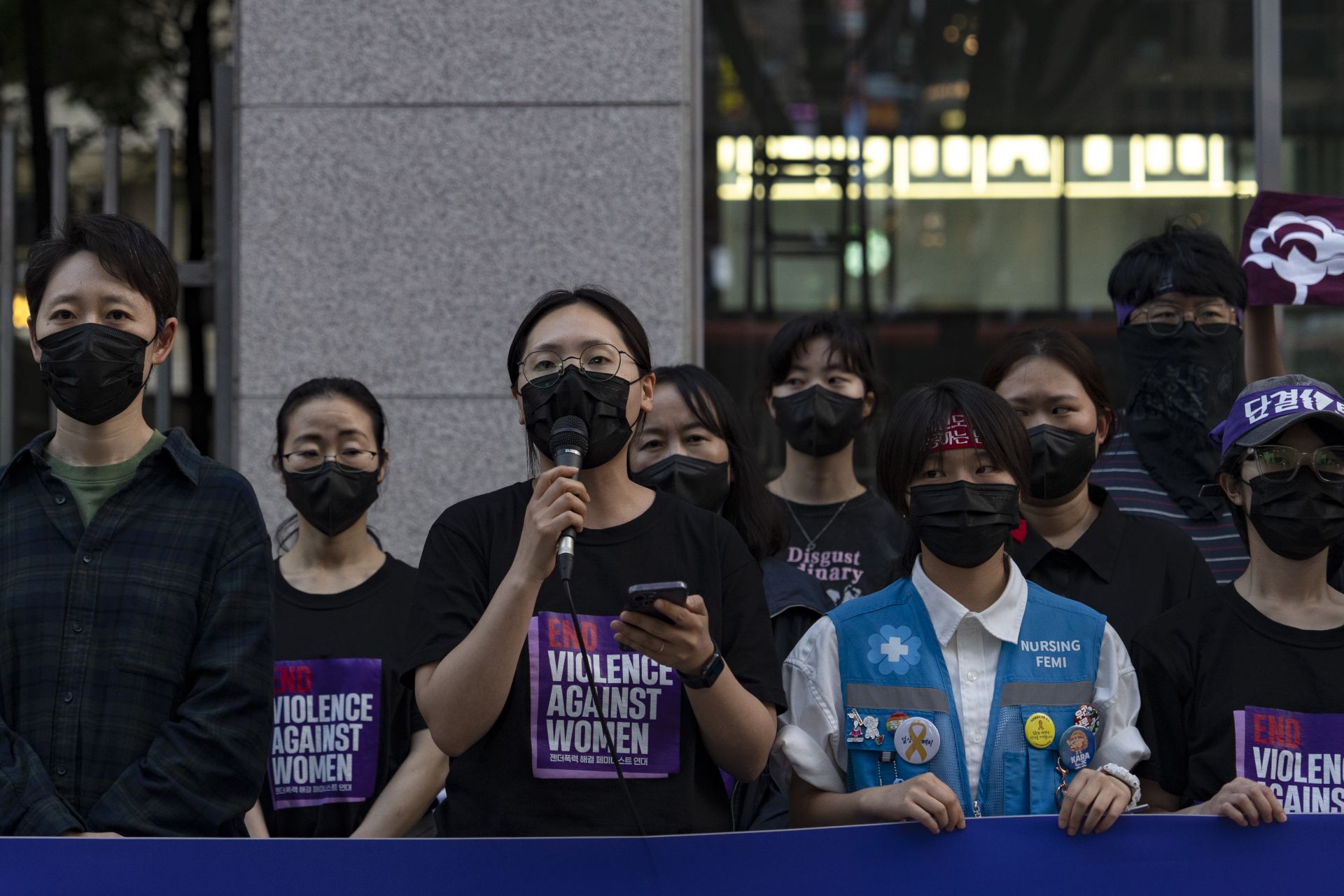
They play soccer and basketball. They go on picnics, rock climb, knit, read books and play board games together. They have organized multiday summer camps and New Year’s gatherings attended by hundreds. They have joined street rallies protesting gender violence.
Dozens of such social communities — some led by 4B followers, others by more loosely defined networks of bihon women — have sprung up across the country. The Bihon Fair, attended by nearly 2,000 women according to ticket counts, was the latest event they organized.
A bihon woman is “often frowned upon as someone eccentric, selfish — or even someone responsible for our low birth rates,” Moon, dressed in a black pantsuit and with short-cropped hair, said during the opening speech.
“But we know our bihon choice is a way to reclaim the autonomy of women’s lives and build solidarity among women,” she said to loud cheers from the hundreds-strong crowd, who mostly appeared to be in their 20s and 30s.
Multiple factors are blamed for young South Koreans increasingly shunning marriage and childbirth, including notoriously long working hours, sky-high housing prices and the enormous cost of raising a child. And while these factors affect both men and women, women consistently show far less interest in marriage, childbirth or even dating than their male peers.
In one recent survey conducted by the Korean magazine SisaIN, only 8.3% and 27% of women in their 20s, respectively, considered marriage and dating essential — far lower than the 32% and 56% of young men.
In an analysis by the Korean Women’s Development Institute of eight countries, including the Netherlands, Germany and the United Kingdom, South Korean women showed the lowest willingness to have children, while South Korean men showed levels similar to their male peers elsewhere. As a result, South Korea had the biggest gender gap in the willingness to have a child.
Several surveys published since 2022, including by the Korean unit of Planned Parenthood and academic journals in the country, show that South Korean women reject marriage and childbirth to avoid sacrificing personal aspirations and well-being, losing their jobs, suffering career setbacks or accepting gender inequality — sentiments that were on vivid display at the fair.
A large blank poster plastered on a wall at one corner asked: “What made you decide to embrace the bihon [lifestyle]?”
“I don’t want to be called someone’s ‘mother’ only. I’m too free-spirited to have my life bound by husband, in-laws and children,” wrote one. “My life is so fun and happy — I never want to lose this happiness,” wrote another.
“I don’t want to do ‘dokbak’ child care,” wrote a third, invoking a term from local card game jargon that means one player gets stuck with all the losses. The poster filled up so quickly that the organizers had to put up another next to it.
“I grew up watching things like my mother and other women in my family spending days in the kitchen during traditional holidays while men lie on the sofa, watching TV,” Lee said while browsing the booths offering colorful postcards emblazoned “4B” or “I’m bihon, but I’m not alone.”
“Sure, I know there could be many young men who are different from my father’s generation,” she said, “but I don’t want to spend my time searching for a unicorn that may or may not exist [around me] because I am already happy as I am now, and I can live well this way.”
Lee added that pervasive domestic and dating violence — and the government’s failure to address it — made dating “too risky” in many women’s eyes.
South Korea is a relatively safe country, where gun violence and violent crimes in public are rare. But when a violent crime does occur, more than 80% of victims are women. As is the case globally, when a woman endures violence, it is often at the hands of someone she knows, like a family member, a colleague or a former or current partner.
The government does not even release official data on how many women are killed by such violence. But a local women’s rights group counted at least 181 women killed by their current or former partners or stalkers in 2024 alone — almost one death every other day — for reasons including trying to break up or refusing to have sex.
“I know not all men are violent,” said Mia Kim, a 32-year-old office worker in Seoul, as she wrote “safe society,” “female solidarity” and “money” on another poster asking “What do bihon women need most?”
“But when you feel that there are many bad apples out there and you might have to pay a huge price when picking the wrong one, and society may even blame you instead of holding your abuser accountable … what would you do?” she asked. “You retreat — from dating and marriage.”
One survey conducted by Gallup showed only 24% of women aged under 30 wanted intimacy with men — far lower than 62% among men who said they wanted intimacy with a woman.
Both Kim and Lee, like multiple others I met at the event, were not entirely against the idea of having a child, nor did they adhere to the strict tenets of 4B.
But in South Korea, births out of wedlock remain rare, as “unmarried mothers” face social stigma. At the same time, premarital sex is taboo, at least for women. Marriage is still considered by many as a prelude to childbirth, and dating a prelude to marriage.
“So I think I’ll naturally end up having a 4B lifestyle anyway, although I’m simply against marriage,” Lee said with a laugh.
Meanwhile, young men and women in South Korea sharply disagree on this reality, with many men blaming feminism for the chasm.
When a survey done by one Korean matchmaking company asked single men what women should fix most urgently to be suitable marriage material, the men’s top answer was “feminism.” In another survey, young men called being a feminist the worst quality in a potential dating partner.
Women, by contrast, described men’s views on sharing household chores as the key issue to be fixed, and having sexist attitudes as the worst quality in a potential date.
This “gender divide” is also reflected in voting patterns, with young men turning sharply right-wing and young women leaning left.
Young men in their 20s played a key role in the rise to power of the former president, Yoon Suk Yeol, with nearly 60% supporting Yoon when he campaigned on an openly anti-feminist platform in 2022. A majority of them — 74% — continued to support Yoon’s right-wing party and its smaller offshoot in the next presidential election in 2025, even after Yoon’s unconstitutional declaration of martial law, which led to his impeachment.
Meanwhile, young women overwhelmingly voted for the center-left Democratic Party or more progressive parties.
Recent surveys found that nearly 80% of women in their 20s saw “gender conflict” as a serious problem, and nearly 60% of South Koreans wouldn’t marry or date those with different political views.
“I grew up watching too many boys in my school bullying and harassing girls whom they suspect as feminists — someone who is slightly outspoken or complains about the sexist jokes they make,” said Kim Min-seong, a 20-year-old college student in Seoul.
“I know not all men are like that. But I’ve seen so many classmates using sexual or anti-feminist taunting as a form of male bonding and turning more far-right in their worldviews, which I find hard to stomach,” she said.
In a lecture hall behind her, hundreds sat on the chairs or cross-legged on the floor in front of the stage, listening to a doctor talking about women’s health or a lawyer talking about how to respond when falling victim to gender violence.
Kim picked up a green marker beneath the wall poster asking “What do bihon women need most?” and wrote “Life partner law” — like dozens of others who’d already written the same.
Such legislation would allow people living together but not bound by blood or marriage to access similar rights as traditional families, such as co-signing mortgages, co-parenting children or signing a consent for medical care for each other.
Feminist groups and young women, including bihon women who live with their friends, are vocal proponents for the change. Some even adopted friends as adult daughters, taking advantage of the narrow legal definition of family that recognizes only those bound by blood, marriage or adoption. That way, they can co-sign mortgages, sign a consent for medical care for one another, claim tax benefits, take family caregiving leave from work when one of them is sick or hold a funeral when one of them dies.
But efforts since 2023 to pass the law have stalled due to fierce opposition by evangelical church groups, which claimed it would “destroy families” and allow same-sex couples nearly the same rights as heterosexual couples, effectively legalizing same-sex marriage.
Even so, the law is essential to help a growing number of “unconventional families” care for each other as South Korea rapidly ages, said Yong Hye-in, a lawmaker from the left-wing minority Basic Income Party who proposed the law in 2023 and again this year.
More than 1.1 million South Koreans live with their friends, lovers or acquaintances. Seven out of 10 South Koreans believe that those who share a living space and livelihood — but are not bound by blood or marriage — should be considered families, a survey shows.
“The definition and form of families in our society are changing rapidly … but our outdated laws based on the traditional family model are failing to embrace these diverse forms of families that already do exist in our society,” Yong said in a recent press conference. “We need new policies in line with our new reality,” she said.
Yong is not alone. Other parties, including the ruling Democratic Party, recently announced plans to propose similar, if less comprehensive, measures, indicating a growing political recognition.
Births out of wedlock, long stigmatized, are also rising in number despite the overall decline in births, as public opinion shifts and after stories of several unmarried female stars who are having and raising children became public. Such births accounted for 5.8% of all births in 2024 — still far below the OECD average of over 40% but double the 2.9% recorded in South Korea just three years earlier.
The government also vowed to take action, an unthinkable idea only a few years earlier. The president’s chief of staff recently ordered new policies to support unmarried mothers and ensure equal access to services, saying, “our reality has changed.”
“The government needs to break free from its obsession that only married heterosexual couples should have children if it really wants to address the low birth rates crisis,” said Kwon Soo-hyun, a sociology professor at Gyeongsang National University.
Kwon, who has studied communities of bihon women, also said some of these women were open to raising a child. “Apart from having romantic relationships with men, they are pretty open to many possibilities, like having a child, forming an alternative form of family or having a community of care with people they love and support,” she said.
“What they really want is a space where they can be loved, respected and supported as an equal human being, and vice versa. That’s a space many men have failed to create with women.”
Respecting diverse lifestyles and companionship — singles living alone, cohabiting couples, same-sex couples or friends living together — should be a top policy priority to address the growing crisis of elderly care and population decline, Kwon added.
As the Bihon Fair neared the end, Kim Soo-bin, a 32-year-old office worker in a Seoul suburb, said she hoped to return next year with members of her online group of 30 bihon women. “Honestly, it’s not easy to be a 30-something single woman, especially when everyone around me is getting married. It can feel quite lonely,” she said.
She added, however, that her community and the fair gave her a sense of confidence — and hope. “I really hope we can grow old together like this, and live a different life from our parents’ generation,” she said, “A life more fulfilling, independent and, hopefully, happier.”
Become a member today to receive access to all our paywalled essays and the best of New Lines delivered to your inbox through our newsletters.