



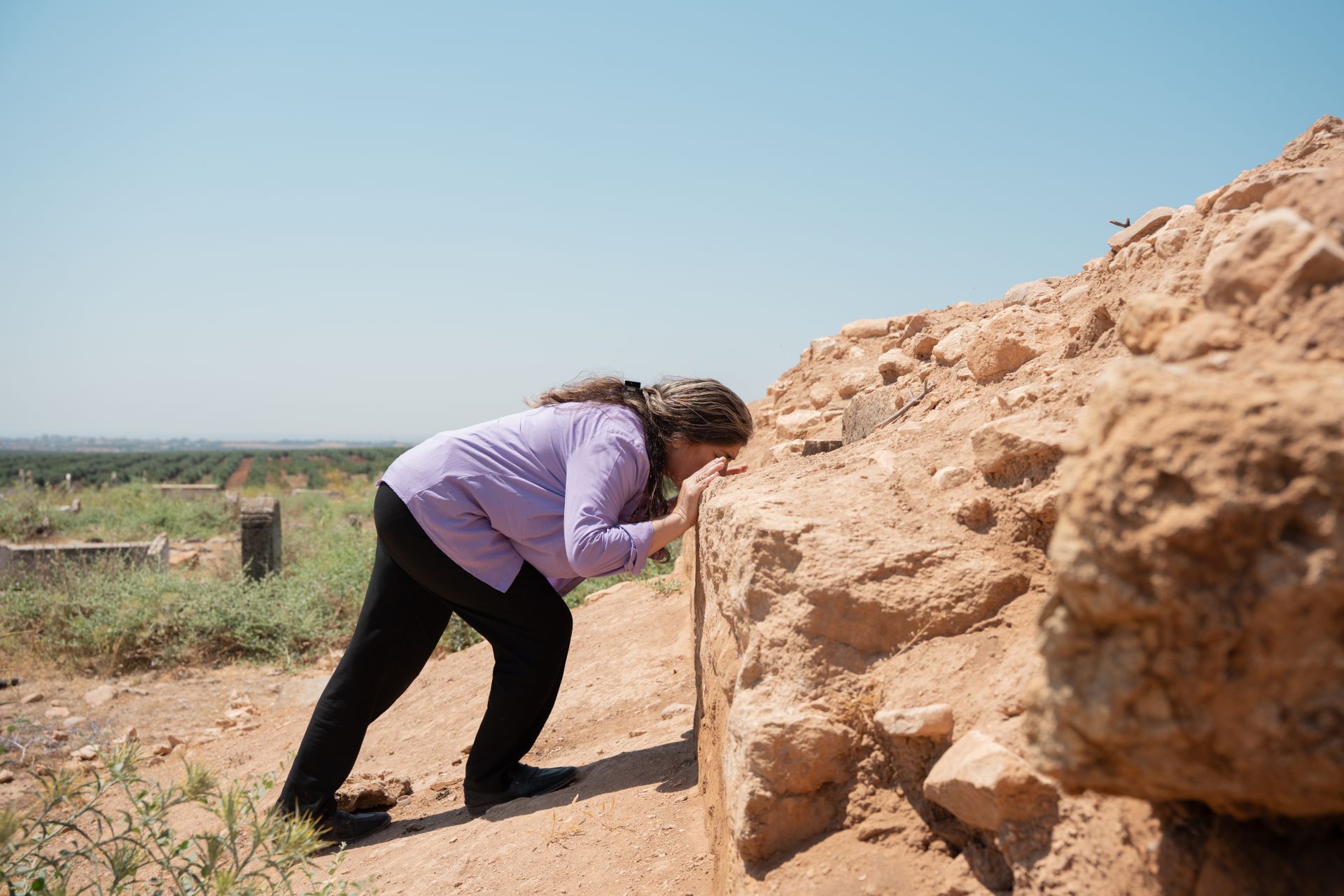
Suad Hiso approached the rubble of a shrine in her village. The red-tinted stone was darkened by olive oil, and half-melted candles were left beside its niche, offerings from Yazidi worshippers who had come before her. Tiny stones balanced in the wall’s crevices, and ribbons adorned a bush nearby — each stone and knotted bow holding someone’s wish.
The Yazidi shrine is one of 19 nestled in the Afrin mountains of northern Syria — where locals say the religion has been practiced for over 5,000 years. Yazidis are a Kurdish-speaking religious minority indigenous to western Asia, including parts of modern-day Syria, Iraq, Turkey and Iran.
Hiso, 52, turned to face the sun, her palms open to the sky. “Oh my sister, oh sun, oh sun,” she recited, demonstrating the way she prays as a Yazidi. “Give us strength, give us your light, heal us from illness, cure diseases, protect our children and the children of the whole world.”
Yazidis (or Ezidi in Kurdish) do not worship the sun, but it is their qibla, or direction of prayer, which they hold sacred as a symbol of “strength, light, eternity and the eye of God,” Hiso explained. Yazidis worship God and venerate the seven angels through whom he acts, chief among them Tawûsî Melek, the Peacock Angel.
Afrin has historically had the highest Yazidi population in Syria, with around 60,000 living in the area prior to 2011. After Turkey’s 2018 offensive — when the Turkish army and allied Syrian militias invaded and then seized control of Afrin to expel the People’s Defense Units (YPG), a Kurdish militia — many Yazidis fled to the northeast, seeking protection under the Kurdish-led government. But since the January integration agreement, which folded the Kurdish government into the Syrian state, hundreds have returned to Afrin — and are fighting to protect their faith under the new rulers in Damascus.
Hiso is one of them. She was living in Qamishli, where she served as a spokesperson for the Yazidi Women’s Union. On June 10, she returned to her village, Qastal Jindo, in a convoy with 1,700 others, one of several organized after the integration agreement. “I want to protect my faith and my rituals,” she said. “I love my religion and my people. This is who I am.”
Hiso had counted the days she was away from Afrin, missing the rolling green hills of her childhood and the shrines where she had spent countless holidays with her family. So when she arrived, she climbed into a car and drove around her village, stopping at the shrine to light candles at its niche. But when she saw its condition, her heart sank.
“It had been eight years and three months since I last visited,” she said, “When I went to the shrine and searched around the area, I felt a lump in my heart — there was no joy.”
She remembered the shrine as it was when she left: a small, white stone cottage, with a large oak tree out front, its branches hugging the low roof. But the shrine in front of her was a pile of rubble, the oak tree uprooted, without even its trunk left behind. Nearby, gravestones etched with tiny suns lay in pieces.
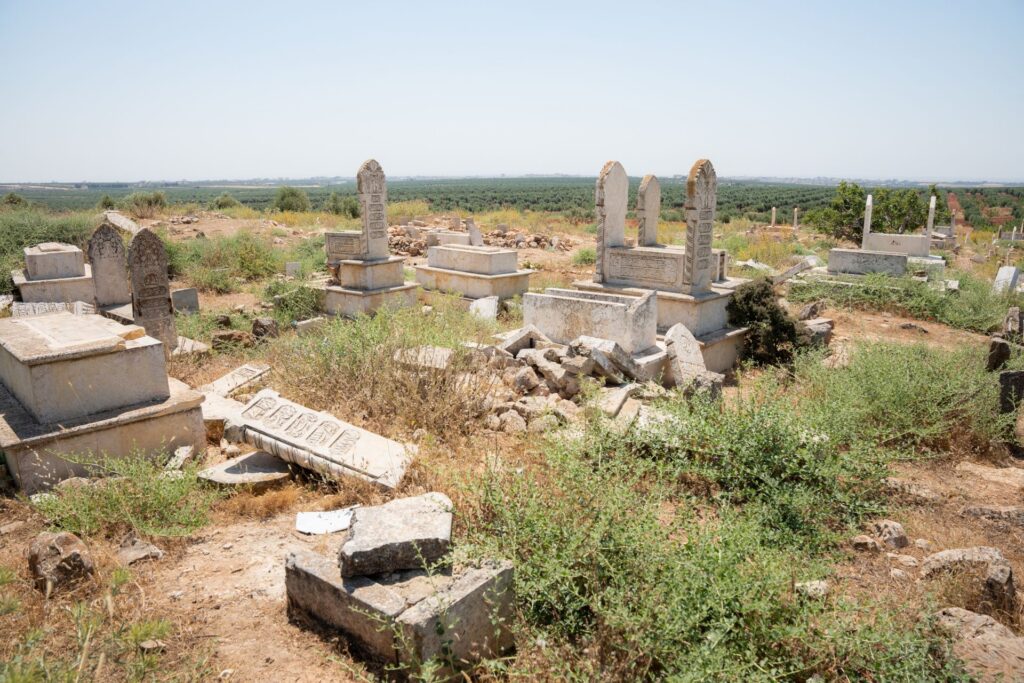
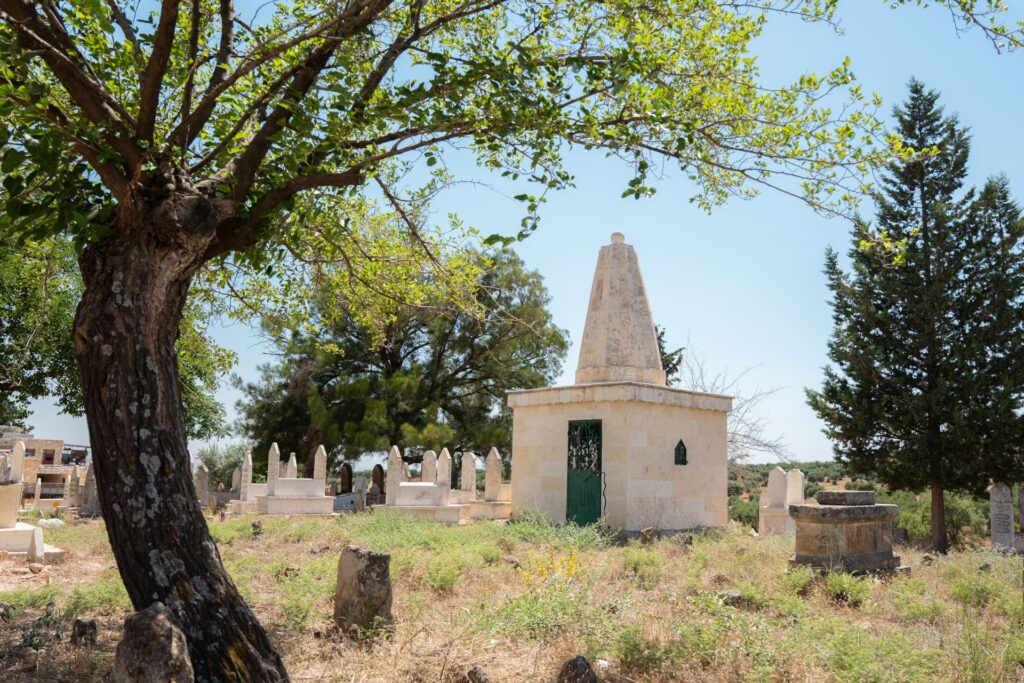
According to the Wilson Center, over half of Yazidi shrines in Afrin were looted or desecrated after Turkish-backed Syrian militias took control of the region. Some of those militia members now hold top government and military positions, leaving many Yazidis uncertain of how they will be treated.
Hiso’s village had two sacred shrines, the second one called the “Parse” shrine, named after one of the 40 female deities that, together, Yazidis call the “Xwedawendan,” she said. Only women were allowed in the shrine, and they would bow as they entered. “Even the trees in front of the shrine seemed to have a feminine quality, growing tall and straight,” she added. “Unfortunately, they were cut down.”
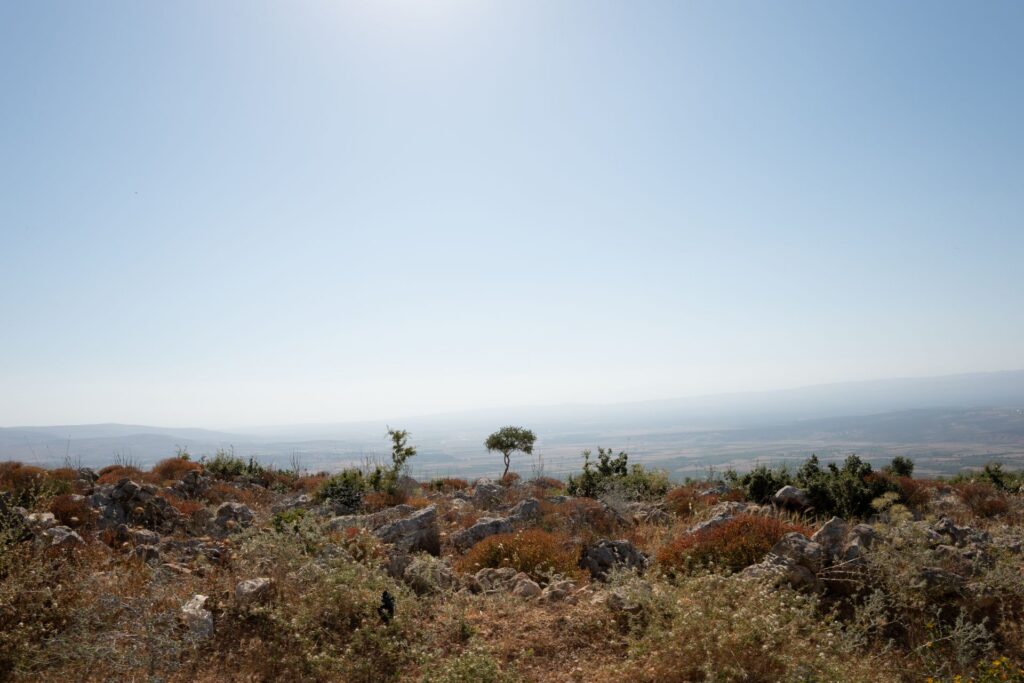
The shrine sat on a mountaintop, where a Turkish base had been erected, making it impossible to visit. A smoothly paved road wound up the mountain, a Turkish flag hoisted near the base. We drove close, but decided to turn around to avoid any trouble.
Heading down the mountain, we passed a garbage dump at the roadside. Trucks slowed to dump plastic bottles and trash bags. Toxic smoke filled the air, impossible to breathe without heaving. Hiso said the dump was not there before, and that the smoke drifted into the village and flared up her psoriasis and eczema.
Also new in the village was a mosque, with construction tape still stuck to the side of the building. Hiso said it, too, had likely been built by Turkish-backed Islamist factions, and was part of Turkey’s plan to Arabize the predominantly Kurdish area since the occupation.
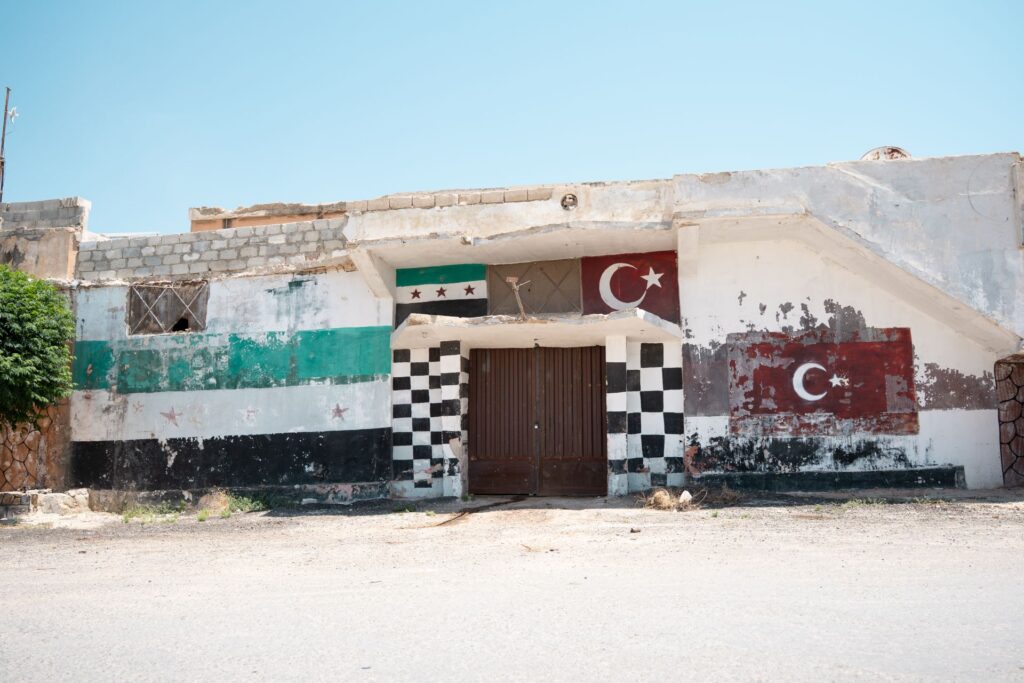
Leaving Hiso’s village, the road wound through seemingly endless olive groves. Only an occasional car or motorcycle passed. The population is spread thinly throughout the expansive area. Turkish flags still clung to the empty checkpoints, and faded posters of Turkish-backed fighters killed in battle lined the road beyond.
Eventually we reached the quaint village of Basufan, only inhabited by Yazidis. Tiny alleyways jutted through small backyard gardens, where trees heavy with fruit drooped over the stone walls. One garden grew out of a Byzantine-era church, the Church of Saint Phocas, dating back to the fifth century CE.
In the center of the ancient village was a Yazidi shrine, its small conical spire resembling the temple at Lalish, Yazidis’ holiest pilgrimage site, in modern-day Iraq. The shrine was another destroyed by the Turkish-backed militias, who in 2020 ran a bulldozer into the spire, according to the Yazidi rights monitoring group, the Ezdina Foundation.
On the outskirts of the village, Suleiman Jafar, 62, was spending his Friday repairing his home — a two-story gated villa, which had been stripped bare while he lived in the northeast. “I came to my house, and there was nothing left. They took the sinks and faucets, even the toilet,” he said. “They say, ‘You are infidels, and we are believers.’ But isn’t being a believer really about one’s actions?” he said.
Jafar hails from the Yazidi “sheikh” class, inheriting the responsibility to pass on Yazidi history and tradition. Since the 1970s, he has taken multiple trips to Lalish and Sinjar — the ancient cultural heartland of the Yazidis — to meet with scholars and sheikhs, and gather information about his religion.
The renowned Yazidi leader Adi ibn Musafir, born in the 11th century in Lebanon’s present-day Beqaa Valley, created the “sheikh” class to uphold the religion after a visit to Baghdad, where he witnessed Yazidis converting to Islam under the Abbasid Caliphate, Jafar explained. At the time, there were just two Yazidi classes: “murid” and “pir.” Murid translates to “follower” or “commoner,” and pir means “elder” — one who, like the sheikh, also has a role as a religious mentor. While there is “mutual respect” between classes, marriage outside one’s class is forbidden, Jafar said.
Jafar tied Yazidi presence in the region to around 3,000 BCE, when he said most Kurds living in the area were Yazidi. “But when the Jews arrived, some converted to Judaism. When Christianity came, people became Christian, and when Islam arrived, some converted to Islam,” Jafer continued. Over millennia, those who followed the Yazidi faith slowly disappeared.
It was only in a few hamlets that pockets of faith survived, the villages in Afrin among them.
For thousands of years, Yazidis passed down the testimonies orally, with written texts forbidden. That changed in the 1970s, said Jafar, who has since compiled a 600-page manuscript on the Yazidi faith for his community to read and pass down.
With Yazidis unable to write about their faith, most written accounts came from Muslim heretic studies, Christian missionaries, Ottoman “civilizing” missions or European orientalists, according to Sebastian Maisel, who wrote a book on Yazidis in Syria. As a result, outsiders largely failed to understand Yazidis’ core beliefs, allowing rhetoric that justified persecution to spread easily.
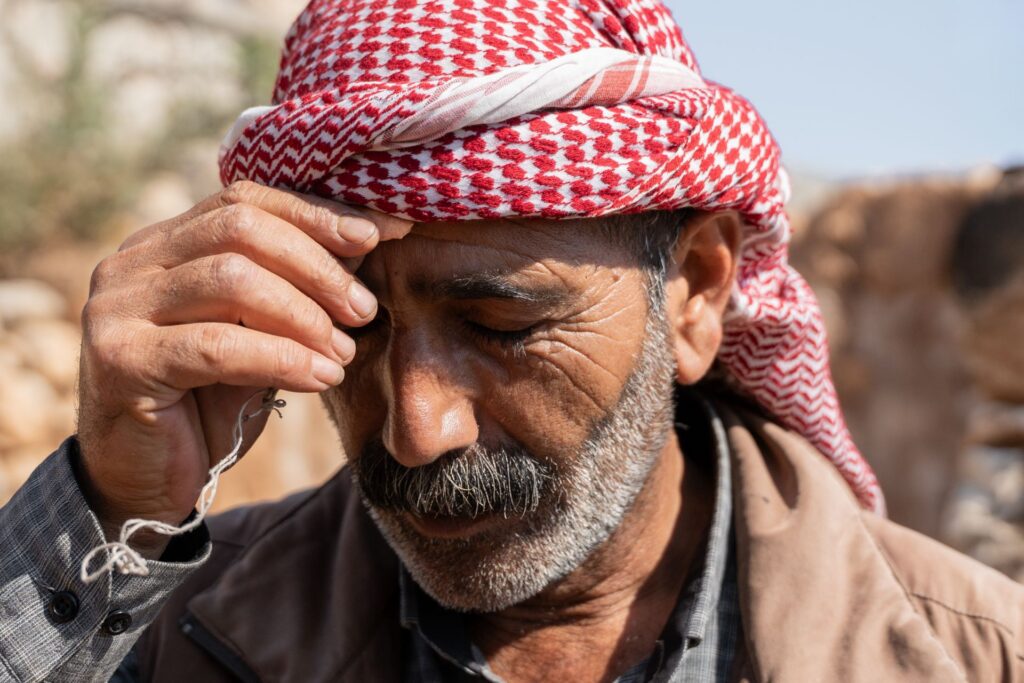
Yazidis have frequently been branded “devil-worshippers” — often by their Muslim neighbors who interpret Tawûsî Melek as Iblis, the figure who in Islam refused God’s command to bow to Adam and was cast out of heaven, becoming Satan.
Jafar, however, noted that in Yazidi tradition, when God commanded the angels to bow to Adam, all bowed except Tawûsî Melek, who said: “You are the Creator, and I will not bow to anyone but You.” Yazidis believe that this answer “was exactly what God was waiting for.” He added that Tawûsî Melek plays a role similar to Gabriel’s in the other Abrahamic faiths — the primary intermediary between God and humanity. The concept of an intermediary between the divine and creation is another sticking point for some Muslims, particularly Salafist and Wahhabi scholars and their followers, who hold humans’ direct connection with God as sacrosanct, and consider reliance on an “intermediary” as blasphemy.
Largely as a result of misinterpretations or intolerance of their faith, Yazidis say they have suffered 74 genocides. The most recent fatwa against Yazidis was declared by the Islamic State group in 2014, which killed at least 3,000 Yazidis and enslaved, raped and forcibly converted more than 7,000 others.
Most violent campaigns against the Yazidis occurred under the Ottoman Empire, Jafar said. One of the most severe fatwas (or religious edicts) against Yazidis was issued by Abu Su’ud al-Imadi, the 16th-century chief Ottoman mufti who declared Yazidis the “original infidel” and killing them a religious obligation. Even to this day, Jafar noted, residents of a nearby Arab village, Burj Haidar, do not eat the food prepared for Yazidis, who were branded infidels by Ottoman-era propaganda.
Although the Assad regime claimed to uphold religious diversity, the oppression continued, Jafar said. Yazidis were forbidden from celebrating religious holidays and displaying religious symbols and were forced to participate in Islamic studies classes in public school. Everyone we met remembered these years: Jafar was arrested for his work supporting Yazidis, and Hiso recounted receiving a beating in school for mentioning her faith.
When the Kurdish-led administration assumed control after the regime’s withdrawal in 2012, it allowed the formation of a Yazidi school in each village, Jafar said. In Afrin city, they established a Yazidi cultural center, which was later destroyed under Turkish occupation.
The oppression has caused the Yazidi population to drop dramatically, Jafar said — from roughly 57 Yazidi villages in the 1930s to about 22 today. Protecting the religion is now a top priority for both him and Hiso. Jafar, a member of the Yazidi Union in Syria, said they are “waiting for the right time” to apply for a permit to legally operate and to eventually rebuild their cultural center.
“As of today,” Jafar said, the government of Syrian President Ahmad al-Sharaa “has not violated the Yazidis.” In Afrin, he added, “there is now more religious freedom than before.” But still skeptical of the government’s conservative Islamic roots, he said protecting Yazidis’ rights must be handled with caution.
In a large pomegranate grove, Zahreddine Shamo, 53, jumped over the sprinkler watering the trees, cooling himself in the thick summer heat. Water droplets shimmered atop the fresh, ruby-red fruit. “This is the fruit of God. God created and sent down from Paradise,” he said.
Shamo, like Jafar, also comes from the Yazidi sheikh class, but he was a farmer by trade. He lived in the village of Burj Abdullah, not far from the pomegranate grove he tended with his brother. The village was tucked against a steep, rocky hillside, with a graveyard marking the entrance, the gravestones — like those in Qastal Jindo — inscribed with tiny suns.
In Shamo’s backyard, there was a small shrine built in the ruins of his father’s 300-year-old home, which he said was destroyed by the Turkish-backed factions. Also like the shrine in Qastal Jindo, candles and oil were placed beside a niche, offerings Shamo said they usually left on Wednesday and Friday nights.
Yazidis often observe rituals on the two days; according to their belief, the earth was formed on Friday and completed on Wednesday. The Yazidi New Year celebration — one of the most important religious observances — typically falls on the first Wednesday of April, according to the Julian calendar.
The holiday, known as “Red Wednesday,” or “Carsema Sor” in Kurdish, marks the day the sun’s rays reach the earth for the first time, turning the sky red, and when Tawûsî Melek descended to earth to make it habitable for all beings, plants and animals alike. Egg painting is an important part of the celebration, the egg representing the creation of life, Shamo said.
Shamo pulled a small stone out of his pocket, from the holy city of Lalish. Yazidis call it “cabri siba,” he explained, a charm for luck and protection. He kissed the stone, then held it to his forehead, repeating the movement three times. In Yazidi practice, many things are done three times, Shamo said, “For the three milestones in a person’s life: when they are born, when they get married, and when they die.”
In Faqira, another Yazidi village in Afrin, the cabri siba stone hung in Fulla Shakro’s living room. Shakro, 48, was among the members of 89 families to return to the village over the past few months.
On Jan. 11, when Shakro fled fighting where she was living in Aleppo, she kept the stone on the dashboard of her red Nissan truck — kissing it along the road for protection. “Mashallah, no one stopped us,” she said. “Put it in the car, in front of you, not under the seat, and you’ll never fear,” she advised.
Shakro’s months-old grandson sat on the floor nearby. Her daughter-in-law lifted his shirt to show the cabri siba fastened to his back — to protect him, Shakro said, a common practice for families of young Yazidi children.
The cabri siba was not the only object in the tradition to help him. She brought out a small ball of clay, about the size of a chickpea, made from the earth of Lalish. This one, she explained, is used to relieve sickness and pain. When her grandson will not stop crying, they bring it out. “We give him a small cup of tea, then dip it into the cup three times, saying ‘bismillah, bismillah, bismillah,’” she said, miming a dipping motion. “Soon enough, he stops crying.”
Shakro’s daughter, 14-year-old Khadija Shakro, brought us to a small square of stones, the remnants of the village shrine. We took off our shoes before entering, our feet bare against the grassy floor. And when we left, we walked backward; turning our backs to the shrine would be a sign of disrespect.
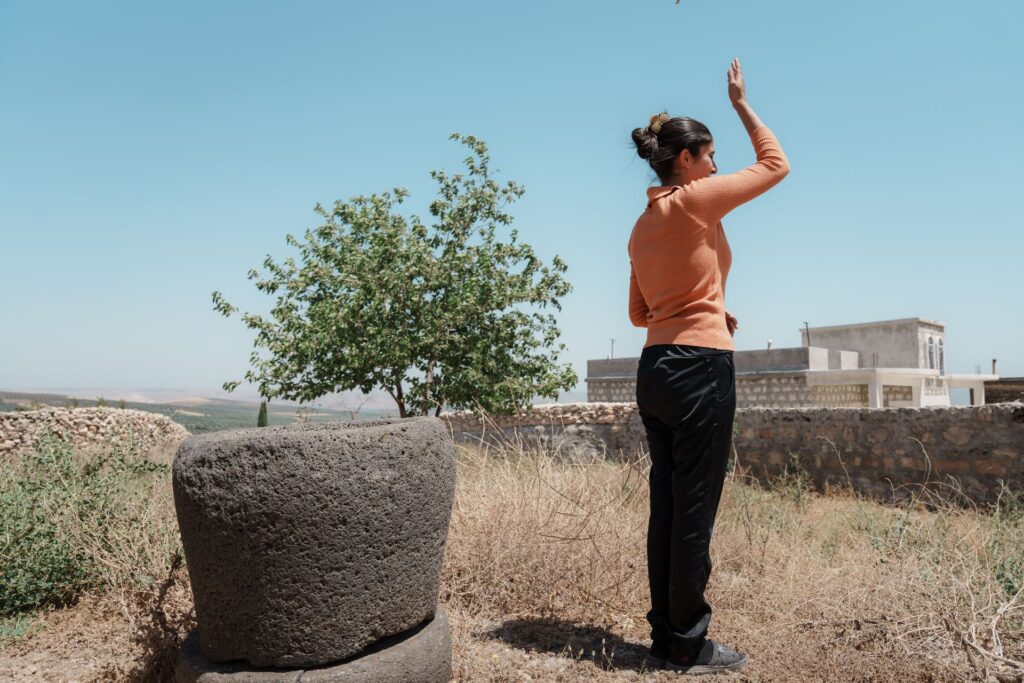
Behind the shrine was a stone well. Khadija stood with her back to it, explaining that she had three chances to land a stone inside for her wish to come true, she said, a grin sliding up her cheeks. She tossed a stone over her shoulder, and sure enough, it landed on the first throw.
Back at the shrine in Hiso’s village of Qastal Jindo, Hiso walked past the ruins and around the massive pit where the oak tree once stood, toward a grove of olive trees. During the Yazidi New Year, she remembered, every villager would bring a dish, laying the spread out under the lush canopy.
A man would shake the tambourine, another would blow the zurna, a double-reed woodwind instrument, and they would dance dabke, a regional folk dance, beneath the trees until the early hours of the morning. “God willing, we will rebuild Afrin again, and God willing, we will restore our shrines too,” she said, turning back toward the grove, reminiscing.
Become a member today to receive access to all our paywalled essays and the best of New Lines delivered to your inbox through our newsletters.