



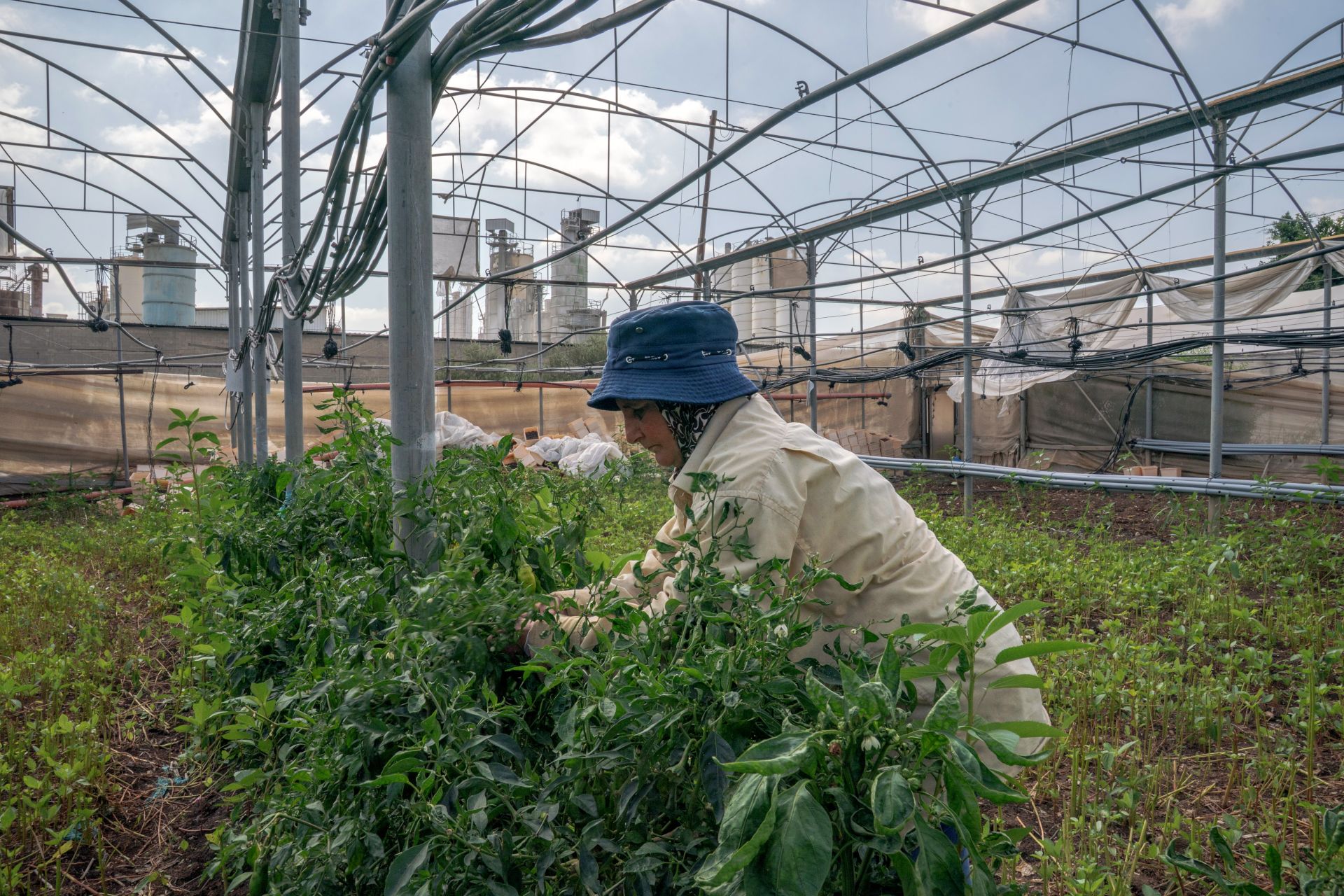
Dressed in work clothes, mother and son walk slowly under the already scorching early morning sun along a dirt track running beside a chemical factory. The mother limps, her knee giving her trouble. When they spot a watchtower operated by Israeli soldiers, they slip out of view. Crouched in the open, the son scans the concrete structure, checking for movement. He sees none. The soldiers are elsewhere. The two run as best they can, crossing the military zone without being seen, heading toward their land.
Oday Taneeb, 36, and his mother Mona, 62, are walking toward their family farm on the western edge of their home town of Tulkarem, a Palestinian city in the occupied West Bank. This is where the two, Palestinians living under Israel’s 59-year military occupation, have cultivated vegetables for decades, on land now surrounded by an Israeli industrial zone. A sharp smell of bleach burns their throats and nostrils as they move along a rural road cutting through the industrial area. Above them, the blue sky is streaked with white industrial emissions that leave the air acidic and the soil bleached. Over the years, pollution created by the factories has progressively reduced the fertility of the land and the family’s harvests.
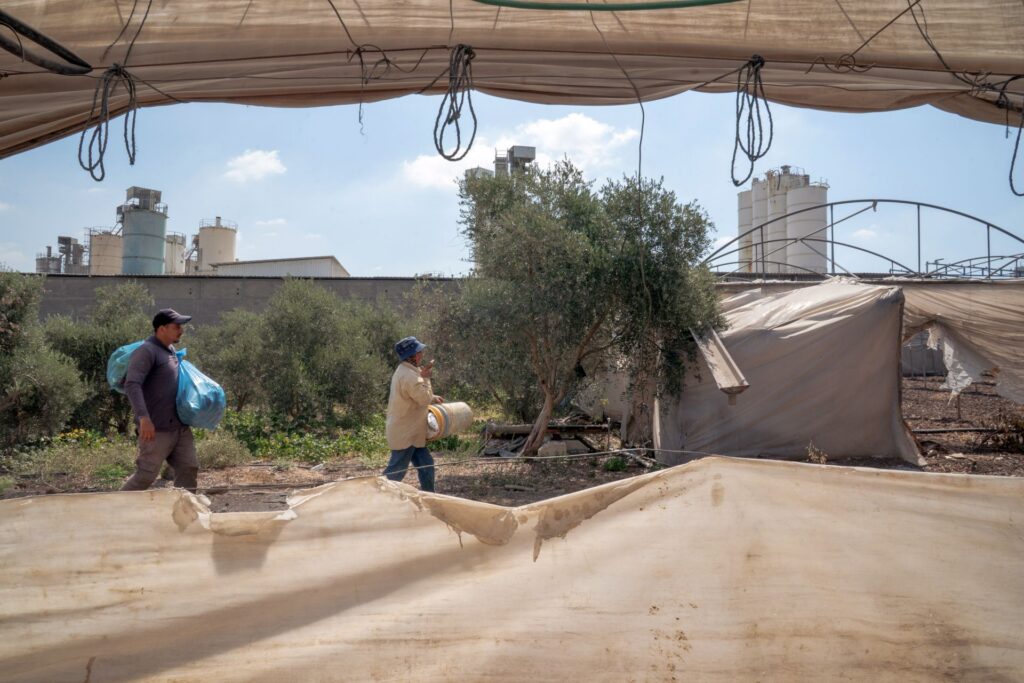
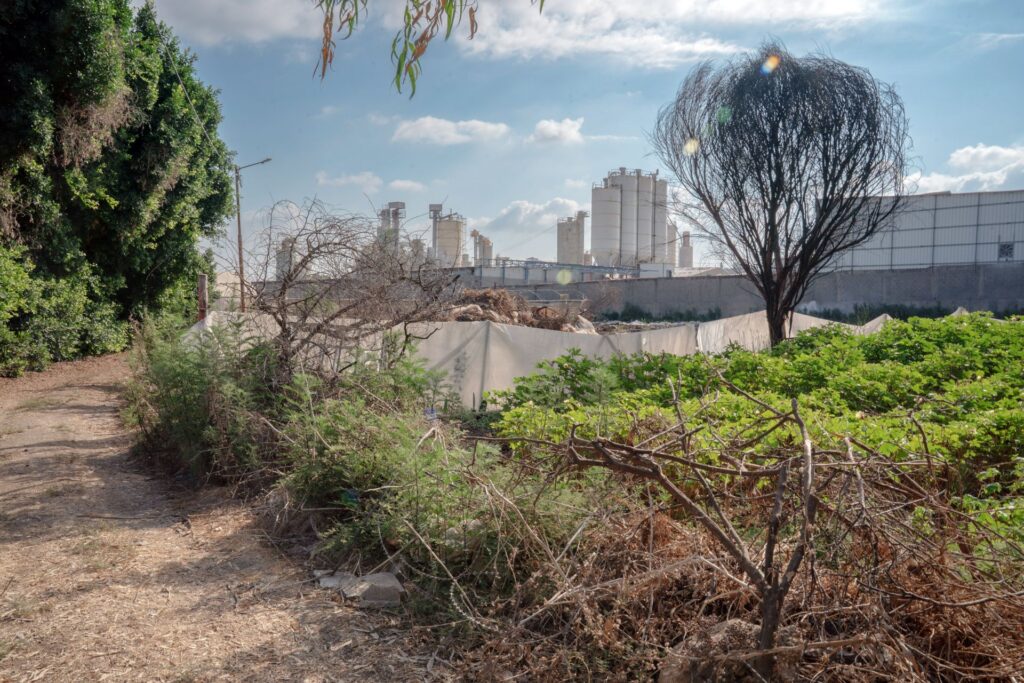
Every morning, Palestinian farmers in Tulkarem attempt to reach farmland now surrounded by industrial infrastructure on the western edge of the city. Over the past four decades, the area has been transformed by the expansion of the Israeli industrial settlement of Nitzanei Shalom, where chemical, cement, plastic, and waste processing factories operate a few hundred yards from residential neighborhoods and agricultural fields. Academic studies and technical reports produced by Palestinian universities and independent organizations have documented environmental degradation linked to the industrial zone, including soil and groundwater contamination by heavy metals such as lead and nickel, alongside pollutants such as dioxins and dioxin-like PCBs, carcinogenic chemicals that have been banned in the U.S. since 1979 and are heavily restricted in Europe. Other studies have outlined declining agricultural productivity, respiratory illnesses and the gradual loss of fertile farmland in the area.
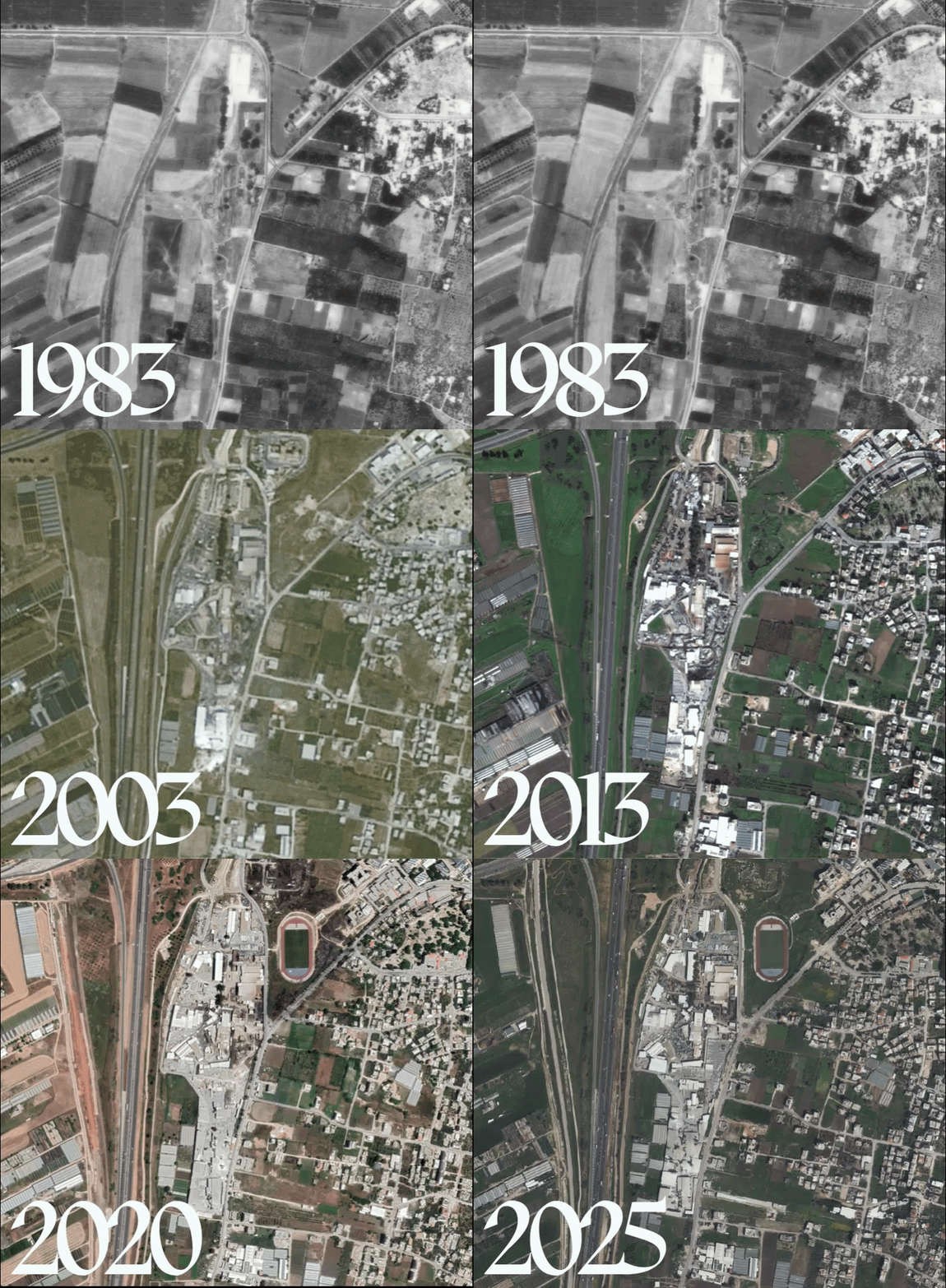
Satellite imagery analyzed for this year-long investigation also documents the progressive industrial expansion of the site and the reduction of surrounding agricultural areas over time. The industrial presence dates back to the mid-1980s, when Geshuri Industries, a chemical facility inside Israel, relocated to the outskirts of Tulkarem. According to the transcript of a 1999 question posed in the Knesset, Israel’s parliament, Geshuri’s relocation was in response to pollution-related disputes and legal pressure at its original site in the Israeli town of Tel Mond. In the following years, additional industries were established in the same area under a fragmented legal framework with limited environmental oversight and restricted independent access for environmental assessment.
What started as a single site expanded into the concentrated industrial zone of 13 factories that is Nitzanei Shalom (“Buds of Peace”).
Industrial activity in the area operates within a framework shaped by fragmented jurisdiction, military restrictions, and weak or unenforced environmental regulations. Israel does not recognize Palestinian environmental legislation in the area and rarely enforces its own environmental regulations in the occupied Palestinian territories. At the same time, Europe-linked companies and Israeli firms continue operating through or alongside businesses in the zone. This fragmented system also shapes the broader regulatory frameworks governing cross-border economic relations between Israel and its international trading partners.
The European Union considers settlements illegal under international law but has no binding legislation that prohibits trade with settlement-linked industries. Existing “differentiation” policies, which exclude settlement products from preferential tariff treatment, are applied inconsistently, resulting in a regulatory environment in which commercial ties to industrial sites like Nitzanei Shalom, which is defined as a settlement under international law, remain unevenly regulated across European markets. For example, products grown or manufactured in a West Bank settlement are exported through Israeli ports, as Israeli goods, with their true provenance obscured.
Satellite imagery and planning records first show a pattern of sustained expansion at Nitzanei Shalom, with the site repeatedly enlarged over time despite formal objections from Palestinian residents and the Tulkarem municipality to the Israeli authorities. The images also reveal a likely absence of water treatment infrastructure for industrial discharge, washing water and rainwater runoff, with untreated alkaline wastewater and sludge flowing into surrounding Palestinian farmland and greenhouses. Access to the area is further restricted due to its designation as a “prohibited military zone,” limiting both independent environmental assessment and the Palestinian farmers’ ability to reach and work their land.
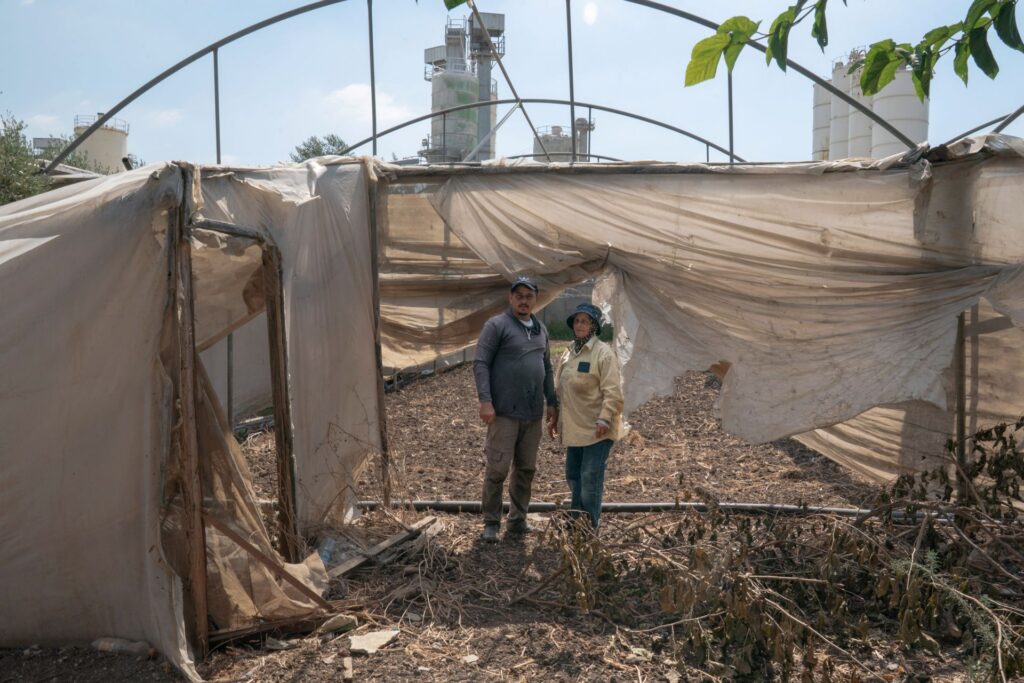
Oday and Mona reach the greenhouses shortly after crossing the military zone. The large silos of the industrial complex rise above the wall, visible just beyond them. The mechanical noise sets the rhythm of the morning, filling the silence around them.
Plastic sheets, torn and brittle, hang loose from the metal frames. Inside, many of the plants have already withered. Oday breaks apart a wooden crate and lights a small fire to boil water for tea. They drink it quickly, knowing they have only a few hours to finish their work before the soldiers patrol along Israel’s separation barrier, which digs deep into the West Bank. Oday knows the danger of being seen: soldiers pointing weapons at them, stun grenades and tear gas fired at head height to drive them away and prevent them from returning.
They move through another greenhouse where they planted peppers months ago, without being able to tend them, gathering what they can. The harvest is thin, barely enough to fill a few plastic bags.
By mid-morning, they are already leaving, glancing over their shoulders as they move back along the path. A van with a broken door is waiting for them, hidden along a dirt road that runs beside the main road. They load the bags of peppers and leave. Behind them, the separation wall. In front, the industrial complex. Their land sits in between, squeezed and exposed.
Over time, Palestinian farmers in Tulkarem have seen both the extent of their farmland and its fertility and productivity diminish, following the expansion of the Nitzanei Shalom industrial zone and its associated pollution.
Satellite imagery shows the steady expansion of the industrial zone alongside a marked loss of biodiversity and the gradual erosion of the area’s agricultural character. This decline accelerated after 1983, with the establishment of the Israeli industrial zone, and again after 2003, following the construction of the separation wall in the area.
The environmental impact of the industrial hub is ongoing. If these factories were located in Israel or in Europe, they would be subject to strict regulations, including detailed environmental assessments, minimum buffer zones separating them from residential areas — depending on production capacity and materials used — and studies of wind direction to limit pollution. In Tulkarem, by contrast, residential proximity remains striking: Around 15 homes lie within 100 yards of the zone, with several dozen more within a 550-yard radius. While silos equipped with structures resembling dust filters are visible, images show a widespread layer of white dust covering rooftops and courtyards, a common feature of this type of industry.
Satellite images also indicate that these facilities most likely lack an adequate wastewater treatment system — normally required for this type of industrial plant — including for processing and washing water, as well as rainwater runoff from the yards. Some tanks may be located beneath the roofs, but their dimensions appear insufficient given the scale of the site. Wastewater from cement factories and blending plants is particularly critical due to its alkaline nature.
Fayez Taneeb, 66, is Mona’s husband and Oday’s father. He sits on the sofa of his home in Tulkarem, sipping tea as sunlight pours through the open window. “This is the land where my father worked from 1953 until 1984,” he says. “And before him, my grandfather.”
In 1984, Fayez had just finished high school and was preparing to travel abroad to continue his studies. Instead, he was arrested by the Israeli army, prevented from leaving and placed under a security ban that forced him to remain in the West Bank.
“To be honest, at that time I had no desire to work in agriculture or become a farmer,” Fayez says.
After the arrest, he began working on the farm — which in the meantime had been occupied by the Israeli military — initially planning to stay only a few months. But that was enough for the first seedlings he planted to begin growing. Watching them day after day, seeing them turn into fruit he could eat, changed something in him. From those days on, he decided to start working on the farm of his ancestors. That experience led him to remain on the land and gradually develop what became known as Hakuretna, the first permaculture farm in Palestine, combining food production with biodiversity conservation and soil restoration. Over the years, it hosted dozens of university students, visiting groups and environmental activists from around the world, drawn by its biogas system and organic cultivation.
The Taneeb family’s land lies west of Tulkarem, confined between industrial and military infrastructure. “The factories surround us from three sides,” Fayez says. To the west stands Israel’s separation barrier. To the north, land confiscated by Israel. To the east, the Ottoman-era Hejaz Railway line, also confiscated, where factories belonging to the Nitzanei Shalom industrial zone were later built.
Along the main road, a protective wall runs for several hundred yards beside the factories. The family farm stretches parallel to the industrial zone, confined within it. “Any harm caused by the factories directly affects us,” Fayez says. “Especially when it comes to wastewater and sewage.”
Fayez explains that when the industrial dust reaches the farm, it burns the crops outside, while plants inside the greenhouse die because the dust forms a layer that blocks the sunlight. It sticks to the plastic covering through the night dew, creating a barrier between the sun and the crops inside.
Academic studies and technical reports produced by Palestinian universities and independent researchers have documented environmental degradation in the area surrounding the Nitzanei Shalom industrial zone, including concerns related to soil, groundwater, air quality, public health and the gradual loss of agricultural land. Residents and researchers have also linked industrial activity in the area to pollution affecting both farming and nearby Palestinian communities.
The industrial zone lies only a short distance from Israeli towns and farmland across the Green Line, the demarcation line between Israel and the West Bank. This raises an important question: Can pollution generated there truly be contained within the occupied West Bank? According to several scientific studies, the answer is far from straightforward.
The most comprehensive assessment of the site concludes that heavy metals released by the industrial complex are dispersed by prevailing winds and deposited through rainfall into surrounding soils and groundwater, with contaminants potentially traveling to areas “even further to the west inside the Green Line.” Hydrological studies also show that Tulkarem lies above the Western Mountain Aquifer, whose groundwater flows from east to west toward the Mediterranean Sea and major Israeli population centers, meaning pollutants could enter the aquifer. According to reports from Human Rights Watch and the Israeli human rights group B’Tselem, the physical reality of the aquifer and prevailing wind patterns ensure that the environmental degradation of Tulkarem remains a direct, uncontainable threat to natural resources and public health on both sides of the Green Line.
No peer-reviewed study has specifically demonstrated that pollution from Nitzanei Shalom has contaminated Israeli farmland, but political boundaries and separation walls cannot divide air currents and shared groundwater systems.
Researchers from Palestinian universities in the West Bank have attempted to investigate possible links between industrial pollution, land contamination and the health conditions reported in the area, but their work has long been constrained by restricted access and limited data. Among them is Basel Al-Natsheh, associate professor in the Environmental and Sustainable Agriculture Department at Palestine Technical University — Kadoorie, in Tulkarem. He explains that much of the existing research examines isolated environmental factors rather than conducting integrated assessments, while studies by the Palestinian Authority’s Environment Quality Authority remain among the few efforts to address environmental, health and socioeconomic impacts together. He warns that, without effective mitigation measures, environmental conditions are likely to deteriorate further, and stresses the need for continuous monitoring of soil and water, safer agricultural practices and treatment of contaminated water before use.
These observations are echoed by Nicola D’Alessandro, associate professor at the Department of Sciences of the University G. D’Annunzio of Chieti and Pescara, in Italy, and an expert in green chemistry and environmental catalysis. Confirming researchers’ difficulties in obtaining comprehensive assessments, D’Alessandro also notes that detailed and accurate scientific reports on the West Bank area are scarce and that the few currently available were produced a long time ago.
In Nitzanei Shalom, industrial activity is largely concentrated in three main operations: Prima Ciment — owned by Ciment IS and formerly by Geshuri; Tal El, focused on waste management; and Margal, previously known as Pelegas, which manufactures gas tanks for vehicles.
Despite shifts in ownership, commercial links with Europe have persisted and, in some cases, become more layered. In the cement sector, products from Prima Ciment have been distributed in Spain, as reported in 2017 by the Observatory on Human Rights and Business in North Africa and the Middle East. Today, Prima Ciment produces for two of Israel’s main market players, Orbond and Tambour, which together account for approximately 80% of the domestic gypsum market. Cement and gypsum imported from countries such as Greece and Turkey are also used in production processes both in Israel and at the Nitzanei Shalom hub in Tulkarem.
Tracing the ownership structure of Cement IS reveals further international connections. The company is part of the Israel Shipyards group, where SK Group holds a 20% stake. Israel Shipyards operates in shipbuilding — including military vessels — port management and trade, while SK Group is active in the arms industry. According to publicly available data collected by the Israeli army and data collected by the Stockholm International Peace Research Institute, both companies maintain export relations with several European countries, including Cyprus, Greece and Romania, alongside a broader global network.
Additional links emerge through Orbond, an Israeli company that manufactures gypsum products. Founded in Israel in 1993, it was later incorporated into the German multinational Knauf, a major multinational producer of construction materials. Prima Ciment also manufactures for Tambour, an Israeli-registered company that manufactures building materials, owned by the Singapore-based Kusto Group. Kusto is controlled by businesspeople of Kazakhstani origin and is active across sectors including oil and gas, fuel distribution and industrial production. It extends its operations into Europe through Tambour. In Italy, this includes the acquisition of Colorificio Zetagi in 2019 and, through it, an 80% stake in Verinlegno in 2024, linking the industrial chain back to regions such as Veneto and Tuscany.
Taken together, these relationships and ownership structures point to an element of European responsibility within the commercial and business interests connected to the illegal industrial settlement of Nitzanei Shalom, where companies operate on occupied Palestinian territory and industrial activity has been established on agricultural land, with documented environmental impacts.
Fayez pulls medical certificates, test results and X-rays from an old folder, laying them carefully across a small table. Over the years spent working his fields, located just behind Israeli chemical factories, he developed a severe respiratory disease. “Breathing has become difficult; even small efforts leave me exhausted,” he says, rearranging the documents into piles. Asthma inhalers are scattered around him. For several years, doctors have advised him to avoid the industrial area of Tulkarem, leaving him unable to continue farming.
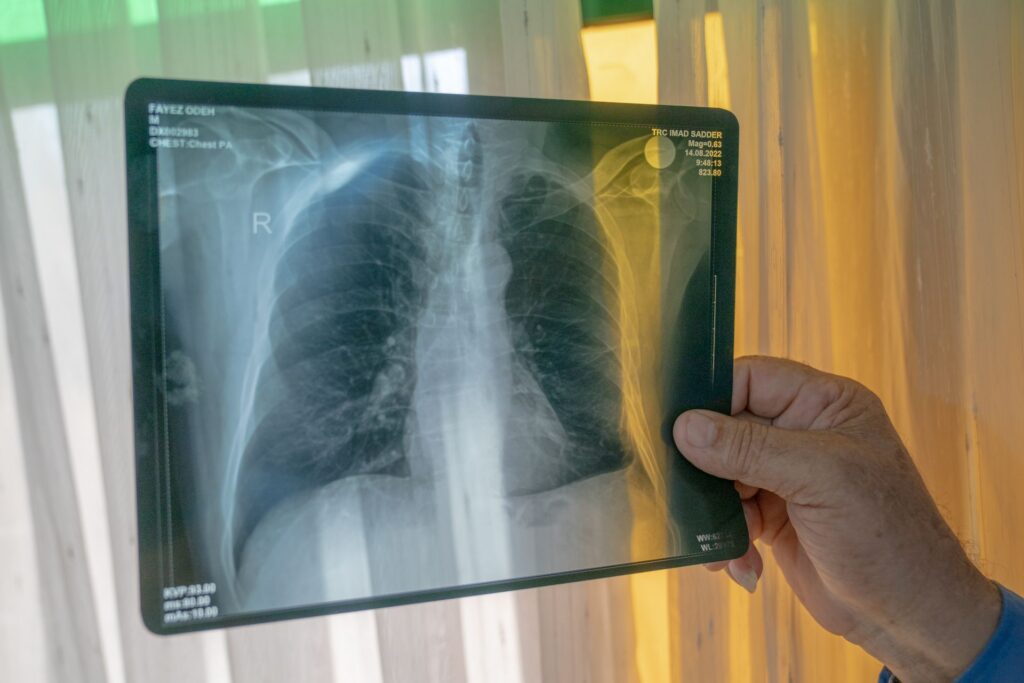
“I felt a deep sense of peace when I went to the farm, worked the soil and engaged with the land,” he says, describing it as a form of resistance against both the military occupation of his property and the pollution surrounding it. He accuses what he calls the “factories of death” of turning the agricultural heart of the West Bank into contaminated farmland.
The pressure on the family has continued to grow. Recently, the Israeli army issued a demolition order concerning agricultural structures that have stood on the property for more than 40 years. According to the Israeli authorities, the order is linked to a 2013 regulation establishing a security buffer zone along the separation wall, prohibiting structures higher than 1 meter within 300 meters of the barrier. “We are living in a constant state of tension and anticipation,” Fayez says. “We may wake up one day and find the agricultural structures demolished or uprooted.”
Today, because of his health issues, he rarely returns to the fields.
This investigation was developed with the support of Journalismfund Europe.
Become a member today to receive access to all our paywalled essays and the best of New Lines delivered to your inbox through our newsletters.