


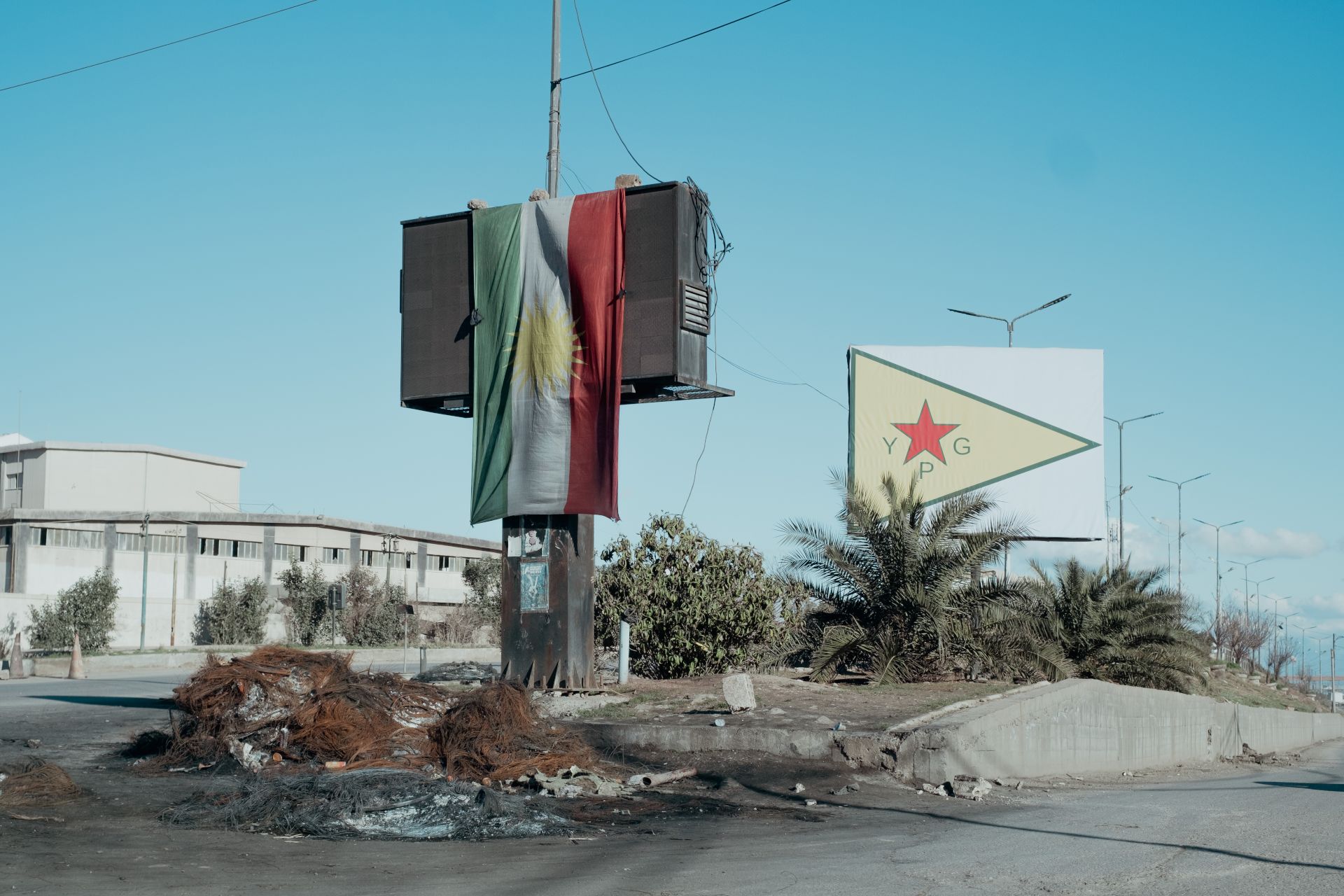
“Welcome to Kurdistan,” a bald, muscular soldier mutters without smiling.
Inside a Syrian Democratic Forces (SDF) base in Hasakah, faces are drawn. Here, there is still an experience of Kurdish autonomy within Syria, even as it begins to unravel.
The walls are covered with portraits of fighters from the Women’s Protection Units or YPJ — the women’s branch of the SDF, long an emblem of the Kurdish cause — alongside the omnipresent image of Abdullah Öcalan, the imprisoned historical leader of the Kurdish movement in Turkey, detained since 1999 on the prison island of Imrali. This is the heart of a political project born amid the ruins of Syria’s war: the Kurdish autonomous region in Syria known as the Autonomous Administration of North and East Syria, which Kurds call Rojava.
Hours earlier on the same day, Feb. 2, a symbolic moment in the process of finalizing an agreement with the central government in Syria had taken place. A convoy of Syrian Interior Ministry security forces entered Hasakah, a bastion of Kurdish autonomy, to formalize the deal announced days earlier between Damascus and the SDF. Fifteen vehicles with tinted windows moved slowly through the city, under the watch of Kurdish snipers.
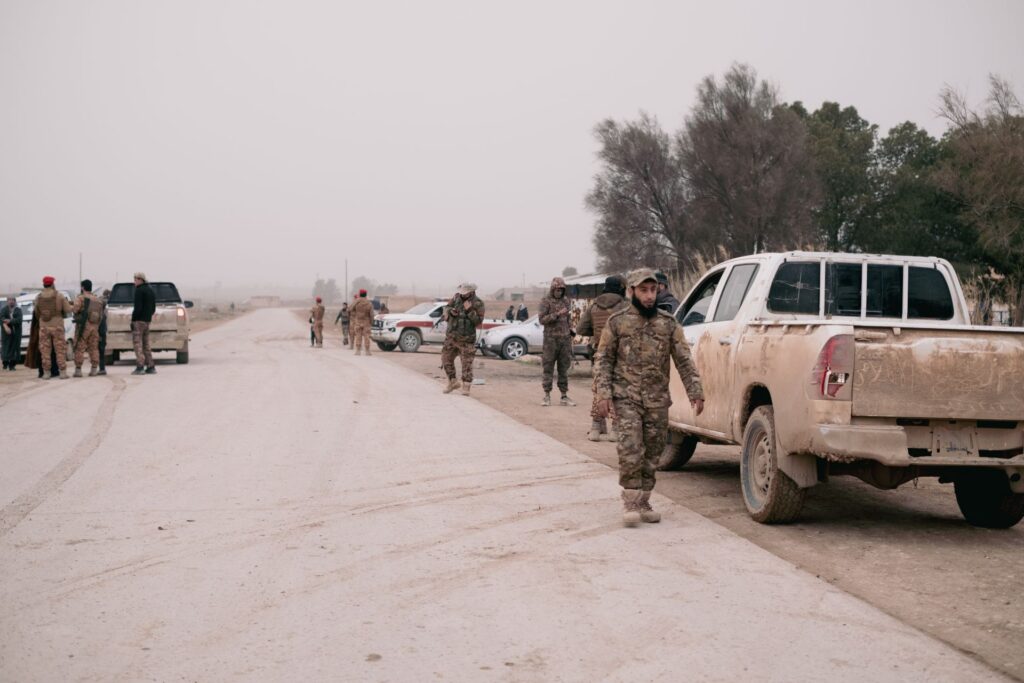
In Damascus, the move was hailed as a step toward “unity.” Here, the atmosphere was one of high tension. On paper, the agreement brings to an end over a decade of de facto Kurdish self-rule born from the collapse of the Syrian state and the war against the Islamic State group.
Kurd Barwan, 47, grips his Kalashnikov. On its yellow strap is written “Kirkuk Kurdistan,” a claim to his hometown of Kirkuk in Iraq. On his chest hangs the photo of a “martyr,” killed in 2013 fighting the Islamic State. The SDF, which was backed by the United States and the international coalition against the Islamic State, was the main local partner in the campaign against the group. Barwan lives in the U.S. and has returned to support what he calls his country.
“Kurdistan is in danger,” he says flatly.
Announced on Jan. 30, the deal now confronts fighters with a concrete reality: the gradual absorption of their forces into Syrian state structures. It establishes a ceasefire with former SDF units, which it is expected will be incorporated as distinct formations within the Syrian army and under its central command. When the topic of reunification with Damascus comes up, he cuts short any ambiguity.
“Impossible to live with ISIS in the same country,” he says. To him, there is no difference between the new Syrian leadership under former Islamist rebel leader Ahmad al-Sharaa and the Islamic State. “Same ideology,” he adds.
Despite the Feb. 2 agreement, the base remains on high alert. The war has not simply ended.
Nearby, Ivan Hussein, 26, a Kurdish volunteer who lived in Finland, is armed and wearing a ballistic vest. He says he came to “help his people.” He speaks bluntly. “Arab people are not good,” he says. Driving through Hasakah, he advises avoiding Arab neighborhoods, then shrugs. “There are Kassad everywhere,” he adds, using the Arabic acronym for the SDF, “so don’t worry.”
He insists that Kurds are “like Europeans.” “We marry one woman. Arabs marry four,” he says. A Christian, he refused to let his Finnish girlfriend join him. Too dangerous, he explains. He says he does not trust Arabs. Moments later, he complains about racism in Finland, where he lives. Back home, he works as a driver. Here, inside the base, he transports armed units. He doesn’t trust the deal with Damascus.
At the market in the city of Qamishli, an SDF and Kurdish stronghold, few want to entertain my questions. Arab vendors refuse to speak. Fear is tangible.
Two young Kurdish sisters walk by. “If the Kurds stay, it’s better,” one says. “We don’t know the rules of the new government. You’ve seen Latakia,” she says, referring to a local initiative announced on Jan. 26 by the governorate in the coastal region banning makeup for women working in some public sector positions, which has caused public backlash. “We wait.”
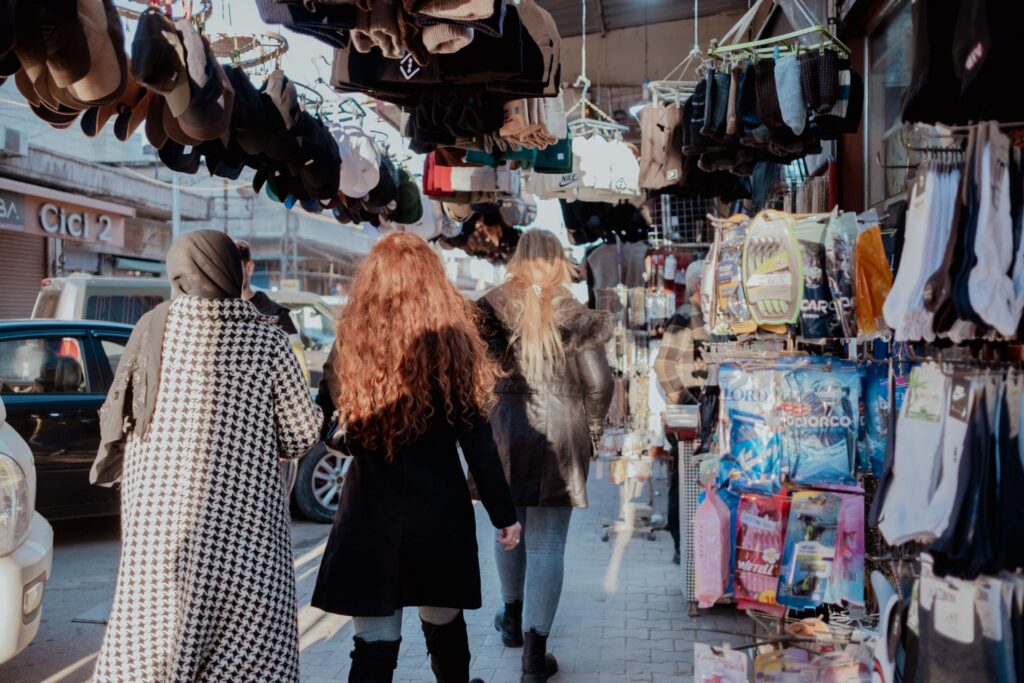
For many residents, the return of state authority raises fears of renewed repression and communal violence, particularly after recent abuses involving Syrian forces elsewhere in the country.
People here have a litany of worries, from fuel provision to safety and security, intolerance of dissent and free expression, and infrastructure and the economy. A citrus vendor shrugs as he complains of a lack of diesel fuel, which the SDF had subsidized. The shortage has left long snaking lines of cars at gas stations. “The oil doesn’t go to the people,” he says. “We want the situation to calm down and for everyone to leave without any problems. The most important point of the agreement is that there must be no clashes.”
All around, the streets are riddled with potholes, and the infrastructure is decaying. Oil fires can be seen burning in the distance. A man who has returned from Germany to visit his family says all he wants is “safety for our people.” An Arab mechanic whispers, “If you raise your voice against the SDF, you go to prison. Some people hate them, but they’re afraid. It’s not a democracy, but we don’t know if what’s coming is better or worse.”
An Arab shopkeeper, speaking quietly in Arabic, says: “We’re still afraid.” He adds that people were too wary to celebrate the anniversary of the toppling of the Assad regime on Dec. 8, or to have a photo of al-Sharaa on their phones. When others enter his shop, he grows tense, changes the subject and talks about peace. “We fought the Islamic State together. We want peace between Arabs and Kurds.”
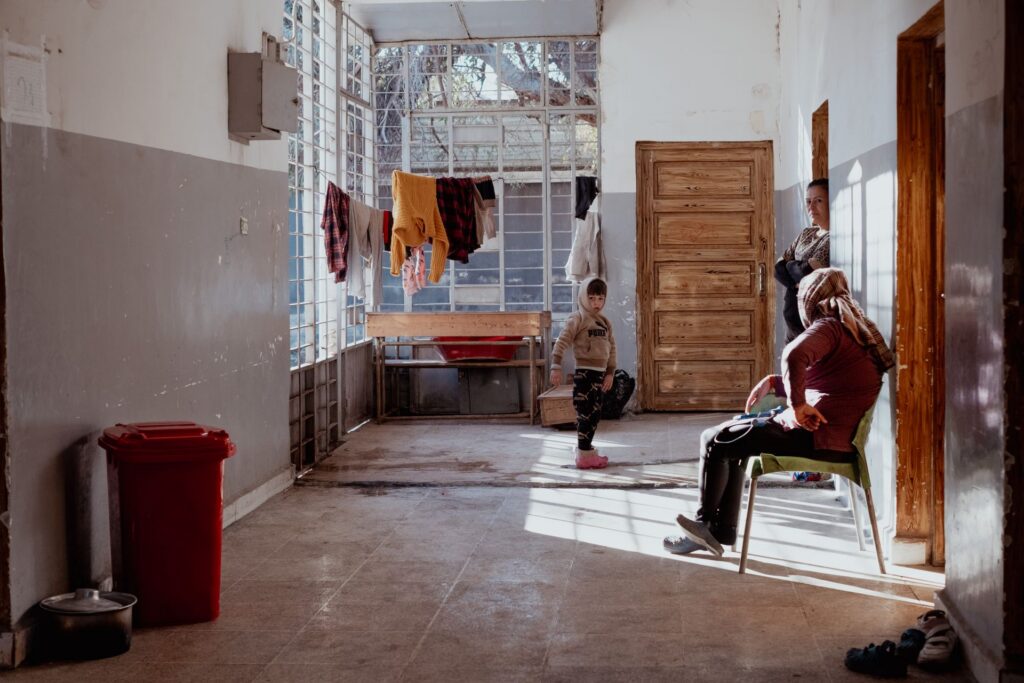
For many civilians, the agreement with Damascus is less about politics than about whether daily life can finally resume. As Syrian government forces advanced, several schools in Qamishli were turned into makeshift shelters for displaced families, forcing classes to shut down. Classrooms now hold mattresses and cooking stoves, as parents wait to see when, or if, their children will return to school.
In the countryside around Qamishli, in the village of Bel Barouf, which had been briefly assaulted by the Islamic State during the group’s rampage in the region, I interview Khaled, a 46-year-old Kurdish shopkeeper. He points to his 2-year-old daughter, Ebenava, who is munching on biscuits, and has never been officially registered with the authorities. “It’s like I don’t have this child,” he says.
He hopes the return of the state will bring birth certificates, passports and recognized diplomas. He fled Damascus, where he grew up, in 2011 to avoid military service under Assad. “We’re still afraid,” he admits. “We don’t know what will really happen.”
Under Assad, he says, Kurds had no rights or ability to speak their language publicly. If the deal holds, he might go back to Damascus, and his eyes light up as he recalls memories of his time there. His uncertainty mirrors the broader ambiguity of the deal itself.
The agreement announced on Jan. 30 provides for the gradual integration of Kurdish forces into Syrian state structures. Concretely, it spells the end of autonomous armed forces, which are to be absorbed into Syria’s national security apparatus. On the ground, no one uses the word dismantling. For many fighters, the deal looks more like a rebranding than a surrender.
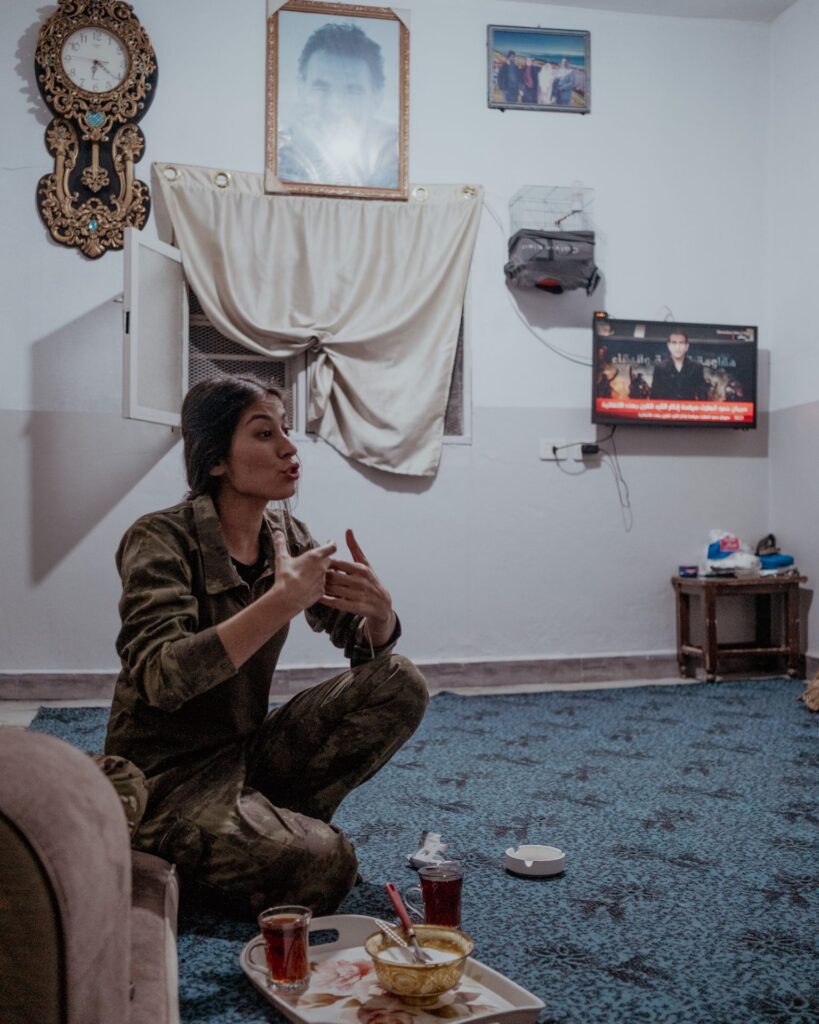
At her family home, beneath a portrait of Öcalan, a 25-year-old YPJ fighter with long brown hair and still-teenage features explains her view of the deal. It is Feb. 4, and Rohani TV is showing footage of Marwan al-Ali, head of the Syrian General Police, standing beside Kurdish authorities at the Traffic Police Center.
Her younger brother, proudly holding her M-16, dreams of joining the Kurdish People’s Defense Units (YPG) one day. Her mother listens silently, but her eyes betray her pride.
The fighter calls herself Barkhodan Jyan — “resistance is life” in Kurdish. She joined the YPJ at 13. Rejected three times for being too young, she kept coming back until she was accepted. Under the Öcalan portrait, next to a clock and a birdcage, she explains his influence on her political worldview. She searches carefully for words he said that shaped her. Then she quotes sentences she attributes to him: “We started with the youth, and we will succeed by the youth,” and “I believe that if nobody is left in the mountains of Kurdistan but one woman, Kurdistan will remain.”
Asked about her teenage years, she answers without hesitation, “I joined very young, so I was cut off from teenage interests. I went to four wedding parties in all my life. I succeeded in saving myself and not becoming part of capitalism.” She pauses, then continues. “Battles became like drugs. This ideology became part of our blood. When I don’t fight for a long time, I become sick.”
She does not support the deal with Damascus, but sees its utility. “Positive to stop massacres and genocides. But they have ISIS thoughts, [like] women shouldn’t be soldiers. She references an image that went viral, which supposedly shows a YPJ sniper thrown from a building by Syrian forces. This footage circulates in the groups she follows online.
Her vision of the ideology she fears is uncompromising: “Women are just for marrying and the kitchen. Hijab — only the eyes should be seen.” She shakes her head. “Here, they learned to work while armed, to command and to move around without asking for permission,” she says.
She says that she asked her commander what would change, and he replied that nothing would.
For her, and for many fighters, wearing the Syrian uniform would be unbearable. “It’s a shame to work under their flag,” she says. “I prefer to kill myself with my weapon rather than serve under it. One reason we accepted is to get back arrested soldiers, to get back bodies, to stop what’s happening.”
Trust does not exist, she says, and the group is ready to fight back if it’s attacked or betrayed. She points out that the SDF and Kurdish forces sacrificed many martyrs to the cause of fighting the Islamic State.
When asked about criticism of the SDF, and the group’s intolerance of dissent, her tone hardens and her smile disappears. “We are the Syrian Democratic Forces. Democracy is in the name, so we are democratic,” she says.
On Jan. 23, as Kurdish forces withdrew from al-Aktan prison in the city of Raqqa, hundreds of detainees, including children, were released. She justifies arrests carried out by the SDF as being an attempt to neutralize divisions, and says the imprisoned children were dangerous, miming a throat-slitting gesture that she claims they frequently used.
The next day, Qamishli announces a curfew. The streets are empty and the shops are closed. The Asayish, Kurdish internal security forces, seal off intersections. On this side of the border, “salam alaykum” becomes “dambash,” Kurdish for “hello,” to pass checkpoints.
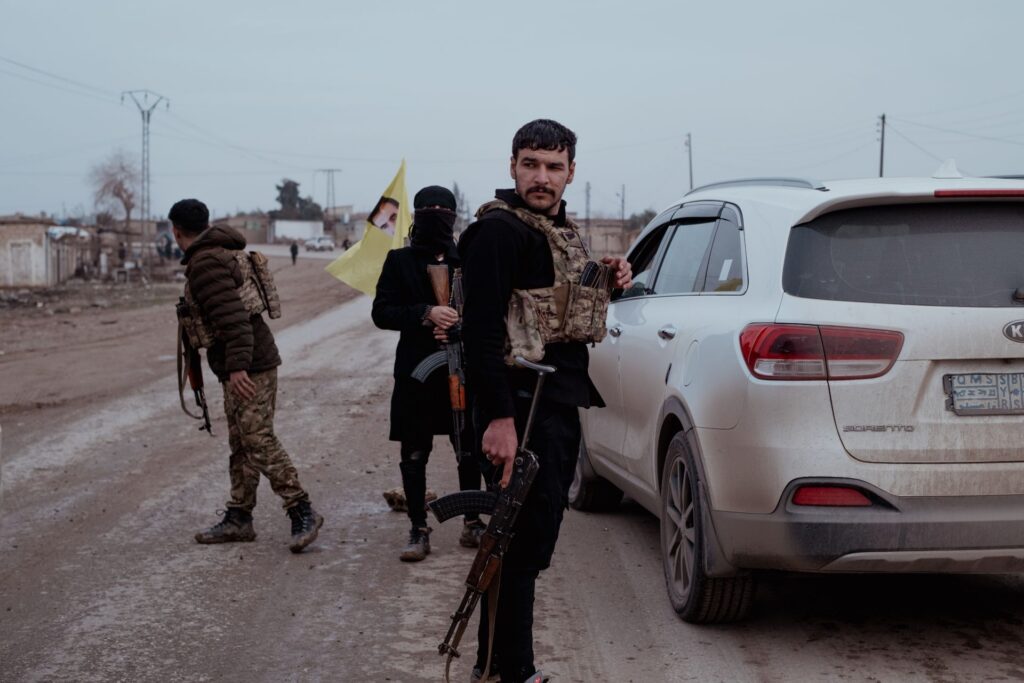
“We will be punished,” an Asayish member whispers, referring to the fact that he must consult the command for any decision. “We do nothing without the commander’s approval.” On his phone screen is a portrait of Bashar al-Assad. The military company Arcel, which most local people use to connect to the internet, is shut down by order of the SDF for the hours the government is in the city.
Despite a valid journalist permit, we are stopped nearly 10 times, each requiring phone calls up the chain of command as the curfew unfolds. That same day, a new government convoy enters Qamishli, after the previous one entered Hasakah. Despite the agreement, the SDF still controls the area — for now.
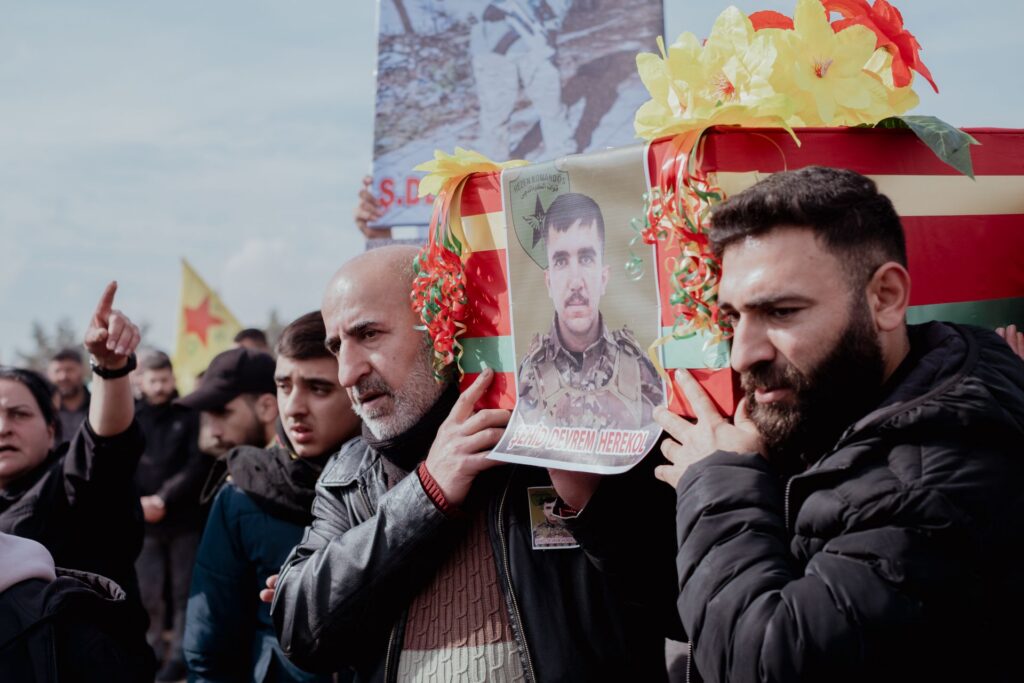
The next day, on Feb. 5, five SDF fighters are buried in Qamishli cemetery. Kurdish flags flutter in the wind as families chant for Rojava. A father of one of the dead says quietly: “The civilian population wants peace, they’re tired.”
In practice, autonomy is already shrinking.
Under the agreement, the main oil fields in northeastern Syria have returned to Syrian state control. Border security with Iraq is now handled by Damascus. For Kurdish authorities, this is a strategic loss.
In 2025, 77% of the autonomous administration’s revenue came from oil, according to economist Benjamin Fève. “These revenues financed military spending (USD 200 million, 62%) and public salaries (USD 80 million), sustaining an administration of roughly 220,000 employees and an armed force of about 85,000 fighters,” he says. “Without oil, the de facto autonomy would not have been financially viable — just as ISIS once depended on it.” With the advance of Syrian forces, the SDF has also lost 80% of its territory.
On Feb. 4, at a U.S. base in Hasakah named al-Wazir, I meet Saleh Muslim, a short elderly man with a moustache and a grandfatherly air who is also a former top Kurdish official and key figure in the movement for Kurdish self-rule. He insists the essential elements of autonomy remain in place.
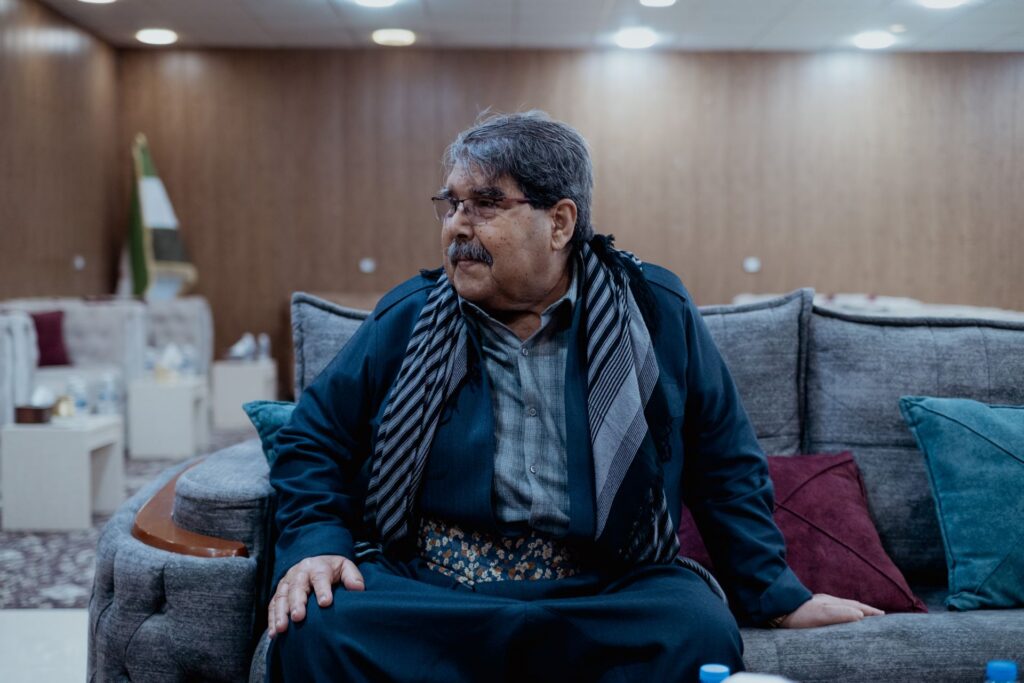
For him, the agreement is a gain, “a way to recognize the status without saying the name.”
“Our forces are still on the ground to protect the region,” he says. In his office are YPG/YPJ and Rojava flags; in a neglected corner, a Syrian flag.
“This is not an end point,” he says. “If we are attacked, we will defend ourselves.”
The American flags once flying on the roundabout outside have been removed. U.S. envoy Tom Barrack made it clear that “the original purpose of the SDF as the primary anti-ISIS force on the ground has largely expired,” backing the integration of Kurdish forces into the Syrian state.
Muslim repeats the word conspiracy to describe the developments targeting the Kurds, which he says aim to pit Kurds and Arabs against each other in an endless conflict. Declarations mean nothing, he says, without constitutional guarantees. He points to al-Sharaa’s promises: Kurdish language recognition, restored citizenship, equal rights.
“We don’t fight for separatism,” he says. “They are risking a civil war, ethnic war for the sake of power and of their vision of a centralized country. We fight for equal citizenship.”
“I hope to see you in better circumstances,” Muslim says as we part.
The terms of the agreement remain vague. Kobane, one of the Kurdish strongholds, remains cut off despite humanitarian convoys and government forces surrounding the area — they are yet to be allowed in.
After the government convoy passes through Hasakah, Kurdish barricades are rebuilt. At nightfall, a bulldozer seals the crossing used by government forces. Kurdish snipers remain motionless on rooftops.
It is an image of northern Syria: unified, but only on paper.
Become a member today to receive access to all our paywalled essays and the best of New Lines delivered to your inbox through our newsletters.