


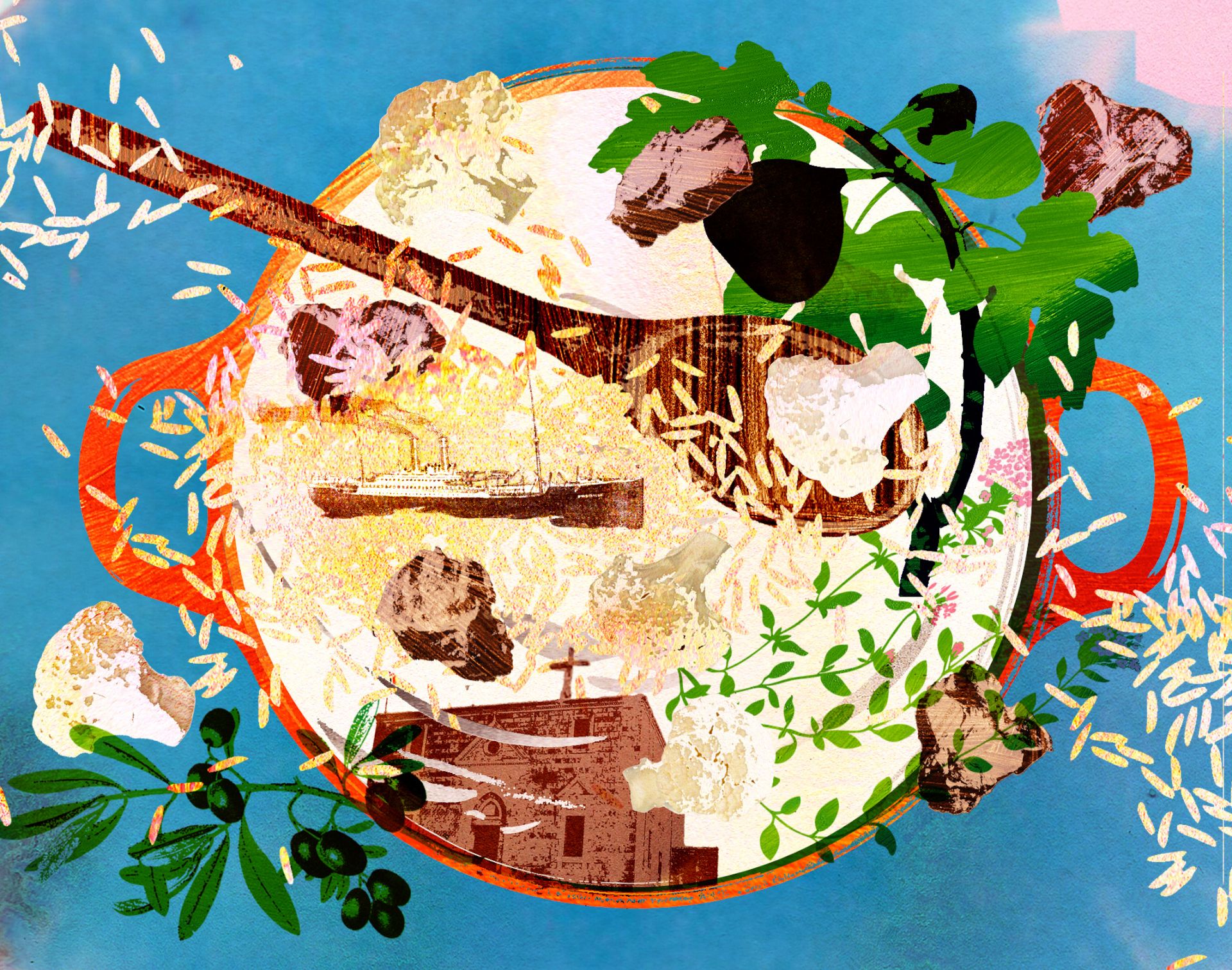
The steam rises before you lift the spoon.
On one side of the plate, yogurt — white, liquid, still moving — covers everything beneath it: the cauliflower, the meat, the onions. On the other side, rice, packed into a small mound, a dirt wall holding back the seeping liquid. You load the spoon with care. A piece of cauliflower. Some meat. A little rice. You bring it to your lips.
The cauliflower disappears almost before you register it. The meat takes a moment longer, a brief resistance, then gone. The rice grains swell as they absorb the yogurt, inflating, holding everything together. But the yogurt is the master of the mouthful. Tangy and hot, it coats the tongue. It is a warmth that lingers.
To make it, you stand over the pot, and you do not stop stirring, not for a moment. You have mixed cornstarch into cold yogurt, beaten it smooth, and now you stir on low heat, and you stir, and you stir, until the pot finally, slowly, boils. The kitchen fills with two competing smells: the sharp, lively tang of heating yogurt and the deep pungency of the cauliflower, fried first if you are doing it right. The two argue all the way to the table. On the plate, there is no contest. The yogurt wins.
This dish is called mlaheeyeh. Search for it. You will find almost nothing.
You will not find the dish easily in the Levant today either. In Jdeidet Marjayoun, the southern Lebanese town it claims to come from, no one I asked knew it by that name or cooked it. What remains there, and elsewhere in Lebanon and the Levant, is a close relative: laban oumou, the same architecture of meat, rice and cooked yogurt, but without the cauliflower. The absence is small enough to sound trivial until you understand that the cauliflower is the dish’s particularity. Mlaheeyeh traveled with the first Marjayounis to Oklahoma City and survived there, while in Marjayoun itself it disappeared into something adjacent, recognizable, almost the same, but not quite.
Jdeidet Marjayoun is perched on a small hilltop in southern Lebanon, now inside or near what Israel has declared a combat zone, along with hundreds of other towns and villages. In recent days, the Israeli army has struck towns in the Marjayoun district and bombed Beirut’s southern suburbs after a ceasefire took effect in April. The Lebanese government has counted the dead, the destroyed buildings, the families without shelter. Nobody is counting what else is being lost.
In a recent video commentary, the Lebanese journalist Hazem al-Amin warned that the war may cost the South not only homes and lives, but dishes such as frakeh, red mujaddara and kibbet al-hileh. He was naming a kind of loss that usually enters the record too late, if it enters at all, the food that disappears when the conditions that made it possible are destroyed.
The destruction of southern Lebanon reaches beyond the military. When Israel burns land registries (the paper record of who owns what) in Marjayoun and Bint Jbeil and declares that displaced residents will not return, it is not only fighting Hezbollah. It is severing the conditions under which a people persist on their land. A people severed from their land lose something that no ceasefire returns and no reconstruction rebuilds: the knowledge of how to feed themselves from it, and the taste of food that grew from its specific soil, a taste that cannot be recreated anywhere else, because the earth itself cannot be carried.
Southern Lebanon is being emptied, leveled and its fields burned. Since March 2026, Israeli bombardment and sweeping evacuation orders have displaced more than a million people, a fifth of the country’s population. Families left in the middle of the night with whatever fit in a bag. Many had kept emergency bags packed near the door since the last evacuation, and the one before that. Cars were kept fueled. Some parked facing the street.
In the late 19th and early 20th centuries, Ottoman conscription, taxation and famine pushed families from Marjayoun out in waves. They packed what they could carry and left, wearing their best clothes for the journey, the good garments saved for occasions that mattered, now pressed into service for one nobody had imagined. The goodbyes were the kind everyone understood might be permanent. Horses and carriages waited on dirt roads. The journey to Beirut took days. They boarded ships whose scale their minds could not have prepared them for, vessels large enough to swallow a village whole, and crossed an ocean most of them would never cross again.
They arrived, improbably, in Oklahoma.
Along with what they carried, draped in cloth bundles, or bohchas, across the backs of horses, they brought their food, or the idea of their food — recipes they would recreate in new kitchens, with ingredients that required substitution and measures that required translation. They built a church and, as if to complete the transplant, brought the priest from the church they had left in Marjayoun. They compiled a cookbook. In it, under a name you will find almost nowhere else, not in Lebanon, not in any culinary archive, not in the village itself, they preserved mlaheeyeh.
The name itself may be a transformation. What they called it in Marjayoun, if they called it something different at all, is uncertain now. Language drifts when spoken within another language for long enough. Generations of American-born children can do to a word what a century of war does to a building, leave it standing but altered.
The dish survived the ocean crossing. It disappeared at the source.
I first encountered the book in my late husband’s Cambridge kitchen, where I live with my son, years before I understood what I was holding. He was born in Oklahoma City, far from the place his ancestors left, but the cookbook was there on his shelf the way inherited things are. I picked it up. He told me: women from the church, Marjayoun recipes.
I leafed through it with a Lebanese woman’s skepticism. The dishes were familiar in name but not always in preparation (each region of Lebanon has its own version of almost everything, and I am not from the South). Some names in the book belonged, in my Lebanon, to entirely different dishes. I set it down thinking: close, but not quite. I did not yet understand that “not quite” was the whole point, that the book was not trying to be Lebanon. It was trying to be Jdeidet Marjayoun, a particular town, preserved in amber at the moment of departure, before the wars that followed, before the village changed, before the dishes began to disappear.
It was called “Culinary Companion II,” by the Antiochian women of Saint Elijah Orthodox Christian Church, Oklahoma City, Oklahoma: first printing 1998, 4,000 copies.
The cover is gray and speckled, bordered with hand-drawn vines, illustrated vegetables at its center: an eggplant, something that might be a pomegranate, a cluster of green beans. The lettering is pink, slightly formal, the kind of design chosen by committee. The spiral binding is silver. It lies flat on a counter, which is the point. This is a book made to be used.
Open it, and the pages are white, the type plain and functional. There are no photographs, just simple line drawings of kitchen jars here and there, sugar and coffee labeled in a cheerful hand. The English is the English of women writing for other women who already know how to cook: terse, instructional and assuming knowledge. “Broil or boil cauliflower. Prepare recipe for meat with yogurt and add cauliflower. Serve over rice pilaf. Serves 8.” Three sentences for a dish that takes an hour of standing and stirring. The rest — the technique, the patience, the particular smell of yogurt heating slowly in a pot — all of that was assumed, carried in the hands, not the pages.
The table of contents divides the world in two: Lebanese first, then general. Appetizers. Dairy and breads. Soups. Meats. Desserts. Then the American half begins, the casseroles, the cookies, the dishes learned in a new country and folded into a life. At the back, a Lebanese glossary. They knew the language would need translation. They built one in.
The authors have no names. No Aunt This or Grandmother That. They are collective, anonymous, as though the women who contributed them understood that the food belonged to all of them equally, that it had always belonged to all of them. Only the committee page names names: Sameera Cohlmia, chairman. Neena Haddad. Margaret Homsey. Abla Musallam. Nadia Shadid.
The Lebanese had prospered in Oklahoma. My husband’s father’s generation, five siblings born in Oklahoma City, had become doctors and lawyers and dentists, as their parents had needed them to. They lived in houses large enough to hold several dozen people at Christmas, furnished with things collected from everywhere, proof arranged in every room that they had arrived somewhere worth arriving at.
The feast rotated: each year a different mansion, the same dishes.
The rooms were warm and loud, generous in the way only large families can be, the generosity of people who have learned to turn abundance into ceremony. I ate and watched and felt, not for the last time, like a tourist in my own culture.
The food did not taste like Lebanon. The kibbeh was thicker, drier, baked in a rectangular pan rather than the round casserole used in Lebanon. The rice was Uncle Ben’s. The short angel hair cooked with rice in Lebanon had been replaced with toasted orzo. I noticed every substitution. The people around me noticed none of them, because for them, there was nothing to compare. This was the thing itself.
They ate with a passion that startled me. Their lives seemed genuinely elevated by these dishes, by the mlaheeyeh especially, which appeared at every table without exception, the dish everyone looked forward to, the one that could not be missing. Most of them had never set foot in Lebanon. Most had never spoken a word of Arabic. They had not lost something and were eating in its memory. They had simply come home.
I thought I understood displacement. I did not yet understand what it means to be so many generations from a place that the displacement itself becomes the place. That Oklahoma or parts of it becomes New Marjayoun. That Uncle Ben’s rice becomes the rice of childhood.
The last time I was at such an event was December 2012. My husband had died earlier that year. The mlaheeyeh was as good as it had always been.
This is the part of the story that doesn’t fit the narrative we tell about war and culture. We say that bombs destroy heritage, that displacement severs people from their traditions, that what is lost in war cannot be recovered. All of this is true. But it is not the whole truth.
The families who left Marjayoun in the early 20th century carried their food into exile and kept it alive for a hundred years in Oklahoma. The village they left behind seems to have forgotten the dish by that name. Displacement, in this case, was the condition of transmission. The community that stayed preserved the family resemblance in laban oumou. The community that left preserved the variant.
What the bombs are doing now in southern Lebanon and in Gaza, and what was done to Syria and Iraq over the preceding decades, is something more complicated than simple destruction. They are accelerating a transformation already underway.
The ghee that once went into stews had already been replaced by vegetable oil. The stone slab on which certain dishes were prepared had already given way to the food processor. The grandmother who could tell from the smell of the onions alone whether the dish was ready, she was already aging, already the last of her kind, her knowledge not yet written anywhere. The fig trees were already disappearing before the latest war. Farmers had been replacing them with avocado and passion fruit, crops that global markets would actually pay for.
And so were the dishes themselves. Frakeh, raw meat pounded with the South’s own kamouneh spice blend, dried Damascene rose petals and cumin, ground together on stone, is a preparation that exists nowhere else in the region, tied to this soil and this particular knowledge. Red mujaddara, its color coming from onions cooked slowly in local olive oil until they darken to the precise hue that gives the dish its name, requires both patience and the specific olive oil of these hills. Foul, the fava beans that in season overwhelmed every table south of the Litani — foul with olive oil, foul with lemon, foul with rice — grew in fields that have burned. These dishes are recipes, but also records of what happens when a specific people cook (in or from) a specific land.
War did not begin this erosion. It simply removed the possibility of reversal.
What displacement takes that nothing can replace is not the recipe. Recipes can be written down, as the women of St. Elijah’s proved. What it takes is the context the recipe assumed: the olive oil from these trees, harvested by their caregivers and pressed this season. The wheat grown by the multigenerational family of farmers in this soil. The person who knows without measuring, who learned by standing next to someone who also learned by standing next to someone. That chain of presence, body to body, hand to hand, across generations, is what bombs actually destroy. The written recipe is the shadow of the knowledge, not the knowledge itself.
In Gaza, a cuisine exists that is distinct from anywhere else in the Palestinian territories, shaped by the specific geography of a coastal strip and by what the sea offered and what the land permitted. That cuisine is now being cooked in displacement, in refugee camps, in apartments in Cairo and Istanbul and Berlin, with whatever is available. The names of the dishes will survive. The context that made them possible is being destroyed in real time.
In Syria, an ancient food culture was dispersed across the world in a decade. In Iraq, the expulsion of the Jewish community carried a cuisine into Israel that now exists there more intact than in Iraq itself, foods no longer made in Baghdad, preserved by people who were forced to leave.
As in Oklahoma.
Mlaheeyeh survived because someone wrote it down in a church cookbook and because women kept making it at family gatherings until it became necessary. Many dishes do not get that luck. What gets selected for survival, when a culture is displaced or a cuisine dispersed, is not what is most essential or most delicious or most representative. It is what is most portable, or what someone had the stubbornness to carry. That filter is not neutral. It favors what can be adapted, repeated, translated, taught. It leaves behind everything that required presence, everything that required this soil.
In my Cambridge kitchen, I make a version of moughrabieh I learned from an aunt, who learned it in South America, adapted to what was available — small pasta balls instead of hand-rolled couscous, everything cooked in one pot instead of two. It is delicious. A Lebanese friend eating it once called it a wannabe. A dish that wants to be the real thing but cannot quite get there. She was not wrong. But she was also not entirely right. It is its own thing now. The question is whether its own thing is enough.
At my son’s school, they serve something called tabbouleh. It contains almost none of the ingredients that make tabbouleh what it is. He comes home and reports this with the outrage of someone who knows the original, who has eaten it, who understands precisely the gap between what is being served and what the name means. That knowledge — the capacity to recognize an absence, to know what’s wrong — is itself a form of transmission. He has it. What he does with it, whether it survives in him long enough to pass somewhere, is a question I cannot answer.
Names outlast the things they name. A word persists long after its meaning has emptied out. The name survives. The dish keeps traveling. What it is traveling toward is uncertain.
Mlaheeyeh exists in Cambridge. It exists in Oklahoma City. It does not exist in Marjayoun.
But as long as someone stands over a pot and does not stop stirring, some version of Marjayoun persists, in the act, in the warmth that lingers on the tongue. The question, as southern Lebanon empties again, is whether there will be anyone left who knows not only how to make it, but what has been lost in making it somewhere else — what the dish remembers that the recipe cannot hold.
Become a member today to receive access to all our paywalled essays and the best of New Lines delivered to your inbox through our newsletters.