


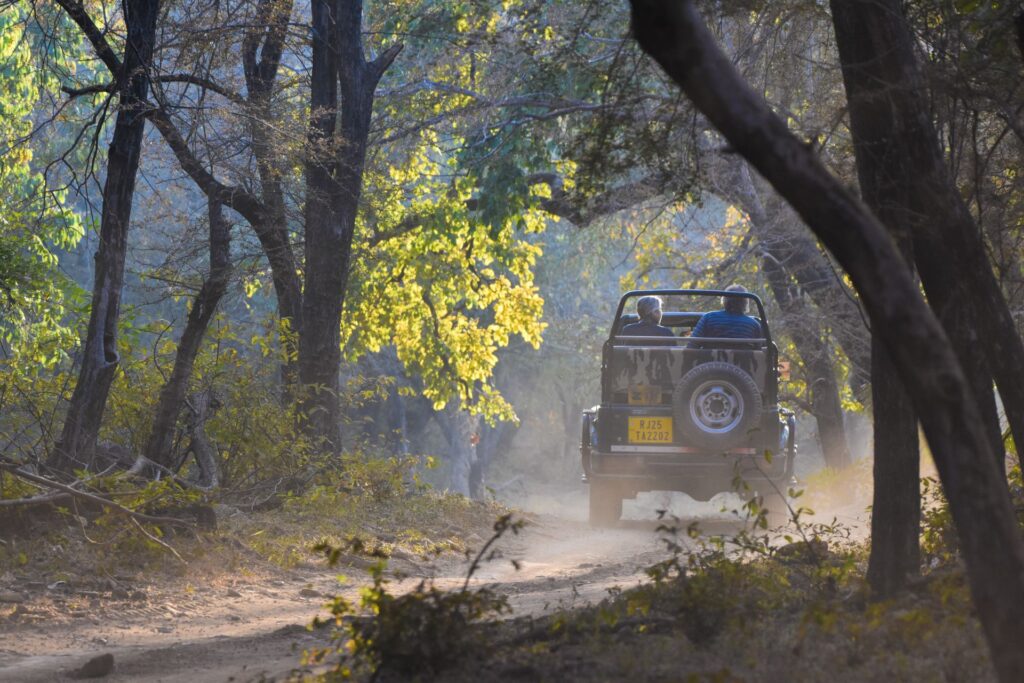
In an open-top jeep, we rumbled into the forest at an ungodly hour of the morning. Bundled in layers and watching as the jeep’s headlights carved into the mist ahead, I was given the same advice Bill Clinton was given when he went looking for Bengal tigers in India more than 20 years earlier. “We’ve warned them [the Americans] that it’s not like British colonial times,” an official at Ranthambore National Park, located in the northwestern state of Rajasthan, had told the BBC after Clinton’s visit in 2000.
I received a very similar forewarning. While clutching my hat as our vehicle jostled and jounced violently along the winding dirt road, our designated tiger-spotter, Manish, turned to me and yelled, “We hope to see one today, sir. But please, you have to be realistic. This is a wilderness place, sir. The tiger will be seen only if it wants to. These are not like the days when the British were here.”
Both Manish and the park official who’d presided over Clinton’s trip were referring to a bygone colonial era, back when the British Raj lured tigers with bait, traps, fire, elephants, drums and hounds for elaborate hunts. Most historians agree that the British wiped out tens of thousands of tigers during their 190 years in India, usually by way of sport or paid bounties.
Officials tallied the kills: The Duke of Windsor bagged 17 cats in a single week; King George V killed 39 in 10 days; and George Yule, a bureaucrat, apparently shot over 400, roughly 10% of India’s tiger population today. Tiger hunting quickly devolved into an imperial pissing contest, a testosterone-fueled display of ego that nearly emptied the subcontinent of its most iconic wild cat.
While the British would roll into the jungle with much fanfare, we, on the other hand, entered Ranthambore with nothing but cameras, sunscreen and Manish’s sharp eye. In other words, an encounter with this magnificent predator was far from guaranteed.
Deeper into the forest we went. Peacocks and sambar deer were among our first sightings. Sometimes our driver would stop so Manish could listen. The occasional rustle within the bush inevitably raised hopes. “What was that?” I’d whisper excitedly into Manish’s ear. Was it another langur? A boar, perhaps? Or something more?
By early afternoon, we’d seen hundreds of gray langurs, a brown fish owl and a trail of fresh leopard tracks — but not as much as a whiff of a single black-and-orange striped cat. Manish told our driver to pull over so we could break for chai.

Around us were enormous, vine-spilling banyan trees, rocky hills carpeted in scrub forest and parched ponds where crocodiles were sunning themselves. Nature, of course, is what makes this place such a draw for visitors. But scattered across the park are also old hunting lodges, crumbling pavilions, abandoned temples, ruins of palaces and ancient stone walls mottled with moss. The park’s unofficial centerpiece, for example, Ranthambore Fort, is a UNESCO World Heritage Site built in the 10th century by the Chauhan rulers.
“This tiger reserve is not just a nature place, but also a history place,” Manish told me while he unscrewed a thermos full of hot chai. “Tourists come here for the animals, but actually there is so much history here.” Manish loved history, maybe even more than tigers. And he, I could tell, was about to go off on a long, long tangent about the fort’s thousand-year past. But he was interrupted.
From somewhere in the bush, there came a roar. A roar so loud, so bone-shaking, that it would’ve made a gunshot sound like a sickly sneeze by comparison. We froze. Manish’s big brown eyes bulged from their sockets. And then he spun in his seat to face me. “That was a tiger!” he gasped.
Today, for anyone hoping to spot a wild tiger, India is the place to be. With over 4,000 of them, it has more of these big cats than anywhere else on the planet. Ask conservationists why, and they’ll likely credit Project Tiger, an ambitious government-led conservation initiative that helped the cats bounce back from extinction.
Launched by then-Prime Minister Indira Gandhi in 1973, the initiative designated chunks of land across the subcontinent as protected “tiger reserves.” Villagers were relocated, buffer zones were established and jeep-riding, rifle-toting rangers were sent in to patrol the reserves in an effort to stymie poaching.
Project Tiger marked a turning point in India: It transformed the once-hunted landscapes into protected land and tried to recast the tiger, not as a monster, as British narratives once insisted, but as a symbol of national pride.
Heralded worldwide, the project has given India a reputation as an international juggernaut in big cat conservation. In 2023, on Project Tiger’s 50th anniversary, the World Wildlife Fund had to tip its hat to the initiative, calling it “one of the most successful species-specific conservation programs globally,” a line of praise inspired by the fresh census tally of 3,862 cats in 2023, up from 2,967 in 2018.
Indeed, the project helped stabilize the country’s shrinking tiger population, but critics also point out that it came at a cost. Indigenous forest-dwelling communities have been displaced, and since the early 2000s, some argue the initiative has underperformed while being overhyped.
Across the subcontinent, 58 tiger reserves now dot the map. Royal hunting grounds, Mughal battlefields and colonial playgrounds are now national parks with souvenir stands and camera traps. Their history mirrors India’s and marks its shift from occupation to independence. And the tiger — once a trophy, and now a totem — has become part of the story of a nation reclaiming itself after many years under foreign rule.
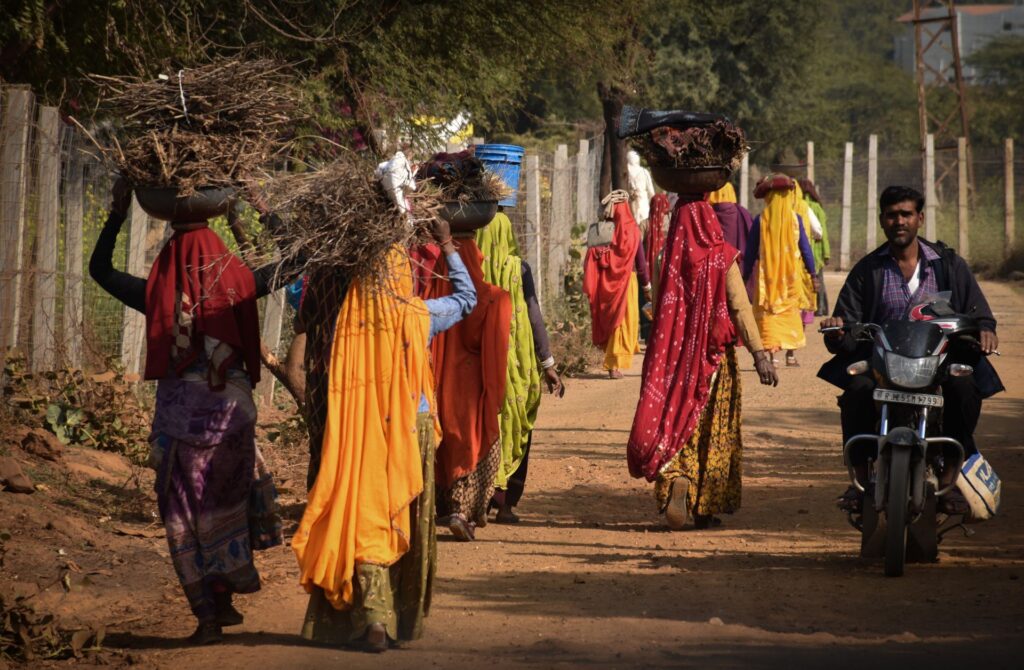
Rami, when I met her, was worried. And for good reason. A line of tiger tracks had been found just outside her home, alarmingly close to the goat enclosure. She and her family lived on the outskirts of Ranthambore National Park, in one of the many rural, agrarian communities found throughout the Sawai Madhopur district of Rajasthan. Here, people rely on subsistence farming — raising crops like wheat, mustard and maize — to make a living.
Rami, like so many women in this region, was responsible for retrieving water and firewood each day. Because these chores were usually done at dawn and dusk (when big cats are most active), and she and the other women from her village had to walk to the forest fringes to fetch water and gather firewood, stumbling across a wild tiger was always a real concern. “I saw one once,” she told me. “By a stream. I was very scared, but it ran away when it saw me.”
Coexisting with tigers means that faith and fear share the same bed. But reverence in a temple is pretty different from coming face-to-face with one of these cats in the bush. “We respect the tiger,” she told me. “But we have to be cautious.” For thousands of years, the striped predator has been both a hero and a villain in India, depending on who was in charge.
Many of the country’s major faiths associate the tiger, in some way, with divinity. In Hindu mythology, the tiger is Goddess Durga’s ride into battle, symbolizing bravery. Buddhist lore tells of a past-life Buddha offering himself up to a starving tigress, who would have cannibalized her own cubs if he hadn’t. This tale promotes the idea that any being, wild or otherwise, deserves empathy. Several Indigenous tribes, like the Soliga (in the southern state of Karnataka) and Idu Mishmi (in the northeastern state of Arunachal Pradesh), have also historically refrained from killing tigers, viewing them as sacred creatures.
How exactly the big cat was portrayed — as either friend or foe — also largely depended on who was in control of India. Vijaya Ramadas, a history professor at the University of Hyderabad, told New Lines that the Mauryan Empire, which ruled over most of the subcontinent in the late fourth century, perceived the tiger as “the enemy of the people,” mostly because of the threat it posed to villagers, their livestock and the agrarian economy more broadly.
The Chola dynasty, on the other hand, which ruled over southern India from the ninth to the 13th centuries, embraced the tiger as its royal emblem, since it was “a symbol of power, bravery and honesty,” Ramadas said. Its depiction on the dynasty’s official flag beside a pair of fish was one of the earliest and clearest associations of the tiger with state power.
In the north, Rajput kingdoms also regarded the tiger as symbolic of courage. But when the Mughals established their empire in India in 1526, they mainstreamed and ritualized the tiger hunt — an elaborate affair undertaken on horseback or camelback or mounted on elephants, often involving dozens of people. Hunting the cat was both spectacle and statement. For Mughal emperors like Akbar and Jahangir, a tiger slain in the forest showed their dominance over nature and, more broadly, their imperial authority.
Things changed again (and for the worse) in the 18th century, when the British, intent on becoming the “new Mughals,” emulated their Islamic predecessors, including the tiger hunt. To them, the big cat embodied “wild, savage India.”
Killing the tiger meant “taming India” and, by extension, the land and its people. “The tiger undeniably became a tool of imperialist ideology and propaganda, used to reinforce the British Raj’s control over the Indian subcontinent,” writes Ana Teodorescu, a history student at Carleton University, in the Columbia Journal of Asia.
Tipu Sultan, the mustachioed ruler of the Kingdom of Mysore in the late 18th century, makes for a good example. Unlike many other rulers at the time, Sultan didn’t submit to the East India Company but instead fought it during its march across India. Tiger-obsessed and battle-hardened, he was nicknamed “the Tiger of Mysore,” as he used the tiger stripe motif in his kingdom’s logo, uniforms, weapons, armor, throne and currency. He even kept live tigers to guard his palace.
But his most infamous showpiece was a life-sized, wooden automaton of a tiger mauling a white man in a red coat and black hat — an English soldier, in other words. The machine doubled as a strange musical instrument of sorts: By turning a crank, the tiger would growl, and the white man would scream. Because he and his kingdom were perhaps the biggest thorn in the side of the British, Sultan’s automaton was a metaphor and a message for them.
But in 1799, when the British stormed the kingdom and killed Sultan, they seized the mechanical tiger as a war trophy. Today, it sits in a display case in the Victoria and Albert Museum in London. Soldiers involved in toppling the kingdom were awarded a medal which depicted a lion — a longtime symbol of the British empire — mangling a tiger.
Since the tiger symbolized India itself, the British Raj used its emblematic cat — the lion — as a symbolic weapon. When the Indians were rebelling against the East India Company, an English cartoonist published “The British Lion’s Vengeance on the Bengal Tiger,” which featured a pouncing lion avenging a white woman who’d been mauled by a tiger.
In 1859, Victorian-era artist Edward Armitage famously painted “Retribution,” in which a sword-wielding white man avenged a dead white woman and her baby by killing a tiger. “Illustrations of tigers pinning down women warped (British) culture to the point that the imagery of the tiger alone invited the audience to finish the story: the dangerous tiger will face its demise at the retributive hands of the British hero,” writes Teodorescu. The tiger morphed into a racist emblem, essentially a caricature of the colonized Indian man: savage, exotic and to be subdued, she adds. Cat-as-metaphor influenced how the British colonial government dealt with the actual animals. Tiger hunting, for the British, increasingly became a “political act,” Ramadas explained.
Although the British didn’t invent the notorious hunt, they did revolutionize it. Clad in khaki and surrounded by an entourage of armed retainers, British officers and sometimes Indian princes, they’d set out to kill the cats en masse. Called “shikars,” a Persian term borrowed from the Mughals, the hunts took place across the subcontinent.
A single hunt could involve dozens of elephants, hundreds of local assistants and a small army of attendants. Tigers were sometimes driven into the open by lines of beaters — local villagers who shouted and banged drums to spook the cats from hiding. The elephants, draped in richly colored cloth and brass ornaments, gave the gun-toting hunters a high vantage point to scan the ground.
The moment of the kill became a familiar photograph of the time: the triumphant British hunter, rifle in hand, standing proudly over the tiger’s limp, dead body. These images circulated in colonial newspapers and even made their way back to Europe, reinforcing the myth of the brave white man taming India’s “wild” lands.
The scale of the slaughter was immense. Historical records suggest that tens of thousands of tigers — perhaps as many as 80,000 cats — were killed between the mid-19th and early 20th centuries. Rewards were sometimes paid for tiger skins, claws or tails, while state-sponsored bounty programs encouraged villagers to kill tigers themselves. Ramadas said that many locals, especially those who’d been pushed into poverty by colonial policies, started hunting the animals just to cash in on the bounty.
“But there were Adivasi tribal communities [Indigenous groups] in central India,” Ramadas explained, “who revered and respected the tiger despite British colonial rule and opposed the British colonial discourse that portrayed the tiger as an enemy of humans and a man-eater.”
When the British expanded commercial agriculture by building railways, roads, dams and reservoirs, and the tigers and leopards lost their natural habitat in the process, they became “man-eaters,” said Ramadas, preying upon village livestock and, on occasion, villagers themselves. It played right into the British government’s hands by perpetuating a merciless cycle of tit-for-tat killing.
Jim Corbett, a British hunter-turned-conservationist, who later helped establish one of India’s very first national parks, initially killed 19 tigers and 14 leopards between 1907 and 1938. But in the 1920s, after a visit to East Africa, where he noticed that the wilderness remained pristine, unlike the steady destruction in India, Corbett became a vocal advocate for tiger conservation.
He was an exception. By the 1940s, as Britain’s grip on India was nearing its end, several decades of relentless hunting, land degradation and paid bounties had altered India’s wild spaces almost irreparably. At the time of India’s independence in 1947, the tiger population had plummeted to 40,000, less than half of the approximately 100,000 wild tigers that roamed India in 1900.
Even after the departure of the British, tiger hunting continued. An entire industry grew around the idea that foreign money could be drawn into India if wealthy tourists came and shot tigers. By the 1950s, the Indian government was sending brochures abroad advertising the “excitement of a tiger shikar,” selling it the same way one might sell a beach vacation. India’s tourism department tried to win over the “white hunters” who favored Africa. “Tigers provide a thrill that the sluggish African lion can never equal,” an official told The New York Times in 1964.
Between 1965 and 1969, more than 4,000 tiger and leopard skins were exported out of the country. The 1964 New York Times article spelled out the scale of it: In 1962, most of the foreign trophy hunters were Americans, and together they spent over $145,000 for the chance to kill a cat — roughly equivalent to $1.5 million today. Poaching became a lucrative business, too, as a market had developed, particularly in China, for tiger skins and bones. Agriculture began eating up more land as well, which destroyed huge swaths of pristine habitat.
Around the same time, experts began sounding the alarm bells, warning the federal government that, if it failed to act, the tiger would vanish from India forever. Kailash Sankhala, one of the original masterminds behind Project Tiger, and Edward Pritchard (aka E.P.) Gee, a renowned tea planter and conservationist, both prophesied disaster for the Bengal tiger. Global attention to the animal’s fate was mounting, too. Both the International Union for Conservation of Nature and the World Wildlife Fund began urging the government to “save India’s hard-pressed tiger from fast-approaching extinction.”
Facing growing pressure, in 1972 the Indian government decided to count the country’s cats. The numbers were startling: A mere 1,827 tigers were left, according to the census. This reportedly rattled India’s prime minister at the time, Indira Gandhi. “We do need foreign exchange,” she said in 1969, after banning the export of tiger skins, “but not at the cost of life and liberty of some of the most beautiful inhabitants of this continent.”
The same year, Gandhi’s government pushed through the Wildlife Protection Act, which banned shooting, killing, trapping or trading native wildlife, and named the Bengal tiger as India’s national animal. In 1973, Project Tiger was launched and the first 30 years were “a surprising major success,” said Ullas Karanth, a conservation zoologist and prominent tiger expert based in Karnataka. “It definitely saved the tiger from extinction, as I personally witnessed,” he told New Lines.
Under the program, the government established nine designated “tiger reserves,” starting with Corbett Tiger Reserve in the hilly northern state of Uttarakhand. Today, the 58 reserves that span the country have a similar anatomy that consists of a core zone, free of humans and protected from hunting, and a buffer zone, where activities like tourism — so long as it’s strictly regulated — are allowed.
In the process, overtourism has emerged as a problem, as millions of tourists pour into India’s tiger reserves every single year, hungry for a glimpse of a cat. That craving has built an entire industry around the sliver of land open to visitors. Safaris are booming, and with them come paved roads, swanky lodgings, and even souvenir stalls hawking tiger-themed trinkets.
In both the Ranthambore reserve and Bandhavgarh National Park — a former royal hunting spot for the maharajas in the central Indian state of Madhya Pradesh — whenever a tiger is spotted, the trail is quickly swarmed by jeeps of eager drivers and even more eager tourists competing for a glimpse. To me, these tiger traffic jams, with narrow trails clogged with tourist-packed jeeps, didn’t seem very conservation-oriented, despite my guide’s reassurances that tourism is forbidden in 80% of a typical reserve.
But more people means more stress on wildlife. In Ranthambore this May, a tigress killed a 40-year-old park ranger — a rare but not unheard-of tragedy. Scientists have long warned that honking jeeps stuffed with giddy, camera-wielding tourists can spark physiological stress in tigers, sometimes pushing them toward aggression.
Even though Project Tiger has seen success, it is not without its share of skeletons in the closet. Perhaps the most scathing criticism of the initiative has been the continued displacement of the Indigenous Adivasi communities. Critics often describe the initiative as “fortress conservation,” an approach that divorces local communities from nature.
From the initiative’s inception until 2006, almost 3,000 families were evicted from their homes across 13 tiger reserves (sometimes with consent, sometimes with a little bureaucratic coercion), which has sparked outrage from the displaced communities and human rights groups.
In response, India’s National Tiger Conservation Authority, instituted after a 2006 amendment to the Wildlife Protection Act, began offering compensation to those willing to “voluntarily” relocate. Households that agreed to leave were paid a lump sum of 1 million rupees (about $11,000 at current exchange rates). Since 2006, over 14,000 families have been relocated and paid by the government.
Karanth told me that another issue with Project Tiger was the exaggeration of its success, by the media and authorities alike. “After 2000 it got overfunded, corruption increased and the momentum stalled,” he said. “But the hype and PR have risen.”
India has about 154,000 square miles of suitable wilderness, he said, which is enough habitat to support 20,000 tigers. Only about 4,000 cats prowl the subcontinent today, a figure that is disappointing for Karanth.
But compared to countries such as Cambodia, Laos and Vietnam — where the tiger was declared extinct in 2016, 2013 and the early 2000s, respectively — India’s population is a relative success story. “This is better than the performance of any other tiger range country,” Karanth admitted.
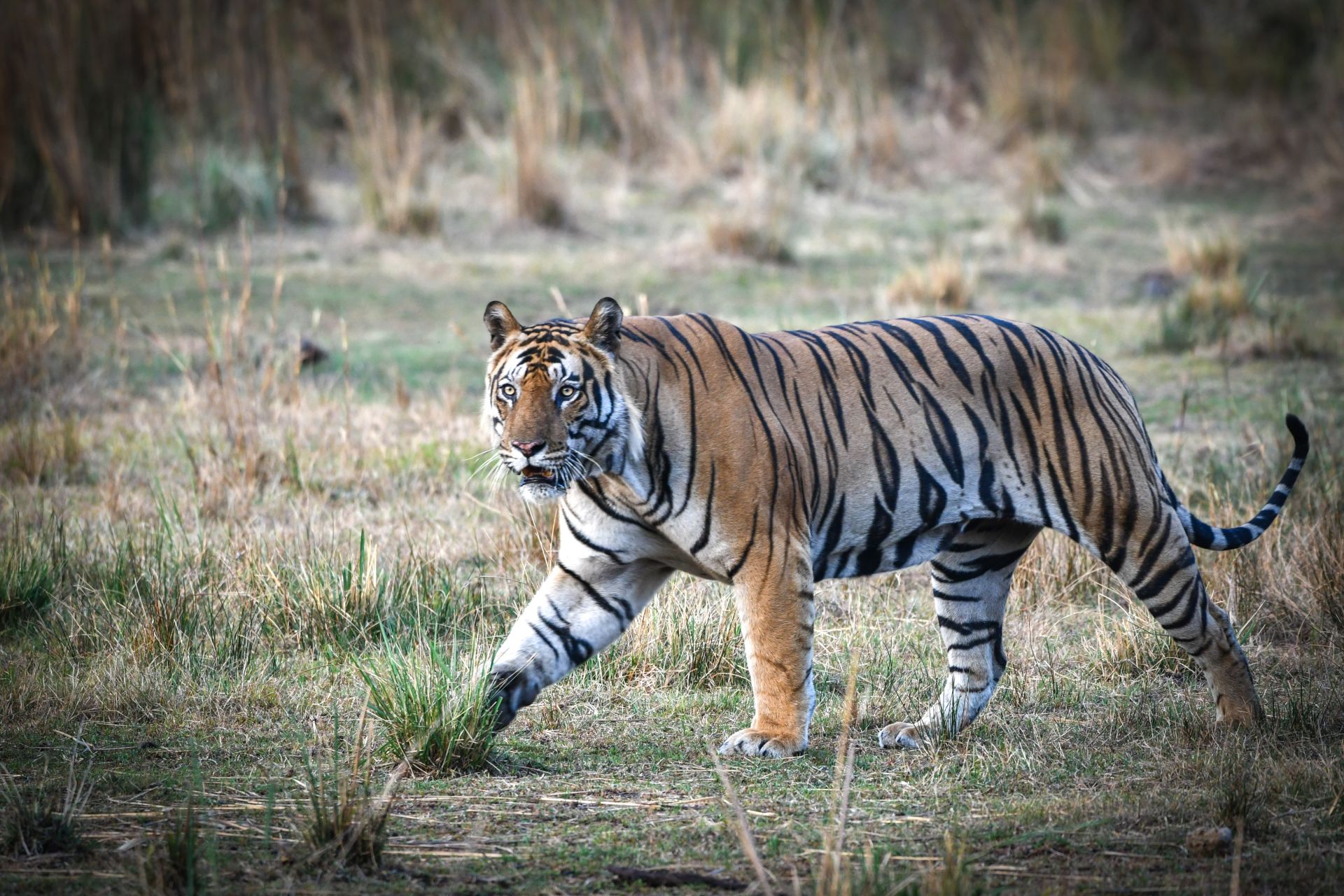
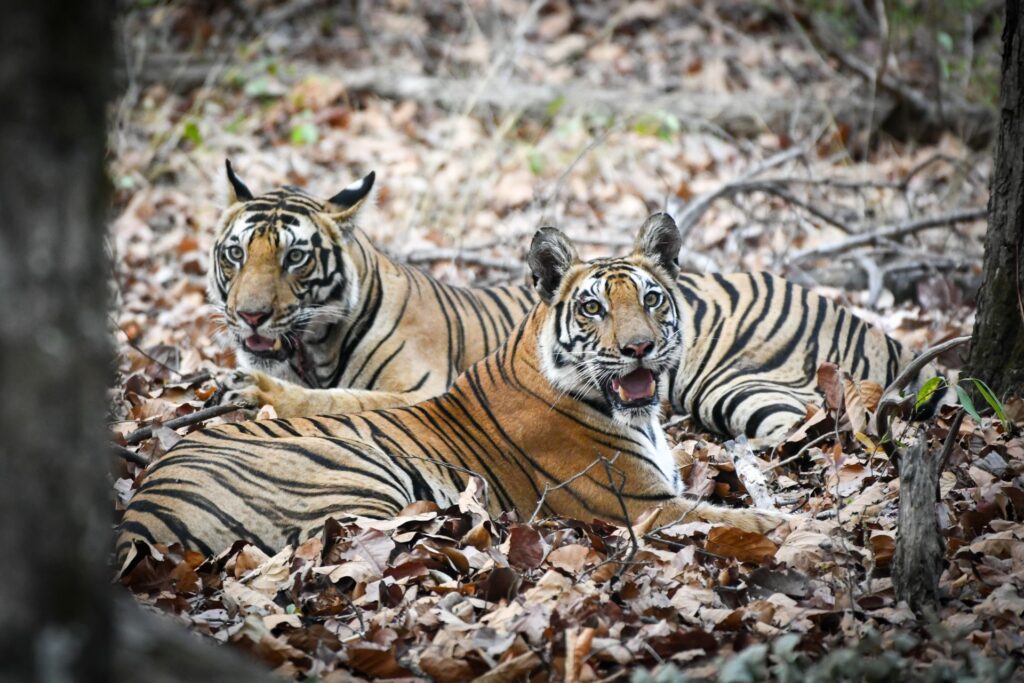
Bandhavgarh National Park is, quite literally, crawling with big cats. On our first day in the park, while sitting in the back of a jeep, we spotted a beautiful, sleek, young tigress. She lay in the shade, half-asleep, purring and stretching her long legs. Moments later, another cat — this time a brawny male with huge paws and rippling shoulder muscles — padded across the trail.
Considering that India’s wild tigers seemed doomed just a few generations ago, it was all the more remarkable to watch not one, not two, but three wild tigers rip meat off a deer carcass. And I felt something unexpected. I felt hope. Weird, I thought. Weird that the sight of wild cats with blood-soaked faces, as they ravenously devoured entrails and organs, could make me feel, of all things, optimistic.
I observed this gory feast alongside Sudhir, a local friend of mine. He mopped sweat from his brow before leaning in and whispering, “Remarkable, isn’t it?”
“I barely have words,” I nodded, careful to keep my voice low. For a few moments, we fell silent again, the only sounds being the tink-tink-tink of the jeep’s cooling engine and the tearing of meat from bone.
Become a member today to receive access to all our paywalled essays and the best of New Lines delivered to your inbox through our newsletters.