


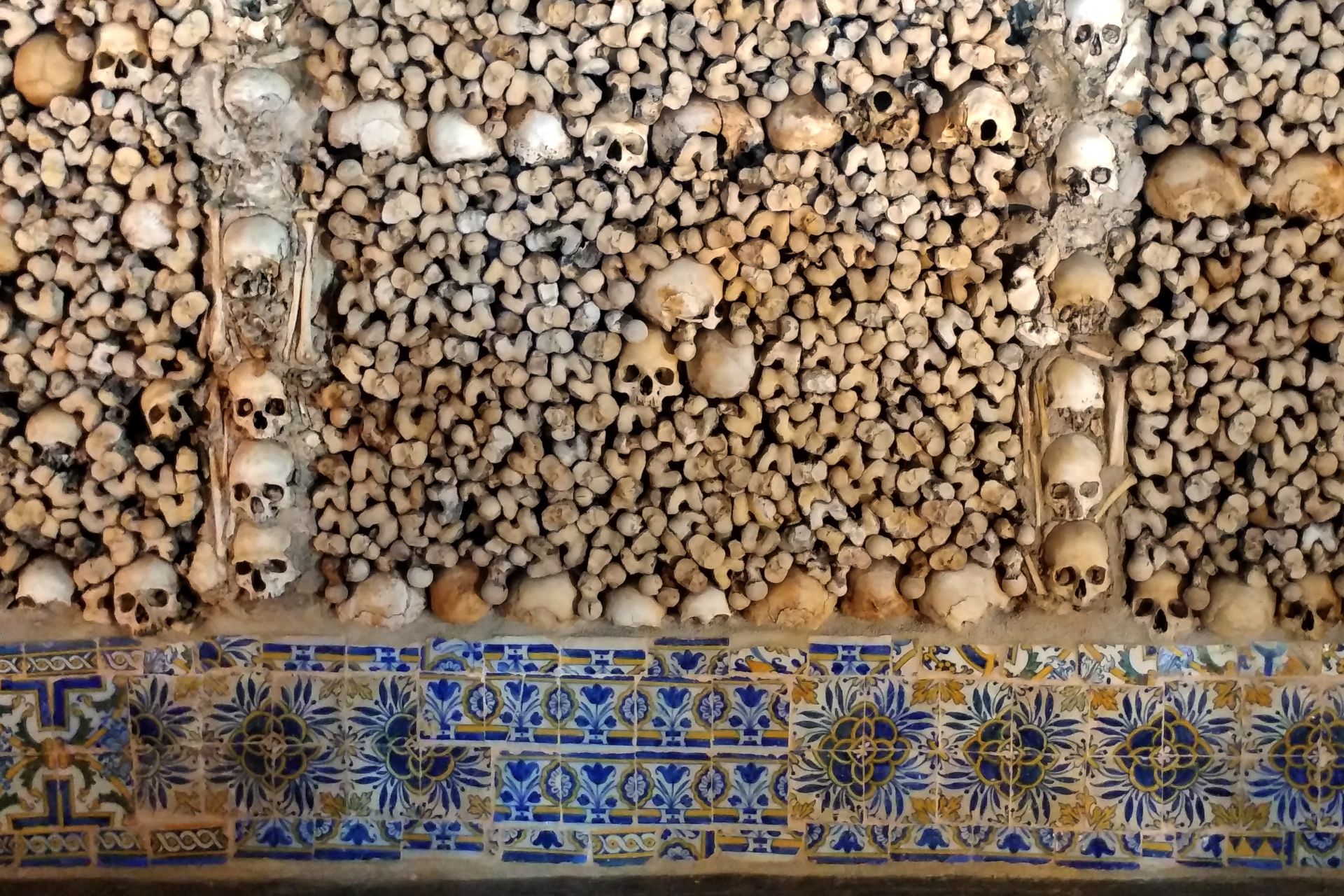
In the Chapel of Bones (Capela dos Ossos) at the Convent of St. Francis in Evora, Portugal, your conversation with the dead begins at the door. On a plinth above its threshold are the words “We bones are here, waiting for yours” — a challenge to the living from the dead, a reminder of our mortality.
There is something intensely sobering about seeing so much concentrated death in one hit. I don’t think anyone visits a bone chapel accidentally; it’s one of those experiences that you research online. But still, no screen visit will chill you as much as the real thing.
While I was making my way to the bone chapel along Evora’s cobbled streets, in mid-September heat, I wondered what the bones would have to say to Russian President Vladimir Putin and Chinese President Xi Jinping had they overheard their conversation about immortality when they met on Sept. 3, 2025. The exchange appeared lighthearted: two dictators celebrating 80 years since the end of World War II and chuckling like schoolboys about their plans to cheat death alongside North Korea’s Kim Jong Un.
The moment was caught on a hot mic as they neared the rostrum at Tiananmen Square in Beijing. Putin’s interpreter was overheard repeating Putin’s words in Chinese to Xi: ”Biotechnology is continuously developing. Human organs can be continuously transplanted. The longer you live, the younger you become, and [you can] even achieve immortality.”
The age Putin mentioned that human life could be extended to was 150 years, but the bigger ambition is clearly to live indefinitely. Two dozen other foreign officials were there to see the military parade — a demonstration of China’s military might — but this special conversation was reserved for just three.
It fascinates me that, in the face of this massive procession of men and machines, the private talk of these leaders as they approached the stage should be so personal, so age-old, and so human. The specter of death haunts these men as it does everyone else, but perhaps they have more reason to want to stay on this side of the grave.
Fundamental to the narcissistic psyche is an inability to comprehend its own end. The nature of the condition is to believe oneself above death. Similarly, the timeframes of these leaders’ totalitarian agendas extend beyond the boundaries of a natural life. They view themselves as colossal in stature compared to almost everyone else. Their destiny is vast and their end unimaginable.
So, the all-powerful seek absolute power over humanity’s greatest equalizer — death. It is understandable that the topic of immortality might be a shared interest at this meeting of titans. Putin mentioned organ transplants to Xi as if it were a shiny new concept, knowing full well that it wasn’t. The story of the new order in China could have been written by Mary Shelley, the difference being that Frankenstein’s monster was stitched together using the body parts of dead people. China’s approach is much more shocking. According to U.S. writer and researcher Ethan Gutmann’s 2014 book (updated and republished in 2016), “The Slaughter: Mass Killings, Organ Harvesting, and China’s Secret Solution to its Dissident Problem,” an estimated 60,000 to 100,000 transplant surgeries are performed every year, using body parts harvested from Falun Gong practitioners killed for that purpose.
It is just this kind of grandiosity that the Franciscans were trying to tackle when they built their Chapel of Bones at Evora. Coming out of the midday sun, walking through the shaded cloisters where the monks had their cells and slept, and going into the darkened chapel creates a stark contrast that heightens the somber intensity of this place. The room is grotto-like, lit by just three small windows inset along the left-hand wall. The floor space is big for a chapel, measuring some 6o feet long and 35 feet wide. There is a central nave, plus two flanking naves that are slightly narrower, leading to an altar.
As your eyes adjust to the dim light, the grim nature of the interior becomes apparent. The chapel is richly decorated with human bones that are geometrically arranged on columns and walls. The ceiling vaults are painted white and decorated with motifs associated with death. Its interior decor of skulls and bones creates a ghastly play of light and shade that is intended to convey the unsettling message of life’s transience.
When Portugal was a maritime superpower during the 15th and 16th centuries, and the richest nation in the world, this chapel of bones would have had a special resonance. The success of the explorer Vasco da Gama’s expedition in 1497 opened the first sea route between India and Europe, beginning a new era of global trade and colonization. Portugal, at the vanguard of exploration and trade with the “New World,” was a conduit of wealth. Traders and financiers were the brutal overlords of subject populations of Muslims and Hindus in East Africa and India. The Portuguese port of Lisbon bustled with ships laden with plunder, precious goods and spices such as saffron, cinnamon, black pepper and ginger. Portugal controlled an empire that was rich and globally expanding.
Lisbon, therefore, became a hub of hedonism. Equally, Evora, 82 miles inland to the east of Lisbon, suffered the same decadent and dissipated fate. During the golden years of Portugal’s Renaissance, Evora was favored by the crown as a residence. At one point, King Joāo II wanted to use land belonging to the Church of St. Francis to extend the neighboring royal palace, but the proposal was thwarted by the Franciscans, who were adamant that they wanted to keep their site. The royal palace at Evora also served as a home to King Afonso V (who also wanted to extend the palace floor plan at the expense of the Franciscan church) and the devout King Joāo III, who was the ruler when Portugal was at the peak of its power.
Living next to the palace at Evora, and in a highly sybaritic society, the record has it that three Franciscan monks in the 1600s decided to use skeletons to chastise the people for their excesses. To make a point, and to ease overcrowding in the 43 graveyards of Evora and the surrounding districts, they exhumed 5,000 bodies and arranged them artistically around the walls. According to the guide who took us to the chapel, permission was sought from relatives, but it is highly unlikely that every skeleton’s family was consulted. There was a bonus, though, to be gained after your bones had been exhumed and used to decorate a sacred site for holy purposes. Church authority has it that these bones will be first “out of the rank” on the Day of Resurrection. The Earth will not have to rend itself, and no graves will be opened, as this has already been done by human hands. The chapel is effectively a departure lounge for the souls of Evora who are waiting to be called up.
Not every bone, however, has been used. Most of those on display are skulls, tibiae and fibulae, stacked on top of each other in ivory-colored patterns that are mesmerizing in their repetition. Fragments and smaller bones were ground down to make the mortar that binds the structure together. Glass now protects columns edged with skulls that, at their lower levels, have been broken off — bumped by bodies and no doubt touched by many curious hands over the centuries.
Today, to the right of the central nave, the complete mummified bodies of an adult and a young child lie on white pillows in glass cases. Once, they hung with other bodies from the walls on chains, as perhaps the chapel’s most gory reminder of death. Records suggest they have been there since the 17th century, but it could be even earlier because no dates relating to the chapel are definitive, including when it was constructed. Next to the mummies (which are both female) was a verse, now displayed at the entrance:
The fleshless skulls
They are my company,
I bring them night and day
Depicted in my memory;
Many were respected
In the world for their talents,
And others vain ornaments,
Who served vanity,
And it may … in eternity
Be the cause of their torments.
In front of you, as you walk down the main nave, is the altar. Close by it on a catafalque sits a sarcophagus-shaped white casket, high-sided but not much more than 3 feet in length. According to the dogma of the place, this contains the remains of the three Franciscan monks who founded the Convent of St. Francis on the same site in the 13th century. These medieval monks are not part of the spectacle like the other bones of Evora, enjoying the privacy of their own sealed space. The distinction of rank was important in the Catholic Church, even among Franciscans.
The Chapel of Bones at Evora was not intended as a place of worship, but rather as a site of reflection. There are none of the usual sacred elements adorning the interior. No stained-glass windows, no painted statues or colorful icons. The message of the place surrounds you. The warning is clear: Human existence is brief and is not an end in itself, but the passage to salvation. Worldliness and possessions must give way to a devout and exemplary existence. And God help all those who ignore this choir of skeletons who are witnesses to death.
The practice of displaying bones is called “morte secca,” or dry death, and it is surprisingly common in the Catholic Church in countries such as Italy, Spain, France, Germany, Austria, Poland, Serbia, the Czech Republic, England, Peru and others. It can also be linked to a cult dedicated to souls in purgatory, which began in Naples, Italy, when plague killed more than half the city’s population. There was so much death in the city that people buried bodies before they could be identified. The cult of souls removed the remains of abandoned and forgotten dead stored in ossuaries. Adherents took skulls home, cleaned them up, and prayed for their souls, helping them to move from the state of purgatory to heaven. This intercession could then be conferred in reverse on the living once the soul was safely through heaven’s door. This practice was not officially condemned by the Catholic Church until 1969. Some sources claim the bone chapel at Evora was dedicated to the cult of the souls in purgatory — which is possible — but its cautionary role, as a display intended to inspire reflection on the transitory nature of human existence, would not have allowed bones to be taken away.
While Evora is one of the largest and most magnificent examples of “morte secca,” Portugal has five more bone chapels, including the less well-known but equally fascinating one at Faro. This is a much smaller, light-filled chapel. Big windows flood the space with a warm glow that is echoed by a skeleton covered in gold that hangs at the front of the chapel. The inscription above the door is less challenging than the one at Evora: “Stop here and think of the fate that will befall you — 1816.” The chapel was built by Carmelite monks in c. 1719, and the bone decoration and inscription were added later. Here, the skulls and mostly femur bones come from the remains of 1,245 monks buried close to the church. Again, the issues were overcrowding and the need to send a message to the wayward living.
After reporting on my visit to Evora and researching the phenomenon of “morte secca” more broadly, I think I can guess what the bones might say about organ transplants and immortality to Putin and Xi if they could talk. And what they might also say about the greedy and gratuitous spending of President Donald Trump on his $250 million ballroom extension at the White House, and the $230 million of taxpayers’ money he is claiming from the Justice Department as compensation for federal cases against him — all of which continued as millions of government workers went unpaid during the government shutdown. The bones’ response is perhaps best summed up by a second poem that hangs from a pillar at Evora. The words were penned on their behalf by Father Antonio de Ascenao as if they were talking to the living:
Where are you going in such a hurry traveler? …
You have no greater concern
Than this one: that on which you focus your sight.
Recall how many have passed from this world,
Reflect on your similar end,
[For] there is good reason to reflect …
And after speaking, the bones might die again, laughing at human folly.
Become a member today to receive access to all our paywalled essays and the best of New Lines delivered to your inbox through our newsletters.