


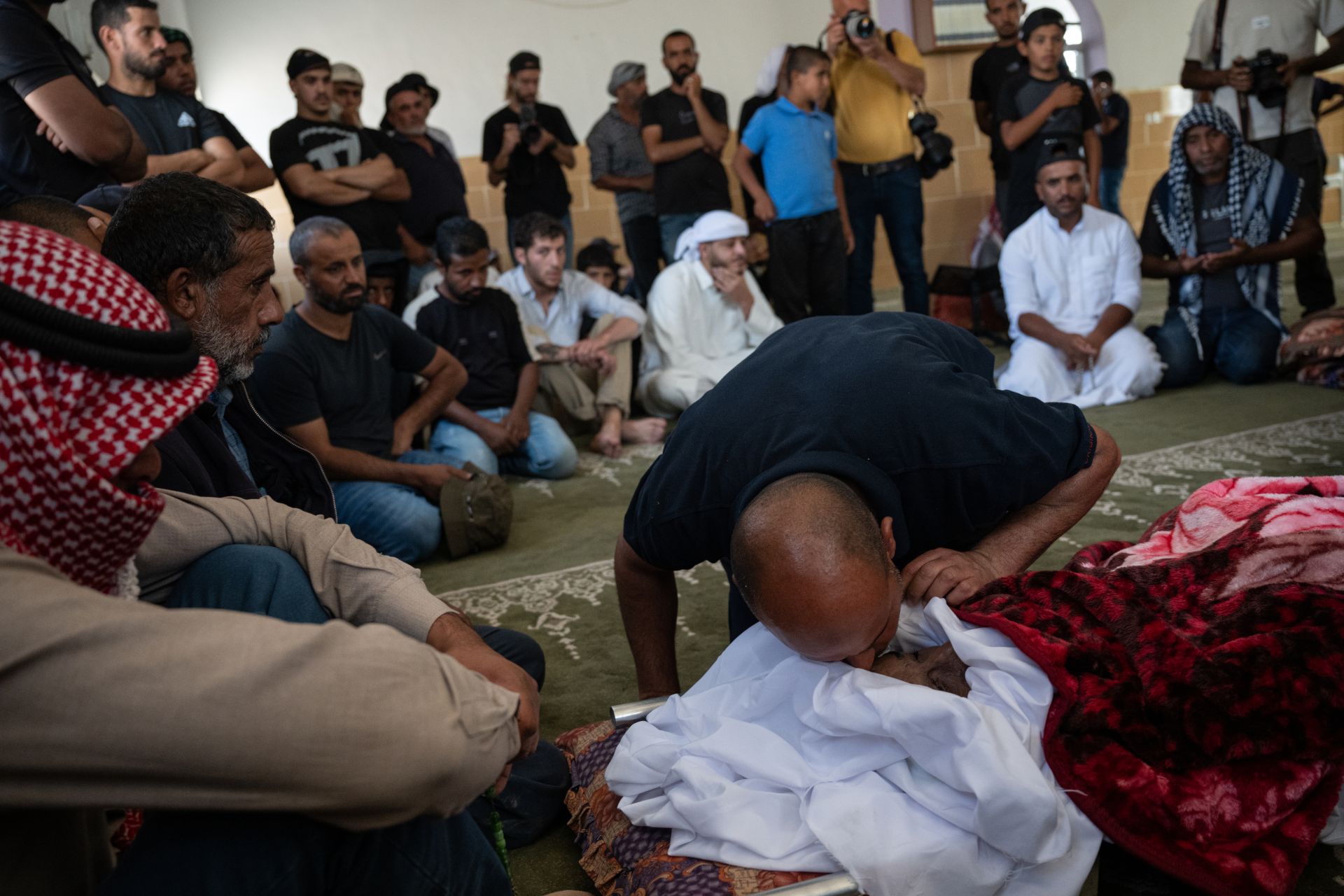
Ari Fuld, an Israeli American who lived in the West Bank settlement of Efrat, was fatally stabbed by a Palestinian in 2018. Nasrallah Abu Siyam, a Palestinian American who lived in the West Bank village of Mukhmas, was shot dead by an Israeli settler in 2026. Both murders were committed in the West Bank against U.S. citizens. But according to U.S. law, only the Fuld family has a legal pathway to pursue civil remedies in U.S. courts under the Anti-Terrorism Act (ATA). The U.S. State Department has not designated Israeli settlers and settler organizations as terrorists or terrorist entities, so Abu Siyam’s family has no comparable pathway to justice in the U.S. court system.
On Oct. 16, 2025, the Fuld family and the family of another U.S. citizen who was a victim of an attack perpetrated by a Palestinian in the West Bank filed a federal lawsuit in the United States District Court for the Southern District of New York against the Palestinian Authority (PA) and the Palestine Liberation Organization (PLO). They cited the organization’s financing of the Palestinian Authority Martyrs Fund, which has provided funds to Palestinian prisoners and to the families of those who have been imprisoned or killed, including those who have perpetrated violent attacks.
Earlier that year, the U.S. Supreme Court upheld the 2019 Promoting Security and Justice for Victims of Terrorism Act, which affirmed the rights of American victims to sue the PA and the PLO in U.S. courts for acts of terrorism committed outside the U.S.
This decision reinforces a pattern of one-sided accountability under U.S. law: Palestinian violence is designated, prosecuted and compensated as terrorism, while Israeli settler violence is not. In effect, American victims of Palestinian violence can sue Palestinians in U.S. courts, but American victims of Israeli attacks can’t sue Israelis for equivalent violent crimes.
The ATA was passed in 1992 to allow U.S. nationals to sue foreign individuals, entities and organizations in U.S. courts for acts of international terrorism. Authored by Sen. Chuck Grassley, the legislation was passed in the wake of increased international attacks targeting U.S. citizens. One prominent incident occurred in October 1985, when four members of the Palestinian Liberation Front hijacked the MS Achille Lauro, a cruise ship, and murdered Leon Klinghoffer, a wheelchair-bound U.S. citizen.
A joint report by the organization Palestine Legal and the Center for Constitutional Rights argues that the legislation was always intended to target the PLO. The report found that the Klinghoffer family testified in favor of passing the ATA on behalf of the Anti-Defamation League (ADL), an explicitly pro-Israel organization, while other testimony in favor of the legislation specifically speculated about PLO financial holdings that could be seized via lawsuits that cited the ATA. However, the courts initially dismissed cases against the PA and the PLO because of a lack of personal jurisdiction, given the limited ties between the U.S. and these organizations. Personal jurisdiction determines whether or not a court has the authority to try a defendant. In this context, it depends on whether the defendant has adequate presence, activities or ties to or within the United States. Without being able to establish jurisdiction, U.S. courts are typically unable to hear and try claims against foreign individuals or entities.
In order to establish jurisdiction specifically over the PA and the PLO, as it appears the ATA intended, Congress passed the Promoting Security and Justice for Victims of Terrorism Act in 2019. The legislation, sponsored by former Rep. Doug Lamborn, stipulates that U.S. courts have jurisdiction over the two organizations if they make payments to prisoners or the families of those responsible for terrorist attacks, or if they engage with the U.S. government. The PA and the PLO, recognized as the representatives of the Palestinian people by the U.S., engage with the U.S. government in some diplomatic and financial capacities. This legislation makes them uniquely subject to the jurisdiction of the courts. Conversely, Israeli settlers residing or operating in the West Bank are generally outside the jurisdiction of U.S. courts unless jurisdictional ties to the U.S., such as U.S. citizenship, property ownership or financial holdings can be proven.
In July 2025, a notoriously violent settler shot and killed Awdah Hathaleen, a well-known and beloved Palestinian activist from the village of Umm al-Khair. Yinon Levi, the shooter, was previously sanctioned by the U.S., subject to President Joseph Biden’s Executive Order 14115. In January 2025, President Donald Trump revoked the penalty, though Levi remains sanctioned by the European Union and the United Kingdom. Former Secretary of State Anthony Blinken stated that Levi was sanctioned for “regularly [leading] groups of settlers … that assaulted Palestinian and Bedouin civilians, threatened them with additional violence if they did not leave their homes, burned their fields, and destroyed their property.”
Hathaleen recorded his own murder with his phone, but despite this indisputable evidence that Levi was the shooter, Israeli authorities only placed him briefly under house arrest. Haaretz reported in February 2026 that the Israeli State Attorney’s Office would charge Levi with reckless manslaughter, but this is a rare case of a settler facing repercussions for committing murder. According to Yesh Din, an Israeli human rights organization, 93.6% of investigations into Israeli settler attacks are closed with no charges. Meanwhile, Israeli military courts convict Palestinians in more than 99% of cases, according to the army’s own data.
Attacks committed by Israeli settlers are often referred to as “settler violence,” a description that gives the impression of downplaying their severity and denying that they are systematic. The effect is to portray settler attacks as isolated incidents by rogue individuals. But Israeli settler attacks have included arson, violent riots, destruction of property and agriculture, assault and murder. They are highly coordinated, with uniformed soldiers often protecting the attackers or even participating in the assaults. On March 26, 2026, Israeli soldiers detained and assaulted a CNN crew that was reporting in the West Bank. The camera operator’s recorded footage shows soldiers confirming that they were there to support the settlers in their takeover of Palestinian land.
The ATA defines international terrorism as “violent acts” that “appear to be intended to intimidate or coerce a civilian population,” or “influence the policy of a government by intimidation or coercion.” Prominent spokespeople for the settler movement, like Daniella Weiss, have said explicitly that the goal of their violent attacks is to expand settlements by forcibly displacing Palestinians from their lands. Understanding the motivation behind their attacks, and using the definition of international terrorism provided by the ATA, it is evident that Israeli “settler violence” easily meets the threshold for the legal definition of terrorism.
So why do Palestinian-American families only receive the occasional condemnation from a U.S. official for the murder of their loved ones at the hands of Israeli settlers or soldiers, while other U.S. families of victims of Palestinian violence have recourse to sue the PA and the PLO for financial remedies?
The answer lies in the biased nature of how, and by whom, U.S. law defines and designates terrorism and terrorists. Israeli settlers and settler organizations have not been designated as “specially designated global terrorists” or “foreign terrorist organizations.” These designations would make it much simpler to prove in court that actions were terrorism. Additionally, due to the lack of U.S.-led investigations into the deaths of Americans killed by settlers and the Israeli police’s general refusal to investigate or publicly disclose investigation findings — which could implicate settlers with dual U.S.-Israeli citizenship, a U.S. bank account or other U.S. ties that establish personal jurisdiction — American families of victims of Israeli settler violence have so far been unable to bring lawsuits against settlers using the ATA.
On July 11, 2025, Israeli settlers beat to death Sayfollah “Saif’ Musallet, a 20-year-old U.S. citizen from Florida who was visiting his family in the town of Sinjil, in the Ramallah area. Witnesses told a reporter for the Times of Israel that Israeli soldiers prevented his family members from coming to his aid and blocked ambulances from reaching the Palestinian town for hours, further delaying lifesaving care for Saif, who died en route to the hospital.
Just 20 days later, on July 31, 2025, Khamis Ayyad, a 41-year-old U.S. citizen from Illinois, died of smoke inhalation while trying to extinguish the flames bursting out of cars that rampaging settlers had torched in the village of Silwad, near Ramallah. Witnesses told ABC News that soldiers had fired tear gas at the men trying to extinguish the flames and that inhaling the combination of smoke and tear gas killed Ayyad.
On Feb. 18, 2026, settlers murdered Nasrallah Abu Siyam, a 19-year-old U.S. citizen born in Philadelphia, in the West Bank village of Mukhmas, where he lived. Abu Siyam was with a group of men trying to protect a farmer from the settlers, who were backed by soldiers who fired tear gas at the Palestinians. One of the settlers fired live ammunition that injured two and killed Abu Siyam. Again, soldiers delayed an ambulance at a checkpoint, preventing medics from reaching Abu Siyam in a timely manner.
All three families have appealed to the U.S. government and U.S. Department of Justice to investigate the deaths of their loved ones and demand accountability from the Israeli government, military and settlers. So far, Mike Huckabee, the U.S. ambassador to Israel, is the only U.S. official who has issued a formal statement condemning settlers for Saif’s murder. Notably, Huckabee referred to it as a “terrorist act” and called for Israel to conduct an immediate investigation. Israel has not released any information about its investigation, nor has it made any arrests.
The only acknowledgment of Khamis’ death was a statement by a State Department official, which confirmed the death of a U.S. citizen in the West Bank, offering light denunciation by saying “we condemn criminal violence by any party in the West Bank.” Israeli authorities said they had carried out an investigation but were unable to identify the perpetrators. While 31 senators signed a letter demanding an investigation into the death of Nasrallah, the State Department only confirmed his death and said that it expected “a full, thorough and transparent investigation.”
Only 3% of investigations by Israeli police into violent acts committed by Israeli settlers have led to convictions, according to Yesh Din, so the families cannot expect justice from Israel’s legal system. Nor do the families currently have the option of suing Israeli settlers in U.S. courts, because Israeli investigations have not publicly named any assailants, meaning personal jurisdiction remains to be established. But the families of Americans killed by Palestinians do have this recourse. These cases highlight the stark imbalance in accountability under U.S. law: The identity of the perpetrator, whether they are an Israeli settler or a Palestinian, determines whether American victims and their families have access to justice.
If the U.S. wishes to ensure that all citizens have equal access to legal accountability, there are steps it can and should follow. These include reimposing sanctions on Israeli settlers and settler organizations implicated in acts of terrorism, which Trump repealed when revoking Executive Order 14115. Congress must advance legislation to amend the ATA so that it applies equally to all perpetrators, regardless of their identity. The U.S. government must also launch independent investigations into the killings of American citizens in the West Bank, since Israeli authorities have demonstrated that they will not do so.
If a U.S. investigation revealed that an act of terrorism that killed an American in the West Bank was committed by an Israeli settler with dual U.S. citizenship, or even a U.S. bank account, this would provide enough personal jurisdiction for a Palestinian-American family to bring a lawsuit. By undertaking these measures, the U.S. government would reaffirm its commitment to equal justice for all American victims of international terrorism.
Become a member today to receive access to all our paywalled essays and the best of New Lines delivered to your inbox through our newsletters.