


At 2:45 p.m. on March 24, air raid sirens sounded across the Negev (Naqab), the desert in southern Israel. Shortly before that, Muhammad Yousef, a 32-year-old doctor, had returned from his shift at the Soroka Medical Center in Beersheba to his home in the Bedouin village of al-Sara. Moments later, a large fragment of an intercepted Iranian rocket pierced the roof of his modest, makeshift dwelling.
Inside were the doctor’s wife and their two children — one 2 years old, the other just 3 months. They were physically unharmed, though badly shaken. The doctor himself was also relatively fortunate: The fragment “only” broke his leg in two places.
“His condition is now very good. After surgery, he is undergoing rehabilitation in Ofakim,” said Ahmed al-Nassara, 66, chair of the local committee in the village of al-Sara — and the injured doctor’s uncle.
Al-Nassara described Yousef as a talented man. He studied medicine in Romania, became an internal medicine specialist and is now training as a cardiologist while working at the largest hospital in southern Israel, where he is well-regarded.
Yet the doctor lives in an “unrecognized” village — one that, according to Israeli law, does not exist. At least 100,000 other Bedouin citizens of Israel live under similar conditions. Many of them are doctors and nurses, teachers, police officers, farmers and members of other respected professions. But they live under the constant threat of demolition, without connection to the electrical grid, often without running water and, crucially in wartime, without bomb shelters.
Following the establishment of Israel in 1948, many Bedouins moved their encampments to Gaza, which at the time was under Egyptian control. Around 10,000 remained within Israel’s borders. They maintained a traditional seminomadic way of life, grazing their herds across vast areas.
The state attempted to forcibly urbanize them by building the city of Rahat and six additional planned towns with urban infrastructure. This was not unique to Israel — in the mid-20th century, several countries attempted to settle nomadic populations. The Soviet Union, for example, pursued similar policies.
But many Bedouins rejected this model. Families returned to lands they had used prior to the establishment of Israel. In some cases, they held legal documents dating back to the Ottoman period while, in others, they did not. This is how the phenomenon of unrecognized Bedouin villages in southern Israel emerged.
In the 1990s, there were 45 such villages in the Negev. In the early 2000s, the state officially recognized 11 of them, creating two new local councils.
“Thirty-five villages remain unrecognized,” said Nati Yefet, spokesperson for the Regional Council of Unrecognized Villages of Negev. “About 100,000 people live in them. None have proper bomb shelters.”
Another roughly 60,000 Bedouins live in recognized towns and villages, but often in similar conditions — in fragile, self-built homes that lack bomb shelters or the reinforced rooms that have been mandated for Israeli apartments since the early 1990s. On Oct. 7, 2023, the day of the Hamas-led attack on southern Israel, rockets launched from Gaza killed several Bedouins, while Hamas abducted six to Gaza and held them hostage in tunnels, where some of them died.
According to a January report by State Comptroller of Israel Matanyahu Englman, 165,000 people in the Bedouin community in the Negev live in unregistered structures. At the start of the war, they had no protective infrastructure at all.
The state has taken some measures, but they are obviously insufficient. According to the report, from the beginning of the war through January 2025, 135 portable shelters and 64 Hesco-type protective structures have been installed across these areas.
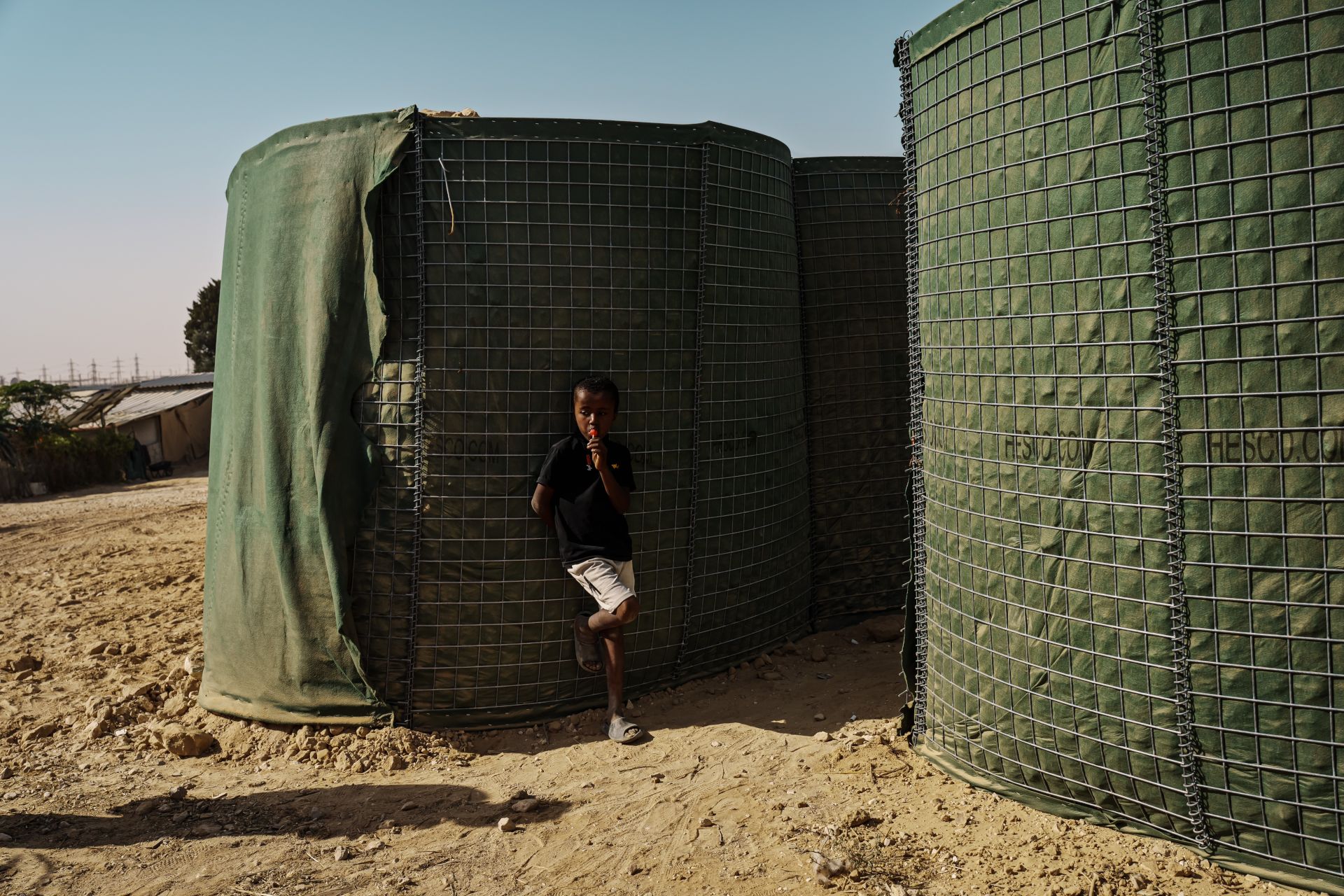
Hesco barriers are a type of defensive structure made from collapsible wire mesh and fabric containers filled with sand. I saw one of these in the unrecognized village of Umm al-Namil. The barrier stands slightly higher than a person. It has no roof and would not withstand a direct hit, but it can protect against shrapnel.
By contrast, al-Araqib has received no assistance from the state or the military. It is one of the most repeatedly demolished unrecognized villages, having been destroyed more than 200 times.
When I visited al-Araqib in early 2024, Aziz Sayeh al-Turi, 52, who is the son of a sheikh, showed me large concrete pipes. Concrete slabs had been placed at both ends. They were brought in to create an improvised shelter from rocket fire.
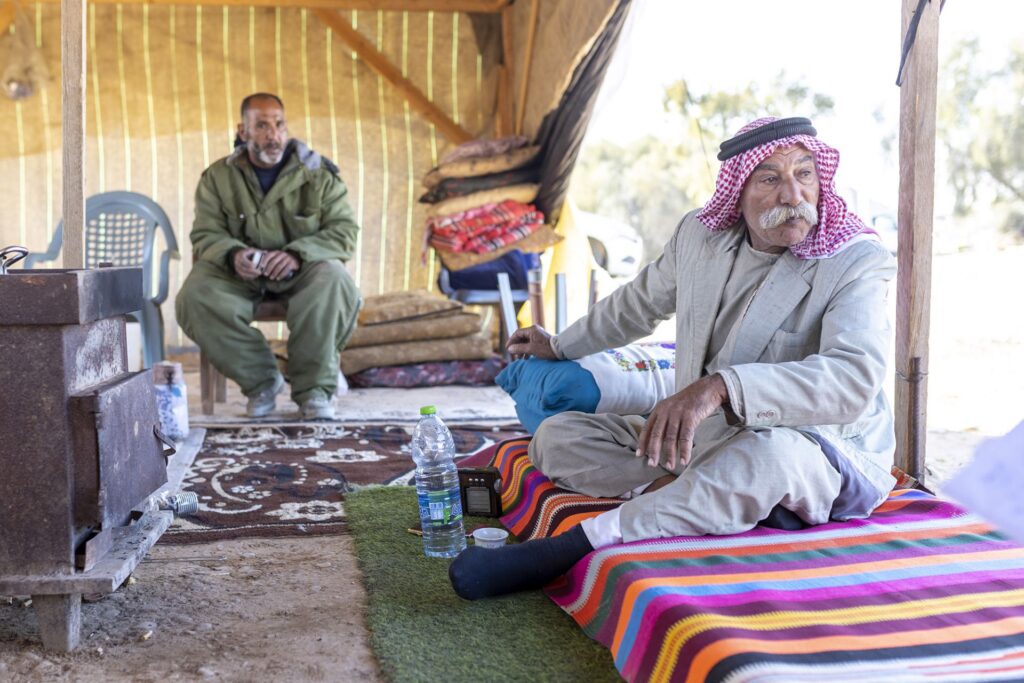
I contacted al-Turi again after the incident involving the injured doctor. He said nothing had changed in terms of protection. The village still has only those two concrete pipes.
Al-Sara occupies a middle ground. It has not been demolished hundreds of times, but it has not received state support either. A demolition order was issued against the village in 2006, but residents challenged it in court and won in two instances. After that, enforcement stopped. However, there are no plans to legalize the village.
Local residents receive water through a pipeline connected to a recognized Bedouin town. Internet access comes from there as well. Electricity is generated by solar panels during the day and stored in batteries for use at night. Wastewater is collected in septic tanks.
After the rocket fragment struck on March 24 and injured the doctor, all emergency services arrived in al-Sara, including police, paramedics and the Home Front Command — the Israeli military body responsible for civilian protection during war and emergencies.
“They helped us, and we thank them,” al-Nassara said. “But in the week since the rocket fragment fell, nothing has changed. In a village of around 600 residents, there are only two mobile shelters.”
The head of the local council considers this a clear case of discrimination.
“The lack of protective measures, the shortage of public shelters and the absence of adequate alternatives cannot be seen as a simple technical oversight. It raises serious concerns about negligence and even a failure by the state to uphold its duty to protect the lives of its citizens without discrimination,” al-Nassara said.
According to Yefet, even in villages that were officially recognized two decades ago, the situation is not much better. Basic infrastructure is still lacking, and there are no adequate bomb shelters. Around 40,000 people live under such conditions.
Overall, 92% of the Bedouins in the Negev — an estimated 300,000 to 360,000 people who are citizens of Israel — do not have access to shelters.
In Israel, protective infrastructure falls into three categories. These are safe rooms inside apartments, shared bomb shelters in residential buildings and institutions, and public shelters. The last group of shelters is the responsibility of municipalities.
According to the same January report by the State Comptroller of Israel, there are 11,776 public shelters in Israel. Only 37 of them are located in Arab communities, just 0.3% of the total. Eight of those 37 are in poor condition.
As of January 2025, 3.2 million Israelis — roughly 1 in 3 — did not have access to a shelter. A disproportionate number of them live in Arab communities.
“Arab municipalities have less funding for all types of infrastructure projects, and shelters are no exception,” said Uri Weltmann, 42, from Tel Aviv. He is one of the leaders of Standing Together, a grassroots Arab-Jewish civil society movement.
Many Bedouins from the Negev are involved in the organization. During the previous war with Iran, they reported coming under fire while lacking any protection.
“That’s when we launched a crowdfunding campaign to purchase standard concrete shelters,” Weltmann said. “Each can accommodate 15 to 20 people, roughly two large families.”
The group managed to purchase 20 shelters. After the outbreak of the current war with Iran, the campaign resumed. In recent days, activists set up their 12th new shelter in the village of Ras Jarab. They have funds for several more, which are expected to be installed soon.
In total, the nongovernmental organization has raised 1.3 million shekels — about $415,000 — from 6,300 donors. These include Jewish Israelis, Arab citizens of Israel and supporters abroad. Each shelter costs around 45,000 shekels, roughly $14,350.
Since these shelters are not enough for entire villages with hundreds of residents, they are usually placed in central locations, often near mosques.
Cheaper solutions were available — digging trenches or building shelters from sandbags — and could have protected more people. But the group chose shelters certified by the Home Front Command to avoid potential liability if anyone were injured.
“We understand this will not solve the shelter problem,” Weltmann said. “But it will highlight it and push the state to act. The problem is political. A few days ago, the Home Front Command began installing shelters, and that is a positive sign.”
“Right now, the Home Front Command plans to deploy 100 additional concrete shelters, but only in recognized villages,” Yefet said. “In addition, the municipalities that include these villages have received funding for about 270 more shelters.”
According to the organization’s estimates, there are currently around 400 shelters of various kinds in unrecognized villages. These include standard mobile shelters, improvised concrete structures and even shipping containers buried in the ground.
After the new measures are implemented, the total number is expected to reach 600 to 700. The actual need is around 15,000.
The state is well aware of the shortage of shelters in the Negev. On March 22, Prime Minister Benjamin Netanyahu visited the area, including the cities of Dimona and Arad, where dozens of people had been injured in an Iranian missile attack the day before.
In addition to his usual security detail, Netanyahu was accompanied by a truck carrying a mobile concrete shelter, which local residents managed to photograph. When he left, the shelter was taken away as well.
The truck driver told residents that the shelter had been borrowed from a military base and was now being returned.
There is another category of unrecognized communities in areas under Israeli control — settler outposts in the West Bank. Some are home to dozens of families, and the state does not build shelters there either.
“The state does not deal with this. We build shelters ourselves, with our own money. Sometimes private donors help us,” said Ester Allouche, spokesperson for the Samaria Regional Council, a settler organization.
The difference is that settlers are at least not prevented from building. Bedouins often are.
Al-Turi dug a shelter into the ground during the war. On one of the police visits, it was filled in again.
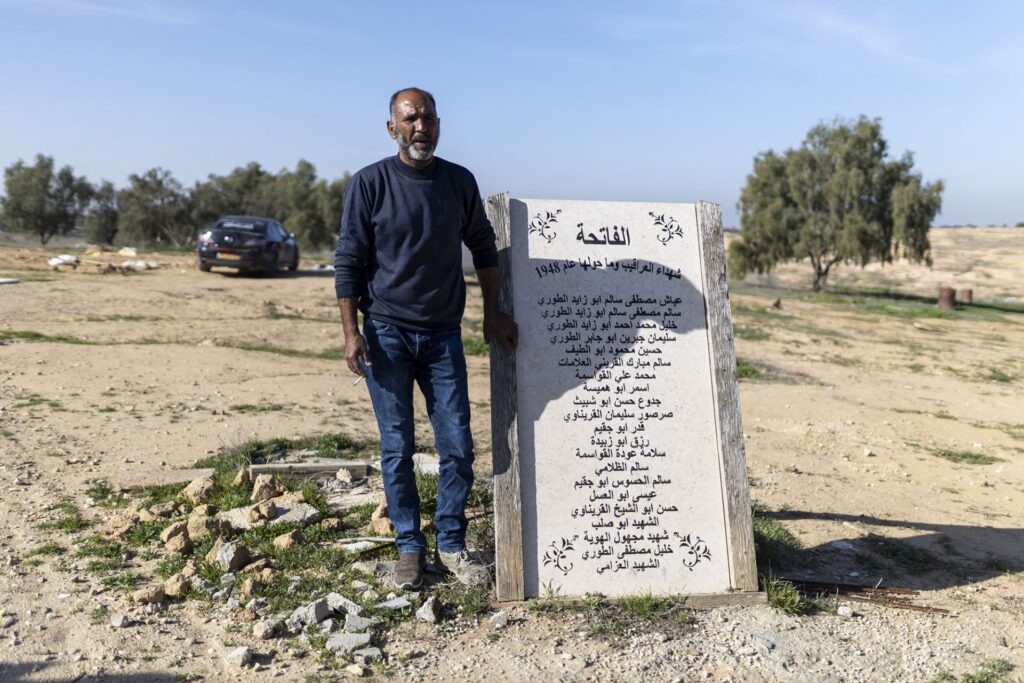
“One of the officers called over an inspector and asked, ‘What is this deep pit?’ The inspector then brought in a bulldozer operator and ordered everything to be covered up,” al-Turi recalled. “I shouted that it was for protection from the shelling, but they would not let me get near the bulldozer.”
Despite the restrictions, many residents try to build shelters on their own.
“But then the state comes and demolishes them as illegal structures,” said Rabee Alsam, 25, a coordinator for the Negev branch of Standing Together. “For example, my cousin was ordered to remove an earthen shelter.”
Yefet said that over the past year, improvised shelters have been destroyed in several villages.
“We do not expect the state to provide shelters for all Bedouins,” he said. “That would cost at least 600 million shekels. But we want people to be allowed to build shelters themselves.”
The most contentious issue concerns Israel’s air defense system. Before Oct. 7, Israeli media repeatedly reported that the Iron Dome and other systems treated unrecognized villages as open areas and did not intercept missiles above them to avoid wasting interceptors. After the war began, officials said interceptions were carried out across the entire country. But when asked directly about unrecognized villages, the Israeli military has not given a clear answer. It did not respond to a request from New Lines either.
“There are interceptions, but residents say that in practice missiles are seriously intercepted only around the Nevatim airbase and in the Be’er Sheva [Beersheba] area,” Yefet said.
Unrecognized villages do not even have air raid sirens. People rely on sirens from nearby localities or on mobile apps.
On Saturday, March 28, a fragment from an interception fell in the unrecognized village of Bir al-Mshash. Fortunately, no one was physically injured.
“But 12 Bedouin children were taken to hospital in shock after the attack. The next day, another 31 children and adults were hospitalized. The children are terrified. This is serious psychological harm,” Yefet said.
“It’s terrifying. It’s a nightmare. We’re very afraid,” said al-Turi, who is well into adulthood. “Yes, we hear sirens in the area, but we have nowhere to go. Either we stay in the car or go down into the wadi. It’s horrifying.”
When residents of al-Sara receive early warnings about Iranian attacks, many run to take cover under a bridge about 300 yards from the village, al-Nassara said. Others get into their cars and drive to villages outside the danger zone.
Rabee and his friends, however, often remain outside during attacks. They sit together, drink tea and watch where the missiles fall. Children are there as well. To keep them calm, Rabee and other adults say it is a big wedding and the explosions are fireworks. Rabee’s young niece watches the lights descending from the sky and dances.
“Spotlight” is a newsletter about underreported cultural trends and news from around the world, emailed to subscribers twice a week. Sign up here.