


The road from Raqqa to al-Hawl stretches across miles of desert, punctuated by a handful of shepherds’ houses. On the morning of Jan. 21, two military vehicles were driving along it at speed. Ahead of them, shapes scattered across the sand initially resembled trees. Only as the car drew closer did they resolve into bodies — more than 20 Syrian government soldiers, their corpses strewn across the desert. Burned-out vehicles lined the road, which is now used almost exclusively by military convoys, the remains marking the advance of Syrian forces toward the Hasakah countryside.
Syrian government forces and the Syrian Democratic Forces (SDF), the Kurdish-led coalition that had controlled northeastern Syria for a decade, had been fighting along shifting front lines. On Jan. 18, an agreement was reached providing for a phased SDF withdrawal. The al-Hawl detention camp changed hands on Jan. 20, but the facility was not transferred via a coordinated handover.
To reach the camp from this military road, one must turn onto a muddy shepherd’s path riddled with potholes. Checkpoints multiply as the camp approaches. Al-Hawl is regularly described as the world’s largest camp holding people presumed to be linked to the Islamic State group, with official numbers of around 24,000 detainees, mostly women and children, including approximately 6,300 foreign women and children from 42 different nationalities, until the SDF withdrawal.
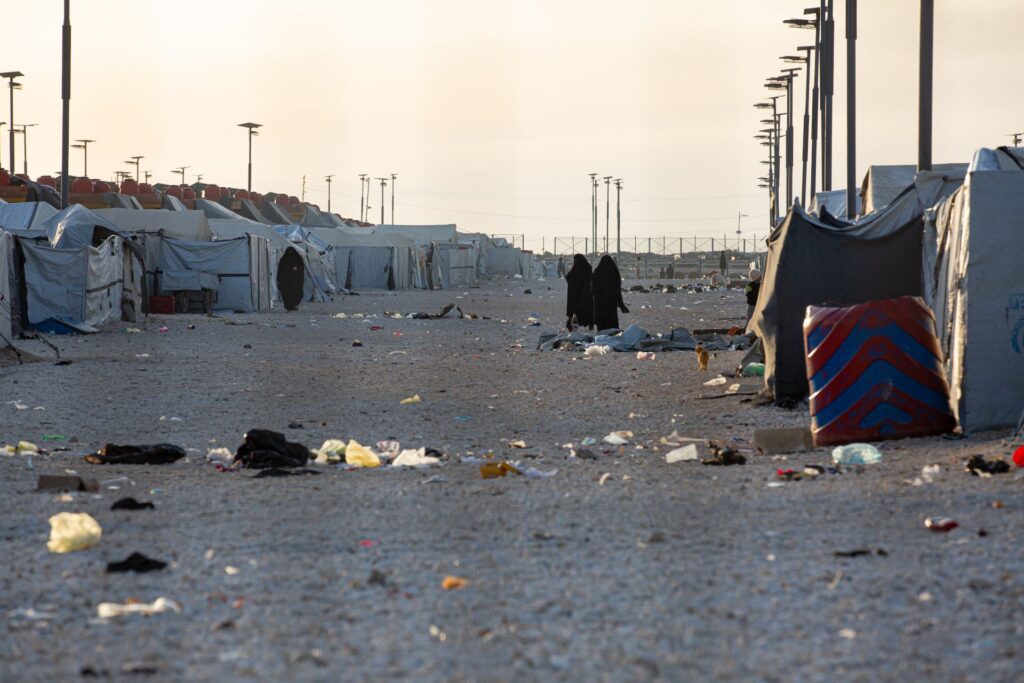
Three weeks after the handover, those figures no longer reflect reality. According to local sources and humanitarian actors, approximately 1,500 families remain in al-Hawl — down from 6,639 families recorded in the days before the SDF withdrawal. Entire sections now stand half empty. What was once a sprawling detention site housing tens of thousands has, in a matter of weeks, largely emptied itself. By mid-February, the foreigners’ annex — once home to 6,000 women and children — was almost entirely empty, with many families reported to have left for Idlib.
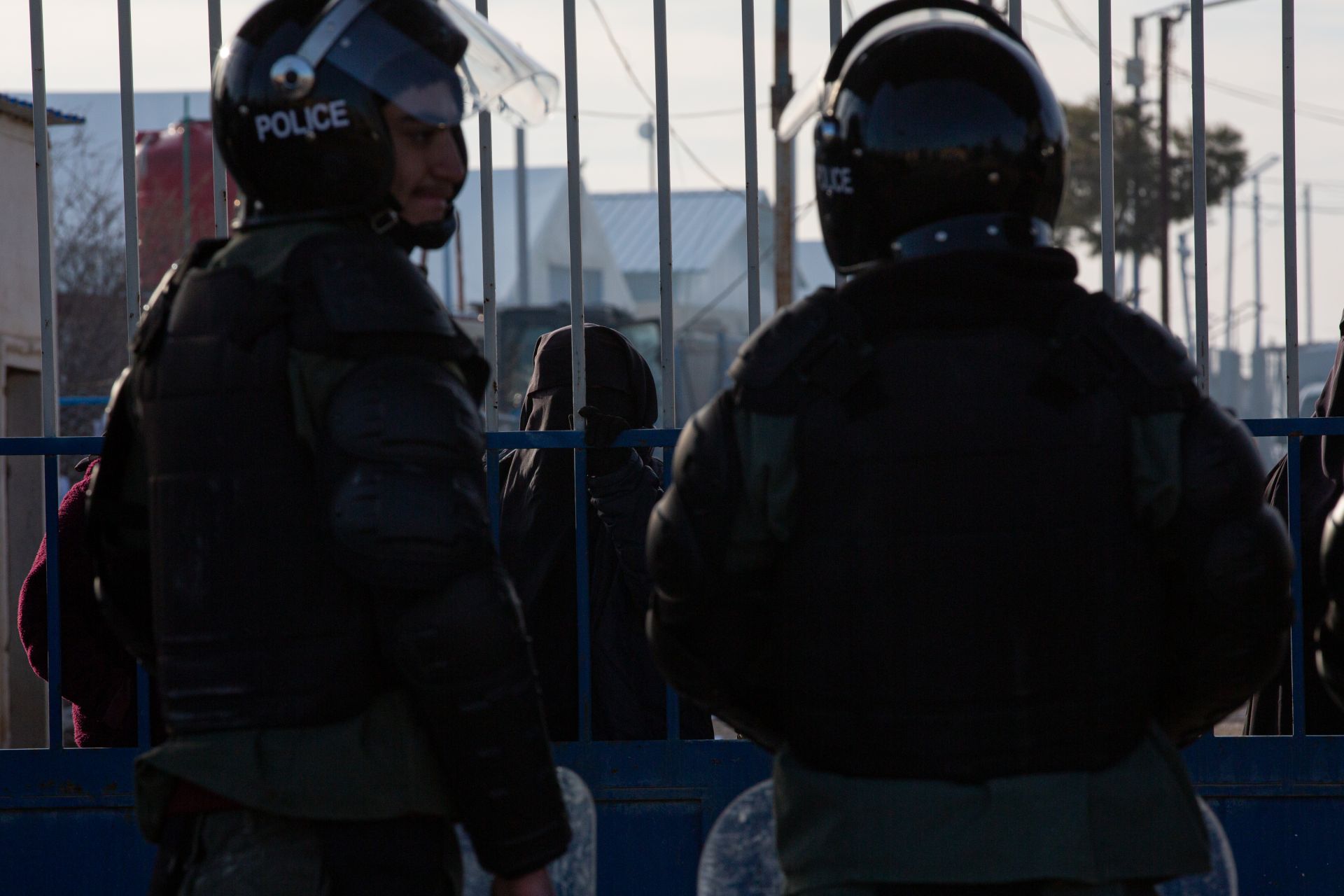
Inside the camp, the collapse of control could be felt immediately, even in the early hours of the handover. On the afternoon of Jan. 21, the day after the handover, Yahya, 18, pressed himself against a blue metal fence to speak.
“The SDF fighters left as government forces were approaching,” said the boy, who spent six years inside al-Hawl. “We jumped over the fence.” He returned, unwilling to leave his family behind. He said some of his neighbors were missing.
Control of the camp shifted in the early afternoon of Jan. 20. According to multiple testimonies, the last SDF soldiers left their positions between 2 p.m. and 2:30 p.m. The withdrawal was officially acknowledged later that day. At 4:08 p.m., the SDF announced they had been “forced to withdraw” from al-Hawl as part of a broader pullback east of the Euphrates.
At 4:14 p.m., the Interior Ministry said on its Telegram channel that the SDF had withdrawn from the camp “without coordination,” releasing detainees they had been tasked with guarding and placing “pressure on government forces.”
At 7:47 p.m., the Interior Ministry published photographs taken inside al-Hawl, stating that internal security forces were in control of the camp.
In the interim, residents said the camp had been left unguarded for several hours. The precise period during which the site was fully unguarded remains unclear, but multiple testimonies suggest that security was fragmented, with no consistent authority in place before Syrian government forces fully secured the site. By Jan. 26, several accounts confirmed what Yahya had described.
“We heard gunfire,” said Brahim, 26. He then saw three SDF snipers fleeing — the last to leave, he believed. “A military car picked them up and hit the barrier on the way out.”
Through the blue fence, Nasser, 14, described the scene: “I saw people leaving on motorcycles, in cars, at least a hundred. There were holes in the barrier. Ten motorcycles and two cars.”
Inside the camp, a man agreed to speak on condition of anonymity. He sat in what residents call the souk alley, lined with makeshift shops selling canned food, vegetables and currency exchange services. A flock of sheep passed as he talked.
“I saw people going through the hole, I estimate around a hundred escaped,” he said. “The SDF left between 2 p.m. and 2:30 p.m. I also had my car inside.” (Under the SDF, residents could keep motorcycles and vehicles inside the camp until 3 p.m.) “I hesitated. My whole family is here — either we all go together, or no one goes. … I also thought the government would release us.”
Nobody seems to know exactly how many people are still in the camp. Residents and aid workers alike question official figures. Escapes happened long before the handover, including under SDF control. “People have always left al-Hawl,” one source said. “The difference now is that the system itself is openly cracking.”
Residents described escapes under the SDF and an informal smuggling economy inside the camp, with some smugglers charging up to $3,000 per person. Several accused intermediaries of exploiting families, taking money or goods and failing to deliver what they promised.
Even before the scale of the departures became clear, signs of dissolution were visible. In several sections of the camp, families had begun packing their belongings — plastic bags, blankets, cooking pots — sensing that something was shifting. Some feared deportation. Others believed the authorities would soon open the gates.
What began as scattered escapes during the security vacuum has since turned into a sustained exodus. Zaher Abdel Hamid, organization coordinator of the Quality, Research and Development Organization, a nongovernmental organization that operates inside the camp, said that security forces remained in place but were overwhelmed. “There was security, but they were outnumbered. There was also a rumor that the SDF would return to oversee the camp. People inside began demonstrating.” According to his information, the largest wave of departures occurred between Feb. 12 and Feb. 13, between 3 a.m. and 6 a.m., as families slipped through breaches in the fence. Escapes took place day and night.
In a video obtained by New Lines, filmed in the early hours of Feb. 13, dozens upon dozens of people can be seen outside al-Hawl. The person filming says: “Anyone could have a car and take people. They are in the streets. Guys, come help some people. Look how many are walking without a car.”
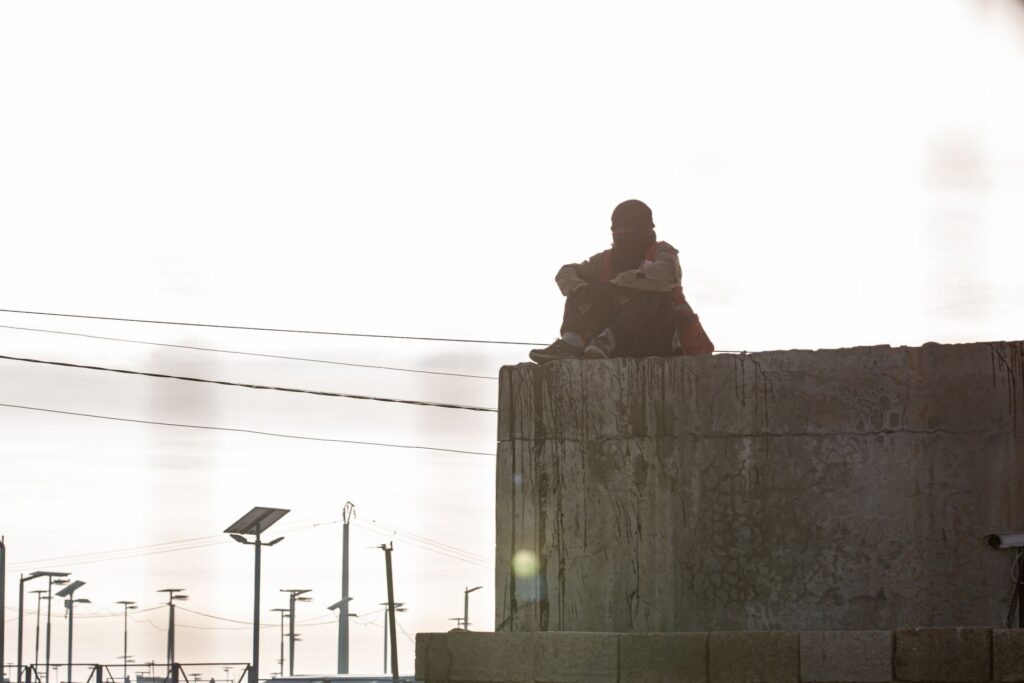
Several residents described what they called a deliberate “strategy of chaos,” particularly in the days immediately after the camp changed hands. Speaking from behind fences or with their faces partially concealed, they said that some inside the camp intentionally sought to make daily life impossible — not necessarily to escape immediately, but to force authorities to act.
“The idea is to make the camp unlivable so they have no choice but to transfer us,” one resident said.
On the afternoon of Jan. 21, fires broke out across multiple sections of al-Hawl, sending thick black smoke above the fences. While it remains difficult to establish responsibility for each incident, several detainees described the same logic. “At night, people want noise, smoke, chaos,” another resident said. “If the camp becomes impossible to control, they will have to move us.”
The consequences were immediate. Humanitarian workers say the handover pushed an already fragile system to the brink. Four days after the camp changed hands, a representative of the Arab Red Crescent was able to enter the site. “This is not even a neighborhood,” he said. “This is a city.” By Jan. 27, aid organizations said they were only able to provide bread to around 70% of the camp’s residents. Supply chains were disrupted, and several essential networks needed to be rebuilt. Humanitarian actors warned that the security vacuum was rapidly turning into a humanitarian emergency.
The authorities insisted that the camp was under control as soon as they secured it and did not acknowledge any escapes. A source speaking anonymously disagreed. “We only obtained a map of the camp on the third day. Of course there were escapes. The camp is massive. Detainees know it by heart.”
He added: “I don’t understand why they say we fully control the area. It’s not shameful to say we didn’t fully control it for two or three days. No one could have.”
The unrest that followed in the days after the handover appears to have accelerated the camp’s dismantling. Authorities confirmed that the remaining 1,500 families would be relocated to Akhtarin camp in northern Aleppo province. The first convoy is expected imminently. For many residents, the announcement confirmed what weeks of uncertainty had already suggested: al-Hawl is effectively over.
Abu Ahmad, 60, wearing a red turban and using crutches, said he knows people who escaped.
“Some of those who fled are safe now,” he said, referring to two neighbors. “But they live in constant fear of being deported to Iraq or arrested.”
He chose not to flee. “I’m not part of the Islamic State. But outside, you’re not free if your record isn’t clean. I hope we’ll be released legally.”
Iraq has said it will take back its nationals held in Syria and prosecute those suspected of Islamic State ties under its counterterrorism laws — a prospect that fuels fear among detainees inside the camp.
Outside al-Hawl, resentment is palpable. In the village nearby, Jamal Abu Khaled, who runs a small falafel stand, said: “The camp was built on private land. I own 350 dunams [86 acres] here. I’ve lived here my whole life. I still have the deeds. I hope they dismantle the camp and give me my land back.”
In surrounding villages, many residents describe al-Hawl as an imposed presence, often referring to detainees as “brothers” and “sisters.” Hostility toward the existence of the camp — and toward those who administered it — is widespread. “They used to say the camp was a ticking bomb,” Jamal scoffed. “The camp is nothing. The SDF were the bomb.”
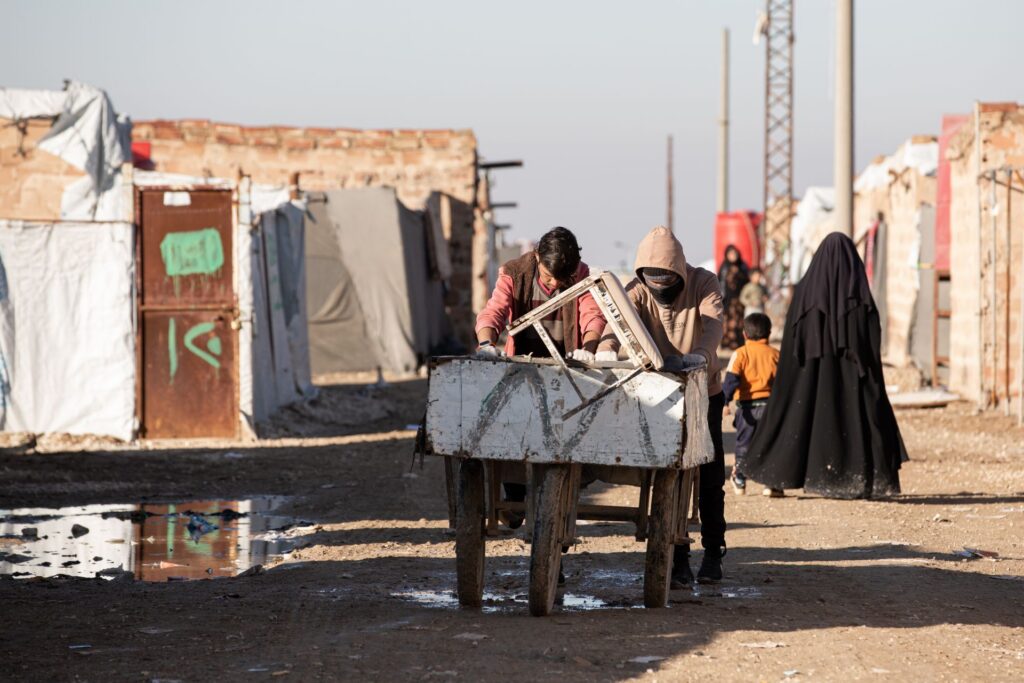
Inside al-Hawl, children roamed freely. Four boys played nearby. One lifted a metal pipe like a weight. Two others fought with iron bars while a guard tried to stop them. “Residents from the nearby village came to visit us,” one child said. “They took us to pray at the mosque, then brought us back.”
Several guards spoke only off the record, lowering their voices. “This mission is too cruel,” a senior guard confided. “Seeing children behind these fences — I want to be reassigned.” As three women tried to escape through a hole, a soldier said: “My sister, we will find a solution. You will leave, but not like this.” For many, al-Hawl has come to symbolize what they see as an unjust form of mass detention.
At 3 p.m., the call to prayer echoed across the camp. Two women in full black niqab walked together. Full-face veiling is the norm in the camp. Um Omar, an Iraqi woman in her 50s, arrived in al-Hawl in 2019 after fleeing Baghouz, the last territory held by the Islamic State in Syria before its defeat. She runs a small shop out of a tent in the camp’s souk with her friend Um Abdelrahman.
When asked about Baghouz, both women light up. “Baghouz,” Um Omar repeated with a smile. “Is it still like it was?” She spoke of green land, a river, and Syrians who welcomed her and treated her as an equal. “I lived there as if it were my town,” she said. “We still have sisters from there.” She did not mention the violence that defined the place. Her story is one among thousands that converged on al-Hawl after the fall of Baghouz.
Originally established in the early 1990s to host Iraqi refugees, al-Hawl was never designed as a detention site. “The population of al-Hawl is primarily civilian,” said Arthur Quesnay, a political scientist and Syria expert. “The camp was initially created to host displaced people, particularly Iraqis fleeing the war, before the Islamic State began exerting ideological control over parts of the population of the camp from 2021 onwards.”
It later absorbed civilians fleeing areas controlled by the Islamic State and, in 2019, following the fall of Baghouz, became a detention site for families suspected of ties to the group. Today, the camp brings together a wide range of profiles from displaced civilians to family members of the Islamic State.
Its transformation into a detention site was gradual and improvised, and it has operated for years without a clear legal framework — with many families held for prolonged periods without facing formal trial.
Since then, the camp has provided fertile ground for Islamic State indoctrination. The day after government forces advanced toward al-Hawl, the Jan. 21 edition of Al-Naba, the Islamic State’s propaganda newsletter, portrayed detention sites as spaces of ideological resistance and urged detainees to remain patient.
Inside the camp, where the newsletter circulates, this narrative still finds echoes. “The detention system at al-Hawl is not effective in preventing the Islamic State threat. On the contrary, it keeps populations captive, turning them into easy prey for jihadist ideology,” Quesnay said.
The security vacuum that followed the handover revived concerns about potential breakouts from detention facilities holding suspected Islamic State members elsewhere in northeastern Syria. During the handover at al-Shaddadi prison, around 120 male detainees presumed to be linked to the Islamic State escaped; most were later recaptured.
Similar scenarios have occurred before. In January 2022, Islamic State fighters stormed the high-security Ghuwayran prison in Hasakah, enabling the escape of around 500 detainees.
Yet some analysts caution against drawing direct parallels. “The contradictions that made ISIS possible are no longer there,” Quesnay said, referring to the fragmentation of territory, porous front lines and rival authorities the group previously exploited. “At the time, fighters could still cross the Euphrates. That is no longer the case if the Syrian state effectively controls the territory.”
In an effort to reduce the risk of further instability during the transition, the United States began transferring detainees deemed high-risk to Iraq in late January. According to U.S. officials, about 3,000 Islamic State detainees have already been moved to Iraqi prisons, with a further 4,000 expected to follow in the coming days. An estimated 9,000 men suspected of links to the Islamic State had previously been held across detention facilities in northern Syria.
On the night of Jan. 26, according to local sources in al-Hawl village, groups of relatives and tribal members attempted to breach the camp in an effort to free detainees. Syrian government forces intervened and regained control. The incident was not publicly disclosed.
At the time, few inside or outside the camp believed it could last in its current form, rejected by those who guard it and those who live around it.
On Jan. 30, Syrian authorities announced plans to gradually close camps housing people suspected of links to the Islamic State, including al-Hawl.
A source described a gap between official statements and what unfolded on the ground. “Officially, the state never said it would free al-Hawl. They spoke about conducting a census,” the source said. “But there was no serious attempt to stop people from leaving either.”
According to several accounts, departures were not actively obstructed. Buses entered the camp in broad daylight to collect certain nationals. Foreign fighters were reportedly present as communities took charge of their own. “The Uzbeks took the Uzbeks,” one source said. The annex housing foreign women and families was vacated particularly quickly.
Al-Hawl’s detainees were not formally released. The camp was allowed to empty.
“Spotlight” is a newsletter about underreported cultural trends and news from around the world, emailed to subscribers twice a week. Sign up here.