

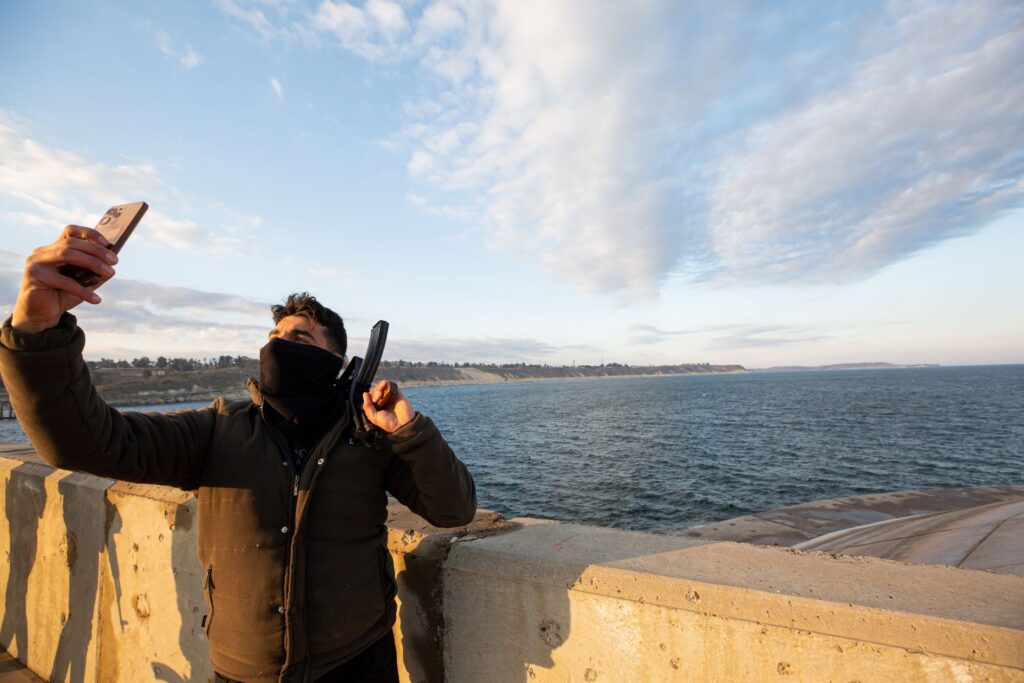
At dawn, by the blue waters of the Euphrates, hundreds of military vehicles streamed toward the Tabqa Dam. Dozens of soldiers stopped to take photos, posing in uniform as a sign of victory. A few hours earlier, on Jan. 18, Tabqa and, soon after, Raqqa had fallen to Syrian government forces.
“The last time I came to Raqqa, it was on a school trip. Today, I’m coming to liberate it,” said Abu Khaled, 33, a soldier from the Syrian army’s 82nd Division, one of the regular units mobilized by Damascus during its push into areas of northern Syria formerly held by the Syrian Democratic Forces (SDF).
On the road, a soldier embraced a man in tears. It was his brother. They had not seen each other for years. Until now, the cities of the region had been under the control of the SDF — a Kurdish-led coalition that, with backing from the U.S. and other international partners allied against the Islamic State, had served as the de facto administration in northeast Syria after the jihadist group’s defeat.
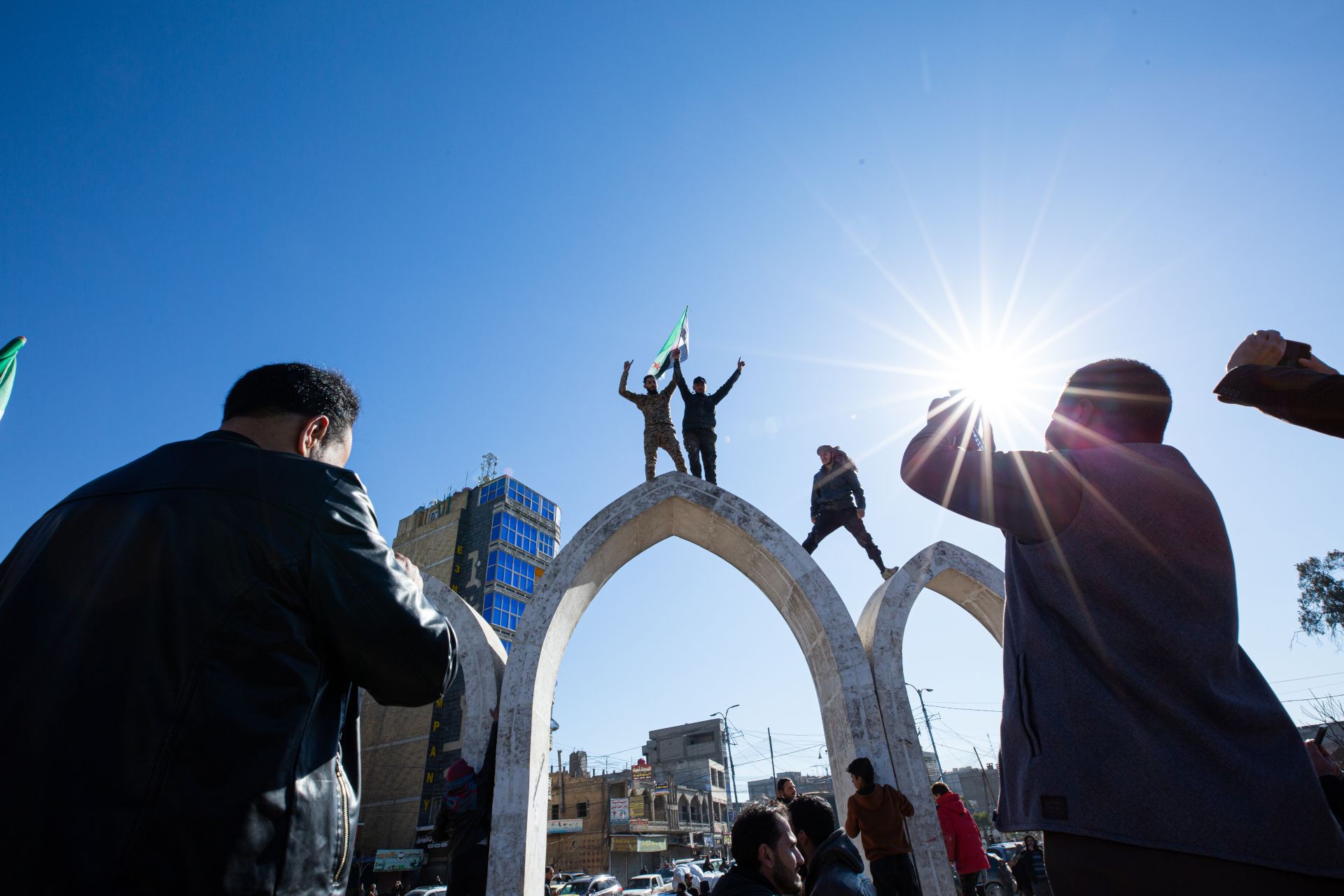
The following day, on Jan. 19, groups gathered at al-Naim Square, in central Raqqa, to celebrate what they called the “liberation.” Gunfire rang out without pause. Many shops remained closed. The smell of burned powder hung in the air.
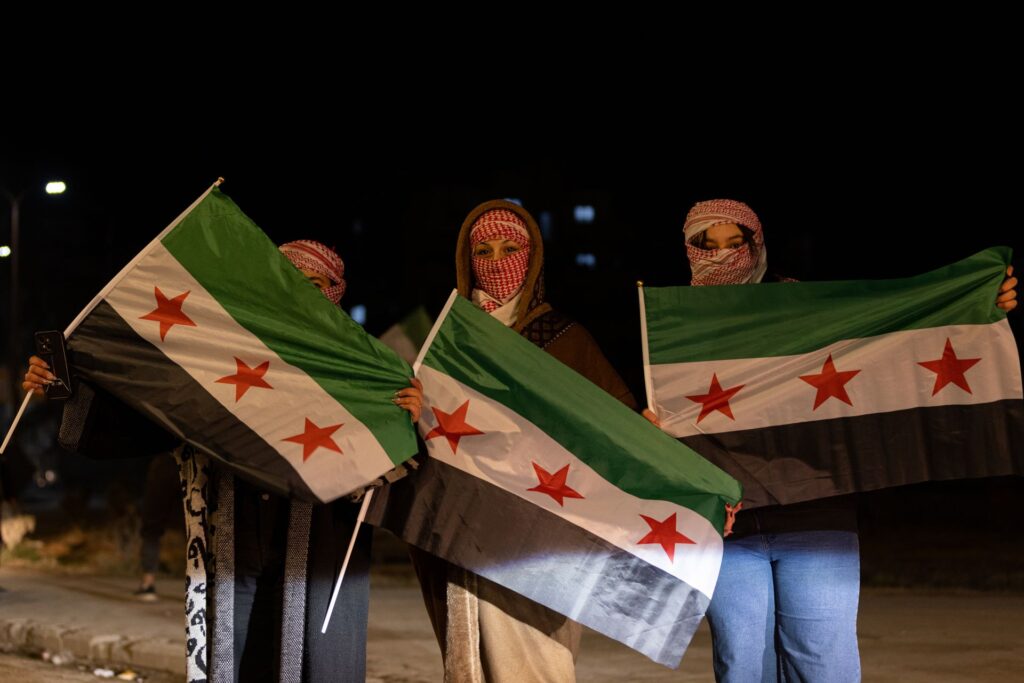
Celebrations on Dec. 8, the anniversary of Bashar al-Assad’s fall, had been banned by the SDF, officially for security reasons. A predominantly Arab city, Raqqa now felt like it was experiencing the delayed cacophony of that day. People talked over one another, waving the Syrian flag. “Where can I find one?” a resident asked. Hundreds danced dabke in the city’s squares.
Ahmed al-Boch, 33, had tried to celebrate on Dec. 8. He was arrested. “We just wanted to celebrate the end of the regime. It was our right,” he said. He spent a day and a half in detention instead. Yet this day, he was able to dance. “For the first time, I feel like I belong to this country.”
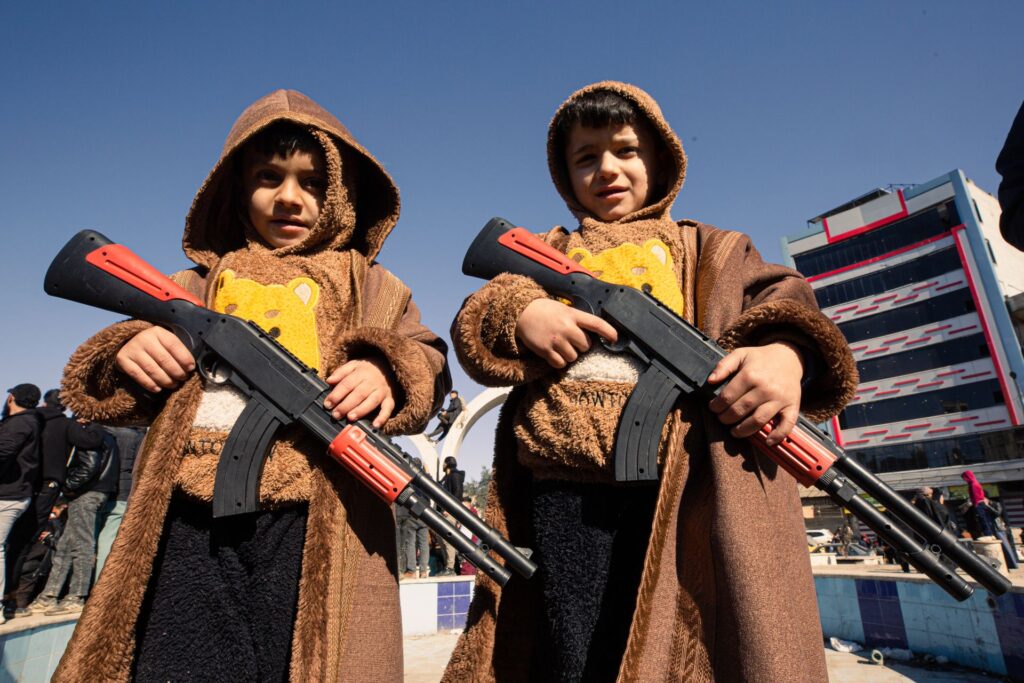
Around him, children waved flags and carried toy weapons in their arms. A 70-year-old woman said she did not sleep all night, out of “too much joy.” Draped in a violet robe, she repeated a refrain as she stood among a group of men: “Thank God. Thanks to those who liberated us, thanks to our brother Ahmad al-Sharaa.”
For many here, the celebration was not only political. Abdulmajid Tuma, 45, from Raqqa, said, “We felt like fourth-class citizens.” Around him, the city was loud again. Men shouted, “God is great.” Cars drove past slowly, Syrian flags hanging from the windows. Celebratory gunfire cracked in the air. Tuma described what he considered systemic discrimination under the administration of the SDF. “Raqqa is 95% Arab,” he said. “Yet we had no power.”
According to Tuma, access to positions and responsibility was closed off. “The resources were here — oil, agriculture — but the situation stayed poor.” He insisted that his community was marginalized based on its ethnic identity. “As Arabs, if you were not with them, you had no rights,” he said.
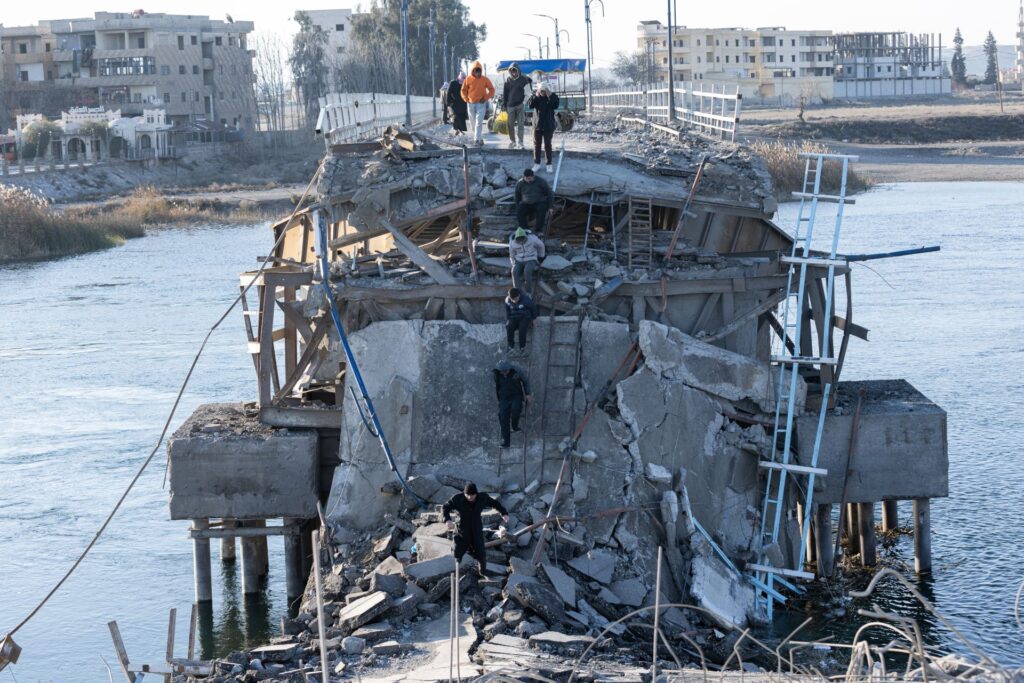
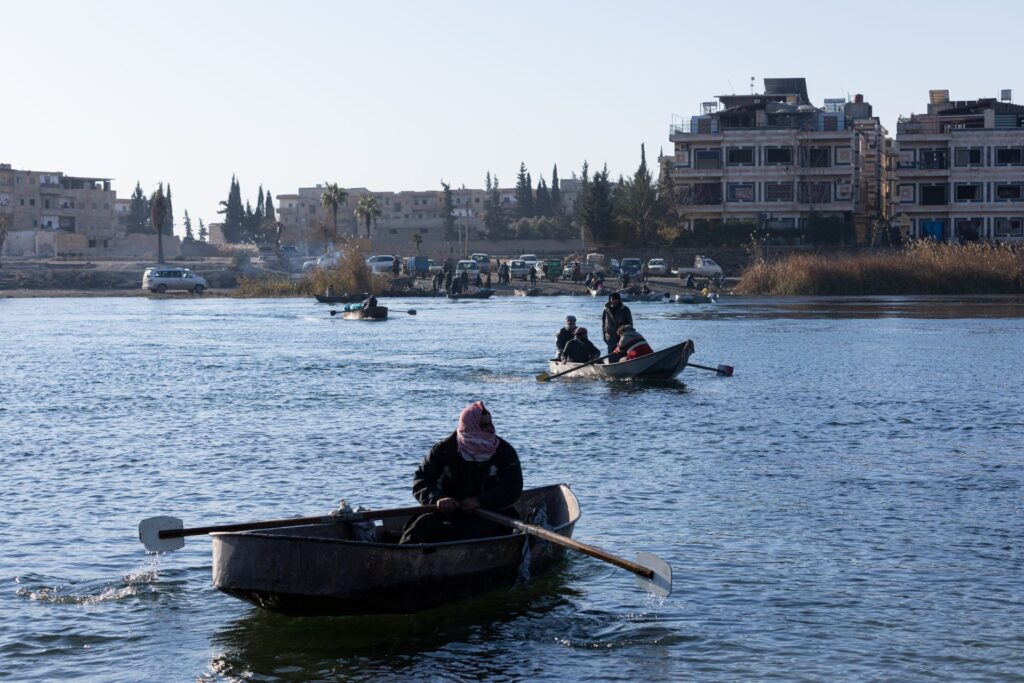
Behind the celebrations, the humanitarian situation remains fragile. In the countryside around Raqqa, several pieces of infrastructure were damaged during clashes. On Jan. 18, as Syrian government forces advanced, a bridge across the Euphrates was bombed by the SDF. On the morning of Jan. 20, Abu Hussein, 32, green-eyed and wearing a dark brown turban, steered a small boat across the water. A fisher by trade, he now ferries people and goods from one side to the other, trying to bring vegetables and chicken into the city. “The old bridge was destroyed,” he said. “Now we cross by boat.”
He said he felt discriminated against as an Arab under the SDF administration. His cousin had been detained for a year on the accusation that he belonged to the Islamic State group — charges that he said were easily made, often without proof. “Here, accusations come fast,” he said.
Hundreds of members of Raqqa’s Kurdish community have left the city. A Kurdish neighborhood known as “the northern belt” remains unsecured, blocked by military checkpoints. Those who stayed keep a low profile. Kurds once made up roughly a quarter of Raqqa’s population. Kurdish symbols have been removed — a yellow Kurdish flag lies on the ground as a child spits on it and stamps it underfoot.
In a secluded office, a Kurdish notable who has lived in the region for more than a decade agreed to speak anonymously. Sitting in front of surveillance screens, he smoked one cigarette after another as gunfire echoed outside. His voice broke as he referred to the toppling of a statue of a fighter from the all-female Women’s Protection Units, the militia known as the YPJ — a symbol of Kurdish self-rule. He called it a “barbaric action.” He said he believed negotiations with Damascus could succeed. When asked about those who fled in recent days, friends and colleagues, he cried. “Many left because they had nothing left to fight for,” he said. He chose to stay. “I did nothing wrong. I shouldn’t be afraid.”
Still, he fears reprisals against Kurdish civilians, fueled by rumors and disinformation. “What happened in Sweida or along the coast, he said, could happen again elsewhere, and they would call it isolated incidents,” he said, referring to communal and sectarian violence after the regime’s fall in those areas.
Using the Kurdish name for the region that had been under self-rule, he insisted that the Rojava project — formally known as the Democratic Autonomous Administration of North and East Syria — was never about secession. “I’m Syrian and Kurdish, I want federalism,” he said, the sounds of ambulances and gunfire occasionally drowning out his words.
On the SDF’s official WhatsApp channel, there was 24 hours of silence as government troops advanced on Raqqa and Tabqa. Then an agreement was announced by Damascus and SDF commander Mazloum Abdi, described as an effort “to avoid a bloodbath.”
The agreement is laid out in 14 clauses. It establishes a nationwide ceasefire and formalizes the transfer of Raqqa and Deir ez-Zor provinces to the Syrian state. Civil and security institutions in Hasakah are to be folded into the central state apparatus. Border crossings, oil fields and gas facilities revert to Damascus’ control.
Kurdish forces are to be absorbed individually into the defense and interior ministries, not as a unified force but on a case-by-case basis. The Kurdish-majority city of Kobane retains limited local autonomy, which does not extend to the broader region. The Syrian state has committed to assuming responsibility for prisons and camps holding Islamic State fighters and their families, and to facilitating the return of displaced Kurds, particularly to Afrin and parts of Aleppo. In exchange, Kurdistan Workers’ Party cadres and fighters are required to leave Syrian territory.
“For me, it’s not the end of Rojava,” the Kurdish notable said. But the agreement effectively marks the end of the autonomous administration in northeast Syria, without constitutional recognition of Kurdish status. In Raqqa’s streets, as the gunfire faded, a soldier wounded in the leg walked past civilians on the sidewalk, returning from the front.
On the afternoon of Jan. 20, at a press conference held in a central Raqqa hotel, the city’s newly appointed mayor, Abdulrahman Salameh, insisted on Kurdish rights and “equal treatment for everyone.”
In a country where Kurds represent around 10% of the population, one resident of Hasakah, the Kurdish stronghold, described a city holding its breath. “Hasakah is home to Armenians, Assyrians, Kurds, Yazidis and Arabs who have lived together despite years of war,” said Patricia, 22, an Armenian resident and media worker. “Until now, the autonomous administration and the SDF provided protection. What comes next is uncertain — especially after reports of massacres along the coast and in Sweida.”
While Raqqa dances, Hasakah waits, as Syrian government forces advance in the countryside. Despite the ceasefire agreement, calls for general mobilization are circulating on the Kurdish side, and sporadic clashes are taking place.
“Spotlight” is a newsletter about underreported cultural trends and news from around the world, emailed to subscribers twice a week. Sign up here.