


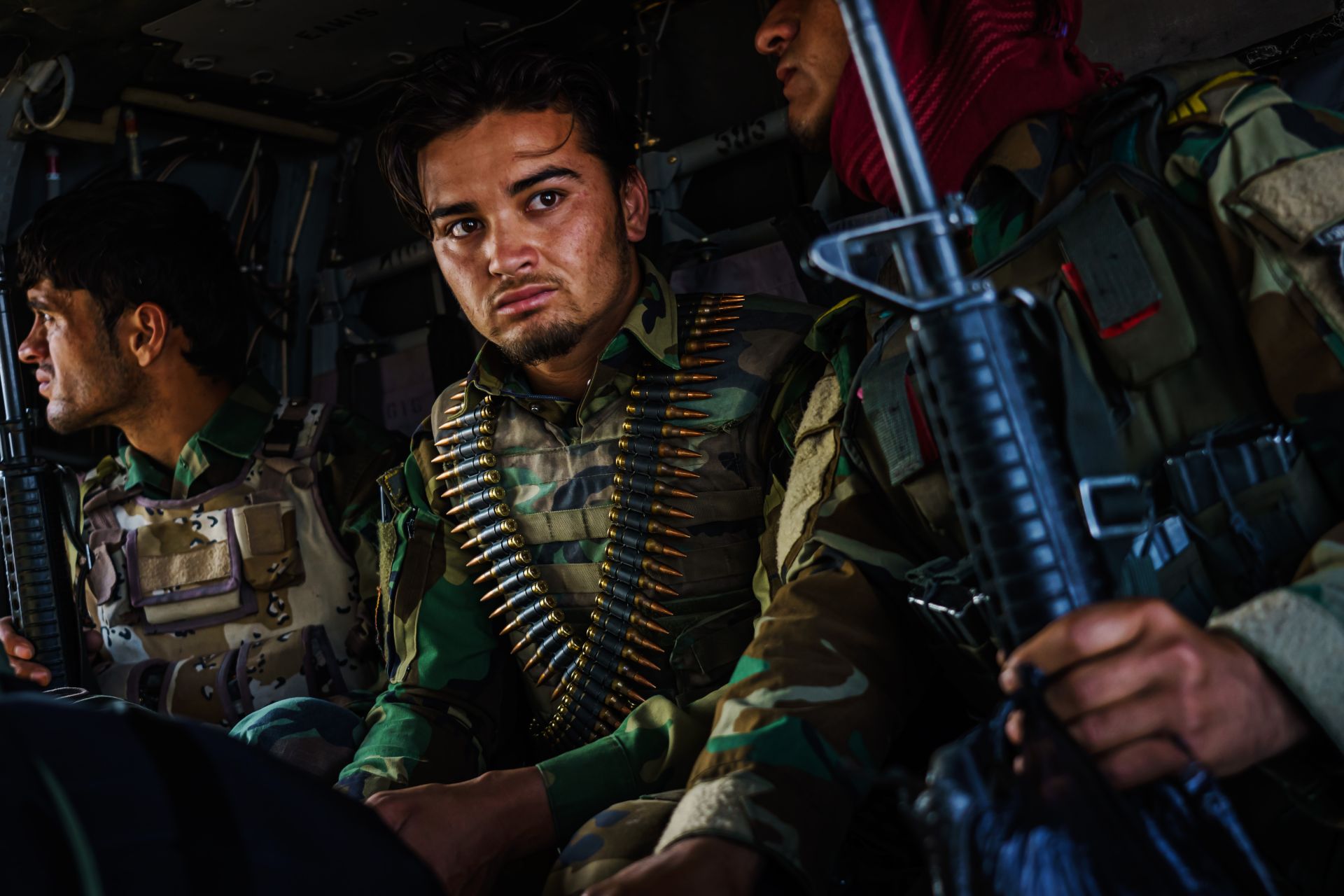
On the eve of Thanksgiving last year, Rahmanullah Lakanwal, a 29-year-old Afghan who had once served alongside U.S. Special Forces, drove across the United States and opened fire on two National Guard members posted near the White House, killing one and critically wounding another. Authorities described the attack as an ambush. Lakanwal himself was injured during the shootout and taken to hospital. He is now facing a first-degree murder charge with the death penalty on the cards. The Donald Trump administration is reportedly still mulling deporting his wife and children back to Afghanistan while visas for Afghan nationals, including those who served alongside U.S. forces, remain suspended.
Initially, the shooting appeared to fit the pattern of a lone-wolf attack connected to the Islamic State group. But as investigators delved deeper into Lakanwal’s past, a different, more confused picture emerged — one that cuts to the very heart of America’s decades-long war in Afghanistan and the parallel security structures it built there. The truth was that Lakanwal was one of America’s own. His fellow commandos were so trusted that they served alongside Green Berets, and so formidable that the Taliban demanded they leave — all 10,000 or so of them — following the conquest of Kabul in 2021.
Lakanwal had served with one of Afghanistan’s most elite and secretive paramilitary formations, the Zero Units, which were developed, funded and directed by the CIA. A senior official from Afghanistan’s National Directorate of Security (NDS) put it plainly: “They were part of NDS only on paper. They were recruited, financed, trained and directed by the CIA. Even the background checks were done by the Americans.”
As a young recruit, Lakanwal joined Zero 3, the Kandahar-based strike unit, around 2011, when he was just 16. Over the next decade, the young man participated in night raids, intelligence collection and counterinsurgency operations across southern Afghanistan. He was also among the forces that helped secure Kabul airport during the chaotic U.S. withdrawal in August 2021. He and his family left when the Afghan republic collapsed with the departure of its last president, Ashraf Ghani.
Yet life in America did not go well. He went from being in a highly trained military unit to menial work and struggling to hold down a job or learn English in supplementary classes. In Afghanistan, he was respected; in America, he was nobody. Some characterized him as a joyful, solitary figure who played Call of Duty and FIFA. His case worker described him as a manic depressive whose mental condition had deteriorated. He holed up for days in a lightless room. He drank and underwent dark phases of suicidal depression, with long, purposeless drives to nowhere. Many suspected post-traumatic stress disorder.
“Many of our comrades were struggling with depression and feeling hopeless,” said Nasir Andar, a Zero Unit veteran. Suicide was common among Afghan commandos, added Gen. Mohammad Shah, a former commander. Did Lakanwal finally crack when he carried out his attack? Or perhaps he was a symptom of a deeper dysfunction? Was he a product of the political and moral entanglement between the United States and the Afghan republic? To understand how a teenage recruit from Kandahar became part of one of the most secretive forces in the U.S. war in Afghanistan, one has to understand the unit itself — and the shadow system that created it.
The CIA has been active in Afghanistan for nearly five decades: from the Texan Rep. Charlie Wilson facilitating the CIA-led Operation Cyclone, arming the mujahideen with Stinger missiles in the ’80s, to CIA spymaster Cofer Black’s Jawbreaker team turning up in northern Afghanistan with a fistful of dollars, 1 million to be exact, offering it to Northern Alliance commanders following 9/11 with instructions to put Bin Laden’s “head in a box.”
The Afghan National Strike Unit to which the Zero Units belonged was heir to that history. Media reports have likened the unit to a new iteration of the Phoenix Program from the Vietnam War era, designed to neutralize insurgents and civilians with little accountability and few constraints. The units, spread across Kabul (Zero 1), Nangarhar (Zero 2) and Kandahar (Zero 3), along with others directly under NDS control, acted swiftly in their Toyota Hiluxes, collecting intelligence and carrying out counterinsurgency operations, sometimes crossing ethical and legal guidelines. They were effective but also left a trail of unjustifiable mistakes and dead bodies.
Human Rights Watch and journalists documented numerous abuses. By 2013, Hamid Karzai, the then-president of Afghanistan, was incensed by the actions of CIA-backed paramilitaries. Under President Barack Obama, their 3,000 members acted with little oversight from Kabul and, in one incident, 10 children were killed. But it was difficult for Karzai to remain indignant for long. After all, he himself was embedded in the system — his own half-brother was paid by the CIA for his services.
Of course, the mounting civilian casualties and the culture of impunity were a propaganda gift for the Taliban, too. “Yes, mistakes happened. Civilian casualties were real and tragic,” the last national security adviser, Hamdullah Mohib, told me as we worked on his memoir, “Shadows Over Kabul: An Insider’s Account of the Fall of the Afghan Republic.” At the same time, “the Taliban’s accusations were part of a broader strategy to discredit some of the republic’s most effective fighters, again chipping away at morale.”
These abuses weren’t only moral failures; they also carried political consequences. By the late 2010s, the Zero Units were no longer just a battlefield instrument — they had become a fault line running through the Afghan state itself. In fact, the actions of Zero Units had direct consequences for Ashraf Ghani’s government, too. When four much-loved brothers were killed by a Zero Unit in Jalalabad in 2019 on the pretext that they belonged to the Islamic State group, Ghani demanded evidence from then-NDS chief Masoom Stanikzai. The latter couldn’t provide the evidence, and Ghani sacked him, saying that he had “zero tolerance for civilian casualties.”
Ahmad Zia Saraj — “a younger and reform-minded” NDS chief, according to Mohib — was appointed by Ghani. “When Ghani appointed him,” Mohib recalled, “he stressed that what he was aiming at was generational and institutional change, and Saraj was to exemplify that.” But by then, perhaps, it was too little, too late. A parallel system constructed and empowered by Washington had entrenched itself in the republic and hollowed out the state. It became impossible to separate the government and the structure created by the CIA. They were knitted together not just at a military level but in the very way the whole republic was configured.
Nowhere were these contradictions more evident than in Kandahar, where Lakanwal himself came of age. Kandahar was the symbolic heart of Afghan rule, where Afghan kings once sat. What happened there was a reflection of how the country was governed. It was also the domain of Gen. Abdul Raziq, the most powerful and contentious figure in the republic’s security order. As Mohib put it, Raziq “wasn’t a protector of the republic — he was its contradiction.”
Following the killing of Mujahid Khan, Raziq became the police chief of Kandahar, and was touted by the U.S. military brass as their man. As Mohib said, he was the Taliban’s most “fearsome opponent,” driven by a thirst for revenge because his father and uncle had been killed by the group.
As the former commander of Joint Special Operations Command, Gen. Sami Sadat, said, “Raziq’s name meant courage, pride and successful mission to his friends and our citizens and meant stone wall to terrorists.” To other Afghans, as Mohib told me, “he was a ruthless warlord, an obstacle to reform, and a symbol of everything the republic was supposed to overcome. The tragedy was that both assessments were true.” At 22, young Raziq returned and joined forces with the U.S.-backed warlord Gul Agha Sherzai to retake Kandahar.
Over the next two decades, Raziq rose through the ranks, leveraging his tribal base, his charisma and his brutal efficiency. “He aligned himself with powerful figures, who protected him when he was accused of personal involvement in killing 16 men from the Noorzai tribe. He allegedly tortured and executed tribal rivals, ran private prisons and oversaw a sprawling smuggling empire that earned him millions. He was said to make $6 million a week and own properties in Kabul, Kandahar, Dubai and other far-flung places, all while backed by the U.S. “To the Americans — especially the CIA and U.S. military — he was indispensable,” Mohib said. “They saw him as a bulwark against the Taliban. And because of that, he operated with near-total impunity.”
Instead of building institutions, and despite U.S. law banning the government from funding foreign military outfits accused of human rights violations, Washington and the CIA continued to fund and back him under the Bush, Obama and Trump administrations. These presidents followed in the footsteps of Franklin Roosevelt when he turned a blind eye to an unsavory dictator: “He may be a bastard, but he’s our bastard.”
They didn’t care how it harmed the republic or ordinary Afghans, and in many ways his unchecked power undermined the republic. “The message was clear: Strength, not service, earned rewards,” Mohib said. “People didn’t fight for the republic because they couldn’t distinguish it morally from its enemies. The Taliban committed atrocities — but so did the men we tolerated in the name of security. What was the difference between us and them?”
The contradiction of Raziq reached its breaking point in October 2018. A 17-year-old Taliban infiltrator, posing as one of Raziq’s elite guards, opened fire during a meeting with U.S. Gen. Scott Miller. Raziq was killed on the spot. The assassin had trained in Pakistan for months. The Taliban celebrated. And in Kandahar, the political aftershocks began. “As for us,” said Mohib, “we portrayed Raziq as a martyr in public — a nationalist who stood firm against Pakistan. Politically, it served us. But privately, we were relieved. His death opened a window to reform. But it was a window we were unable to keep open.”
Raziq’s killing exposed a deeper truth: The Afghan republic had become dependent “on personalities rather than institutions,” Mohib said. “It revealed how foreign pressure could override sovereign decisions. And it laid bare the republic’s greatest vulnerability: Our narrative was not just challenged by the Taliban — it was hollowed out from within. We weren’t just losing the war. We were losing the meaning of the state itself.” The existence of these parallel structures meant that the Afghan republic lost its national story, and that is ultimately why it fell.
It was this world from which Rahmanullah Lakanwal emerged — shaped by a parallel system that undermined the very institutions it claimed to defend. “It sent a message,” Mohib reflected, “that power resided not in institutions but in proximity to foreign patrons.” The United States itself reinforced the pattern: opening dialogue with the Taliban without consulting Kabul, controlling the republic’s finances, and enabling actors like Raziq and the Zero Units even as it encouraged democratic state-building and human rights.
Although Lakanwal is facing a first-degree murder charge and possibly the death penalty, investigators have still not established a definitive motive. We know that the perpetrator was a product of the parallel order that rewarded loyalty, blurred legality and collapsed the line between Afghan and American command. When that world imploded in 2021, Lakanwal carried its ruins with him to the United States. When he fired on National Guard members near the White House, the tragedy was not an isolated act, nor merely a case of individual breakdown. It was, in many ways, the blowback of America’s own choices in Afghanistan. These were the aftershocks of a security order built in darkness, devoid of accountability and discarded with little thought of the consequences. Lakanwal was the product of a system that promised loyalty but offered no path home, a casualty not only of war but of the political architecture that the U.S. war machine had created. In Washington, the consequences of that architecture finally arrived — not in theory, but in blood.
“Spotlight” is a newsletter about underreported cultural trends and news from around the world, emailed to subscribers twice a week. Sign up here.