

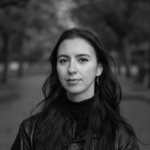
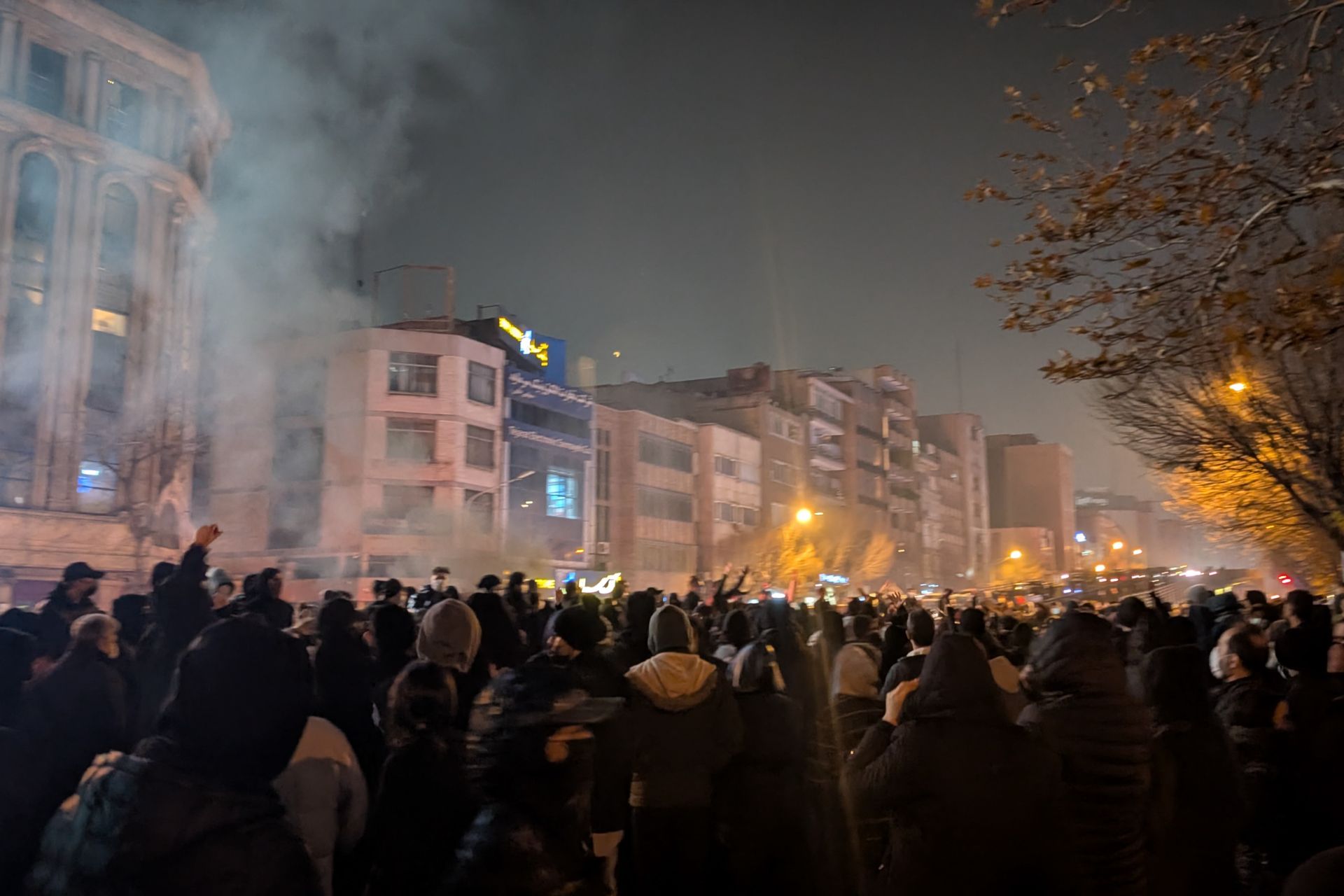
Sahba Rashtian’s family and friends went to the Bagh-e Rezvan Cemetery in Isfahan to claim her body on Jan. 15. The 23-year-old was killed after sustaining a fatal gunshot wound to her side during anti-government protests on Jan. 8, during a brutal nationwide crackdown in which the regime killed thousands in a matter of days. Her friends and family looked for her name on a monitor that was constantly refreshing, adding names upon names of bodies that were prepared for retrieval.
Typically at Bagh-e Rezvan, a body is washed and wrapped in a white shroud, following the Shiite practice of “ghusl al-mayyit” (washing of the dead), before being placed in a coffin. Loved ones then carry the coffin past a prayer room and place it on the ground so that mourners recite the “salat al-mayyit” (prayer over the dead) before the burial. But that day, her friends and family broke with religious and state practices.
“I remember that the mullah who worked at Bagh-e Rezvan yelled that we had to stop and recite the funeral prayer for her. Sahba’s father told the mullah to get lost. They didn’t recite the funeral prayer for her nor engage in any other Shiite customs,” her friend said, who spoke on the condition of anonymity for fear of reprisal from the authorities.
Instead, they lifted her coffin and carried it out themselves. Her father dressed head-to-toe in white and joined the crowd in chanting her name as they took Sahba to a burial plot.
“When we saw her father to give our condolences, he told us: ‘No, I celebrate you. Your friend was martyred on the path to freedom. Be happy that you were her friend. Be happy that there was a hero among you,’” said Sahba’s friend.
At her burial, her mother defiantly said, “I don’t want to see her in a grave. I want to see the people who shot her in the grave. I said I wouldn’t cry one tear here. They should know we’re standing with our country.”
In the Shiite funerary tradition, mourners gather at the burial, followed by ceremonies on the third and seventh days after the death, followed by a “chehellom” ceremony marking the 40th day. Typically, these ceremonies are emotionally intense, with public displays of men and women sobbing, wailing and slapping their own bodies. But Sahbha’s community left those customs behind, and so did many others.
In videos posted to social media, mourning ceremonies for people killed in this latest uprising showed different expressions of grief that are seemingly more joyful. In the chehellom for 19-year-old Arnika Dabbagh, a crowd danced and clapped as a pop song about love played loudly. In another, the sister of Sajjad Bayat proclaimed, “In the memory of my brother, the son of Iran,” as she released doves into the air. One video shows balloons flying above a crowd as people sing “If we gave our lives, if we gave our youth, it was the price humans pay for freedom.” At Mani Sarafpour’s chehellom, a large crowd clapped and a circle of men danced around her grave before chanting, “We swear upon the blood of our loved ones, we will stand until the end.”
“[These scenes] seem very defiantly to oppose practices that have been in place for decades, if not centuries, in Shia Islamic practices. It’s a language that people share with that of their government,” said Nahid Siamdoust, an assistant professor in media and Middle East studies at the University of Texas at Austin.
“Instantly, you see these and you understand that they are political, that these joyous sort of celebrations at these funerals are intentionally mounted to oppose a state that has championed a religion that they are now refusing.”
Many grieving families have been targeted by security officials, who have warned them not to hold a public gathering. This happened to Sahba’s family as well. Her friend said that intelligence officers called the family and told them they couldn’t hold a chehellom for her.
Iran’s leaders understand the power and danger of gatherings, especially those centered on public expressions of grief. During the final days of Shah Mohammad Reza Pahlavi’s rule, the then-revolutionaries seized on the way that grief can transmute into rage and then into action for their own gain. In July 1978, religious leaders — who then were part of the opposition to the Pahlavi monarchy — organized mass protests around the death of a popular opposition figure, Sheikh Ahmad Kafi.
“He died in a car accident, but it was widely known that the car accident was planned and executed by security forces,” said Reza H. Akbari, a program manager for the Middle East and North Africa at the Institute for War and Peace Reporting. “Mourners in large funeral processions in Mashhad and other cities raised antiregime slogans. They clashed with the police, who back then fired into the crowd and supposedly killed around 40 individuals, according to the protesters.”
Seven months after this incident, the revolution overthrew the shah.
During the 2022 “Woman, Life, Freedom” movement, when at least 530 protesters were killed according to the U.S.-based Human Rights Activist News Agency, mourning ceremonies also drew the ire of security forces. Then, there were dozens of cases of state violence in which members of the Islamic Revolutionary Guard Corps, along with uniformed and plainclothed policing units, used fatal force when people gathered for various funerary events.
Perhaps these gatherings, with their celebratory aspects, weren’t shared so prominently online in 2022 because the number of deaths was significantly lower than in the current moment. In addition, the rage from each anti-government movement layers on top of the preceding uprisings, shaping new forms of resistance.
“In the ‘Woman, Life, Freedom’ uprising, there was definitely a sense of yes, reforms were way out of the window,” Siamdoust said. “This was about the downfall of the regime, but the finality of it wasn’t as evident as it is now. And I think this has to do with the extreme worsening of people’s economic situation, and the fact that the state, having gone through that huge uprising, didn’t really give an inch.”
Sabha’s friend points to the public execution of Majidreza Rahnavard in December 2022 as a breaking point for many Iranians. Following Rahnavard’s unfair trial of just one session in front of the Revolutionary Court, he was charged with “moharebeh,” or “enmity against God.” Authorities accused Rahnavard of fatally stabbing two agents of the paramilitary Basij Resistance Force in Mashhad. The Islamic Republic of Iran Broadcasting (IRIB), the country’s only public service broadcaster, ran multiple propaganda campaigns during his case. Videos of forced “confessions” were broadcast, showing him with a bandaged left arm in a cast, drawing concerns from human rights groups that he was tortured.
“In the last interview that IRIB aired with Majidreza Rahnavard, he said, ‘After my death, don’t recite the Quran for me. Don’t cry, be joyful for me. I don’t want religion to be included in my funeral,’” said Sahba’s friend.
He added that the state broadcaster’s intention was to show Rahnavard as an enemy of Islam by including his secular demands for his funeral rights. Instead, it backfired. “This turned Majidreza Rahnavard into a hero for many of us. This was the first person who said this and sparked the flame of ‘Don’t cry at my funeral or recite Quran for me or pray for me.’”
In previous protests, some of those killed by the state were sometimes called shahids or “martyrs” by members of their communities. With martyrdom as a central facet of Shiite Islam, the regime has continued to promote this concept. This language has been used as a political tool to justify and honor those who have died for the state or for the well-being of the people, drawing on the heritage of the deaths of Imam Ali and Imam Hussein centuries ago. Civilians killed during the Israeli airstrikes during June’s 12-day war were elevated as martyrs in their communities. Even medical professionals who died amid the pandemic were called martyrs, because they died in the line of duty while serving their people and country. And in this protest round, Supreme Leader Ayatollah Ali Khamenei called the people killed during the demonstrations martyrs and blamed the United States, Israel and other outside forces for the unrest.
To break with the state, friends and families of protesters killed recently have found a new secular term for their dead — “javid naam,” which translates to “eternal name.”
“This is a very tangible example of how society, especially the grieving individuals who’ve lost loved ones amidst these protests, are trying to essentially reclaim their loved ones by challenging these established rituals, words, narratives,” Akbari said.
When Sabha’s friend was asked to describe her, he said that she “was a unique woman, not because she was a javid naam who was killed for Iran.” Sabha trained and worked as an animator, and always dreamed of one day working for Disney. When she introduced herself as Sabha years ago, her friend responded that he had never met a Sabha before. “I asked her what her name meant and she laughed and said, ‘My name means wine, I’m illegal in the Islamic republic,’” he said.
Days before she was killed, Sabha showed him her sketchbook that she carried around with her everywhere. With a pen tucked into its pages, she would take it out and draw whenever she was inspired. He saw portraits of her sister, her beloved cat, people she saw on the bus or at the park. They flipped through the book, and he saw it was filled with her wishes and portraits of loved ones. As Sabha was showing him everything she drew, her friend noticed that she had no empty pages left, no new things to daydream about.
“Two days before she was killed, we had ice cream together,” her friend said. He paused as his voice started to crack with emotion. “We talked about the future. We talked about the mullahs and how they had disrupted our youth. We spoke about how we had to free our country.”
With Iran once again being targeted by U.S. and Israel airstrikes, Iranians are grappling with what their country might look like now that Khamenei has been killed. Sahba’s friend said that, for years, Iranians protested, and the state never reformed. He viewed the U.S. and Israeli attack as the only remaining option for change.
“Right now, although all of us are worried about the future and the potential power vacuum — although Iran may move toward civil war or even fragmentation — there is no alternative, and overthrowing the government is our first and last priority,” he said.
“Spotlight” is a newsletter about underreported cultural trends and news from around the world, emailed to subscribers twice a week. Sign up here.