


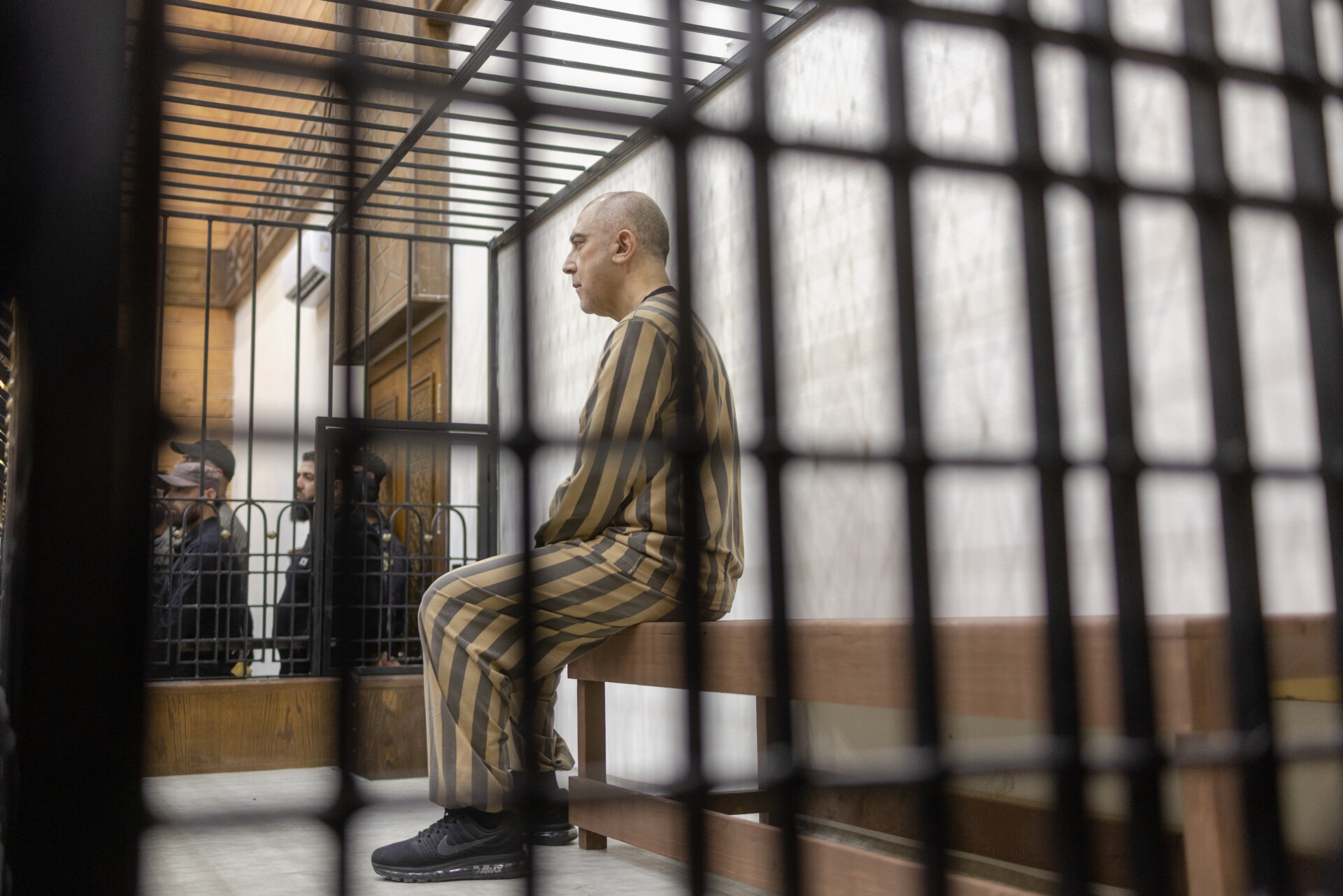
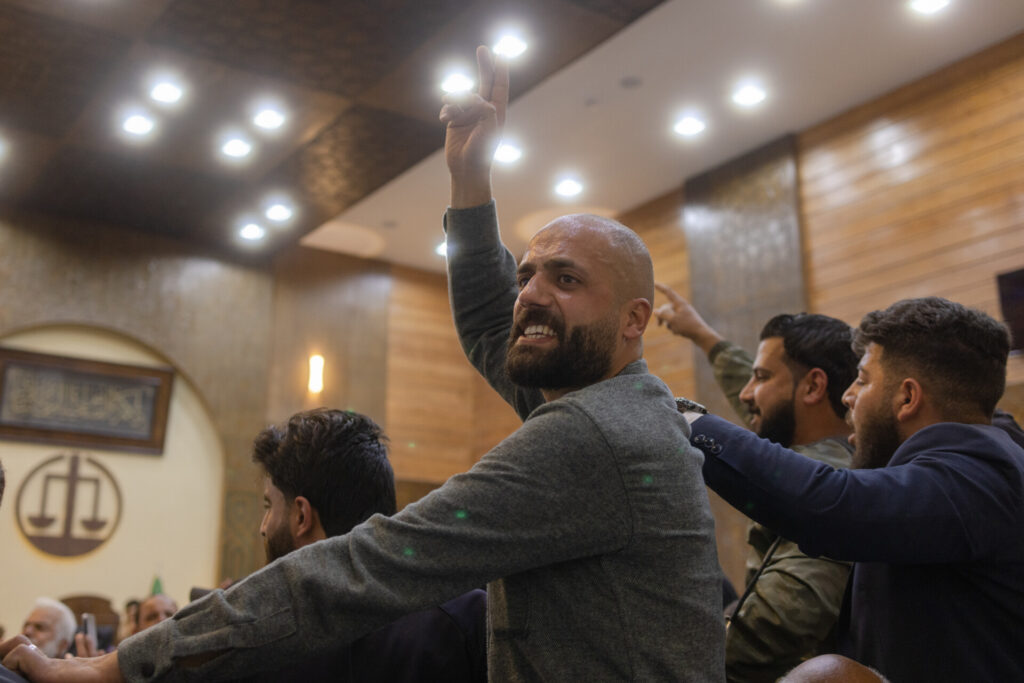
“The day has come, Atef Najib, the day has come.” The chant rose inside the Palace of Justice in central Damascus, carried by families of victims as they filed into the courtroom, heads held high. Moments earlier, they had sung songs from Daraa: “Daraa al-balad, oh vast land, oh mighty mountain.” Outside, police checkpoints blocked access to the building, and a heavy security presence surrounded the courthouse. Inside, corridors across three floors were packed.
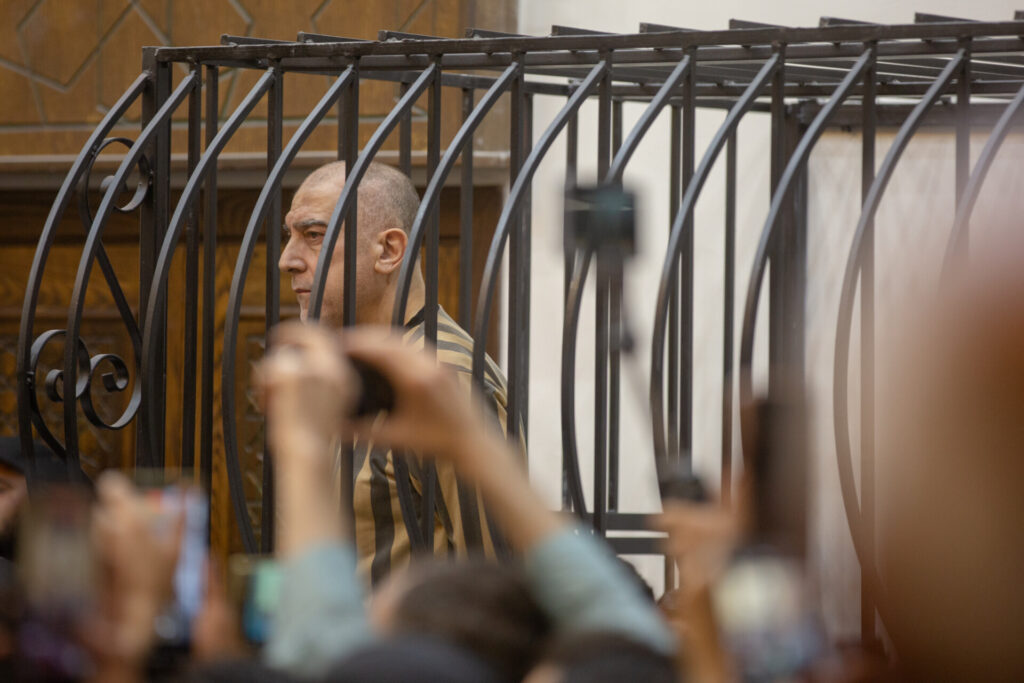
At the center of the room, a black iron cage stood in stark contrast to the formal setting. Shortly before 11 a.m. on Sunday, Atef Najib, cousin of the ousted president Bashar al-Assad, was led in. Dressed in a brown, striped prison uniform, his face remained expressionless, his gaze cold, as he stepped into the cage and sat down. In Daraa, locals long remembered him for a chilling claim: “I am God in Daraa.”
Facing him was a placard bearing the face of 13-year-old Hamza al-Khatib, a boy who became a symbol of the early days of the Syrian uprising. In Daraa, at the onset of the Arab Spring, a group of teenagers had scrawled antiregime slogans on a school wall, including “Doctor, it’s your turn” — a reference to Assad, a trained ophthalmologist. At the time, Najib was head of security in the city. Several children were arrested. Their detention, marked by torture, fueled the first protests and set in motion what would become 14 years of uprising and war.
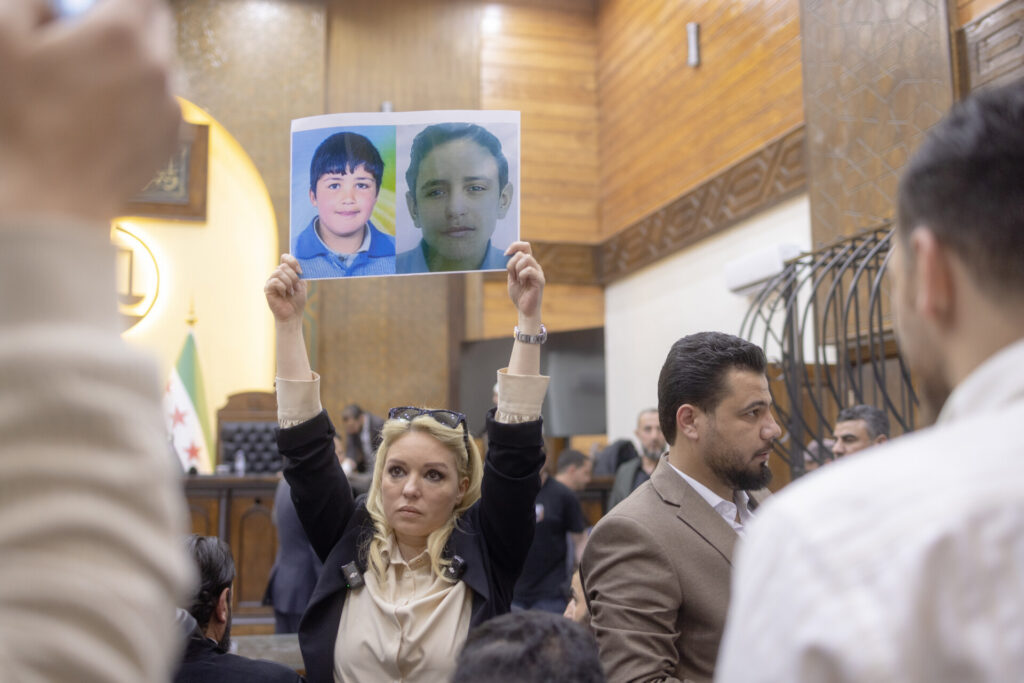
Al-Khatib, arrested during a protest in Daraa, was returned dead to his family weeks later. His body bore clear signs of torture: burn marks and mutilated genitals. In the courtroom, a woman held up his photograph alongside that of another child, 15-year-old Thamer al-Charai, who was also detained, tortured and killed.
Nearby, a man held up a placard bearing a verse from the Quran: “Today every soul will be recompensed for what it has earned. No injustice today. God is swift in reckoning.” At the bottom, it read: “The trial of the criminal Atef Najib, 26 April 2026.” Families of the victims described the moment as “historic.” A chant rang out: “The martyrs are the heroes — Atef, you are the dog.”
A former head of political security in Daraa, Najib was among the first senior officials arrested following the regime’s collapse, just weeks after Assad’s fall, on Jan. 29, 2025, on Syria’s coast. Since then, families have been waiting for this trial.
As protests escalated in late March 2011, Assad ordered the formation of a committee to investigate the events in Daraa, in an effort to contain the growing uprising. He did not remove his cousin, however, instead transferring him to Idlib, where he served as head of political security. In June 2011, the committee imposed a travel ban on Najib.
The trial comes as authorities seek to demonstrate that transitional justice is advancing. Two days earlier, Amjad Youssef, the main suspect in the 2013 Tadamon massacre, in which nearly 300 civilians were executed, was arrested. The arrest, widely publicized, was followed by a statement from the Ministry of Interior, which aired footage of his capture as well as a filmed confession. The transitional justice process remains slow in a country exhausted after 14 years of war.
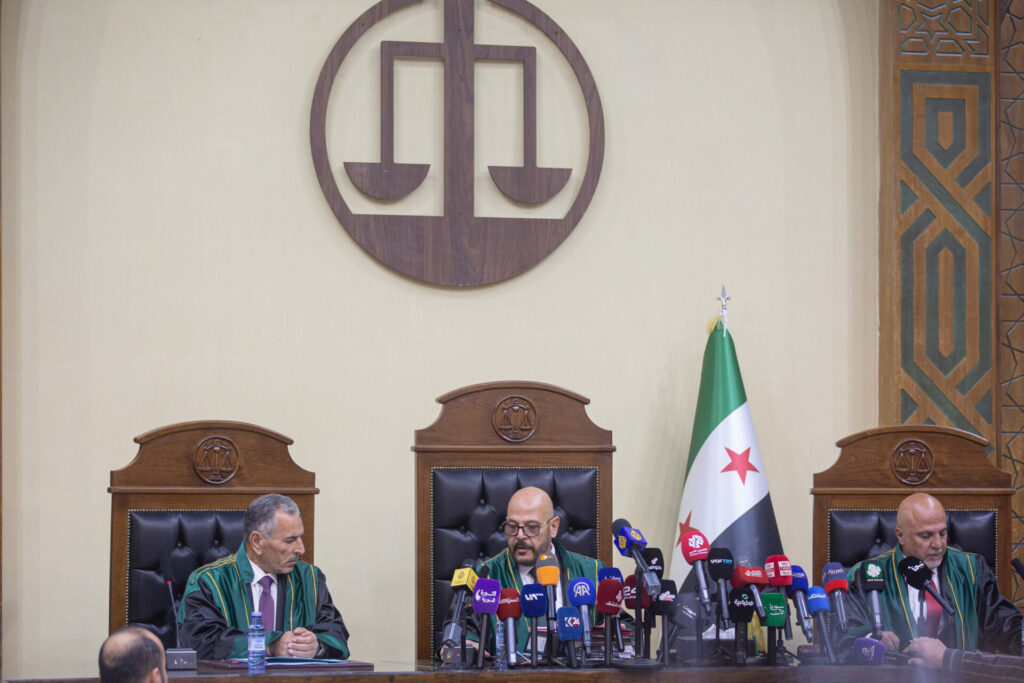
Emotions ran high at Najib’s trial. Outside the cage, families filed past before a crowd of journalists. Behind Damascus’ public prosecutor, Hosam Katab, a large scale symbolized justice. “Transitional justice begins with him,” he said, referring to Najib. “Trust the state and justice.”
“He was the first ‘pharaoh’ when he gave the orders to fire on protesters,” he added. “This will be neither the last nor the first, we will pursue them all. … It’s the will of God and will be fulfilled on Syrian land.”
He then addressed Najib directly: “Our God has given us what we wanted. And you, did your God, Bashar al-Assad, give you what he promised?”
Judge Fakhr al-Din al-Aryan announced a list of 10 suspects set to be tried. The first name cited was Bashar al-Assad. Others followed, including his brother Maher al-Assad, who commanded the 4th Armored Division, an elite unit of the Syrian army that embodied the regime’s armed wing, as well as other officials of the Assad regime. Assad fled to Russia and will be tried in absentia.
An observer tasked with assessing the trial’s impartiality on site, who requested anonymity, warned: “We must maintain a degree of neutrality and avoid overly political language in order to meet the standards of justice, even if this is difficult in the face of victims. It will happen gradually — this was only the first day.” The observer also stressed the importance of addressing the victims’ mental health, noting that expressions such as chanting or dancing are normal responses given what they have endured.
As the hearing ended after just over an hour, a crowd gathered in the courthouse hall. Women ululated. Shaza Alsalmoni, a Syrian-British human rights lawyer, stood with her hands pressed to her cheeks, her square glasses slightly askew, her long bleached hair framing reddened eyes. “To see victims in a courtroom at last, to see Najib behind bars in a Syrian court. … The last time I saw a war criminal was in The Hague in 2014. Now it’s in Syria. It’s incredible.”
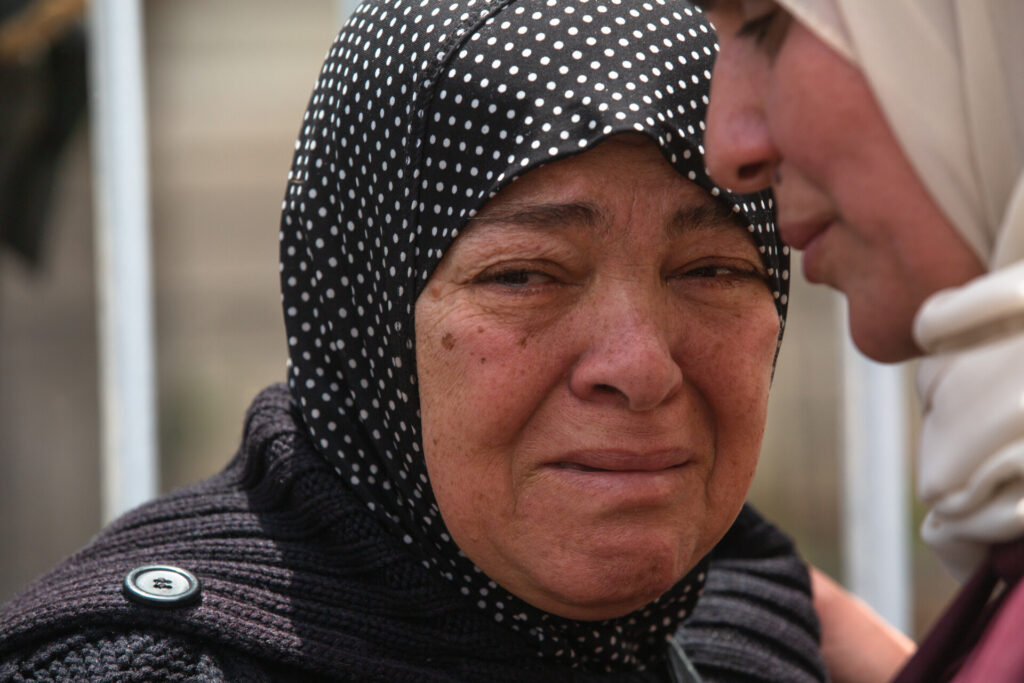
Chants from the 2011 protests echoed once again as the detainee left the courtroom: “Syria is ours, not the Assad family’s.” Outside the courthouse, after the trial, families waited for the bus back to Daraa in southern Syria, sitting on plastic chairs as traffic slowed around them. Mothers, in tears, embraced, stroking each other’s faces.
Warda Radwan, in her 50s, the mother of a young man who was killed in the protests, said: “This is the most beautiful day of my life. Since my son was martyred, I was waiting for this day. God has put him in the cage. We hope justice will prevail and that we will see him hanged in Al-Omari Mosque Square.”
It was there that she lost her son in March 2011, when security forces opened fire on protesters gathered around the mosque. Her son was there but not taking part in the demonstrations, and was shot. At her side, her other son, who said he did not sleep all night out of anxiety, said they thought Najib would be executed the same day, before adding: “We know that there are procedures and we respect them. Even if there were a hundred sessions we will attend all of them until he is hanged or executed.”
After the trial, Abdulbaset Abdullatif, the head of the National Commission of Transitional Justice, said on X: “The first session of the trial of Atef Najib has begun, a long-awaited step on the path to justice. … There will be no impunity, and justice continues.”
Noal Massri, 54, a lawyer representing families and whose brother was killed in the uprising, said: “It’s a victory after more than a year of work on this process — I was part of it. Because there is all the evidence, even if justice comes late, it will come and that’s what we need.”
The death penalty remains in force in Syria, while the notions of crimes against humanity and war crimes are still not incorporated into national law. At this stage, the charges against Najib remain uncertain. The judge did not question Najib during Sunday’s session, which focused on preparatory administrative and legal procedures. A second hearing will take place on May 10.
“Spotlight” is a newsletter about underreported cultural trends and news from around the world, emailed to subscribers twice a week. Sign up here.