

Wake up, there is a new Mamdani controversy in town. This time, New York City is debating who gets to belong and how one gets represented in one of the world’s most diverse metropolises.
The latest flash point is a map of immigrant enclaves dotting the city’s five boroughs. The image features a range of ethnicities — from Chinese, African, Latino and South Asian to Arab and Eastern European.

Since it omitted Little Italy and some other ethnic hubs, the map ended up drawing the ire of the Italian-American community as well as Irish and Jewish New Yorkers who saw it as an attempt to erase the city’s European immigrant past.
After a letter from the Italian American Civil Rights League went viral, and the City Council’s Italian Caucus objected, Mayor Zohran Mamdani clarified that his administration had merely updated the map and that it was not “an exhaustive list of the more than 200 ethnic communities that call our city home.” His aides later said they’d added the neighborhoods of Little Egypt, Little Senegal, Little Palestine and Little Odessa to the map.
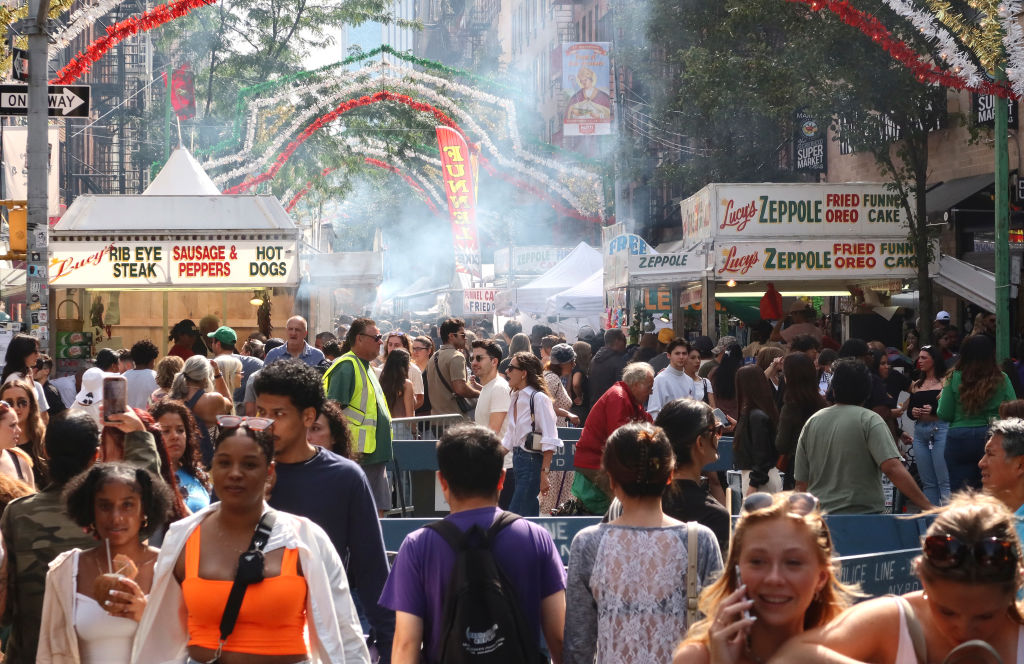
Little Italy in lower Manhattan was once the heart of New York’s Italian-American community, reaching its peak in the early 20th century before many residents moved to the outer boroughs, New Jersey and upstate New York, and the neighboring Chinatown neighborhood steadily expanded. Today, Little Italy has shrunk to roughly five blocks along Mulberry Street, infamously considered a “tourist trap,” which New York City journalist Pete Hamill once called “a ‘Sopranos’ theme park.”
A lot has been written about the neighborhood being a shadow of its former self, including that most of its pizzerias and Italian restaurants, like those across the city, are now owned and run by members of the Albanian community.
As the map raised broader questions about who gets to be called an “immigrant” and what qualifies as an “immigrant enclave,” many Jewish New Yorkers also pointed out that since their grandparents — and, in some cases, great-grandparents — had spent their entire lives in the city, they didn’t recognize “immigrant” as an identity of their own.
But scratch the surface, and the grievances of some immigrant communities mask a deeper shift, one that some observers have been highlighting since the 2025 mayoral election, although it has been unfolding for much longer: the waning influence of Irish, Italian and Jewish communities, or the “white ethnics,” as American sociologists have long described them, in present-day New York City politics.
Once upon a time, the three groups dominated and shaped city politics, from the peak of Tammany Hall, the Democratic machine built by Irish Catholic immigrants, through the late-20th-century administrations of mayors like Ed Koch and Rudy Giuliani. Until the 1980s, they accounted for almost half of the city’s population and held immense influence over its social fabric. It was said that a balanced ticket in New York City politics consisted of someone Irish, someone Italian and someone Jewish.
But a “white flight,” fueled by higher levels of education and socioeconomic mobility, led to a decline of the white ethnic population in the city from the 1950s to the 1990s, including in Little Italy. That left a power vacuum to be filled by Black, Latino, Asian and Afro-Caribbean communities, who built coalitions that continue to shape present-day city politics. The standard balanced ticket then began to include Black and Latino candidates, along with women.
As Mamdani’s historic upset last year once again upended city politics, it ushered in a new electoral coalition powered by young people, including renters and recent transplants. It is racially diverse, with strong majorities among Black, Latino and Asian voters, and now includes Muslim and South Asian New Yorkers, who had historically been underrepresented in the city. One manifestation of that shift is the growing perception that the city’s working-class Bangladeshi immigrant community is a vital voting bloc.
This realignment has heightened anxieties that are being expressed in myriad ways.
Brooklyn borough historian Asad Dandia, known for his walking tours, recently captured this shift in an online post: “It is undeniable that Irish, Italian, and Jewish immigrants have left an indelible mark on this city. Their cultures dominated art, literature, cinema, and civic life through much of the 20th century. But in no way can we say that they are representative of the 21st century immigrant city.”