


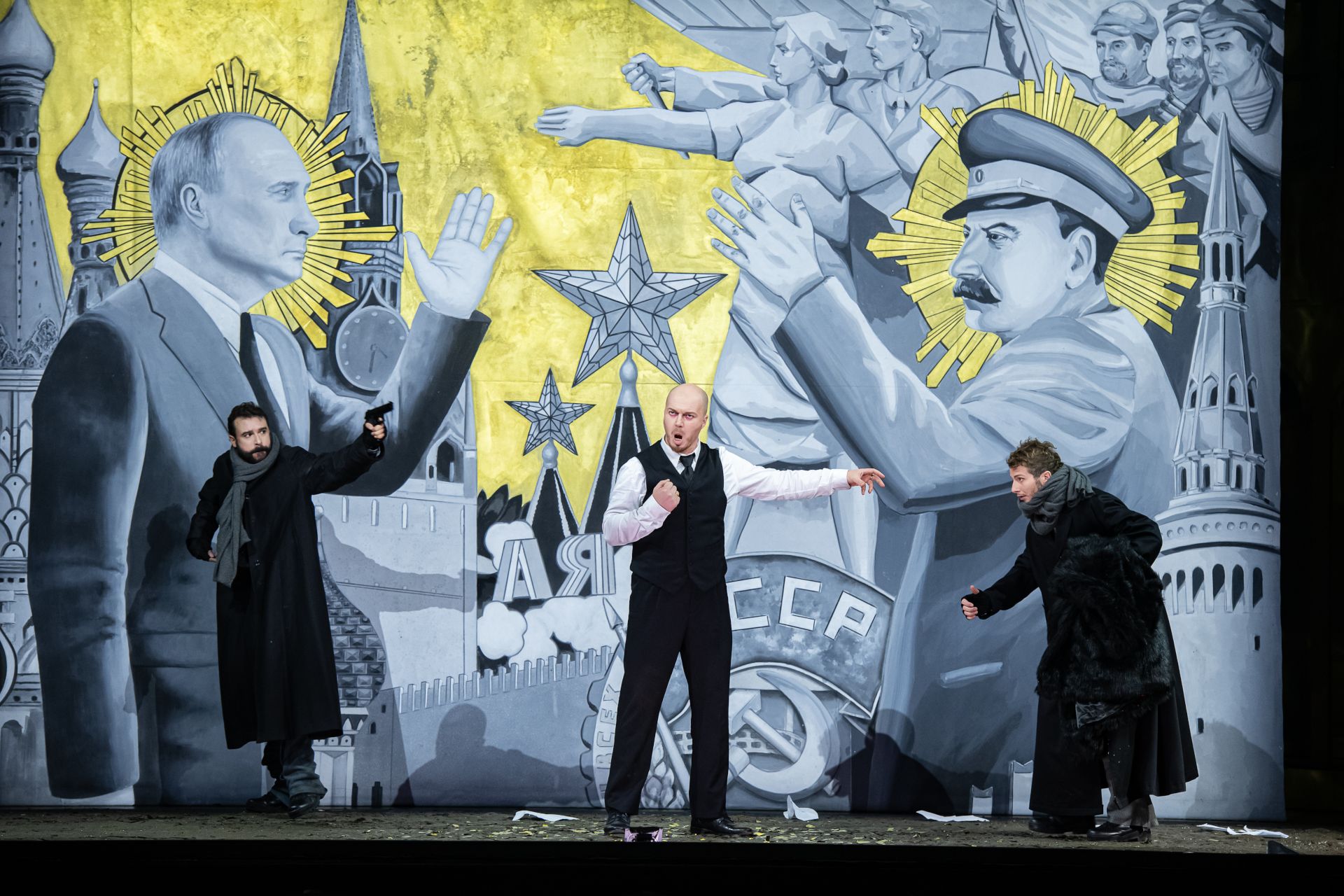
Earlier this year at the Amsterdam Opera House, a modern reimagining of a Russian classic about a murderous tsar left little doubt about its real-life inspiration: President Vladimir Putin.
“Boris Godunov,” the 19th-century opera by composer Modest Mussorgsky, chronicles the rise and fall of the ill-fated Russian tsar 400 years ago, whose reign was plagued by famine and guilt over the murder of his child-rival. When Godunov dies as Russia is invaded by Polish-backed forces, the nation is plunged into chaos.
In emigre Russian director Kirill Serebrennikov’s production in Amsterdam, the opera was reimagined for the 21st century. The coronation of Godunov became the moment Putin was elevated to the presidency, on New Year’s Eve, 1999. On stage, Godunov wore a dark suit, red tie and overcoat as he sang a triumphant aria tinged with foreboding. Behind him, unsuspecting Russians in a Soviet apartment block decorated with tinsel rang in the New Year, clinking champagne glasses and sitting down to festive meals.
The character of the Holy Fool, traditionally the opera’s moral compass, was reimagined by Serebrennikov as a liberal protester, dressed in jeans and a T-shirt, and reciting excerpts from speeches by Russian political prisoners. A Polish-supported coup was portrayed as a televised fabrication orchestrated by Kremlin spin doctors, and the chorus staged funerals for soldiers killed in Ukraine.
“Boris Godunov is an opera about power and politicians, and about the problems of humans who are put in an impossible situation,” Tomasz Konieczny, the Polish bass who played the role of Godunov, told New Lines after the premiere in the Dutch capital. “You can make a direct comparison with the situation today.”
Whether or not directors make the comparison as overtly as Serebrennikov, “Boris Godunov” — which was first performed in St. Petersburg in 1874 — has, in recent years, become a lightning rod for clashing interpretations of Putin’s regime and, by extension, the question of Russian complicity in the bloodshed in Ukraine.
The opera has long been a firm favorite in both Russia and the West, performed regularly throughout the 20th century. Despite, or perhaps because of, its distinctive “Russianness,” there has been no let-up in performances since the full-scale invasion of Ukraine. It has become one of the most performed Russian operas; in the last three years, there have been at least 13 new productions in Europe. After the Netherlands in June, it will be performed this month in Lyon, France, and in November in Frankfurt, Germany. A revival with prominent bass Bryn Terfel in the role of Godunov is scheduled for London’s Royal Opera House in early 2026. At the same time, the opera has been no less popular in wartime Russia, where a hypertraditional version remains a fixture in the repertoire of Moscow’s Bolshoi Opera. Two new productions of “Boris Godunov” were put on in Siberia: in Ulan Ude in 2024, and in Krasnoyarsk the year before.
One exception has been Ukraine’s neighbor Poland, where the Polish National Opera canceled a 2022 production due to the invasion and has not staged one since. “We are based in Warsaw, a city that vividly remembers the first bombs that fell from the sky during the Second World War,” the opera said in a statement at the time. “We are deeply affected by the war in Ukraine and the suffering of the Ukrainian people.”
One aspect of the appeal of “Boris Godunov” is the scope it provides for reinterpretation. Not only does it address dozens of different themes (from regicide to the fragility of borders), but there are four different versions. Based on a play by Alexander Pushkin, Mussorgsky composed two versions: an original, more austere version in 1869, and a later, expanded revision featuring additional scenes and a prominent role for a leading female character, completed after the first version was rejected for staging.
Later, the opera was reorchestrated by both Nikolai Rimsky-Korsakov and Dmitry Shostakovich. “The opera’s an odd and interesting tangle of things that you can easily reinterpret any way you like,” said Simon Morrison, an expert on Russian music at Princeton University.
In other words, directors can create a production in line with their artistic, or political, visions. That also explains how a visitor to Russia could see a pro-Kremlin version before hopping across to the Netherlands for one laden with criticism of Putin’s authoritarianism.
“This is obviously a piece that is so open — in fact, that’s almost its problem,” said British director Keith Warner, who is staging the Shostakovich version of the opera in Frankfurt later this year. “What are you going to do with it? What are you going to say? Because you can do anything. Which is wonderful.”

Serebrennikov — who left Moscow after Russia’s invasion of Ukraine and now lives in Berlin — is not the only director in the West to stage “Boris Godunov” with pointed parallels to his country’s wartime reality.
In a 2023 staging in Toulouse, France, performed a year later in Paris, French director Oliver Py included soldiers armed with AK-47s, the “Z” identification symbol used by Russian forces in Ukraine and a huge mural of Putin facing off against Soviet leader Josef Stalin.
Of course, productions with such interpretations are impossible in modern Russia, where public criticism of the regime is taboo and often punished with a jail sentence. Many anti-war performers left the country following Russia’s full-scale invasion of its southern neighbor in 2022, and artistic self-censorship among those who remained is widespread. As a result, new productions of “Boris Godunov” in Russia have ranged from those with a nakedly pro-regime slant to those where political messages are deeply buried.
Interpretations of the opera tend to revolve around who exactly is the most important character. “Which character is the protagonist and the main focus is up in the air,” Morrison said. Some productions put “the people,” played by the chorus, in the spotlight, exploring their suffering at the hands of scheming rulers and a corrupt elite; others center the personal drama of Godunov.
A version performed last year by the Buryat National Opera in the city of Ulan-Ude, north of Russia’s border with Mongolia, put Godunov at the heart of the opera. “Tsar Boris Godunov is the main character of the tragedy without a shadow of a doubt. Any discussions about the role of the people are just the idle inventions of democratic and communist ideologues,” director Vladimir Rylov said in an email exchange. He made several alterations to the opera, particularly at the end, to downplay the role of “the people” as an independent voice.
Rylov’s pro-regime production also strove to elicit maximum sympathy for Godunov and, more broadly, the concept of autocratic power, making the opera a lesson in the disasters that follow when a strong leader is undermined. If it had not been for treachery, and his own sudden death, Godunov would have led Russia to victory against a Polish-backed invasion, according to Rylov. “My staging is imbued with respect and thanks for his [Godunov’s] remarkable personality,” Rylov said.
The British director Warner said he was also more interested in the personality of Godunov, although his focus was the tsar’s struggle with feelings of guilt. Warner said he wasn’t convinced of the “richness” of making the people the main role, “apart from to say that people are notoriously fickle toward political leaders.”
In contrast, Serebrennikov’s version deliberately sought to limit the pity the audience feels for Godunov by reducing the stage time for Godunov’s children, who are a vehicle for presenting the tsar as a loving father, and not showing the moment of Godunov’s death. Serebrennikov also put “the people” front and center. Haunting images of those on the margins of Russian society taken by photographer Dmitry Markov, who died of an overdose in 2023, were projected onto the set throughout the production. The people’s suffering even included Russians fighting in Ukraine: As Godunov sang his final words, he turned to ask forgiveness of a line of bloodied men in combat fatigues — apparently soldiers killed in Ukraine — with angel halos.
“Most people in this opera are victims,” said Konieczny, the Polish bass singer. “They are all victims of the system. If they have nothing to eat, if they go to the front … they are also victims. All the Russian people in this situation are victims. Of course, Putin is no victim. But it is a show about victims, and what we do with victims.”
Another wartime Russian version of the show, which was staged in Krasnoyarsk in 2023, tried to avoid the dilemma of taking either “the people” or Godunov as the protagonist. “Even more important than [Godunov] is the relationship between the authorities and the people. Not the people, nor the tsar, but what happens between them,” said a person involved in the production who spoke on the condition of anonymity, fearful of repercussions. “Do the people understand that they are being treated well or badly? Or don’t they care as long as life is easy? It’s a totally contemporary situation.”
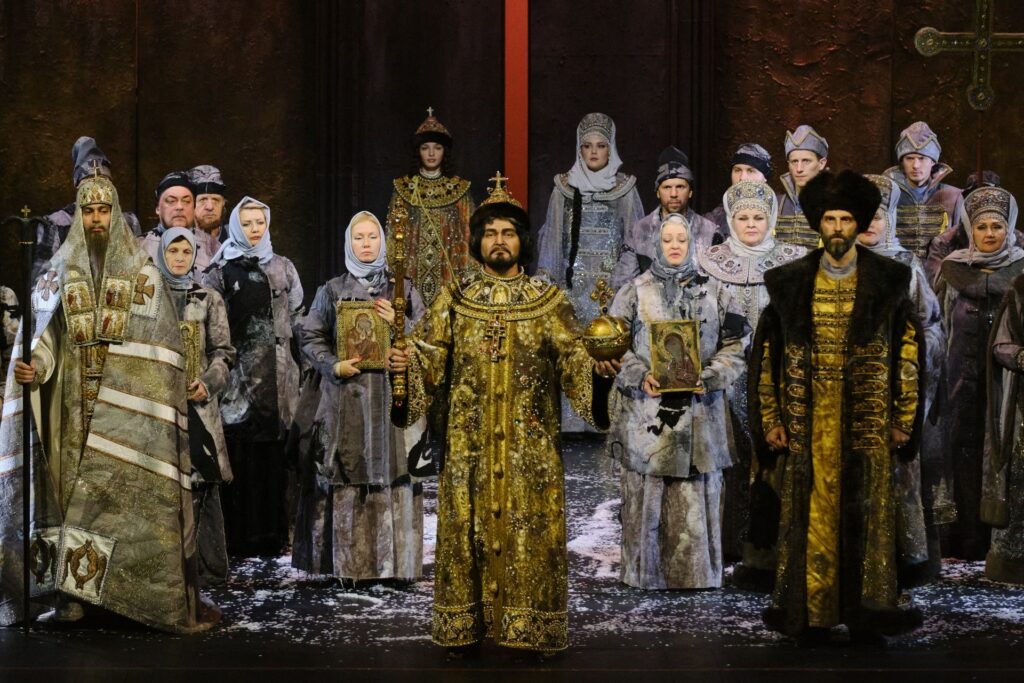
The Krasnoyarsk production used Mussorgsky’s more stripped-down 1869 version, which is focused on exploring a crisis of political power. While the cast was dressed in traditional costume, and there were no alterations to the score or libretto, the person involved in the production said the focus was on Godunov’s original sin: the murder of his 8-year-old rival, the Tsarevich Dmitry — an interpretation that could be understood as an indirect criticism of the Putin regime. “It’s a simple, even banal, thought: People shouldn’t kill other people,” said the person. “For me, a murder carried out in order to achieve power is unacceptable.”
Mussorgsky’s music provides scope for different interpretations of the flawed tsar, according to Morrison. “You can easily demonize Godunov and render him despotic, but the music explores the complexity of his character,” he said. “It’s a fascinating psychological study … how the music tightens up when he is talking about the office he occupies, and then how it all breaks down and he’s just a messy, sweaty human being like the rest of us.”
In addition to being a vehicle for ideological messaging, the opera has also been at the center of controversy in the West over the prominence that should be given to Russian art during Moscow’s imperialist war in Ukraine, as well as the roles afforded to Russian artists who have not unambiguously condemned the Kremlin.
Last month, demonstrators gathered outside the Royal Opera House in London to criticize the decision to hand the title role in Giacomo Puccini’s “Tosca” to Anna Netrebko, a Russian soprano whom protesters accuse of having links to the Kremlin. And earlier this year, a public outcry caused organizers of an Italian music festival to cancel a concert with Russian conductor Valery Gergiev, a close ally of Putin.
“Boris Godunov” attracted similar controversy when it was performed at Milan’s La Scala in December 2022, just 10 months after Russian tanks invaded Ukraine. Protesters gathered outside the opera house on opening night, which was attended by Italian Prime Minister Giorgia Meloni and European Commission President Ursula von der Leyen. The Russian bass who sang Godunov, Ildar Abdrazakov, was later dropped by opera houses in Europe and the United States because of his ties to the Kremlin.
While Abdrazakov no longer performs in the West, there are still some Russian artists who manage to get major roles in both their homeland and on European stages. One of them is Russian bass Dmitry Ulyanov, who is singing Godunov in Lyon, and sang Godunov in 2023 in the Krasnoyarsk production. At least in public, Ulyanov has not condemned the war in Ukraine and, through a spokesperson, declined a request for an interview unless given veto power over the article. Vasily Barkhatov, the emigre Russian director putting on “Boris Godunov” in Lyon, also refused to speak to New Lines.
If Russian artists can be canceled in the West, in Russia they risk being unable to find work — or even jailed — if they speak out against the Kremlin. Konieczny said two Russian artists who were supposed to be in the Serebrennikov production pulled out when they realized how critical of Putin the staging was going to be. They were, he said, frightened of repercussions for their families inside Russia.
Konieczny was the bass due to sing Godunov at the 2022 production in Warsaw that was pulled after the full-scale invasion. While he refused to take Russian-language roles for two years subsequently, he said he now believes boycotting Russian art, or artists who sing in Russian, is wrong. “It’s much stronger to make some form of statement, and explain to people that [Russian] music is not owned by Russia. It’s a part of world art,” he said. “We have to be smarter than Putin.” Earlier this year, Konieczny gave a recital in Vienna in which he juxtaposed songs by Ukrainian composer Mykola Lysenko and Mussorgsky.
At the same time, “Boris Godunov” doesn’t necessarily have to be staged in the context of modern Russia, and — even as the Ukraine war rages — some directors are looking beyond references to the Putin regime. Warner, who is staging Boris Godunov in November with Ukrainian bass Alexander Tsymablyuk in the title role, said he was not going to put the cast in modern dress or “make it relate to a particular milieu or political message.”
Instead, over the four-and-a-half-hour production, Warner said he wanted to draw out a broader message related to the rightward lurch of politics across Europe and the United States. “It’s strangely not about [Russia] as a whole. It’s about the pressures of leadership, and the struggle for truth,” he said. “I think the universality screams so clear.”
In the last scene of the opera, which shows Russia torn apart in the aftermath of Godunov’s death, Warner said he was intending to include infanticide, rape and torture. His reference point, though, was less Putin’s Moscow and more Donald Trump’s Washington. “I keep thinking about America, really,” he said. “What’s the aftermath of this? What’s going to happen to that country?”
Whether it is reimagined to provide a commentary on modern America, or modern Russia, Mussorgsky’s vision is unremittingly bleak for what comes after the demise of an autocrat who does unspeakable things to preserve or gain power.
The last lines of the opera are given to the Holy Fool, arguably the only character who tells the truth, as he stands alone on stage. He sings: “Eyes are burning / bitter tears flowing / cry, faithful heart / cry in deep anguish: / Soon the foe will come / and the dark will fall / night will blind us all / and no hope of dawn.”
Become a member today to receive access to all our paywalled essays and the best of New Lines delivered to your inbox through our newsletters.