


Over the years, my mother and I have developed a system for handling whatever political storm is blowing through Sweden. She calls me — often breathless, sometimes panicked — after seeing a news segment or reading a headline about a new proposal targeting immigrants, and I reassure her. I tell her it’s only political theater, that it will never pass into law, and that it doesn’t apply to us. We may be immigrants, yes, but we are immigrants with Swedish passports, with permanent residence rights long since secured. We are citizens, in every legal and literal sense of the word — even though we were once Iraqi refugees. I tell my mother repeatedly that she has nothing to fear, but my words have no effect.
When a proposal appeared on the news earlier this year, one that would allow authorities to revoke the citizenship of immigrants under extraordinary conditions, I told her again: This will never pass a vote. It’s illegal, and Sweden would never do this. But as the proposal went from headlines to gaining political momentum, I felt a different kind of fear set in. The measure was described as targeting only “serious offenders,” and it would require changing the constitution. But once a state grants itself the power to unmake a citizen, the line can always be moved.
For the first time, I felt a small crack open in the confidence I had leaned on for years. Instead of quieting my mother’s fears, I called her back to admit that this time, I could barely silence my own.
For many decades, Sweden occupied a near-mythical position in the global imagination: a small Nordic nation where equality was not an aspiration but a fact of life. Women and men lived under some of the most egalitarian conditions in the world, and Sweden has routinely topped the EU’s Gender Equality Index since it was introduced in 2013. It was held up as a model society, politically, socially and culturally, a place where transparency, democracy and universal welfare formed a coherent moral project.
Those who remember the darkest years of the Iraq war will recall how Sweden stood almost alone in Europe. At the height of the crisis, in 2006 and 2007, the country received close to half of all Iraqi asylum applications lodged within the EU, in an extraordinary act of humanitarian openness from a country with a population that was then just under 9 million. This generosity became part of the national brand: Sweden as the moral superpower, the state that opened doors when others slammed theirs shut. Today, Sweden still sells the world the image of a progressive, democratic utopia: flat-packed, minimalist, friction-free. But at home, the story has changed, and laws that once would have been politically unthinkable have become ordinary.
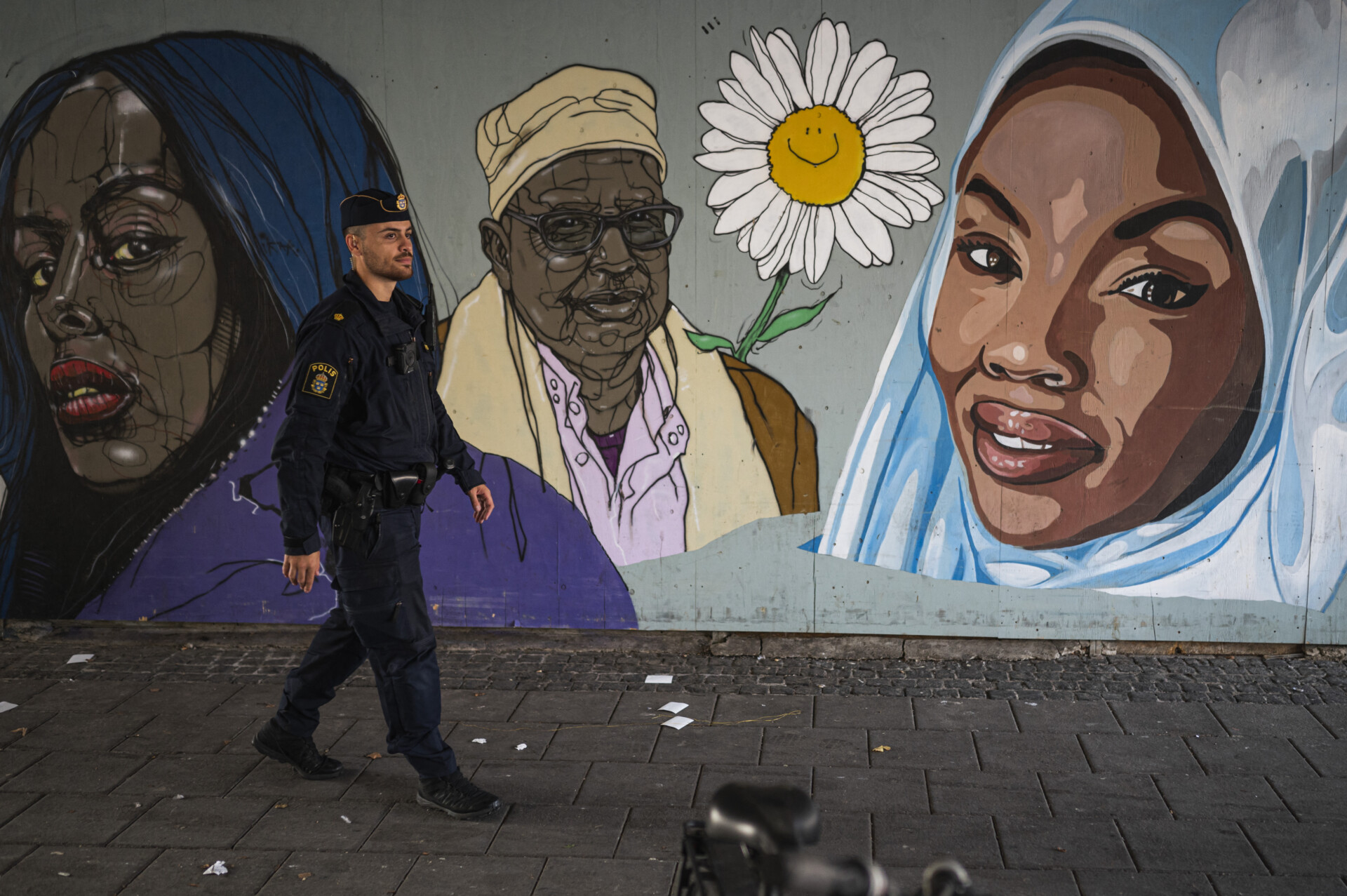
In the new Sweden, a family that lives in public housing risks eviction if one of its children commits a crime. The police have been granted sweeping new powers, including “stop-and-search zones” that allow officers to search anyone, even if they have no demonstrable reason for targeting that individual. Insulting an officer during an arrest can lead to heavy fines or even prison.
At the same time, the government has tightened migration policy to an unprecedented degree. Sweden has slashed its refugee quota from 5,000 people per year to a maximum of 900.
Since 2022, Sweden has been governed by a center-right coalition that is led by the Moderate Party, but depends on the support of the far-right Sweden Democrats (SD), a party that does not hold Cabinet posts but effectively sets policy on migration and law and order. Under this arrangement, the government is pushing through a series of highly controversial proposals, among them a plan to incarcerate children as young as 13 in adult prisons rather than offering them juvenile care. It is also advancing a proposed “Swedish values contract” that would require asylum-seekers to sign a loyalty pledge, and a proposal to deny and revoke residence permits for so-called “social misconduct,” a term that could include exhibiting “disruptive behavior,” or failing to adhere to fundamental Swedish values.
Over the years, watching the rhetoric harden, I’ve often tried to locate the moment when the trajectory changed. When I ask people to identify the turning point, the answer is almost always the same: the moment the SD entered parliament in September 2010. That was the day Swedish politics shifted, and a party with roots in the neo-Nazi movement crossed the parliamentary threshold, forcing itself into the national conversation. What had long been dismissed as fringe suddenly sat inside the legislature, and nothing was ever quite the same again.
Ann-Cathrine Jungar, a political scientist at Sodertorn University and expert on European radical-right parties, described the rise of the SD as “a textbook case of normalization,” which refers to the fact that the current political discourse in Sweden is now dominated by issues that are important to the Sweden Democrats, which are primarily about nonwhite immigrants. “Before that, the big political debates were all about taxes, welfare, schools, health care. Migration simply wasn’t a major political conflict,” she said.
Founded in 1988 with clear links to white-power and far-right movements, the Sweden Democrats spent years on the political margins, shunned by all major actors. But under the leadership of Jimmie Åkesson, who took over in 2005, the SD launched a strategic makeover, trading shaved heads and bomber jackets for tailored suits and a relentless focus on immigration as the root of every social problem. The party favors a punitive approach to crime, and its socially conservative worldview elevates what it claims are “traditional Swedish values” — ideas rooted in cultural preservation, emphasizing assimilation over integration and preservation of the nuclear family while resisting LGBTQ+ rights and multiculturalism.
Rather than describing how Swedes historically lived, for the SD “traditional Swedish values” function as a political shorthand for cultural conformity and national belonging. These values draw on shared rituals such as Christmas or celebrating Midsummer, eating pork and adhering to “jantelagen” — the unwritten social code that discourages standing out or presenting oneself as better than others.
In a more political sense, the phrase “traditional Swedish values” also translates into an expectation to preserve Sweden as the SD and its supporters imagine it was before large-scale migration, which brought Muslim newcomers. The phrase refers to a time before there were mosques in Sweden, before there were women wearing hijabs on the streets, a time when being Swedish meant being a white person.
The SD appealed to voters by speaking to their fears about migration, segregation and rising gang violence. Mainstream parties responded by adopting the SD’s rhetoric. The Overton window slid to the right.
As Jungar, the Swedish political scientist, put it: “The rise of the populist radical right is the biggest political transformation of the Nordic region in the last 20 years. Their influence is everywhere, in how people vote, how politicians speak, and how governments are put together.” When the party first won seats in parliament, gaining 5.7% of the votes, footage from the public service broadcaster SVT showed people at the leftist Social Democrats’ election night gathering openly crying at the precise moment the results confirmed the SD’s entry into parliament. Their tears were not only for their own loss, but over the fact that the SD had just forced its way into the political mainstream.
Several leaders, among them Frederik Reinfeldt, the former prime minister and head of the center-right Moderate Party, repeatedly stressed that he would never cooperate with the SD. With his professed stance, he exemplified a long-held Swedish self-image in politics, that one simply did not cooperate with a party rooted in extremist ideology.
Reinfeldt’s promise would prove impossible to keep, since the SD more than doubled its support in 2014, becoming the third-largest party in parliament. Today, the SD is Sweden’s second-largest party and the most influential force behind the current government. After Reinfeldt left politics, the Moderates gradually moved to the right; they abandoned their liberal position on migration in favor of stricter asylum and border policies and later accepted parliamentary cooperation with the SD.
Last month, Prime Minister Ulf Kristersson, who heads the Moderate Party, became the first political leader in the country’s modern history to take the stage at the SD’s national congress. The prime minister publicly thanked the far-right party and its supporters for three years of close cooperation. “Step by step, together we have taken the decisions necessary to change course for Sweden,” Kristersson said.
The SD’s influence is visible not only in election results but also in how thoroughly it has reshaped the political landscape. Over the past decade, every major party has moved in its direction as positions once confined to the far right — asylum limits, demands for assimilation, talk of “Swedish values,” even proposals for repatriation — entered the mainstream.
“The political positions of the radical right parties are no longer considered radical. They have become the new normal, to varying degrees across different countries, and of course, also in Sweden,” Jungar said.
Abroad, Sweden is still defined by its global exports: Ikea’s Billy bookcases assembled from Brooklyn to Bangalore, H&M’s budget fashion dressing half the planet in Scandinavian minimalism and Spotify providing the soundtrack. The export version of Sweden remains sleek, efficient and egalitarian, even as the country itself moves in the opposite direction.
Sweden is richer than ever. Its GDP per capita has nearly doubled since the early 2000s, and Stockholm is home to more billion-dollar tech companies per capita than any city outside Silicon Valley. Spotify, Skype, Klarna, King, Mojang and Northvolt are just a few of the best-known multinational tech companies born and headquartered in Sweden. But the wealth they generate is concentrated among a very few.
Journalist and author Andreas Cervenka argues in his 2023 book “Girig-Sverige” (“Greedy Sweden”) that Swedish tax policy has quietly created what he calls “a paradise” for billionaires. In the first decade of this century, the government abolished the inheritance tax, the wealth tax and finally the property tax; today, accumulating and passing on fortunes is easier in Sweden than in any other country in Europe. The effects are staggering.
In 1996, Sweden was home to just 28 kronor billionaires (people whose wealth was about $91 million), most of whom were the products of inherited wealth. By 2019, there were 206. Two years later, the number was 542. Their share of Sweden’s total wealth has risen just as dramatically: from the equivalent of 6% of GDP in 1996 to 34% in 2019 and an extraordinary 68% in 2021. Sweden, now with a population of 10 million, has the world’s highest proportion of dollar billionaires per capita. In 2024, Forbes Magazine listed 43 Swedes worth $1 billion or more on its annual rich list.
This fiscal prosperity has risen in inverse proportion to the country’s social equity. Over the past two decades, Sweden has experienced one of the largest increases in income inequality in the Organization for Economic Cooperation and Development (OECD). While billionaires have multiplied, so has deprivation at the bottom. According to a recent report published by Save the Children’s Sweden branch, nearly 13% of the country’s children now grow up in households officially classified as poor. The overall percentage of children in Europe who live in poverty is 24.2%, but that includes the newest and poorest members of the EU, like Romania, where child poverty is 33.8%, and Bulgaria, where it is over 35%. Sweden is one of the richest and least populated countries in Europe. And its poverty crisis is deepening fast. According to a 2025 report by TV4, a Swedish broadcaster, 700,000 people were living in poverty in 2024, almost twice as many as in 2021.
The poverty in many immigrant and working-class districts, some argue, is directly connected to the wave of violence Sweden has experienced in recent years. Gun homicides and bombings in residential areas have surged amid escalating gang conflict. These are manifestations of a prolonged, multisided turf war between organized criminal networks. SVT, the Swedish broadcaster, reported that there were 391 shootings in 2022, in which 107 people were injured and 62 were killed, compared with 281 shootings in 2017. Meanwhile, reports show that bomb detonations rose from 149 in 2023 to 317 in 2024. In January 2025 alone, there was on average one explosion per day across Swedish towns. The blasts are largely linked to organized criminal networks, who pay young children or teenagers in marginalized communities to detonate grenades, shoot somebody to death or plant improvised explosive devices. This type of violence is often motivated by rivalry between criminal gangs who want to collect protection money or assert territorial control.
In immigrant-dense neighborhoods, children as young as 12 are drawn into this type of crime. This has led to a government policy response that targets younger and younger age groups, rather than addressing the structures that recruit them in the first place. The transformation is especially jarring for a society that once built its identity on equality, stability and the belief that social differences could be managed before they hardened into crises.
That ideal shaped the postwar decades, when Sweden was so committed to flattening class differences that having a housemaid was considered embarrassing; even the wealthy performed a kind of aesthetic modesty. Today, household services have become a booming industry, subsidized by tax deductions; it is no longer unusual for middle-class families to employ cleaners, often immigrant women, whose pay puts them at the bottom of the wage distribution.
This new inequality stands in sharp contrast to Sweden’s mid-century reinvention. The country that had seen active Nazi sympathizers in the 1930s and ’40s recast itself after World War II as a humanitarian power, exporting a model that made it the envy of Europe. This turn was rooted not in religion alone, but in a broader moral and political reorientation built on postwar consensus. It was seen as a reckoning with wartime neutrality, a result of decades of social democratic system-building and a secularized Lutheran ethic that translated collective responsibility into state policy. At home, this vision was crystallized in the idea of “Folkhemmet” (the people’s home), a practical vision of how society should work according to social democracy. It meant affordable housing, publicly funded child care, free university education, strong unions and universal free health care.
By 1975, Sweden’s school and child care system drew international praise. Low-income families gained access to social protections that many Europeans lacked. The Swedish model was celebrated by some as proof that high taxes could build a high-trust, high-functioning society. For others, it was a cautionary tale of overextended social democracy. But either way, Sweden symbolized a bold experiment in collective prosperity.
But the moral project that once defined Folkhemmet has been hollowed out, eroded by a widening wealth gap, a shrinking welfare state and a political climate in which the social contract has been turned upside down, with security for the wealthy and scrutiny for the rest.
The decline is, however, not only economic but also visible in the country’s democracy.
For migrants and minorities, these political and economic changes have translated into concrete and punitive effects. The current government has made reducing immigration a central priority, tightening the rules for family reunification, scaling up forceful deportations and shifting the system toward temporary rather than permanent residence permits.
It has also expanded incentives for voluntary return by earmarking $269 million for repatriation grants. Beginning next year, people who hold residence permits, including refugees and people with subsidiary protection, will be granted 350,000 Swedish kronor each (about $37,000 at the time of writing) if they agree to return to their countries of origin. This is a drastic increase from the current grant of about $1,000 offered to refugees who choose to leave the country.
Sweden is quite literally paying people to leave.
In early December, for the first time in 15 years, around 150 far-right activists participated in a torchlight procession, under heavy police presence, in the Stockholm suburb of Salem. The march, named for the suburb in which it takes place, was historically organized by Nazi groups between 2000 and 2010; the first was held in memory of Daniel Westrom, a 17-year-old skinhead identified with the white power movement; Westrom was allegedly beaten and stabbed to death in December 2000 by adolescents from immigrant backgrounds, in a dispute that broke out at a local bus station.
The resurgence of the Salem March comes amid renewed visibility of militant far-right networks such as Aktivklubb, an organization presenting itself as a fitness and combat sports club that is in fact a neo-Nazi cell whose members have been linked to acts of extreme violence. In August 2025, in three separate incidents, four young men associated with Aktivklubb assaulted three randomly selected immigrant men in Stockholm’s subway. They performed Nazi salutes on the streets as they searched for their next victim. An investigative report by the anti-racism watchdog Expo revealed that the 16-year-old son of Johan Forssell, Sweden’s Minister for Migration and Asylum Policy, was linked to the Aktivklub. Forssell, who is from the Moderate Party, acknowledged the veracity of the Expo report, but claimed he had not known about his son’s activities. He did not resign from the government.
As Sweden’s politics have altered, so too has the language used to describe those who once formed an unquestionable part of the country’s social fabric. The evidence of this change shows up in even the most mundane corner of everyday life: job applications.
Sweden now has the widest employment gap between native and foreign-born citizens of any other country in the OECD. Studies and testimonials show that, while Sweden is notable for its narrow gender gap in hiring, there is stark evidence that the gap between applicants with Swedish names and those with foreign-sounding names is very wide. A job seeker who submits a CV with a Swedish name like “Erik” might apply to 10 jobs until he finds one, while an applicant with a foreign name like “Ahmed” who has the exact same qualifications will have to apply for 15 job openings to reach the same starting line. Among those with foreign names, men are contacted even less often than women.
The debate on migration, once technical and administrative, has hardened into something visceral. Immigrants are now spoken of less as workers and neighbors, and more as problems to be contained, as cultural outsiders who threaten a fragile sense of national cohesion. Nowhere has this shift been more visible than in the treatment of Muslims.
Over the past two decades, Islam has gone from being one of many faiths in Sweden to a recurring symbol of danger in political discourse. Politicians publicly warn of “Islamization,” speaking of immigrant areas as “parallel societies” and framing cultural differences as an existential threat. Terms that once belonged to the far right now circulate freely in the mainstream.
In 2021, before becoming prime minister, Kristersson said in an interview published by the newspaper Aftonbladet that “immigration in Sweden has become a burden.” He pointed to crime, so-called honor killings, social problems and overcrowding in public housing. The remark, which he described as an “obvious” observation, drew sharp criticism from the opposition.
In 2022, Magdalena Andersson, leader of the leftist Social Democratic Party, said “we don’t want Chinatowns in Sweden, we don’t want Somalitowns” — using deliberately blunt language to criticize segregation and the existence of neighborhoods with populations that are mostly composed of immigrants.
In 2023, Åkesson, leader of the SD, said that mosques function as “hubs for radicalization” and called for a complete stop to new mosque construction in the country. He also argued that Sweden should “confiscate and demolish” mosques because they “contribute to Islamization.”
In 2024, Richard Jomshof (SD), chair of the Swedish parliament’s justice committee, argued for a ban on Islamic symbols such as minarets and the crescent moon in public spaces, comparing his suggestion to the prohibition of the swastika.
In 2024, Deputy Prime Minister Ebba Busch of the Christian Democrats declared that “Islam must adapt to Swedish values,” arguing that Muslims who do not do so “should not receive asylum” and “should leave.”
The results are unmistakable: Muslims have become political shorthand for anxieties about crime, identity and national decline.
The Quran burnings made this transformation impossible to ignore. Protected under Sweden’s expansive free speech laws, the public events became recurring national spectacles, with flames rising outside embassies, outside mosques during Friday prayers and in immigrant neighborhoods, provoking counterdemonstrations in Sweden and diplomatic crises with Muslim-majority countries like Turkey, Iraq and Saudi Arabia.
The consequences filter into daily life. Mosque leaders describe threats and vandalism that the media rarely reports. In conversations with Swedish Muslims, one theme recurs: the feeling that their very presence, their faith and their customs have become a battleground in a much larger political struggle.
It is this lived reality that brings me to Kashif Virk, a 37-year-old imam in the Ahmadiyya community in Malmo, a prosperous, ethnically diverse city in southern Sweden. For the past eight years, he has traveled across the country with a simple campaign called “Ask a Muslim,” a project born out of frustration with a public debate in which Islam was increasingly treated as a problem, and Muslims as symbols rather than citizens. The congregation holds public events in towns and cities across Sweden. So far, Virk and his colleagues have visited more than 150 of them, answering questions from anyone curious about what it means to live as a Muslim.
“I felt we had to respond by reaching as many people as possible. The reactions have been overwhelmingly positive, people come up and ask all kinds of questions,” he told New Lines.
Most of the time, he said, the questions revolve around women’s rights and gender equality in Islam. Other times, people want explanations for things they’ve seen on television, such as the Quran burnings, for example, or the Taliban’s actions in Afghanistan. The campaign also exists on social media, but the reactions there look very different. Comment sections often fill with waves of hatred, which Kashif Virk believes are driven by a handful of coordinated accounts.
I asked Virk how he experienced political changes, and what it feels like to lead a congregation at a time when Islam is more contested than ever. Born in Sweden to Pakistani parents, he points to two turning points he believes shaped everything that followed: the 9/11 attacks in the United States and, closer to home (no surprises there), the SD’s election to parliament. “Islam is framed as an expansive force and something that wants to take over. When a religion is spoken about in that way, when children and adults constantly hear this narrative, it creates deep anxiety,” Kashif said.
In the long run, he fears this rhetoric and climate of hostility risks pushing Muslims further to the margins of Swedish society. Many people he meets in his work describe a feeling of not belonging. “When a country signals that you’re not wanted, you stop wanting to integrate. If people are treated as if they don’t belong, as if they’re always a suspect, the willingness disappears.”
For many immigrants, including my parents, the political shift has always been felt in the body before it is seen in the law. The uncertainty is not abstract. It sits in the chest like a second heartbeat. It is not just ideological, it is existential. They cannot return to Iraq, not safely or permanently, and yet they live with a constant sense of precarity, as if the ground under them might give away without warning. This is the paradox at the heart of the new Sweden: a country urging people to leave, while fully aware that the very reason they were granted protection was that they had nowhere else to go.
What remains instead is the feeling of being squeezed from both sides, unwanted in the country you came from and increasingly unwelcome in the country you rebuilt your life in. It is an impossible demand: to remain grateful yet make oneself invisible, to belong but never fully. And yet, that is the reality that now defines everyday life for many of Sweden’s minorities.
Next year, Sweden will go to the polls again. For months, I’ve wondered what, exactly, people will be voting for. This is the inflection point: a country deciding who belongs and who does not, and the terrifying realization that our futures depend on how strangers vote.
Sweden once imagined itself as a nation immune to the tides of history. But the myth has already shattered. What remains now is a crossroads: one path that narrows, and one that widens. And the choice, when it comes, will not only determine policy — it will decide who gets to exhale, and who must keep holding their breath.
Sign up to our mailing list to receive our stories in your inbox.