

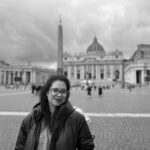
Aurora Velásquez, 40, was sleeping in her home in Petare, one of the largest neighborhoods in eastern Caracas, Venezuela’s capital, when she heard her parrot Kenny squawking. It was Saturday, Jan. 3, and the time was 2 a.m., so her pet’s behavior was unusual. A few minutes later, she heard a loud bang, accompanied by the sound of fighter jets streaking across the city’s dark sky.
The explosions continued as the windows shook and the jets flew by. The roaring noise awakened her husband and son, who turned to social media for information about what was happening.
Hours later, the Donald Trump administration confirmed that it was behind a series of attacks that hit military and civilian areas in Caracas, as well as in three other Venezuelan states — Miranda, Aragua and La Guaira.
Shortly afterward, a news story spread through Venezuelan WhatsApp groups — a story so astonishing that, for many Venezuelans, it seemed like fake news: Donald Trump, president of the United States, announced on Truth Social that the U.S. military had carried out a successful raid to capture Nicolás Maduro, until then the president of Venezuela.
Maduro was only days away from completing the first year of his third term as the country’s leader, following the contested 2024 presidential elections, after which Maduro’s authoritarian regime declared itself victorious despite failing to present voter tallies or other proof of the results. The opposition, however, had gathered the tally sheets, which indicated that the winner had been Edmundo González, the opposition’s candidate. When protests erupted across the country, thousands of demonstrators were arrested and dozens were killed by government security forces.
Now, Venezuelans were learning that Maduro was being taken to a prison in New York, alongside his wife, Cilia Flores, who was also captured in the raid.
“It was horrible. We heard repeated explosions, and my mother, grandmother and I stayed at the entrance to our flat,” said a 27-year-old woman who requested anonymity for safety reasons, because she lives in El Valle, south of Caracas, an area near Fuerte Tiuna, one of the country’s military complexes that was affected by the U.S. attack. “My mother looked out the window and saw an orange flame. After the first explosion, the power went out and I had no phone signal. We found out what had happened in the morning,” she told New Lines.
The explosions left several areas of Caracas without power and, therefore, without telephone service. Social media and international outlets soon showed worldwide celebrations by Venezuelan exiles, the vast majority of whom left the country due to the crisis brought about by the authoritarian government. In Caracas, the atmosphere was much more subdued.
On Monday, Jan. 5, the Venezuelan government issued a decree declaring a “state of external commotion,” granting broad powers to the presidency and authorizing security forces to arrest “any person involved in promoting or supporting” last Saturday’s military raid by the United States.
“National, state and municipal police forces shall immediately undertake the search and capture throughout the national territory of any person involved in promoting or supporting the armed attack by the United States of America against the territory of the republic … with a view to their prosecution,” the text states.
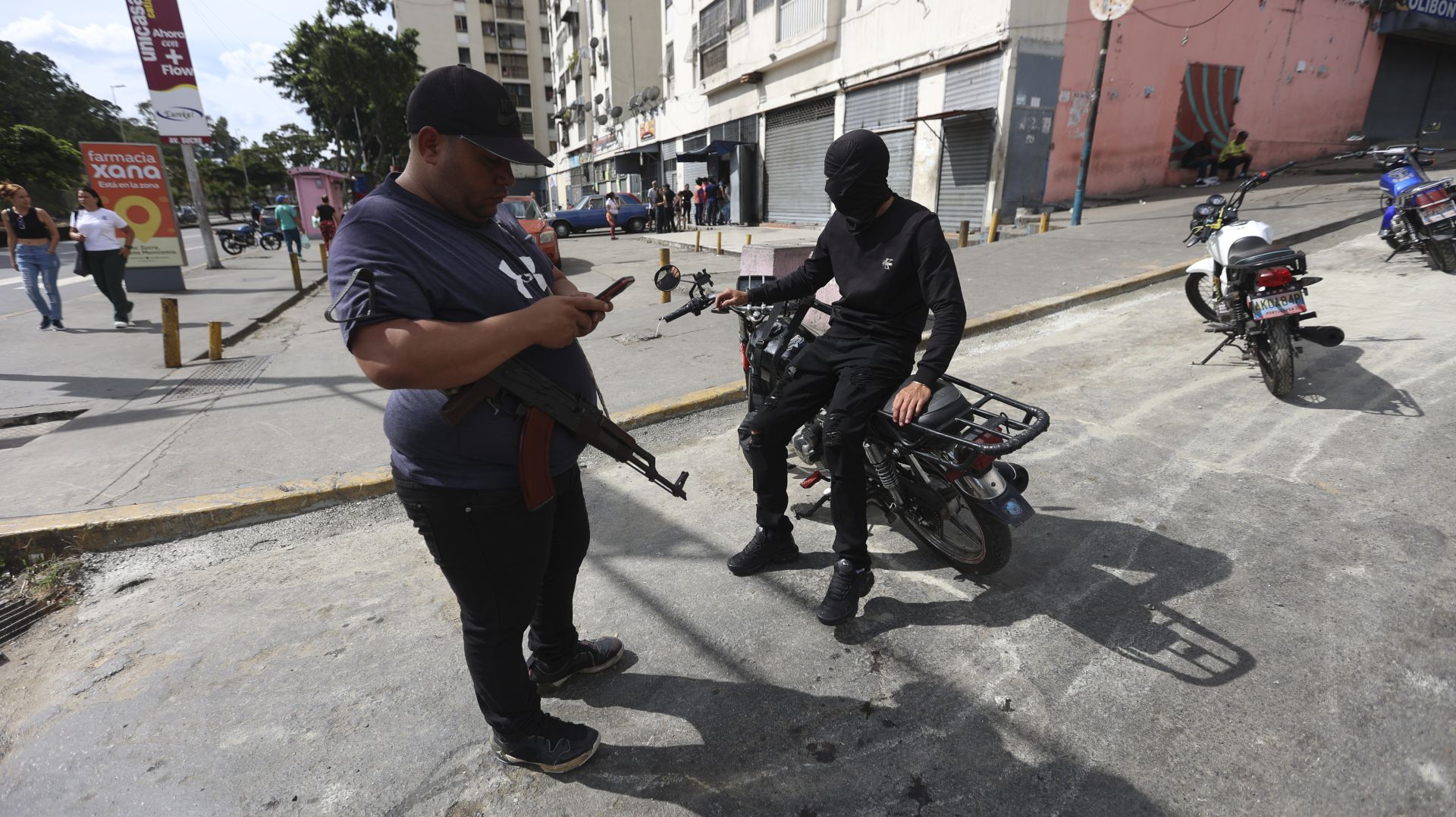
Today, on the streets of Caracas, paramilitary groups of pro-regime civilians known as “colectivos” — hooded and dressed in black — can be seen roaming about. On motorcycles and sometimes armed, they frequently guard neighborhood entrances or station themselves outside businesses to intimidate customers.
People are afraid of being targeted. Many, if not all, avoid talking to the press because they fear retribution. “I have nothing to say,” a taxi driver sitting on a bench in a northern district of the city told New Lines, when asked for his opinion on the attacks.
Venezuelans are taking digital precautions. In WhatsApp groups, users activate auto-delete functions for messages. Others exchange tips on how to conceal sensitive conversations. These measures are not new: Since the 2024 presidential elections, government officials and armed militias have made it routine practice to stop people and search through their phones, looking for signs of opposition to the government.
Caleidoscopio Humano, a Venezuelan nongovernmental organization dedicated to raising awareness of human rights violations in the country, reported that, as of Tuesday, Jan. 6, various citizens remained in detention after being searched at checkpoints by armed civilians and accused of celebrating Maduro’s “arrest.”
That same day, the police in Merida, a state in western Venezuela, reported on their Instagram account that they had arrested two citizens who celebrated the “kidnapping of President Maduro.”
Hundreds of Venezuelans flooded the streets of Caracas on Saturday morning following the U.S. military raid. Unlike their compatriots abroad, hardly anyone was celebrating — or mourning — the news. Having spent the night without sleep, they formed quiet lines in front of supermarkets, pharmacies and bakeries to stock up on food and other essential supplies.
Once again, uncertainty has befallen a country that has experienced 26 years of nominally socialist rule — a country with repeated and severe food and medicine shortages, where security forces violently suppress anti-government protests and hyperinflation reached 130,060% in 2018.
Last year, inflation fell to lower levels — “only” 470%, according to estimates from the Venezuelan economist Asdrúbal Oliveros. It has become normal in Venezuela to rely on independent projections, since the government has grown increasingly reluctant to release official economic data. In the case of inflation, the Central Bank of Venezuela has not published official figures since 2024.
Given its staggering abundance of oil — the largest proven crude oil reserves in the world — Venezuela is, on paper, one of the richest countries on Earth. But the economic and political crisis runs so deep that 8 million citizens, a quarter of the population, have left the country seeking better opportunities abroad — most of them young. A 2021 study by researchers at the Andrés Bello Catholic University in Caracas estimated that about half of those who left between 2013 and 2021 were between the ages of 15 and 29.
Over the weekend following the U.S. attacks, public transport did not run across Caracas, the streets remained empty and the food shops served customers behind closed doors and controlled their entry, fearing possible looting.
“I stay out of everything, I don’t say anything about one side or the other [the government or the opposition]. It’s better to stay out of it because that way you protect your family too. I hope all this passes so things can get better,” Velásquez told New Lines, while sitting in a square in eastern Caracas. “I just ask that the dollar goes down. We are Venezuelans and we are using dollars, we get paid in bolivars but we pay everyday stuff in dollars.”
Venezuela’s national currency is the bolivar, but high and unpredictable inflation has made it nearly worthless. With prices in bolivars fluctuating wildly from day to day (and sometimes from hour to hour), citizens have turned to U.S. dollars to preserve their purchasing power. After years of tight control, the government has loosened its hold on the foreign exchange market. However, there is currently a significant gap between the official exchange rate set by the Central Bank of Venezuela and the black market rate, which is used by most Venezuelans. In practice, a dollar fetches far more bolivars on the black market than the government’s rate.
“No one wants to hold bolivars for long because they lose value, so they convert them into foreign currency or assets. Everyone does this, from the most humble informal worker to the largest company. No one wants to hold balances in bolivars for a long time,” said Giorgio Cunto Morales, a Venezuelan economist and data specialist.
Since Maduro took power in 2013, Venezuela’s economy has shrunk by more than 80%. The monthly minimum wage in the country is less than $1.50, pushing people to take informal and precarious jobs. Velásquez, for example, works as a bartender and in child care despite having a bachelor’s degree in computer science.
As Oliveros, the economist, told New Lines, Venezuela’s economic situation has gotten even worse as a result of U.S. military action in the Caribbean and its seizure of oil tankers linked to exports of Venezuelan oil. “[Because] the flow of oil has stopped, foreign currency has not been coming in,” he explained.
On Monday, Maduro pleaded not guilty when he appeared for the first time before a U.S. federal judge, to whom he claimed to have been “kidnapped” and insisted that he remains the president of Venezuela. The 63-year-old deposed Venezuelan leader and his wife were taken to the U.S. District Court for the Southern District of New York for the reading of the charges against them for drug trafficking and other crimes.
Hours later, in Caracas, Delcy Rodríguez, Maduro’s vice president, was sworn in as acting president at the Supreme Court of Justice, known for its affiliation with Chavismo, the ideology of Venezuela’s ruling party. The swearing-in was conducted by Delcy’s brother, Jorge Rodríguez, the president of the National Assembly (Venezuela’s legislative branch), which is also controlled by the governing party.
“In the end, we’re back where we started, because they put that woman in power,” said Belky González, a 45-year-old housewife, from a square in central Caracas.
Among those interviewed by New Lines, the sentiment was unanimous: Even with Maduro sitting in a jail cell, the same government, wielding the same tactics, remains in power, except now the figurehead’s name has changed.
Despite pervasive fear, uncertainty and the threat of persecution, the streets have gradually returned to normal, with public transport operating, people going to work and more businesses opening.
“There has to be a transition, there has to be a change, because otherwise, how can we go on?” Tito Sánchez, a car park attendant, told New Lines. “I am not a supporter of this government. There has to be a change for the better, and it has to be a national consensus. We want work and peace.”
Become a member today to receive access to all our paywalled essays and the best of New Lines delivered to your inbox through our newsletters.