


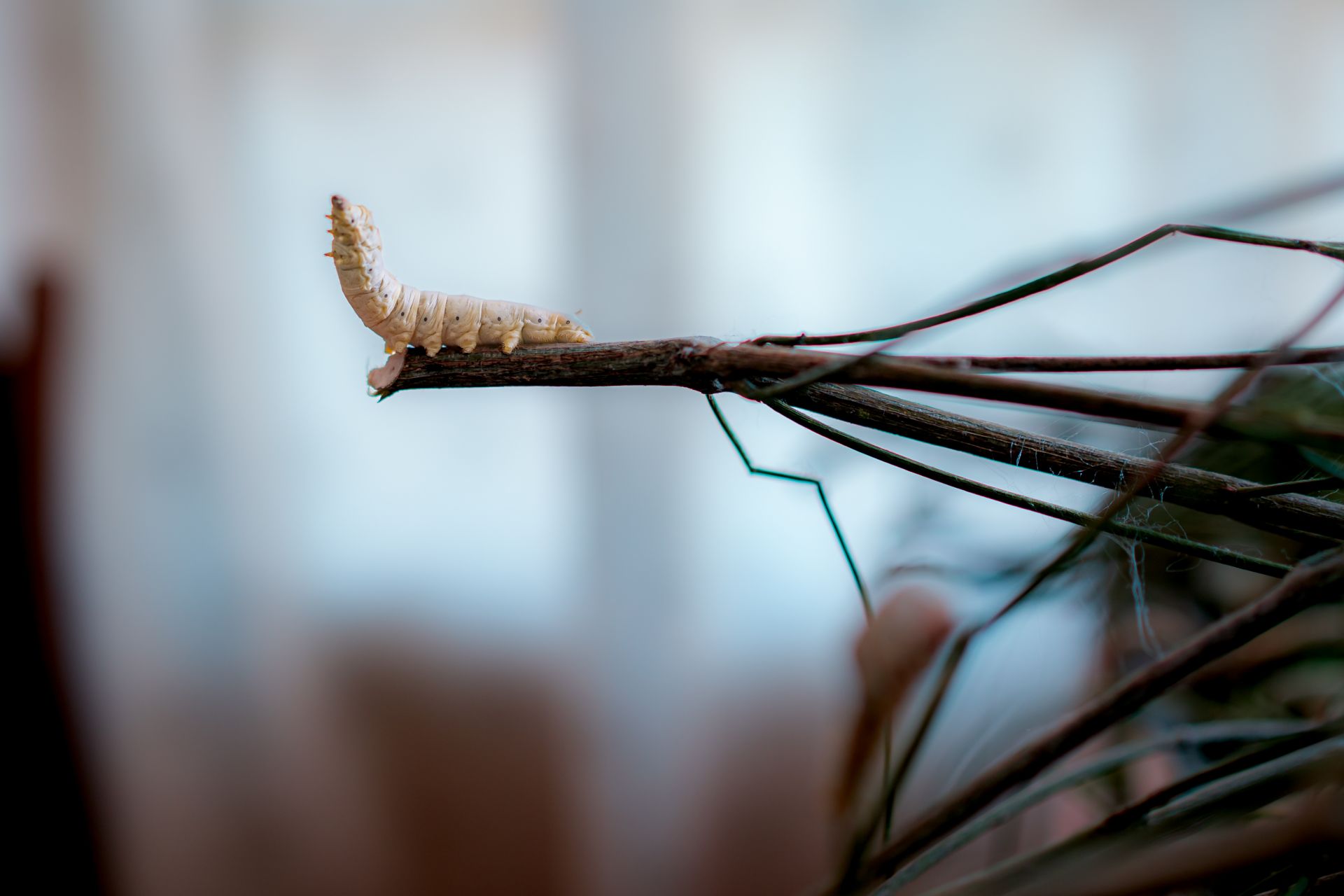
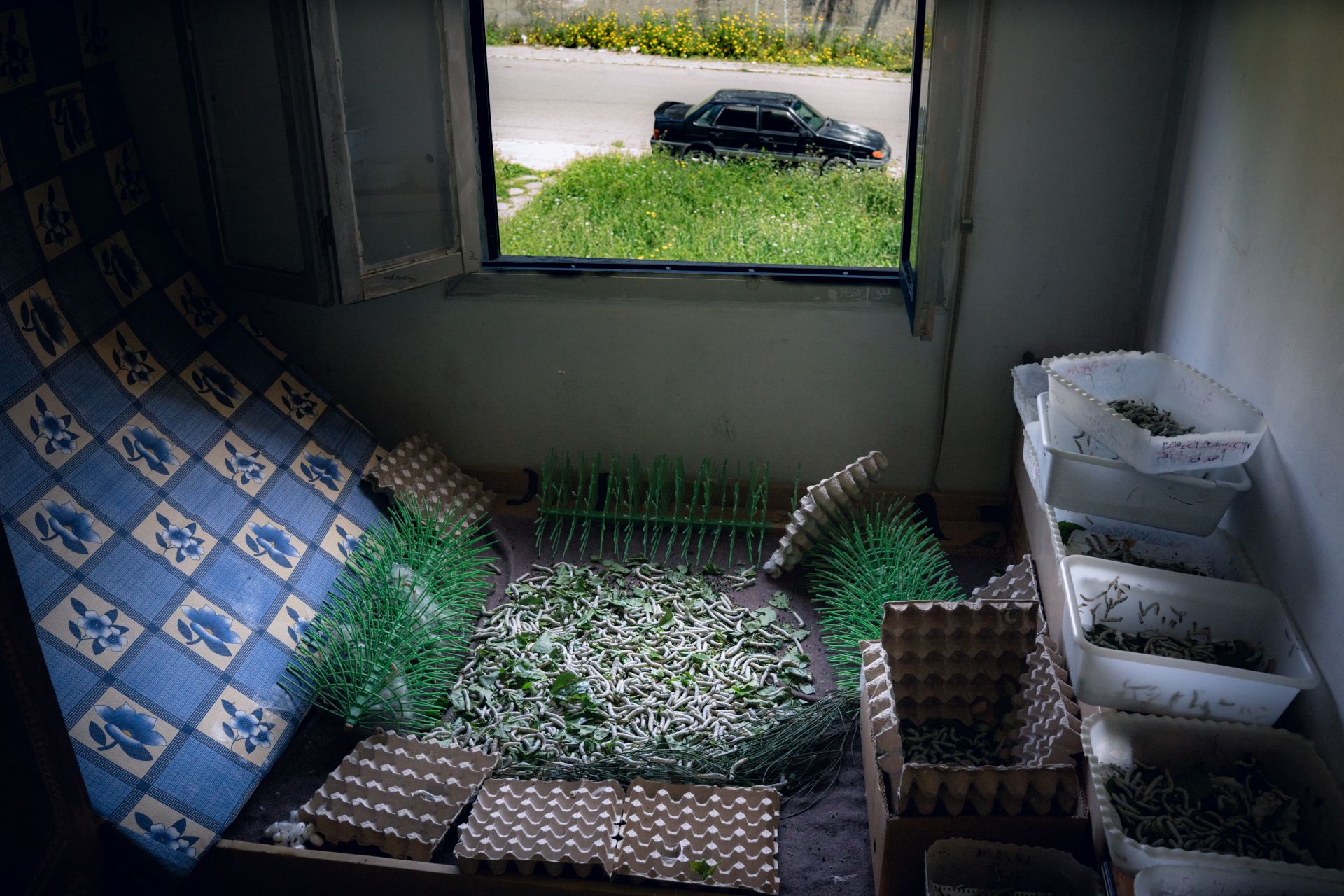

Under the pale glow of a neon light lies a bed of freshly cut leaves spread across some tables. As eyes adjust to the darkness, a mass of white forms gradually comes into view, along with the faint sound of chewing. Here, day and night, thousands of silkworms feed exclusively on white mulberry leaves supplied by Mohammad Saoud, 70, and his wife Amal Saoud, 68.
The art of silkworm breeding has been passed down the generations of the family, an Alawite household that has lived in the Syrian village of Deir Mama for centuries. In their two-story home, nestled on the green slopes of the Jabal Ansariyah, a dedicated room is prepared each spring to house the silk-producing moth larvae. In Syria, the family is among the last to continue natural silk production.
For the family patriarch Mohammad, a retired schoolteacher with twinkling eyes and an always impeccably tailored shirt, abandoning this tradition is out of the question despite economic hardship and the lack of market opportunities. Deeply attached to the practice, he views it as inseparable from his identity.
“Silk is an integral part of the history of our region, of the village and of the collective memory of the families who live here,” he explains. “For centuries, Deir Mama has been a renowned center for cocoon production, and the village was once a stop along the Silk Roads linking Tadmor [Palmyra] and Aleppo to the ports of the Levantine coast.”
Imported from China, where the silkworm was domesticated more than 5,000 years ago, silk production in Syria dates back to the sixth century CE. Traditionally, silkworm breeding was carried out by women along the Syrian coast, in the countryside around Homs and Hama, as well as in the Ghouta near Damascus, the city’s breadbasket region that endured hundreds of airstrikes from the Assad regime and Russian jets, as well as a sarin attack.
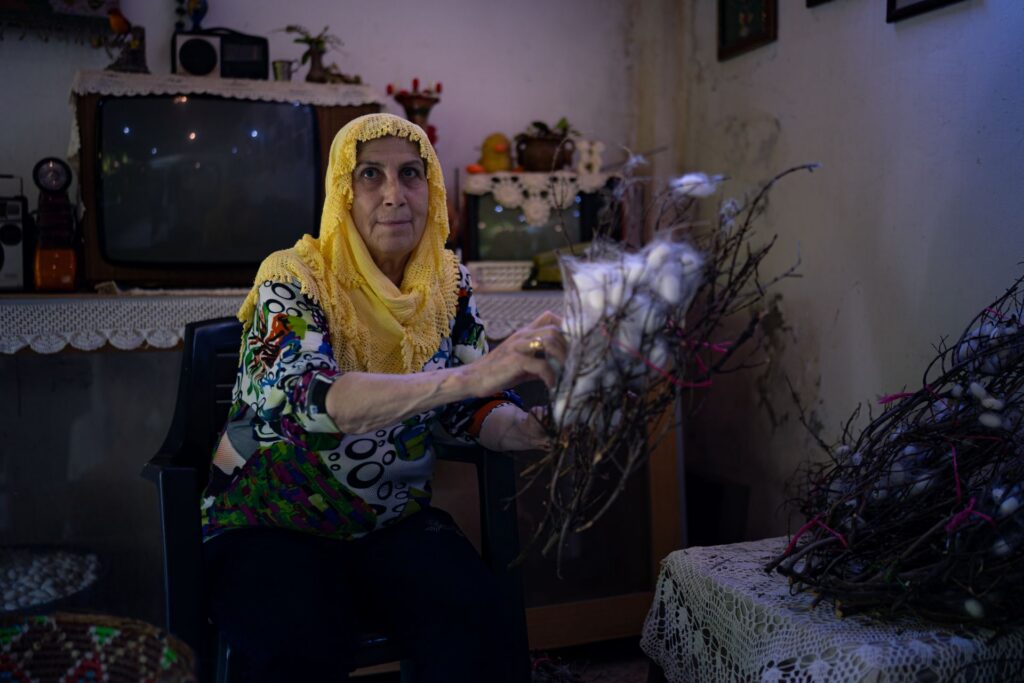
As a seasonal activity, silk production always provided a supplementary income, as it does for the Saoud family. Until the middle of the 20th century, silk intertwined the landscapes and social fabric of Syria and neighboring Lebanon. It also attracted foreign powers, becoming entangled in French colonial ambitions in the Levant. When Syria’s last mechanical silk mill, located in Dreykish near the city of Tartus, shut down at the onset of Syria’s uprising in 2011, the production chain was broken, and most breeders abandoned the trade. And so, from the 1960s to the present day, Syrian silk production has collapsed in stages, falling from more than 300 tons annually to less than 1 ton in 2025.
Several factors explain this decline. First came foreign competition, particularly from Asia, as well as the rise of artificial silk, which proved cheaper to produce. The nationalization of spinning mills and the Assad regime’s lack of support for the industry also dealt it a severe blow. Ultimately, the civil war nearly wiped out Syrian silkworm breeding altogether. Between 2011 and 2014, production ceased entirely and has only marginally resumed since.
“Thirty years ago, almost every family in Deir Mama raised silkworms each year. Today, only four households continue this tradition,” lamented Mohammad Saoud.
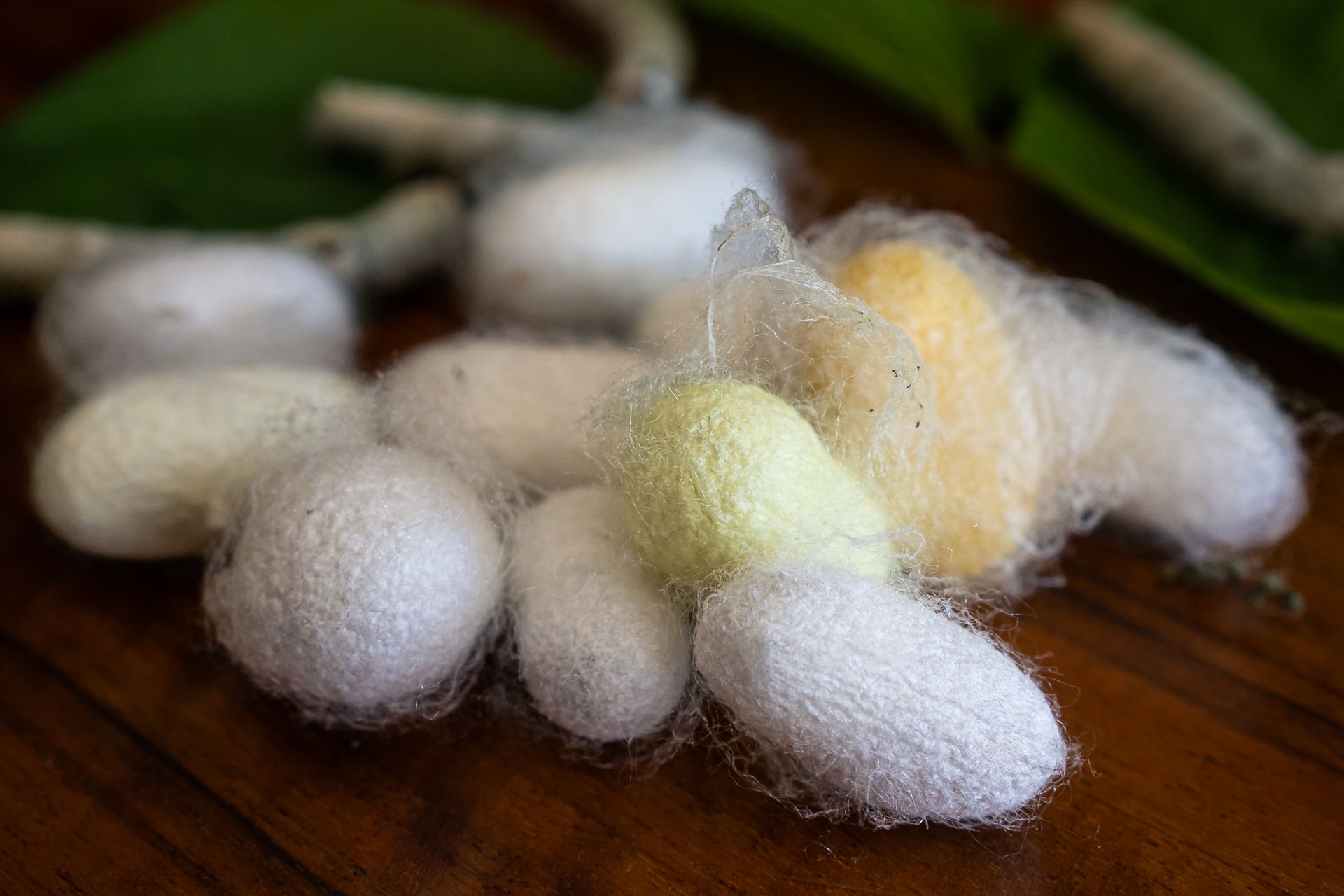
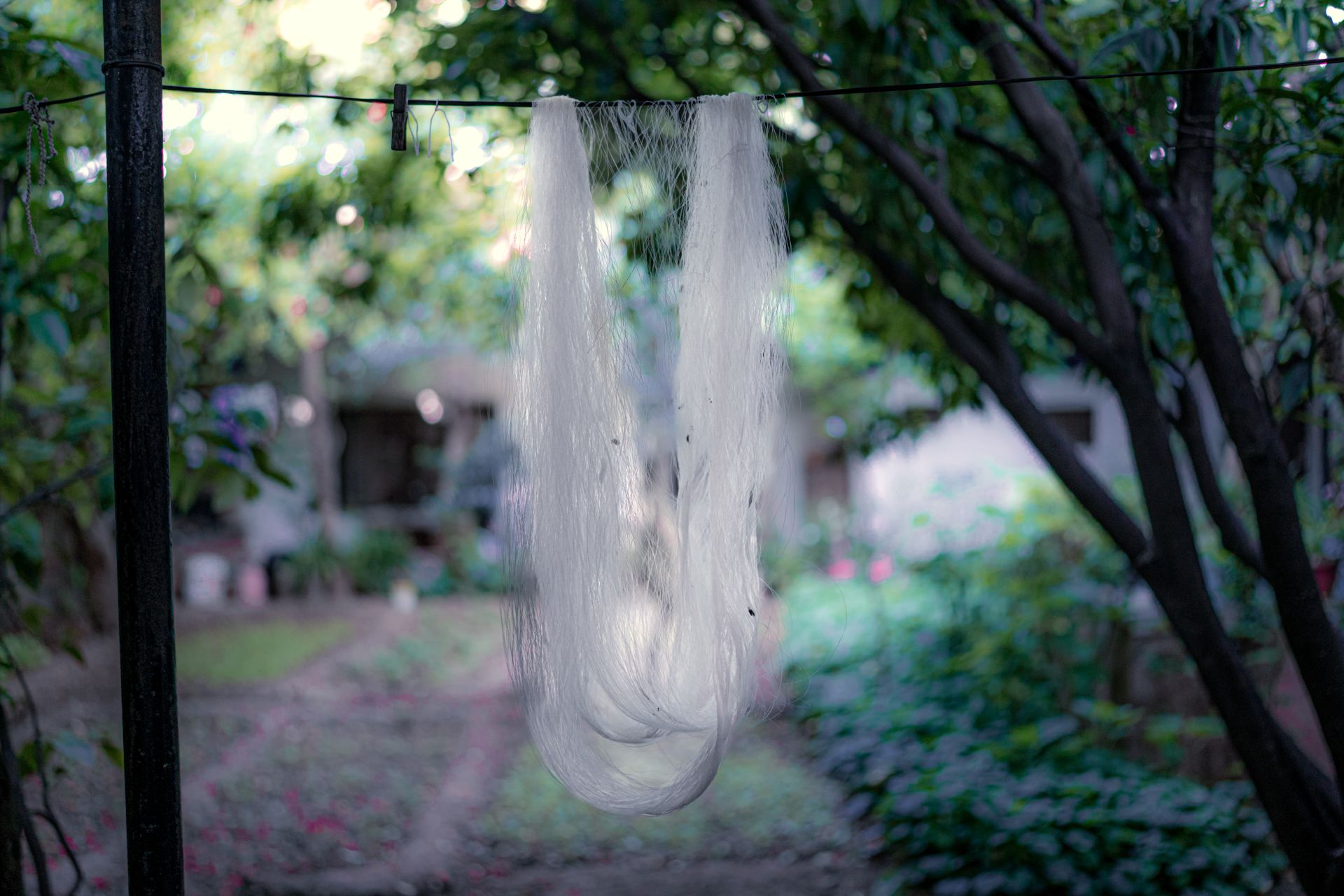
This year, as has increasingly been the case in recent years, the three Saoud sons contribute most of the harvest under the supervision of their parents. Once the breeding period is over, the silkworms spin cocoons made of silk threads. After a few days, and before they mature enough to transform into moths, the cocoons are immersed in boiling water and the filament is unwound to form raw silk, which is then used to manufacture various silk products.
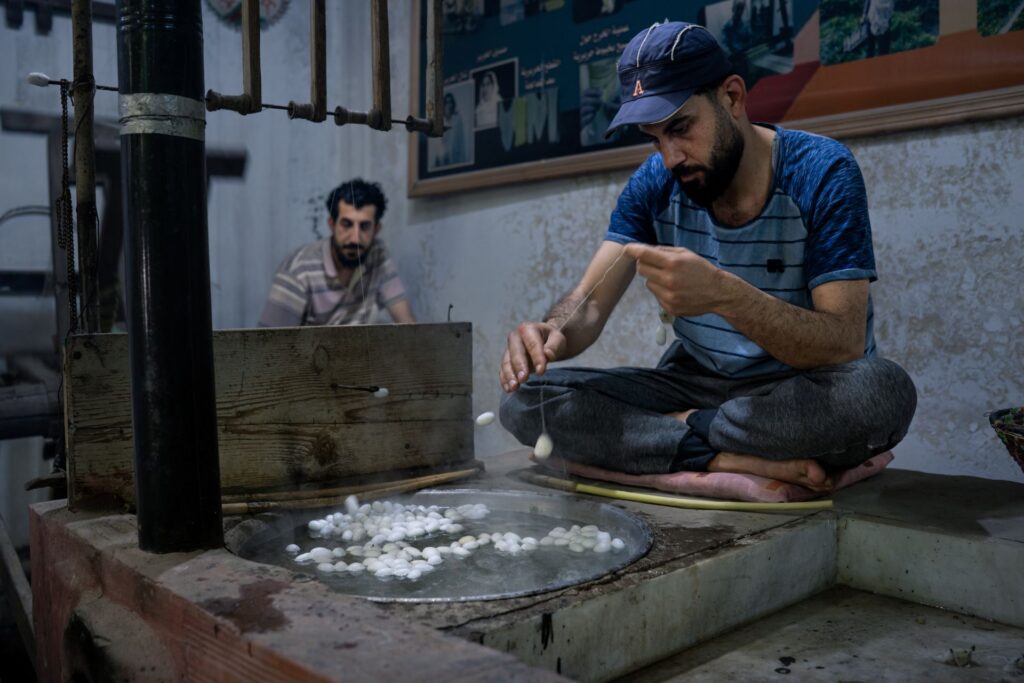
With a scruffy beard and making gentle movements, Ahmad, 34, is bent over a 150-year-old spinning wheel almost as tall as him. Standing next to him is Ali, 37, who handles the cocoons and ensures that the thread is distributed evenly across the wheel. Behind them, their younger brother Yaqzan, 30, films the process on his phone, planning to post the videos on social media to promote the family business.
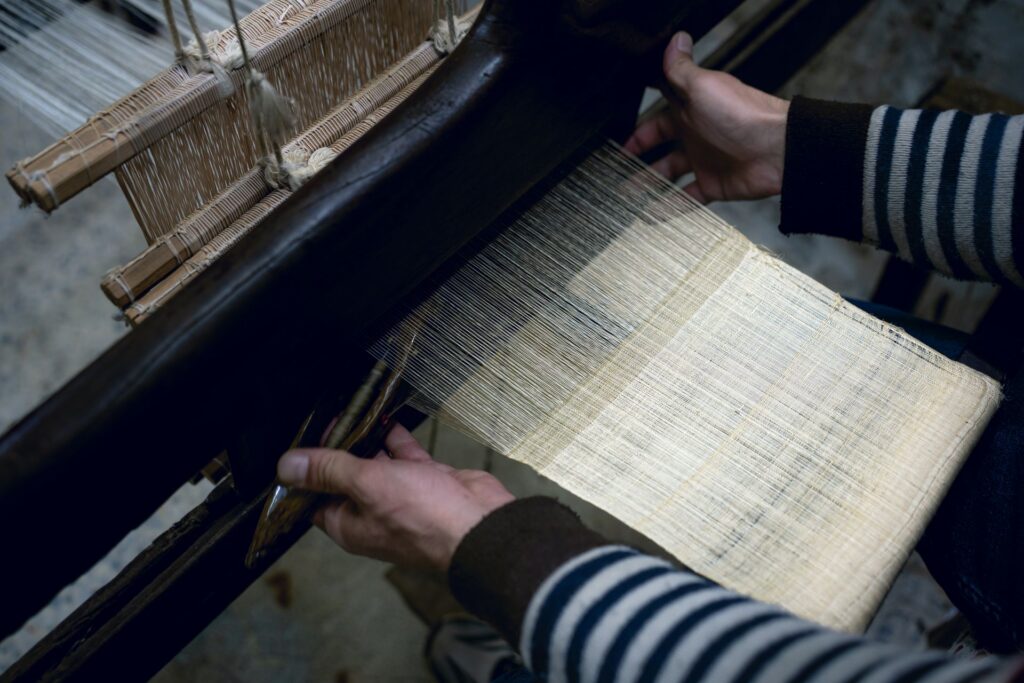
The brothers are among the few younger people in Deir Mama who have acquired the know-how to complete every stage of silk production, from raising silkworms to weaving textiles. For Ali, one of the main reasons younger generations have lost interest in silkworm cultivation lies in changing mentalities.
“Most people in Deir Mama have lost the village spirit that once encouraged self-reliance and local production. Silkworm breeding was part of that ecosystem, but it is gradually disappearing. Today, someone who works behind a bank counter no longer thinks about raising silkworms when they return home in the evening,” explains Ali, who also works as a lawyer in the neighboring city of Masyaf.
Sitting next to his son in the family courtyard, the walls of which are decorated with silk products and old artifacts used by his ancestors, his father Mohammad agrees.
“The problem with our era is that people are in a hurry. If they invest, they want a quick return. If they get married, the first clash leads to separation. We are suffering from these changes, from a way of life that does not correspond to our customs or to the patience required for silk production,” Mohammad says.
If silkworm breeding has declined so dramatically, it is also because it requires time and effort without necessarily guaranteeing substantial profits. The silkworm growth cycle lasts around 40 days, during which they must be fed daily, monitored closely and kept in carefully controlled conditions.
Entirely dependent on humans, the silkworm feeds exclusively on white mulberry leaves, which must be provided four times a day. As Ahmad Saoud explains, an average harvest involving between 20,000 and 30,000 silkworms requires over half a ton of mulberry leaves, and yields around 100 pounds of cocoons. To create just one piece of shawl from natural silk, it requires around 20 pounds of cocoons, or around 5,000 silkworms.
Amal Saoud, 68, dignified beneath a white crocheted silk shawl of her own making, evokes the rhythm of the harvest. Each year, she lives through it, though she admits some weariness. “I no longer have the enthusiasm of my youth, the motivation to collect mulberry leaves or to hand-spin the silk once the cocoons have formed.” Gradually, her three sons are taking over these tasks under her supervision.
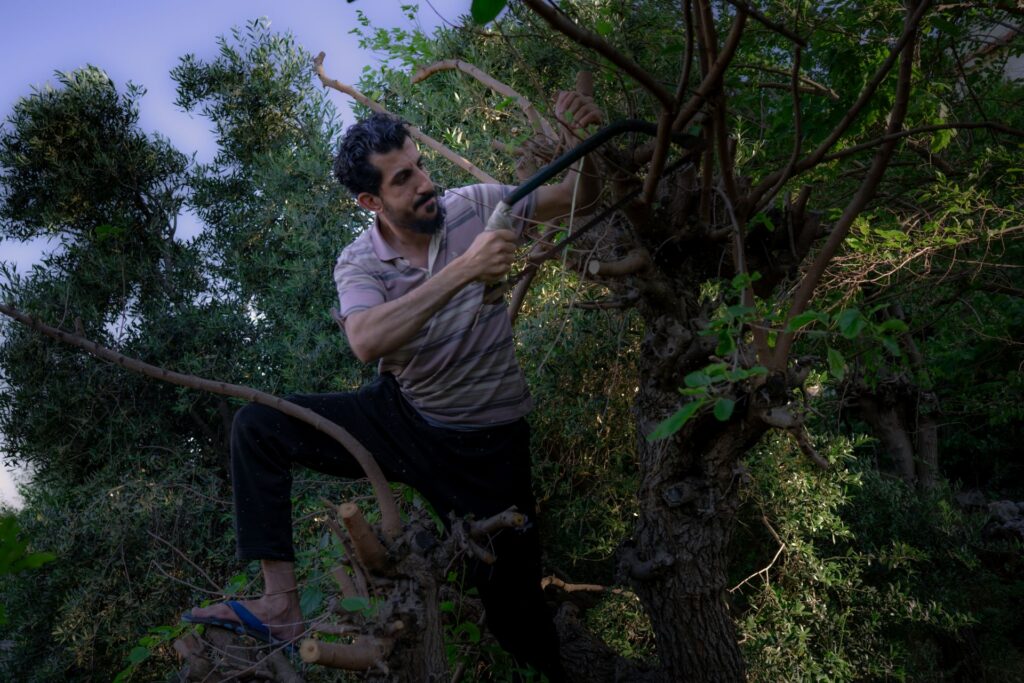
In the past, Syria’s silk-producing regions were covered with white mulberry trees. Their disappearance from the landscape symbolizes the population’s growing disinterest in silk production. “In Deir Mama, we knew no trees other than mulberry. When I was young, I didn’t even know what an olive tree looked like,” recalls Mohammad Saoud.
Times have changed. From the Saoud family home overlooking the Ghab Plain, the view from the terrace now stretches across hills covered in olive groves, considered more profitable and less labor-intensive by local residents.
A handful of mulberry trees remain in the village, particularly two centuries-old specimens in front of the Saoud family home, enabling them to feed their silkworms. But any large-scale revival of production would require extensive replanting. Without mulberry trees, silkworms simply cannot survive.
Some 60 miles to the northwest, in the countryside of Latakia, Sahar Hmeichou is also leading the fight to preserve silkworm breeding.
Born in 1966 and originally from Syria’s Mediterranean coast, she is a historian currently working on a book about the history of silk in her country. For the past decade, she has been passing on expertise inherited from her grandmother, who raised silkworms each year, and has trained more than 20 people in silkworm breeding, including her friends Suzanne Aziz Hattab and Lina Kinnan.
In 2015, at the height of Syria’s war, she met Suzanne, who at the time worked as an agricultural engineer with the Ministry of Agriculture. Together, they decided to preserve the remaining stocks of Syrian silkworm eggs, so they discreetly removed part of the ministry’s reserves, a move they credit with saving the local silkworm strain from near extinction. For the ensuing years, as the war raged on, Sahar hid the eggs in her refrigerator at home, convinced that she and fellow silkworm proponents might one day bring back a craft that many believed had vanished forever.
In May, in the midst of the silkworm breeding season, Suzanne welcomes New Lines and her friend Sahar into her Latakian apartment, her navy-striped shirt catching the salt and pepper of her hair. She shows off an entire room that she has converted into a silkworm nursery. Sahar marvels at the caterpillars’ progress, comparing them with her own, which are not as big yet, and affectionately addresses the caterpillars with a series of diminutives.
“Even if Syria were to die, we would preserve its silk!” Suzanne declares.
For both women, the challenge is to show that Syrian know-how has not been lost and that there are still ways to ensure its long-term survival.
“We have the experience, we have trained people; all we lack is government support. Both the Assad regime and the current authorities have expressed interest in supporting silk producers, but those intentions have never materialized,” laments Sahar, adding that “many new employees of the Ministry of Agriculture have absolutely no clue about how silk is made, and therefore don’t understand why it’s important.”
“In addition to preserving a social and environmental heritage, there is also a financial dimension,” she explains. “The sale of cocoons, or the production of silk goods by breeders themselves, can generate supplementary income which, in the current economic crisis, would be welcomed by many Syrians.”
If market opportunities emerged, “silkworm breeding would resume on a large scale in Syria,” the two women predict in unison.
Yet Sahar remains realistic. “Compared to production levels of 20 years ago, Syrian silk is now close to zero. The priority is therefore to preserve what remains, and to encourage those who wish to return to this activity, before rebuilding a network and reconnecting producers and manufacturers.”
In the old souks of Aleppo and Damascus, no merchant selling silk products is sourcing materials from Syria anymore. All have been driven by both economic and quality considerations to import their thread, which is often synthetic, from abroad, turning their backs on a long history of local production.
Antoun Mezannar, 45, heir to a prominent family of Damascene weavers operating since 1890, owns one of the last brocade workshops in Syria. For him, the thread now produced locally is no longer of sufficient quality for modern silk-working machines, as it is not properly twisted in industrial spinning mills.
“My family historically bought silk thread from the Dreykish, but since the war we’ve been buying everything from China. If Syrian producers ever had the opportunity to offer me a thread of the same quality as the Chinese one, I would turn to them without hesitation,” he says.
“Recently, people came to me with silk thread presenting themselves as Syrian producers,” Antoun recounts, “but I quickly saw that their thread was not really suitable for my production and would not have withstood my machines, so I had to refuse.”
“Even if they had offered me a kilo for $1 [the usual price is $100 per kilo], I would have refused,” he adds.
In Deir Mama, the fall of Assad has opened new horizons. A few years before the war, the Saoud family inaugurated a “Museum of Syrian Silk” in their home and began welcoming tourists who purchased their products directly. “Between 2008 and 2010, we quadrupled our production, going from 50 to 200 kilos of cocoons per year to meet demand,” recalls Mohammad Saoud. “Tourists came from everywhere, but the war brought our activities to an almost fatal halt. For the first five years, we were unable to raise silkworms because there were no eggs anymore.”
Now that domestic tourism is developing again in Syria, Mohammad hopes to once again benefit from his expertise and from Deir Mama’s privileged position. “Our village is well located on a tourist route between Masyaf, the archaeological site of Apamea, and Hama. The government now needs to make efforts to promote handicrafts in this part of the country,” he insists. Foreign tourists will also need to return, as they were the Saoud family’s best customers, given the high production costs of handmade silk products, unaffordable for most Syrians.
This golden age is something Ahmad Saoud remembers and hopes to revive by relaunching the family business. During the war, he and his younger brother did not report for military service. “For eight years, Yaqzan and I were wanted [by the Assad regime authorities] and lived under the radar. When Assad fell, I was one of the happiest in the village, because a new chapter of my life had opened and I hope to make the most of it.”
The massacres that took place on the coast in March 2025, targeting the Alawite community, have undermined these hopes. Even though Deir Mama was not directly affected by the violence, which left more than 1,500 civilians dead, people in this mostly Alawite region now struggle to trust the new authorities.
Ali, Yaqzan and Ahmad Saoud are calling on the new authorities “to make a better future possible for the younger generations and to stop stigmatizing entire communities as used to be the case under Assad.”
“I’m tired of living in limbo since the war, day by day,” Ahmad says. He dreams of opening a training center above the family home in Deir Mama. He would like to teach young people how to raise silkworms and produce fabrics and shawls from silk, as his family has always done. For this, he is calling for support from the state or a benefactor.
“I want to help people live with dignity from their work, and bring tourists back to Deir Mama. We have endured hell for 15 years. Enough with the humiliations and reprimands! All we want is a better life, and I believe it’s achievable through silk, even if it takes time and effort.”
From Latakia’s countryside to Deir Mama, in these agricultural regions where silk was once a source of wealth and pride, not everything is lost. Preserved by elders, revitalized by some like Sahar, and carried by the optimism of younger generations, Syrian silk is still hanging by a thread, determined not to be forgotten.
Become a member today to receive access to all our paywalled essays and the best of New Lines delivered to your inbox through our newsletters.