

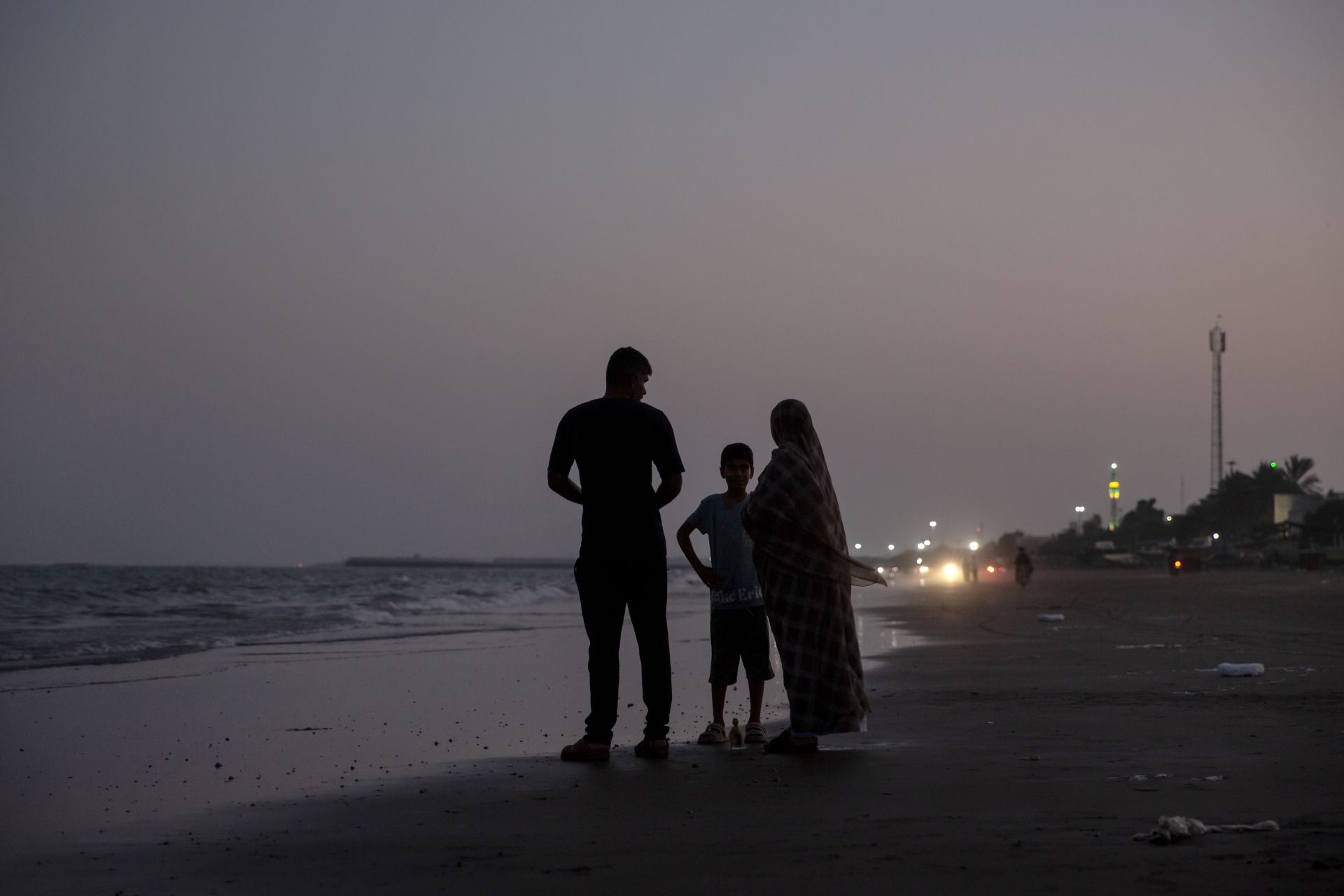
The average air temperature in the southern Iranian city of Bandar Abbas has hovered around 43 degrees Celsius in recent days. While summer temperatures have always been difficult for people in the region, enduring the heat in Bandar Abbas has been far more challenging this year due to the impact of U.S. attacks on the city and its surroundings — including damage to power stations and infrastructure that has subjected the city to rolling blackouts and disrupted access to air conditioning and other critical services.
Iran’s southern coastline stretches 3,000 miles, from the Iraqi border to Pakistan, including the country’s islands in the Persian Gulf. Since hostilities resumed between Tehran and Washington this month, the U.S. military has been striking this long coastline, home to 14 million people.
Bandar Abbas is Iran’s most important commercial port, through which roughly 70% of the country’s imports pass. Two years ago in April, the same port was hit by a massive explosion and fire that disrupted trade for weeks and for locals brought to mind the notorious Beirut port explosion of 2020.
The city has become grimly accustomed to war of late: Bandar Abbas was also targeted during the 12-day war in June and July of last year, as well as during the February-March campaign earlier this year dubbed “Epic Fury.” The U.S. is now engaged in a third wave of attacks. Ali, who runs a falafel shop in Bandar Abbas, was recording an ordinary video about his restaurant on the first night of this latest round of U.S. strikes when he was startled by the deafening sound of an explosion. His phone camera was still recording and his Instagram livestream was still running as he rushed out of the shop. Crying out, he began urging his neighbors to flee the neighborhood.
At the same time, people across the rest of Iran watched the scene unfold live on their screens, powerless to do anything about the terror that had descended upon their fellow citizens in the south.
The attack that Ali captured was a strike on Bandar Abbas’ Panj Peleh Pier, a commercial dock serving civilian passenger vessels as well as fishing boats. The attack also struck the city’s fish market, which is connected to the pier. The video he recorded in the first moments of the attack horrified many Iranians, and has been viewed more than 4 million times on Instagram.
Two days later, Ali posted another video to Instagram. In it, he said: “At night, we can’t sleep because of the sound of bombs and missiles. During the day, we can’t live because of the power cuts. What have we done to deserve this? What have our little children done to deserve dying in this heat? Between the heat and the war, our business has come to a standstill.”
The impact of the attacks has devastated a coastal city where the fishing industry has for generations been both an economic lifeblood and a core part of local identity. U.S. missile strikes on small boats have already destroyed the livelihood of many fishers, while the uncertainty triggered by the war has made it impossible for others to operate.
“Fortunately, we weren’t at the fish market when it was attacked. But when they struck the pier, the fishing boats belonging to these poor fishers suffered enormous damage. Many boats were destroyed and can’t be repaired. Many others have also been affected because the pier itself has been destroyed,” said Iman, a 47-year-old fisher and vendor from Bandar Abbas. “But the problem isn’t just these recent attacks on the fishers’ docks. The problem is that when there’s a war, the sea becomes unsafe, and the number of days when you can go out to fish drops dramatically.”
In addition to strikes on fishing piers, U.S. attacks have struck local airports. This has made it impossible to send fish caught locally to other parts of the country. The destruction of the local fish market has also deprived locals of a place to sell their own catch inside the city. The cumulative effect of the attacks has been the steady erosion of the local economy.
“When the catch declines, naturally the price of fish goes up. At the same time, many people are unemployed, and because they have no income, their purchasing power has fallen,” Iman continued. “Do you see what’s happened? The catch is smaller, there’s less fish in the market, and the available fish is more expensive. At the very same time, people have less money to spend.”
On top of the disruption to his ability to earn a livelihood, the impact of the war, the end of which seems nowhere on the horizon, has frayed the nerves of Iman and other locals who fear for the future of their region after the widespread destruction of civilian infrastructure.
“The nights when we’re jolted awake by the sound of American missiles, or the days when the unbearable heat leaves us exhausted, that’s one thing,” he said. “But during the rest of the day, these are the thoughts that occupy our minds: In Bandar Abbas they’ve bombed the airport, the railway lines, the city’s roads and the bridge connecting the city to Shiraz. And they’re still saying the attacks will continue. I honestly don’t know what’s left that they haven’t hit.”
Like Iran’s other coastal cities, Bandar Abbas has seaside roads that, after sunset, become gathering places for people to relax. Cafes play live music, families play volleyball and frisbee, and people eat shark omelets, ash-reshteh soup, known simply as “ash,” and locally baked bread. In recent years, this vibrant waterfront has also created economic opportunities for women. With modest savings, many women set up small home-based businesses, baking bread, preparing ash and other light foods, and selling them to visitors along the shore.
Since the war began, however, both the waterfront and the coastal road have been emptied.
“We spent years trying to create a family-friendly atmosphere along the coastal roads here. It was attractive for tourists, and the city’s own residents enjoyed it as well. The government supported women’s small businesses through low-interest self-employment loans, and over time we built something healthy and vibrant,” said Mrs. Jalali, a resident of Bandar Abbas. “The war has reduced everything we created to rubble.”
Bushehr, a city near Bandar Abbas, has also been repeatedly targeted by U.S. attacks in recent days. It is not only home to two Iranian military bases, one belonging to the air force and the other to ground forces, but also to the Bushehr nuclear power plant, which is operated under Russian supervision. The area surrounding the plant was heavily struck during the previous two rounds of attacks on Iran.
“Centcom issues a statement every day around the early morning hours saying that tonight’s attacks are over. Only then do we close our eyes and try to sleep,” said Omid, a 32-year-old resident of Bushehr. “Before that, even if we don’t hear the explosions, we know something is happening nearby from the intensity of the tremors.”
Repeated U.S. attacks near the Bushehr nuclear facility have also raised the fear of residents that they will suffer catastrophic radiation effects if the plant is heavily damaged.
“Bushehr is heavily targeted because it has both an air force base and a ground forces base nearby. Just like during the previous round of attacks, people are deeply worried that eventually one of these missiles will hit the Bushehr nuclear power plant and wipe out the entire region,” Omid said. “During last summer’s war, at family gatherings, some people were advising others to keep iodine tablets at home so that if the nuclear plant was hit, we could reduce the severity of the damage.”
Many of the same communities being struck by warplanes were considered safe havens when the capital of Tehran and other metropolises were being hit by Israeli and U.S. attacks earlier this year. The current offensive against the south has brought back bad memories of the 1980s, when the region came under assault by the Iraqi military during the Iran-Iraq War.
At that time, the region was heavily devastated by Iraqi attacks, forcing many to flee. After spending two generations rebuilding, the prospect of potentially having to abandon communities and livelihoods once again is unthinkable to many in Bandar Abbas.
“Among those who support the son of Iran’s deposed shah, some people living outside the country have been telling people on social media these days to ‘flee the south’ or evacuate the cities. These are people who know nothing about the lived experience of the people of southern Iran,” Omid said. “My cousin said, ‘If I am going to die, then I will die in my own home.’ That is the mindset that exists right now in the cities being hit by American missiles.”
Public anger intensified further following two tragedies at the end of the first week of U.S. attacks on Iran. During heavy strikes on the night of Wednesday, July 15, the grounds of Shahid Baghaei Specialized Hospital in Ahvaz were targeted by missiles. The hospital is one of the few well-equipped medical centers treating children with cancer and has admitted many pediatric cancer patients from across Iran’s southern regions and its western border areas.
The attacks forced an emergency evacuation of the hospital. However, limited facilities and resources meant that hospital officials were unable to transfer the most critically ill children out of the building. Images of the hospital’s condition, shared widely on social media, shocked Iranians throughout the country.
“People are confused and worried and do not know where the country is heading,” said Hajar, a resident of Ahvaz, who added that unemployment had increased in the region after U.S. and Israeli attacks against local steel plants during the previous campaign. “The reality is that if the infrastructure is targeted further, if the electricity and water cuts in 55 degrees Celsius temperatures are repeated in Ahvaz, if hospitals and roads are destroyed further like what is happening in islands and Bandar Abbas, most people will have no choice but to leave the city.”
On the first night of U.S. attacks on Iran during the recent escalation, the port city of Chabahar and its famous 216-foot white Coast Guard Tower — a regional landmark, tourist attraction and masterpiece of local architecture — were targeted. In the days that followed, the tower was struck at least twice more until it was destroyed. After its destruction, U.S. Secretary of Defense Pete Hegseth shared a photo of the collapsing tower on social media.
Sedigheh, the first woman to work in the tower as an operations engineer, watched the destruction of a building that she called her second home.
“The Coast Guard Tower is not — or was not — a military site. When the war began, we were working remotely, so we were not there when U.S. forces targeted it. They first struck the upper part of the tower. One missile landed directly in my office. Then they targeted the lower sections as well. It took several strikes over several days to destroy it completely. Even watching it happen was difficult,” she said. “I was the first woman ever to work there. Two other women joined me over the years, showing how the maritime industry was slowly opening its doors to women engineers and experts. Now all of us are homeless.”As people were mourning the loss of the tower, a U.S. strike on a soldiers’ dormitory in Bampur city, near Iranshahr in Sistan and Baluchestan Province, killed seven soldiers and wounded at least dozens of others. Military service in Iran is mandatory. All men over the age of 18 are required to complete 18 months of military service during peacetime and 24 months during wartime. The young men currently serving in the military were generally born after 2005, and Sistan and Baluchestan is considered one of the most difficult places in the country to serve.
The harsh climate and difficult living conditions are among the reasons for this, as are repeated attacks by Baloch separatist groups and militants operating from Pakistani territory. Now, in the midst of war, the targeting of these young soldiers has sparked a wave of public grief.
“On the third night of the war, they struck Bampur on the road to Iranshahr. When the sounds of explosions began, everyone thought they had hit the power plant. But the reality was a much worse tragedy,” said Rahimeh, a local woman. “These young men were in their dormitory, asleep and unarmed. They were not a threat to anyone. Bampur is a very small city with very few fire engines and ambulances. Its hospital also does not have the capacity to receive people injured in a missile attack. That is why people drove from Iranshahr toward Bampur in their own cars. Anyone who could fit an injured person into their cars did so and brought them back to Iranshahr.”
One day after the Bampur tragedy, a short video was posted on Instagram showing a young conscripted man looking into the camera and saying: “I have 40 days left of my military service, but war has started again. I am recording this video as my last will to say that I love you all very much. My dream of owning a white pneumatic Peugeot Pars never came true. Forgive me. They are going to attack this place, and they will hit us. We are strong, and we will strike back too. But if they hit us and I die, forgive me.”
The phrase “forgive me” (“halal konid”) in Persian Islamic culture is a request for forgiveness for one’s shortcomings and mistakes throughout life. A common religious belief is that if the living forgive the sins and failures of those who have died, God will also forgive them, allowing the deceased to have an easier fate in the afterlife.
One user commenting on this Instagram video, which received more than 3 million views and 14,000 comments, wrote a comment that emphasized the feeling of grief and uncertainty that has overtaken many Iranians, as the U.S. war against their homeland continues: “My dear child, my dear brother, what sin did you commit that you have to ask anyone for forgiveness?”
Become a member today to receive access to all our paywalled essays and the best of New Lines delivered to your inbox through our newsletters.