


The children were already on stage at East Jerusalem’s El-Hakawati Theatre, waiting for the lights to dim and for “Dreams Under the Olive Tree,” a performance celebrating Palestinian heritage, to begin. After months of rehearsals and dressed in full costume, they were finally about to perform before an audience of proud parents and loved ones.
But before a single note could be played, masked Israeli police officers burst into the packed auditorium.
Video of the November 2025 incident quickly went viral. One video captured the moment the armed forces entered the theater in the Sheikh Jarrah neighborhood in occupied East Jerusalem.
In another clip, an Israeli official is seen waving a document and ordering theater staff to evacuate before shutting down the performance.
Other footage captured the aftermath of the raid from different angles: children in costumes crying and moving through the chaos as they searched urgently for their parents, police officers blocking the doors to the stage. One boy, appearing visibly distressed, was filmed vomiting in the theater lobby.
“The police came in and started shouting, ‘Out! Out!’ And it was panic and kids started to cry,” the theater director, Amer Khalil, told me after the November raid. “I was afraid that they would put tear gas. They had the guns. They did it 10 years ago.”
A veteran Palestinian actor and director, Khalil has spent more than four decades on Jerusalem’s stages and screens, his career unfolding alongside the systematic, accelerating collapse of the Palestinian cultural landscape in the occupied eastern half of the city. During that time, Palestinians have watched their artistic scene contract under Israeli policies and interventions: cultural institutions shuttered, bookshops raided and the renowned El-Hakawati Theatre stormed dozens of times by Israeli authorities.
The latest attack on El-Hakawati, which has operated in the Sheikh Jarrah neighborhood since the 1980s, is part of a broader, long-running pattern of Israeli crackdowns on Palestinian life in the city.
Authorities claimed the children’s play violated laws that prohibit the Palestinian Authority (PA) from operating in the territory of Israel. Israel has broadly applied its own laws banning PA support to the eastern part of the city, despite its annexation not being recognized by most of the international community, cutting off vital funding to Palestinian cultural institutions.
“Actually, the project was funded by the British Council through the EU … as part of a program specialized for art and music in Jerusalem and the West Bank,” the play’s director, Khader Abu-Sway, told me the day following the storming of the play. “They told us we had five minutes to leave,” he added.
Similar laws are routinely applied to shutter or suppress Palestinian cultural events in East Jerusalem, a territory Israel illegally annexed after the 1967 war and which much of the world, apart from the United States and a handful of other countries, still considers occupied territory.
On July 22, 2020, for example, Israeli police and intelligence forces raided the Edward Said National Conservatory of Music, the Yabous Cultural Centre and the Jerusalem Arts Network-Shafaq in East Jerusalem, seizing computers, documents and files. The directors of the institutions were detained during the operation amid Israeli allegations that the organizations were linked to the financing of terrorism, a claim they denied and for which no evidence was presented. Some of the files and equipment taken were not returned.
“Loving Beethoven and your country seem to be a dangerous combination,” the National Conservatory of Music’s director, composer Suhail Khoury, wrote in a statement in the aftermath of the raids.
“Israel now believes it is successfully engaging in a final offensive to shatter the Palestinian community in East Jerusalem, to fragment and atomize it and transform it into a demographic reality with no political or national significance,” said the author Mouin Rabbani, “as in any other situation, cultural institutions are central and integral to sustaining communal life and providing it with its identity. This explains their targeting.”
It’s an evolution I’ve witnessed firsthand. The streets and markets of old East Jerusalem have changed noticeably in the 25 years since I first started reporting from that part of the world. The Jewish presence, once confined to smaller pockets of orthodox and rabbinical schools, has become visibly more dominant and, often, more aggressive. “Jerusalem Day,” the celebration of the Israeli takeover of East Jerusalem, has become an annual display of verbal and physical abuse toward native Palestinian Jerusalemites, often perpetrated by Jewish Israeli teenagers, and protected by Israeli police.
And it wasn’t far from the daily walks I took from my hotel on Sultan Suleiman Street, through Damascus Gate and into the meandering alleyways of the old Souk, on Salah al-Din Street, that another attack on a Palestinian cultural hub took place.
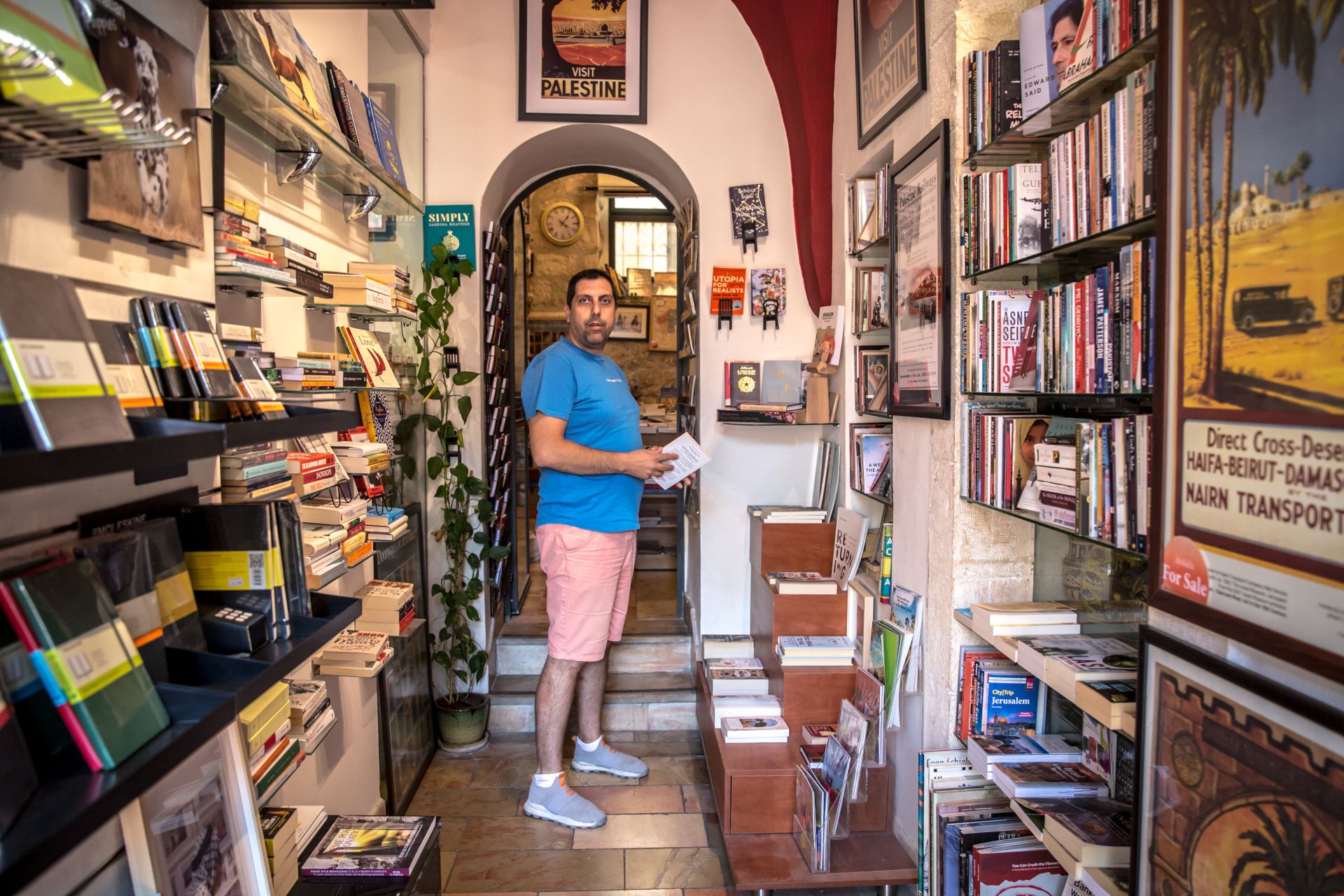
First in February and again in March 2025, Israeli police stormed the historic Educational Bookshop, arresting two of the owners, Mahmoud Muna and his nephew Ahmad.
Officers confiscated hundreds of books, specifically targeting titles bearing the words “Palestine” or “Palestinian,” displaying the Palestinian flag or referencing the West Bank. Among the books taken were works by authors like Noam Chomsky, Banksy and Rashid Khalidi, as well as a children’s coloring book titled “From the River to the Sea,” a single copy of which was in a back storeroom and not for sale.
I met up with the owners, who had been arrested under suspicion of “selling books containing incitement and support for terrorism” at their multifamily home not far from their bookshop in East Jerusalem. They had been placed under house arrest and barred from entering their own stores. Footage of the pair being led into court to face a judge, handcuffed, dazed and wearing brown prison uniforms, had caused widespread condemnation from critics of Israeli policy, who saw in the attack on the city’s Palestinian intellectual class a dangerous escalation of Israel’s attempts to suffocate Arab cultural representation in East Jerusalem.
The conditions under which the interviews had to be conducted were bordering on the absurd. I was forced to speak to the two separately and in their respective apartments, because authorities had banned them from speaking to each other during their house arrest, even though they lived in the same four-story building.
“There is an attempt for years now, particularly in Jerusalem, from the Israeli government, to try to shrink the spaces in which there is cultural expressions of the Jerusalemites or the Palestinians in any way possible: theaters, music schools, artists, filmmakers,” Morad Muna told me shortly after his court appearance. “Those spaces in which the cultural identity of the Palestinians can be expressed, they see that as a danger somehow.”
The Munas told me authorities raiding the Educational Bookshop also seized works by Israeli and American Jewish authors like Ilan Pappé’s “The Ethnic Cleansing of Palestine” and Nathan Thrall’s “A Day in the Life of Abed Salama.” “The word Palestine was enough to take the books,” Morad said.
The efforts to “Judaize” the entire city, uniting East Jerusalem with West Jerusalem and suppressing Palestinian cultural and artistic life, began long before Oct. 7, 2023, in what has been described as a violation of signed agreements between Palestinian and Israeli negotiators during the Oslo peace process.
When Israeli authorities shuttered the Orient House, the seat of Palestinian political presence in East Jerusalem, they de facto eliminated Palestinian political representation from the city. They were subsequently accused of looting the Arab Studies Society photography collection located in the building. A 2001 Institute for Palestine Studies publication noted that the stolen collection constituted “a unique record of Jerusalem‘s ethno-graphic relations among its 19th and 20th century population” and that its theft contributed to erasing Palestinian cultural and artistic history from the city.
Israel‘s record with stolen documents began much earlier, at the country’s inception. On April 30, 1948, the renowned educator and Christian Arab writer Khalil Sakakini fled his home in the Qatamon neighborhood in West Jerusalem one day after it was taken over by Haganah forces. His journals, portions of which have been translated into Hebrew, document the shifting reality of Palestine, moving from the hopeful atmosphere of the 1920s to the devastating realities of occupation and subsequent exile in Egypt, where Sakakini died in 1961.
The Israeli historian and author Tom Segev, who made Sakakini one of the protagonists of his book on Palestine during the British Mandate, wrote that he learned from Sakakini’s daughter, Hala, that her father’s books were on display in the Jewish National and University Library in 1967. She had visited that summer and recognized them by the handwritten notes in the margin.
They were never returned.
Israeli historian Gish Amit conducted research on the theft of Palestinian cultural property in 1948 and likened it to an organized and regulated activity undertaken by Israeli state institutions. He estimated that, in West Jerusalem alone, 30,000 books were stolen from Palestinian homes and cultural centers.
“Israel has sought to manufacture a new narrative on Jerusalem from the beginning, one rooted in a largely biblical interpretation of history and ahistorical claims,” said Yara Hawari, the co-director of Al-Shabaka, a Palestinian research institute. “They have done this in the epistemic realm, literally through rewriting history books, but also in the material realm by renaming streets, monuments and historical sites and stealing houses and artifacts. In this way, they have tried to paint a picture of a city that has little to do with its indigenous Palestinian population.”
I have witnessed these changes with each visit to East Jerusalem, where the growing Jewish Israeli presence has increasingly appropriated, rebranded or reshaped elements of the city’s historically Palestinian cultural heritage.
The Jerusalem Municipality has implemented a policy of “Hebraizing” street signs and alleys in East Jerusalem, replacing historic Arabic place names with Hebrew or biblical designations. In 2015, for instance, 30 streets and landmarks were given Hebrew names, including Sultan Suleiman Street (Eliyahu Street) and a street near Damascus Gate, renamed “Amir Drori,” for the founder of the Israel Antiquities Authority.
Defending its decision, the municipality argued that it also allowed Palestinian residents to submit names for areas not considered to have “a weighty Jewish historical legacy” but that their submissions needed the approval of an Israeli Islam expert, Yitzhak Reiter, who would ensure that the suggested names were vetted to “preclude terrorists.”
As for Jerusalem itself, authorities have relegated the Arabic name for the city, Al-Quds, to parentheses, with the ancient name of Urshalim prominently displayed instead and the Hebrew version of every location listed first.
“The trampling of the Arabic name of Al-Quds and its subordination to its new name is an aggressive act for the conquest of the public mind, complementing the physical conquest of the city and the dispossession it entails,” wrote Palestinian historian and author Umar Al-Ghubari in an article for +972 Magazine about the changing street names in East Jerusalem in 2015.
Crucially, measures to suppress Palestinian cultural and artistic life in East Jerusalem include the isolation of Jerusalem from the remainder of the West Bank. A suffocating system of checkpoints has virtually sealed off the two territories, especially since the construction of the separation wall began in 2002. These measures not only prevent Palestinians from moving freely but make finding funding for artistic and cultural events virtually impossible since Israeli law, applied in East Jerusalem, bans any funding from PA coffers. The 400,000 Palestinians living in East Jerusalem are now sealed off from their communities in the occupied West Bank, governed by the legal framework of their occupiers, and too small a group to be economically self-sufficient.
Abu-Sway, the “Dreams Under the Olive Tree” director, told me the children whose performance was interrupted by the storming of the El-Hakawati Theatre last November were traumatized for weeks after the event and that the police raids are making it more difficult to put on new shows.
“We will think definitely differently. We will think about the consequences even more, besides all the challenges that we already face,” he said.
El-Hakawati means “the storyteller” in Arabic. And it is often the storytellers who decide what survives. Those who claim the authority to narrate a land, because they have made the laws that determine who is allowed to create art, also gain the power to erase the cultural memory of others.
Last year, I spent a few days at the American Colony hotel in East Jerusalem, a gorgeous historic stone compound once occupied in the 19th century by the Palestinian Pasha Rabbah Daoud Amin Effendi al-Husseini. The historic building was later sold to Christian missionaries and has been run by a Swiss hospitality group for decades.
During my visit, I was struck by how much the clientele had changed over the more than 20 years I had been coming to the hotel. Many of those enjoying brunch on a Saturday morning were Israeli and American tourists. The buffet food in the “Arabesque” dining room featured hummus, labneh, shishbarak as well as meats and continental pastries. Though much of what was served was unmistakably Palestinian food, those dishes were typically described as “local” or “Middle Eastern.” It was as if the cuisine had become a touristic curiosity for visiting patrons, no longer embedded in the fabric of Arab culture, or as if the origins of the food itself had already become a residue of the past and not a living part of Jerusalem’s present.
The Czech novelist Milan Kundera once wrote that to “liquidate” a people is to “destroy its books, its culture, its history. Then have someone write new books, manufacture a new culture, invent a new history.”
Whether that project will succeed in Jerusalem will depend not only on how fiercely its Arab cultural life resists, but also on how it is met by the world beyond, by governments with the political influence to shape what is protected, what is erased and, ultimately, what endures.
Become a member today to receive access to all our paywalled essays and the best of New Lines delivered to your inbox through our newsletters.