

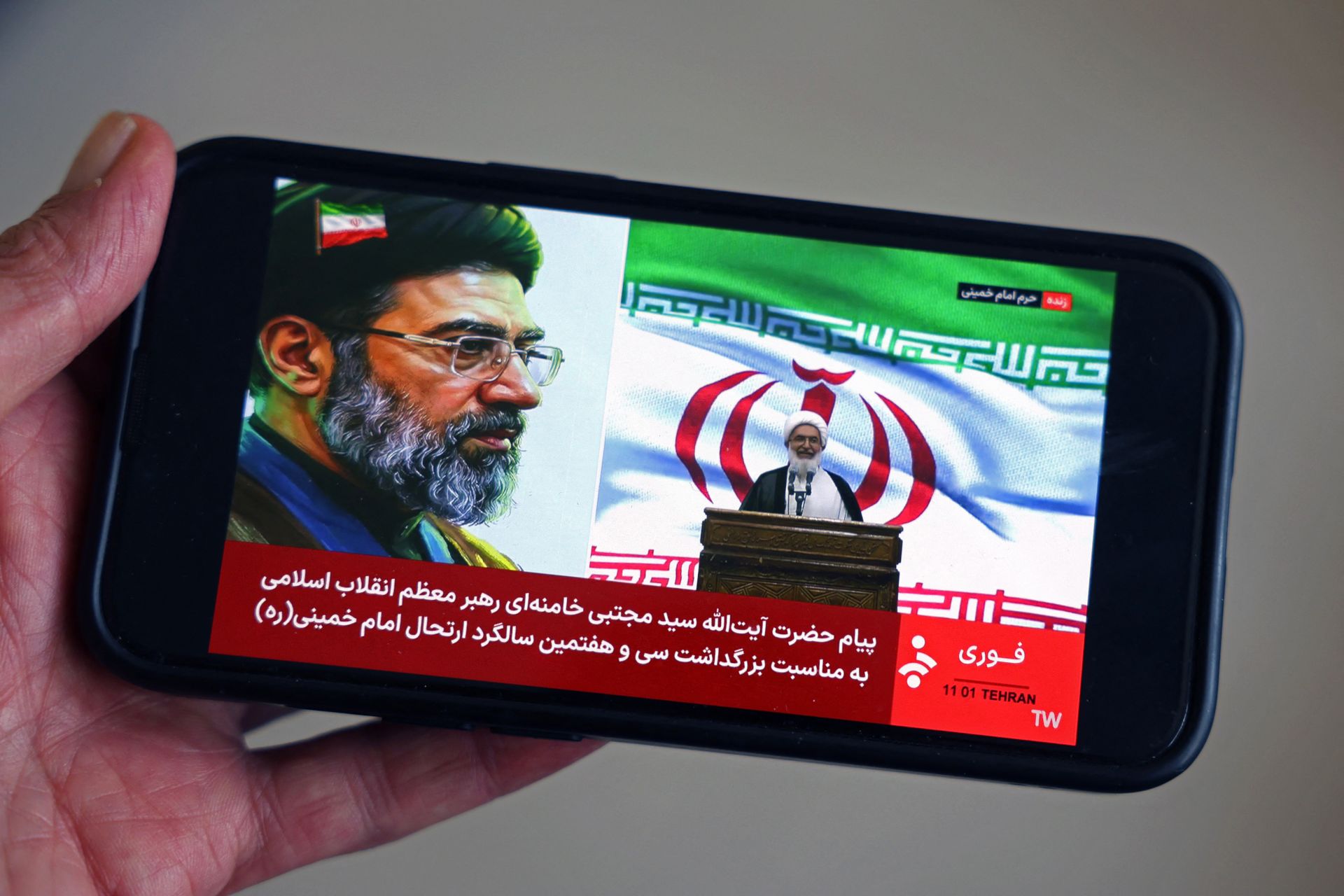
In early June, millions of Iranians slowly began emerging from an 88-day blackout of global internet access — the longest shutdown recorded by any country to date. During the lockdown, many came to use the term “solitary confinement” to describe their disconnected lives and the sudden disruption of their ability to communicate, connect and make a living online.
An account called “Narrative of Silence,” active on X and claiming to publish Iranians’ accounts of how the internet shutdown affected their daily lives, tweeted dozens of stories of anonymous Iranians describing their lives offline.
“The internet being cut off gives me a feeling of suffocation and being imprisoned,” read one account from late May by an Iranian graphic design student. “The fact that the whole world is updating with new technologies and we’ve been thrown back 20 years kills me and destroys me bit by bit.”
While the scale of the recent blackout was unprecedented, it was far from the first time Iranians have been severed from the digital world to enforce social and political control. Internet shutdowns have a long history in Iran, tracing the arc of the country’s modern political turmoil.
The first complete internet shutdown in Iran occurred during the events following the 2009 presidential election. During the protests against the election results that year, the internet was severely disrupted for several weeks. Once stability returned, parts of the internet, including social networks like Twitter and Facebook, were blocked for Iranian users, remaining accessible only through a VPN.
Between 2011 and 2013, internet access in certain cities or neighborhoods was temporarily restricted in response to incidents of local unrest. In the wake of intensified unrest in 2016, the pattern was repeated across the country, with platforms such as Telegram and Instagram also nominally blocked from Iranians’ reach. In November 2019, amid a new wave of anti-government demonstrations, international internet access across the entire country was cut off for seven days — the first nationwide cut — leaving users to rely solely on a limited domestic intranet.
In recent years, as the country has become increasingly unstable amid protests over economic collapse and social restrictions, as well as, more recently, external attack by foreign powers, the level of online repression has sharpened in response.
During the social protests of 2022, known as the Woman, Life, Freedom movement, international internet access was again cut off, this time for a longer period. Upon its return, access to WhatsApp and Instagram, key applications used for daily life across Iran, was disrupted.
During the 12-day war of 2025, internet access was cut for several weeks — a measure publicly justified as preventing the enemy from using Iranian internet infrastructure. Afterward, during a new wave of protests in January 2026, internet access was cut nationwide for about seven days. Discussions on expanding internet restrictions continued in January, and then the outbreak of yet another war against Iran led to internet access being shut down for about 88 days for ordinary users — the historic blackout from which Iranians are only now just emerging.
The Iranian government’s war with the open internet has been long in the making.
Concerns about the internet began to grow in the early 1990s. This was the peak era of discussions about the “information society” and “networked power.” Outside the U.S.-dominated liberal order, anxieties rapidly began to emerge about the political implications of this revolutionary new technology. One of the first countries to take practical action against the free internet was China, which moved to develop a national internet through its “Great Firewall.” The Chinese path found supporters in Iran in the early 2000s.
At the same time, a nascent blogging movement in Iran provided policymakers with the pretext they needed to stoke fears about the internet.
While restrictions since the dawn of the printing age had always involved some form of prepublication oversight of all kinds of published content, the blog was a space that allowed anyone with internet access to record and publish their own views, which Iran’s rulers could not easily countenance. At the height of the blogging movement in the mid‑2000s, pressure increased on providers of free domains for Persian blogs to delete certain posts or entire blogs.
At the same time, summonses and arrests of bloggers, many of whom had been public figures before the blogging era, and some of whom had moved from newspapers and media into blogging, while others had done the reverse, became more frequent. Owners of domain‑hosting sites that provided blog pages were not exempt from this harassment. But the issue was not limited to the use of hardware to control Iranians’ expression.
If it was not possible to persuade all those who failed to exercise caution in their writing to change course, software offered tools to control what was publicly accessible. At the technical level, the idea was to apply the same censorship system used for books and publications to blogs. A set of words, topics and individuals, already considered forbidden or gradually added to the list of forbidden items, was created, so that if they were mentioned on a webpage, searching for that page would automatically result in an error and redirect to another page.
With the passage of the Electronic Commerce Law in 2008, this path gained legal backing. A secretariat under the judiciary was formed, called the Committee for Determining Instances of Criminal Content. This secretariat decided which webpages were accessible and which were not. Pages deemed inaccessible were covered with a screen that later became known as the “Peivandha Page” (Links Page). When you entered the title, word or site address filtered by the committee into the search bar, the request was redirected to another page stating: “Access to the requested website is not possible.”
Over time, the design of this page improved, and a list of “permitted” blogs and websites was offered as suggestions. Your request to view a censored site was not only blocked, but also alternative options were provided to accommodate your preferences. For example, amid judicial conflicts with the Iranian Journalists’ Association in the mid‑2000s, the association’s own site and the blogs of its members and supporters were filtered. When you searched for those addresses, the Peivandha Page suggested visiting the “Muslim Journalists’ Association” site, which, at that time, had been created as an officially recognized substitute for the professional association of journalists. This page was one of the earliest attempts to realize a national internet in Iran.
By 2009, digital resistance against censorship was advancing in fits and starts through the creation of new blogs, the use of email lists to send content in downloadable packages, and the circulation of early VPNs to bypass the Peivandha Page. In fact, the same experiences gained in dealing with the censorship of books and newspapers were applied to the blogosphere as well. Another turning point awaited in 2009.
The events leading up to and resulting from the 2009 presidential election in Iran are remembered by many as the first time Twitter helped to create and steer a political crisis. Even the internet penetration rate in Iran at that time was debated, let alone Twitter’s usage. Yet the moment was a milestone in the regime’s approach to Iranians’ access to free information.
While before the June 2009 election there was an unprecedented wave of electoral enthusiasm in Iran, the evening of election day, June 12, was marked by raids and mass arrests of activists at one campaign headquarters, widespread disruption of phone calls and text messaging, and, of course, restrictions on internet access. The social networks Twitter and Facebook were among the first targets of suppression, filtered as part of efforts by the security apparatus to quell what it assessed as a “color revolution.” Access to them was only possible through IP changes by users.
The protests that followed the announcement of the election results lasted about eight months. In the early days of these protests, not only the internet but also phone lines and SMS services were blocked. As time passed, phone lines were restored, but Twitter and Facebook filtering remained firmly in place. These two networks, along with YouTube, Orkut, FriendFeed and Yahoo 360, the “grandfathers” of today’s social networks, joined the list of platforms that had already been filtered in Iran before the 2009 election.
The restrictions imposed on the internet during this period took the form of severe speed reductions and connectivity disruptions. This era marked the beginning of the widespread use of “throttling,” the deliberate slowing of internet speeds, in Iran. But this path did not fully meet the need to impose restrictions and “control” over the internet. In 2011, Iran created a new structure for managing the internet called the Supreme Council of Cyberspace. This council was essentially an expanded version of the Committee for Determining Instances of Criminal Content, with a mission to confront “internet threats.” But instead of being limited to the judiciary, it included members from all legal institutions of the country and was chaired by the president, although the elected administrations did not hold the upper hand in terms of member numbers or influence.
Hamed Beedi is an internet access campaigner and the manager of an interactive social services site in Iran. “A general review of the council’s resolutions shows that from its inception until today, its overall effort has been directed toward building a ‘national internet’ and blocking pathways to international internet access,” he told New Lines.
The main idea behind the development of a “national internet” was that Iran could manage a significant portion of the digital services needed by its citizens without dependence on the global internet. Investment and pressure from institutions such as the Supreme Council of Cyberspace kick-started a gradual development of domestic data centers, local search engines, domestic messaging platforms and internal traffic exchange hubs. The effort was to ensure that for every service or network removed or filtered, there would be a domestic version capable of handling redirected traffic and meeting the generated demand.
Sufficient funding existed for the growth of this network, which was expanding beneath the surface of the global internet. Its technical model had already been developed in China and, to some extent, in Russia. The only obstacle was a group of activists, both offline and online. Relying on an interpretation of the right to free access to information as a human right, they sporadically called themselves “free access rights activists,” and spoke out against the emerging practices online, in the press and at certain informal or semiformal gatherings.
The “internet management” program continued to advance. Domestic video sites such as Aparat replaced foreign platforms like YouTube; a local version was created in place of Twitter; and dozens of domestic messaging apps were introduced to replace Telegram and WhatsApp. Meanwhile, despite experts’ concerns, the country’s entire internet traffic remained concentrated around a few choke points, meaning that the main gateways for entering and exiting the country’s internet were largely managed by the Telecommunications Infrastructure Company.
In practice, this meant that Iranian users simultaneously existed on two networks: the global internet and Iran’s domestic network. Under normal conditions, both operated together. But in times of crisis, the country could restrict access to the global internet while keeping the domestic network running, so that banks, government systems and approved services remained active.
Alongside experiments with different methods of restricting online access to information, the regime has also been classifying people to determine their level of internet access. This has led to the emergence of a “whitelisted internet” and special access for approved individuals.
With a security‑based definition of people and data, certain data can be accessible to certain groups, while some individuals may have access to all available data. In the old model, the government would shut down the entire country’s internet, a move with high economic and political costs. But in the new model, the internet is not cut off for everyone. Instead, those managing internet access decide that certain “vehicles” with special license plates can always cross the border gateways. This access in Iran is known as the “white SIM card,” which, except in extremely limited cases, usually retains access to the international internet.
In other words, the internet shifts from being a public service to a form of “license‑based access.” Who can hold this license? The list includes some government employees, university professors and students, individuals working in engineering fields, lawyers, traders, doctors and others engaged in knowledge production; journalists; content creators; game and video producers; social media influencers; and online business owners.
At one point, it seemed that any professional group willing to accept this new order could submit a collective request to the National Center for Cyberspace, the executive arm of the Supreme Council of Cyberspace, and be placed in one of the tiers defined for global internet access, thereby guaranteeing a level of access for its members. White SIM cards were even sold on the black market. Later, during the most recent wave of internet restrictions in Iran, mobile operators began selling internet packages that temporarily granted these “white plates” to anyone who could afford them. This revealed how quickly the issue of internet access could shift from a plan focused on social classes to one centered on economic classes.
Recently in Iran, amid growing protests against severe and prolonged internet restrictions, President Masoud Pezeshkian created a new headquarters to manage internet issues and appointed his first vice president — an engineering professor specializing in telecommunications and networks at Sharif University of Technology — to lead it.
The first action of this headquarters was to restore internet access to its state before the war with Israel and the United States began in February. After nearly 88 days of a nationwide shutdown affecting everyone, VPN use to reach the global internet once again became possible, though, as expected, many free VPNs had gone offline, and returning traffic to its previous state would require more time. Nevertheless, tracing the path Iran has taken over nearly two decades shows the country moving closer and closer to fully implementing a Chinese‑style internet model.
“The history of resistance against internet restrictions is just as long as the history of efforts to impose them. Technology, in the same way it imposes restrictions, can also provide free access,” said Vahid Farid, a network and information security expert working in Iran. “The fact that we have come this far, increased internet penetration so much, and made free internet access a nonnegotiable right in the eyes of many people shows that we have traveled a long road — and we can continue along it.”
The National Information Network is probably not what automatically comes to mind when hearing the phrase “solitary confinement.” But whether it is justified by security concerns or economic calculations, it offers yet another avenue for the government to try and maintain its own curated version of reality in the digital world, amid a wave of internal and external disturbances that shows no sign of abating.
Become a member today to receive access to all our paywalled essays and the best of New Lines delivered to your inbox through our newsletters.