


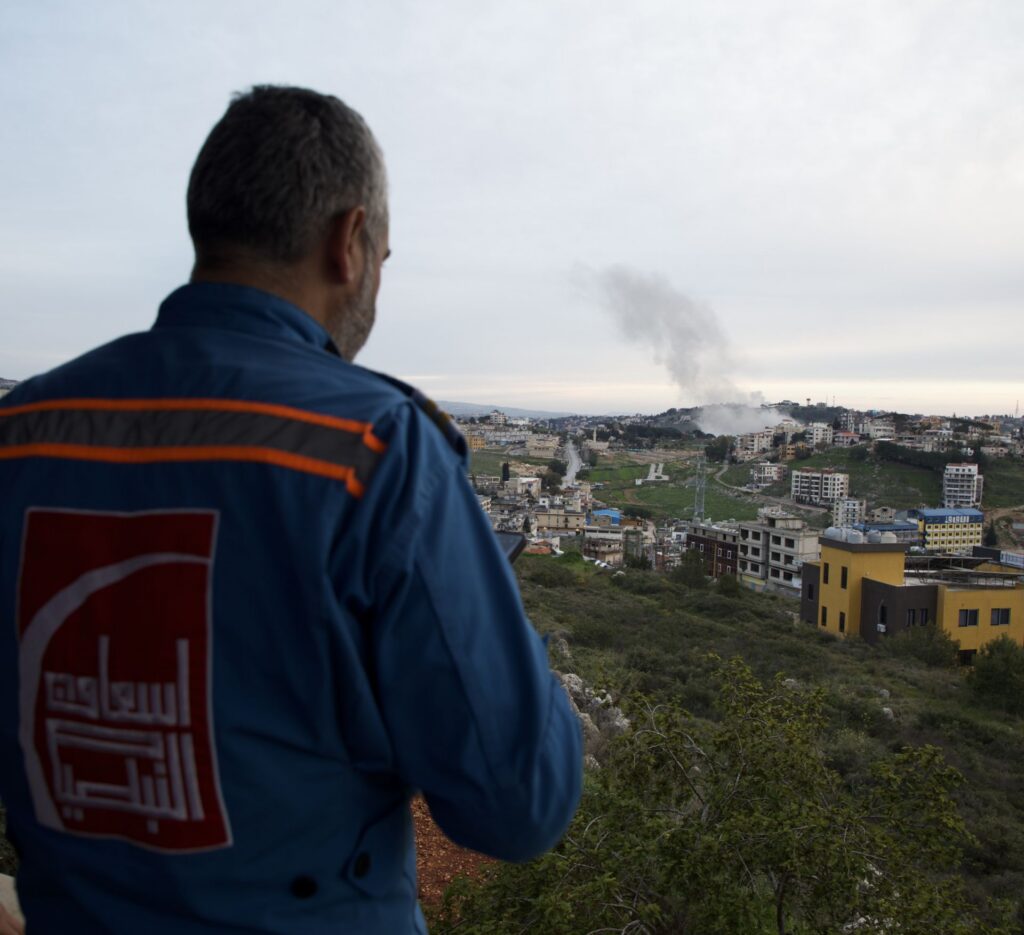
On a craggy hilltop overlooking the city of Nabatieh in southern Lebanon, next to the Al-Najda Al-Shaabiya Hospital, is a bungalow that is currently being used as the headquarters and dormitory of Esaaf Al Nabatieh, a volunteer paramedic group. From Beirut, it is reached by taking the coastal road heading south, passing through the city of Sidon, and cutting inland. Outside of times of war, this highway would be populated by a steady stream of cars and vans in both directions. But four weeks into the current conflict, the only company to be had is the watchful whir of the overhead drone, and the mobile homes streaking past in the opposite direction. Mattresses and chairs hang precariously from a van’s side as it takes a family to the relative safety of Beirut and beyond.
Nabatieh itself has been transformed from a historic market center into a ghost town. Apartment blocks — those not reduced to mounds of concrete and twisted rebar — stare back blankly, and signs of life are imperceptible. Two canine corpses lie motionless on the sidewalk. Shops are boarded up, and the families that have remained show little outward signs of having done so.
Only up the hill to the north, where the medical professionals of the hospital, and the paramedics of the Lebanese Red Cross and Esaaf Al Nabatieh have made their home, is there a semblance of life.
But while the other two groups are permanently established here, Esaaf Al Nabatieh’s improvised HQ resembles a school dormitory more than an emergency facility — a school in which the students major in nicotine addiction. A dozen or more argilehs (water pipes) are scattered across the kitchen, around one for every two members. White packets of Cedars cigarettes are available, should they all be in use. It means that, inevitably, more than one of the paramedics has taken up chain smoking since the conflict began. They vow to quit once it is over.
The floor of the house is covered with polyester mink blankets on thin mattresses, and pink pillowcases and multicolored bedcovers give the scene an adolescent feel — something that the team mirrors with their constant joking and buffooning. Without doubt, the sound of laughter is the first responders’ greatest ally.
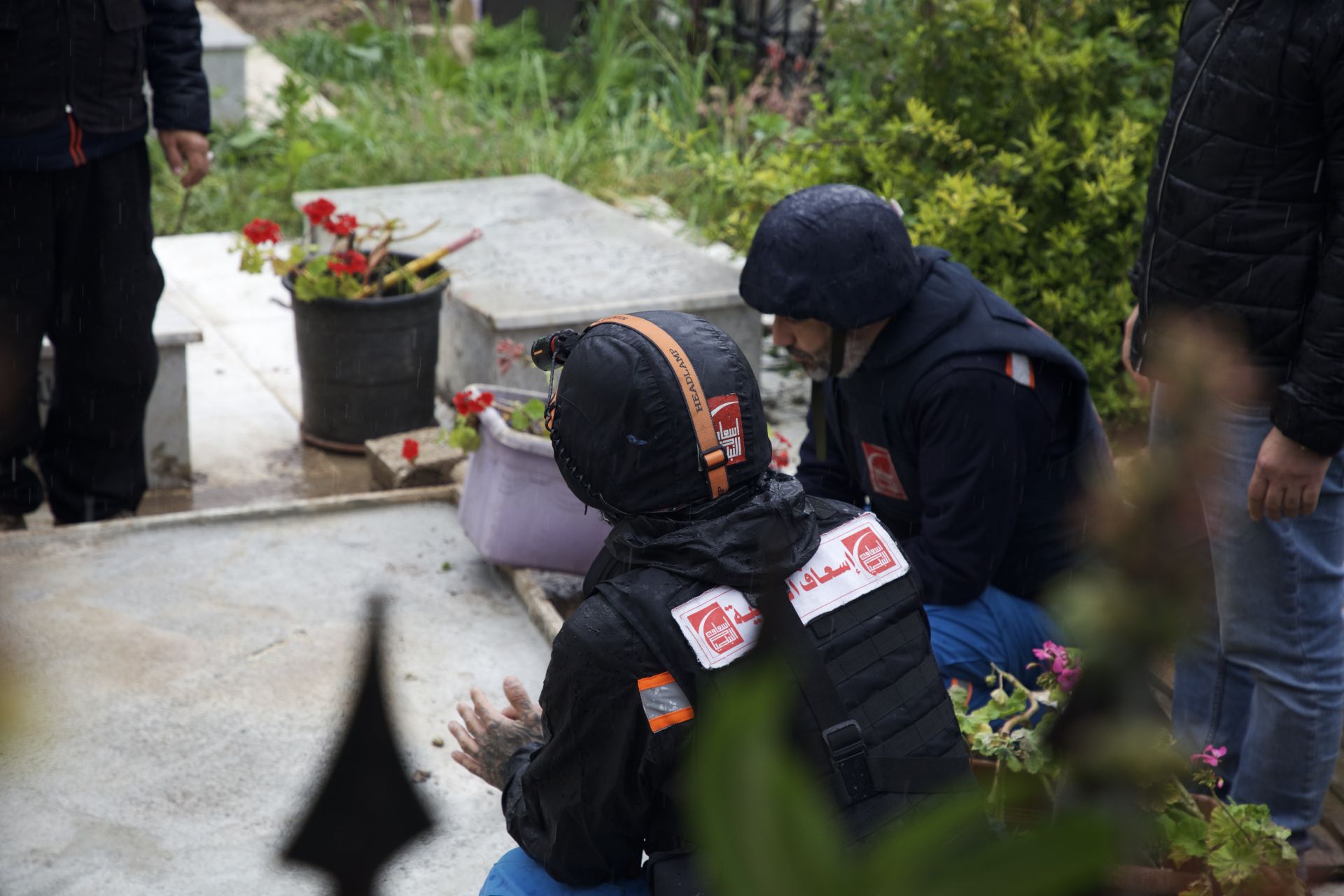
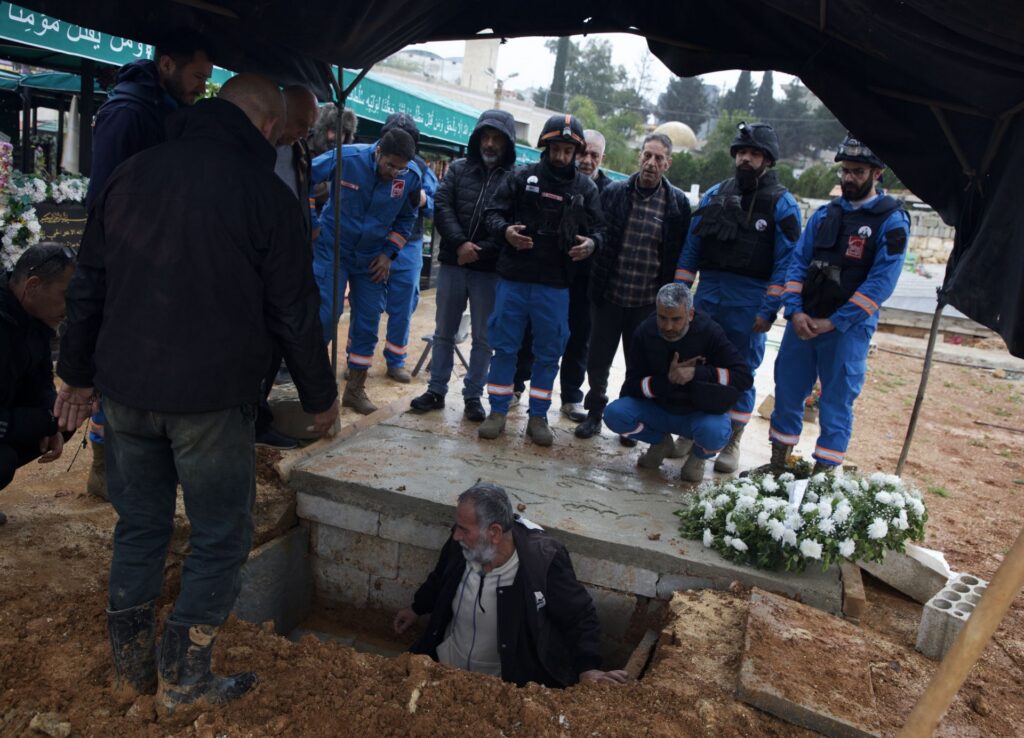
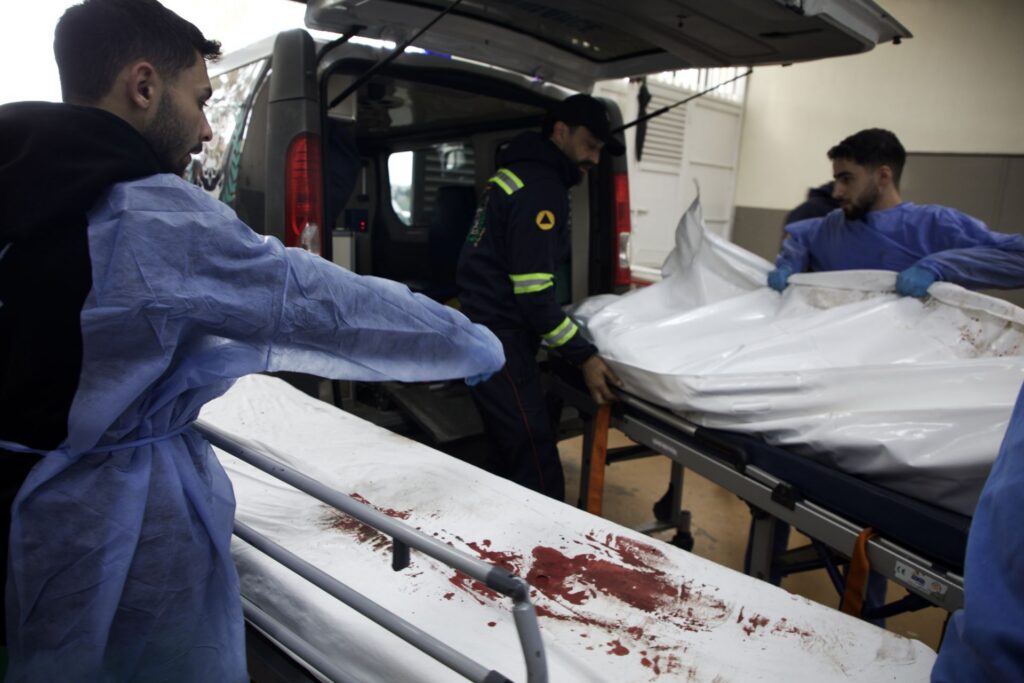
But on this early afternoon, on March 25, the room is shrouded in silence. Ten or so members of the group are inside, some sitting, some smoking, others staring blankly. One is praying. Successively rising to his feet, kneeling and prostrating himself on his prayer mat, his whispered invocations become almost audible in the hush. Next to him is a small mattress covered in flower petals. It belonged to 23-year-old Ali Jaber. On March 24, he and another volunteer, 16-year-old Joud Suleiman, were targeted and killed by an Israeli strike while on a motorcycle. They were the 41st and 42nd medics to be killed in Lebanon since the conflict began on March 2. As is tradition, both were swiftly buried that morning.
The current iteration of the Hezbollah-Israel conflict was sparked by the former sending a series of rockets and drones into northern Israel in retaliation for the killing of Ali Khamenei, the Iranian supreme leader. Since then, Israel has conducted wide-ranging missile and drone strikes and issued forced evacuation orders for much of southern Lebanon up to the Zahrani River. Nabatieh is located around 9 miles south of this new demarcation line, meaning that, as per its spokesperson, the Israeli military cannot guarantee the safety of the civilians who remain. And while Nabatieh is estimated to have lost, according to the paramedics, between 80% and 90% of its prewar population of around 100,000, a significant minority has chosen, or been forced, to stay. Nevertheless, the deliberate targeting and killing of civilians and medical personnel is considered a war crime under the Geneva Convention. The killing of Joud and Ali falls under this category.
Mahdi Salloum, one of the more experienced members of the group, remains impassive when recalling the boys. “It might be a psychological loss, but the martyrdom of our two colleagues gives us more motivation to continue our work.” He is one of the top jokers of Esaaf Al Nabatieh, a heavily contested crown, but he is also one of the most professional. “We pledged to be present here in Nabatieh, and we will continue as long as the war lasts, even if there are more martyrs.”
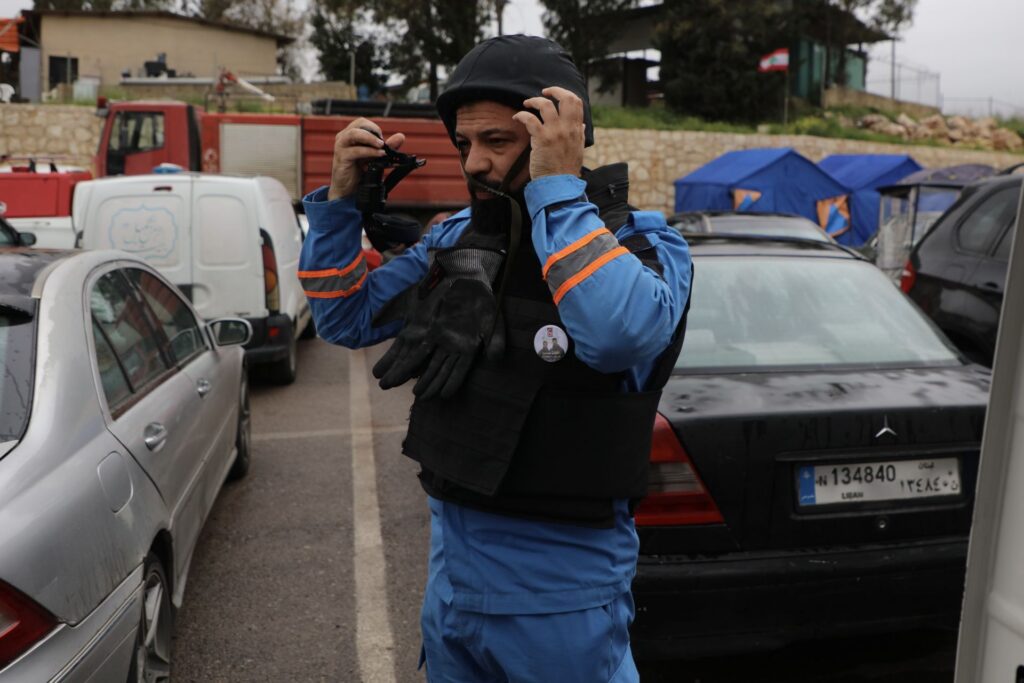
No first responders working in southern Lebanon are under any illusions as to the risks associated with their work. “When we go out for an airstrike, we wear our protective gear, like body armor and helmets,” Salloum says. This is placed over their bright blue overalls, adorned with Esaaf Al Nabatieh’s red crest. These are deliberate choices to make them stand out as much as possible.
“They protect us from things like rocks and shrapnel, but not if a missile comes down on us.” On a previous emergency run, Salloum was close to being able to attest to that fact. “Once, I responded to a drone attack and they double-tapped” — the act of striking again several minutes after an initial strike, thus targeting first responders who arrive at the scene, a tactic that the paramedics report is being used multiple times every week — “but luckily the second missile didn’t detonate.” His words are almost drowned out by the impact of two Israeli missiles landing close by, in reply to a Hezbollah missile salvo launched from the vicinity of Nabatieh. Salloum talks on as if it is less than the sound of a buzzing mosquito.
But however much the precarity of their situation might affect the average civilian, the first responder doesn’t have the time to mull it over. Always on the lookout from their terrace — the defining feature of the bungalow, offering an almost panoramic view of their surroundings — they are well placed to spot and locate nearby strikes. And soon enough, a precision strike hits a building within 900 yards of their hilltop HQ and Esaaf Al Nabatieh springs into action.
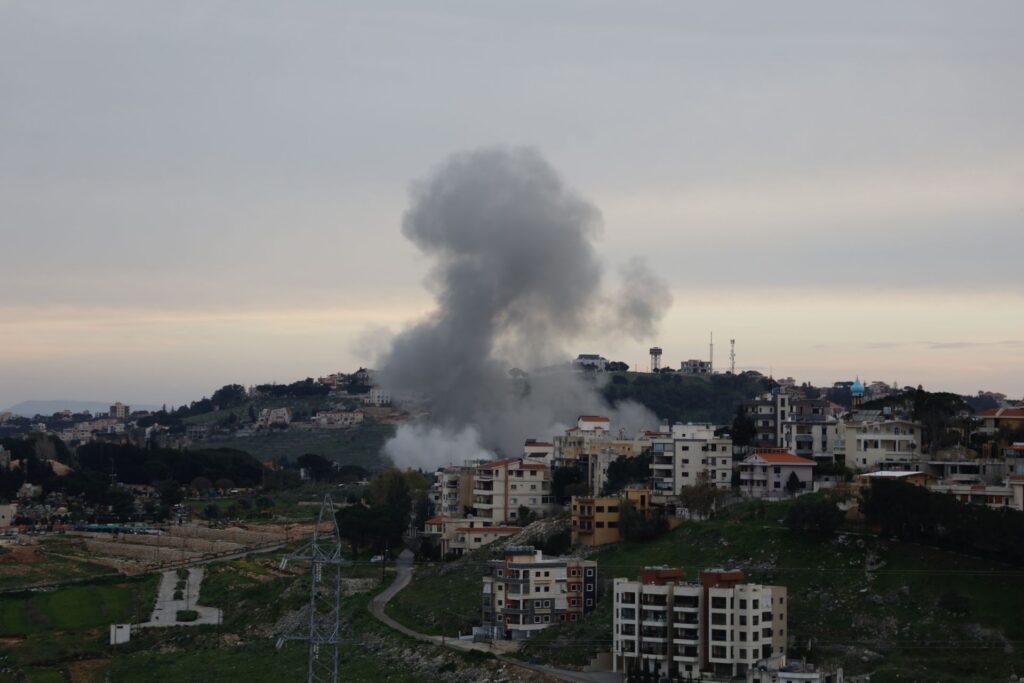
The protocol is now second nature. First, from the terrace, they film the plumes of smoke emanating from the targeted building to pinpoint its location. Concurrently, the chief radios in other teams in the area to coordinate deployment and, when given the go-ahead, the team strides into their ambulances and the frantic search begins.
Esaaf Al Nabatieh is unique in that — unlike Civil Defence groups laden with internationally standardized protocols like the Red Cross — they do not leave much time for any potential second strike to take place, risking the double tap in order to maximize their chances of rescuing the injured. Within 10 minutes, they are on their way. And once inside the ambulance, the switch flicks, and as the vehicle careens from one side of the road to the other, the typical laughs and smiles subside in favor of intense concentration and quiet, save for the blaring of the sirens.
As the adrenaline pumps and the seconds stretch, a feeling of exposure comes over those inside, as if the roof of the ambulance is marked with an X, and an overwhelming desire to arrive at the strike location takes over. The paramedics can’t help but feed off the fine line between exhilaration and fear.
On this particular day, the weather deals them a bad hand: It is sunny, cloudless and windy. Sun means drones have a clear line of sight for a potential double tap, while wind means the orderly plume of smoke from the strike location is turned into a diffused haze. And the latter proves to be a major problem.
For 10 minutes that feel like 30, the convoy of two ambulances (the typical deployment, with four paramedics in each — one driver, one chief and two others) conducts a fruitless search down dead end after dead end before they finally arrive at the location, following another first response unit. As per procedure, one ambulance parks 50 yards further away to minimize the casualties in case of another strike.
An efficient, choreographed search follows. Floor by floor, the paramedics probe every room, splitting and joining up again on the stairs as they comb through the apartment. Eventually, the other team announces the all clear.
“There is no one here,” comes a muffled shout from above.
Within a few minutes, they are back at HQ, argileh in one hand, phone in the other.
Esaaf Al Nabatieh was formed in 2003, and counts the present conflict as its third, after 2006 and 2024. It means that for some, including the long-serving group chief Mohammed Suleiman, they have seen it all before, including now the death of Suleiman’s son, 16-year-old Joud.
“In this time, you cannot let the feelings get on top of you. We cannot let anything prevent us from working.” He brings a smile to his face, one that would have looked perfectly natural if removed from its context. As the leader of the pack, one who has been in this field since 1988, he knows his men will only redouble their efforts in light of his stoicism. He has no choice but to carry on.
“In 2006, it was the same, as was 2024, as it is now. It is the same airstrikes.” But he does admit that “this time around we are being hurt more.”
Since his son was killed, he hasn’t spent any time away from the team. He will occasionally take a couple of hours off to wash and clean his clothes, but the idea of taking a day off is anathema. “All of us are like sons and brothers. Even if I’m resting for a few hours, I am still thinking about them.” He says that only “after the war there will be time to have a break.” Only then will the loss of his son sink in.
Esaaf Al Nabatieh does have female volunteers who are involved in the administrative side, such as organizing food supplies for distribution and managing their mental health hotline. But all the first responders are men. Nevertheless, and perhaps somewhat surprisingly, there is an absence of bravado and machismo in the group.
Suleiman leads a team of around 40, of whom 30 are on duty at any given time. Ages range from 18 to 45. Every 10 days, they receive two days off, which most spend with their families in Beirut. Families who urge their sons and husbands to stay with them. But for many, whether it is the sense of duty or the call of the wild, the impulse to return is simply too strong.
Volunteers here experience a deep psychological break from the civilian life of peacetime. Ali, a 25-year-old who is new to the group, owns a bakery in Nabatieh. Hadi, also 25, is a dance instructor and winner of a competition for Lebanese dabke, a popular Arab dance. He shows a video of himself on a friend’s shoulders, dancing with the small trophy in an atrium with tens of friends.
Salloum walks the fine balance between perpetual danger and brotherly camaraderie with gusto. He is grinning, showing off his brilliant white teeth. “During the war, we laugh so much. We are just trying to be good. If we don’t do that, we die.” He mimics someone being shot in his chair, his tongue hanging out. “And we eat so much. Why? We don’t know. A lot of eating, and a little work. But every mission is hard, so you need to be strong.”
He nods at two young members hanging up wet clothes in the garden. One holds an impossibly large pair of pants against his own waist, joking that whoever owns it must be the leftover thief.
“We have learned all of this during this war, cleaning, clearing up, cooking,” Salloum continues, beaming.
Mohammad Khalil, another seasoned member of the team, is Salloum’s close friend. Introspective and thoughtful, he contrasts with his sharp-witted colleague.
He tries to explain why the volunteers keep coming back. “We have, in our religion, an icon called Imam Hussein, who we take all our noble attributes from. From the beginning of our childhood, we start to learn from him,” he says.
“Here, in South Lebanon, there has been conflict all the time. So we grow up to find that the Israeli army is cruel. They don’t differentiate between civilian or military people. So they kill everyone. So these feelings start to grow with you. That’s why we found that, when someone is injured, we can’t stay still, we must help them.
“If you don’t live it, you can’t understand it. The feelings are very strong. When you start working, you forget yourself. Totally. You start thinking: Does this casualty have children? Is this martyr a child? Does he have family?”
His voice cracks.
“And they took two of our children. They wore vests and helmets. They showed everyone they are medical personnel. But they don’t care, because they are against humanity. They want you to be a slave to them. But we are human beings, not slaves. That’s why we can’t stay and sit and watch like it is a movie. No. These are our people, and we will help them.”
Salloum nods quietly, sipping his tea.
As night falls, the sounds that order the lives of Esaaf Al Nabatieh start to merge, forming a kind of ensemble. The bass line is played by the constant comings and goings of the jets, a sound which rarely ceases. The muffled thumps of distant bombs falling nearer the border form a sinister beat. They happen at regular intervals, every 10 or so minutes at their peak. But in defiance is the calming bubble of the argileh, always accompanied by either loud Arabic music or the obnoxious soundtrack of games being played on mobile phones.
As this routine plays out, the group assigned just to emergency response, 20 people each day according to the rota, continues its work. On another day, March 28, they make six deployments in total. Unusually, they are thankful there are no additions to Esaaf Al Nabatieh’s grim tally of 15 dead and 18 injured since March 2. When there are, they will be taken to the emergency ward of the Al-Najda Al-Shaabiya Hospital to be treated or prepared for burial.
Nearby, however, at the Nabih Berri Hospital, affiliated with the Shiite Amal movement, five paramedics associated with the hospital are targeted by an Israeli strike, leaving two dead and three in intensive care. All three will later succumb to their injuries.
The last order of Esaaf Al Nabatieh’s day is to announce the rota for the coming week. It is where the greatest hilarity ensues as the group finds out who has the dreaded cleaning shifts and who is on emergency response. They huddle around Suleiman as he leans against the wall on his mattress, like a pantomime king holding court. The group all have their arms around one another as he calls out names one by one, feigning surprise.
Before settling in for the night, the team conducts a Shiite mourning ritual called “latmiya,” consisting of chanting poetry while thumping their chests. It is often done to remember Hussein ibn Ali, the first Shiite martyr, but now, while they still invoke his name, they are thinking more close to home. Some cry while others laugh. And then, those who can, sleep.
The following morning, Sunday, March 29, is a somber one. Over the course of one short hour between 9 a.m. and 10 a.m., they attend the funeral of an elderly civilian killed in a strike, pay their respects at the graves of their two former colleagues and go to Nabih Berri Hospital to offer condolences for the deaths of their five paramedics.
It brings the total number of medical personnel killed since March 2 to 51. Four hospitals and 51 health care centers have also been forced to close as a result of continued strikes.
Afterward, as the convoy of ambulances returns to the hilltop, somewhat sheltered from the eyes in the sky by torrential rainfall, they turn to the other part of their role, distribution of supplies.
Using a QR code disseminated among the residents still in Nabatieh, 264 families have signed up for emergency aid. The paramedics suspect there are some 600 more families who haven’t, for one reason or another.
The paramedics then issue a general call on WhatsApp, after which they drive to a large canopy in the middle of town, under which stands a huddle of 30 or so men. Not a word is spoken as the men lethargically form a queue to collect the bread, filtration systems, detergent, medicine, fresh meat and chicken that have been purchased with the help of donations. Before the war, Esaaf Al Nabatieh would spend $50,000 a month on aid. Over the past four weeks, a surge in donations — from organizations such as the Zahra Trust and Catholic Relief Services, as well as from private donors — has enabled them to spend $300,000.
Vans emptied, they drive back to HQ. The mood is heavy. As they walk back inside, past the argilehs and empty steel bowls once containing mountains of food, two of them who didn’t join the aid convoy are hanging a large print on the wall. It shows Joud and Ali, the younger one with his arm draped over the older, looking directly at anyone who happens to glance at them, smiling and unafraid.
Become a member today to receive access to all our paywalled essays and the best of New Lines delivered to your inbox through our newsletters.