


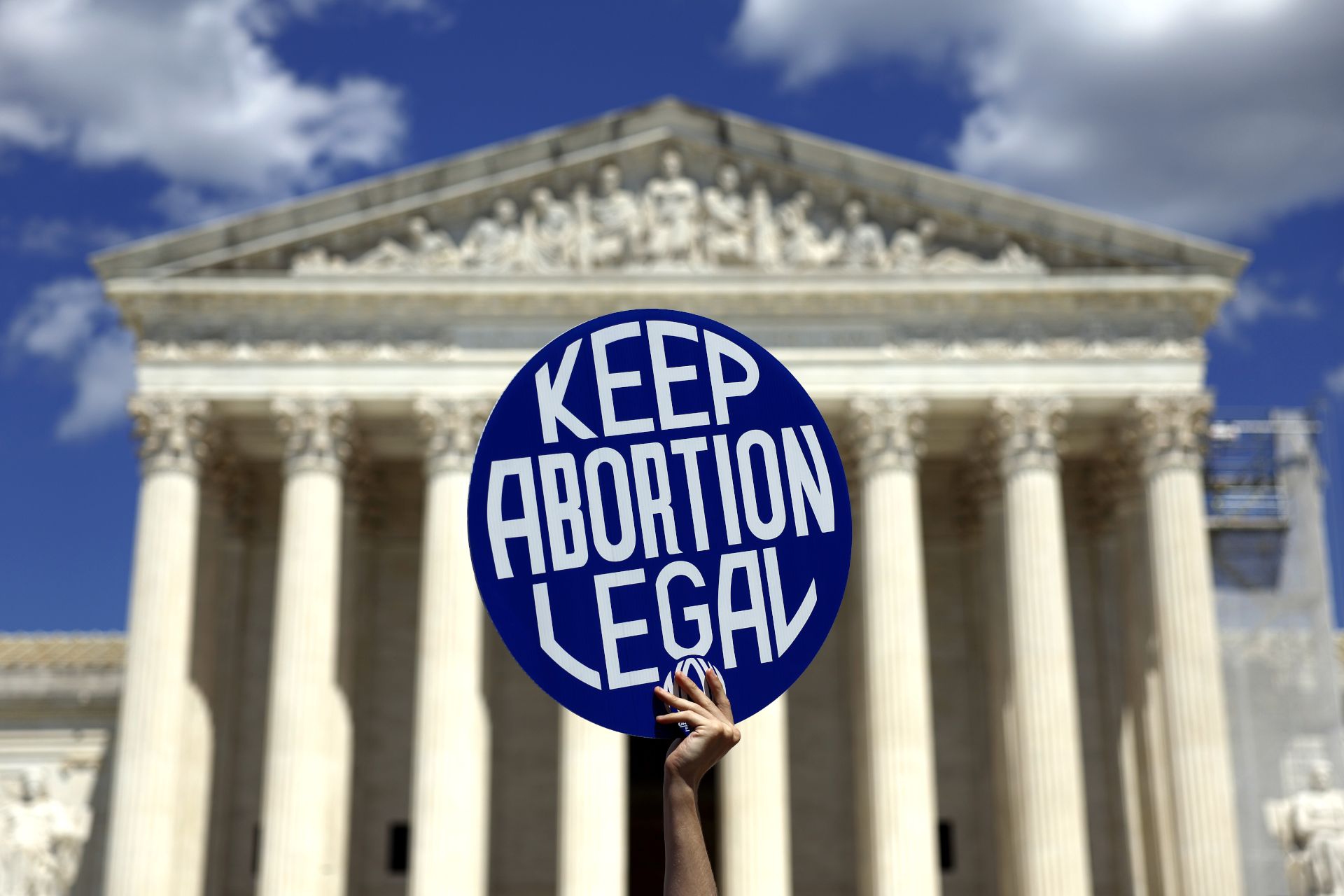
Along the broad, ceremonial expanse of Pennsylvania Avenue in Washington, D.C., its lanes framed by rows of evenly spaced trees, Amy Allina paused to remember how her career began. Years before she established herself as a consultant for reproductive rights nonprofits, she learned how to perform abortions with nothing more than a length of plastic tubing and a mason jar.
It was the early 1990s. She was part of a loose network of feminist health collectives — women who believed, with a conviction that feels almost radical now, that information belonged to everyone, especially when it concerned their bodies. A mentor taught her “menstrual extraction,” a low-tech method capable of removing the contents of the uterus in very early pregnancy. The procedure was performed in living rooms and kitchens, surrounded by friends. There were no machines, no metal instruments, no men in white coats.
The procedure is remarkably simple — much easier than strapping a sprained ankle or using an automated external defibrillator, both components of a basic first aid course. The late Carol Downer, one of the feminist pioneers of menstrual extraction, was straightforward in her description to Ms. Magazine: “One woman guides the cannula. Another woman pumps the syringe. And another woman holds a mirror for the woman who is having the procedure so she can see the material coming out of her uterus into this tube and then to the collection jar.”
Despite the Supreme Court’s 1973 Roe v. Wade decision, which declared the procedure protected by the Constitution of the United States, abortion was still restricted by financial and other access problems when community-based groups were using menstrual extraction. “We wanted to build up our skills so that we could safely provide abortion in our own community,” Allina told me.
Since the 1970s, community self-help groups have been performing early procedural abortions, within the first six weeks of pregnancy, with very few complications, and maintaining close connections to trusted physicians who could help manage any issues with retained tissue or bleeding.
Now, after the Supreme Court overturned Roe v. Wade, in the 2022 decision known as Dobbs v. Jackson Women’s Health Organization, American women are again relying on grassroots knowledge and networks.
As a doctor, this idea of self-care through community help is a paradigm shift. Why rely on metal instruments and men in scrubs if we could help each other in the comfort of our homes — if our sisters, friends, neighbors, mothers and aunts had this knowledge, or knew someone who did?
I am a British obstetrician and gynecologist working in London’s National Health Service, also trained as an abortion surgeon. In August 2024, I arrived in New York on a Harkness Fellowship in Health Policy to understand the American post-Dobbs landscape. I expected to find a country in dystopic disarray: women dying from unsafe abortions, others forced to travel hundreds of miles, a massive influx into clinics in New York and California, scenes reminiscent of the coat hanger era.
But the bigger picture was far more unexpected: The U.S. had actually managed to expand access in this hostile legal climate. According to the Guttmacher Institute, in the most recent data available, 12% more women received abortions from providers post-Dobbs in 2024 than in 2020, before Roe fell. Traveling the country and interviewing dozens of sex educators, faith leaders, doulas and others, I found that everyday people and communities are building new models of abortion care in post-Dobbs America.
There were, of course, ordinary women, many already mothers, who, in recent years, died after their pregnancies ended or became complicated, often tragically and preventably, because they could not access timely or appropriate medical care. Some, like Amber Thurman, died from a treatable infection after doctors in Georgia delayed performing a routine procedure following complications from abortion pills. Others, like Porsha Ngumezi and Josseli Barnica, died after miscarriages, when state laws restricting abortion or abortion-adjacent care made hospitals fearful or uncertain, turning medical emergencies into death sentences. Official government review panels set up by states formally judged many of these deaths as “preventable,” underscoring how legal bans can transform routine pregnancy complications into lethal crises.
These women symbolize the human cost of restrictive laws. In Ireland, the 2012 death of Savita Halappanavar during a miscarriage became a national reckoning that helped propel the 2018 referendum legalizing abortion. In the United States, similar deaths have only strengthened and mobilized the community-driven movement.
In the sandy brush country of southern Texas, near the Mexican border, Laura (not her real name) once volunteered as a clinic escort, shielding patients from screaming protesters. “The anti-choice protesters would target the men,” she remembered, “telling them they weren’t real men if they didn’t ‘save their baby.’”
When all the clinics in Texas had to close in 2022, after Dobbs, Mexican abortion “companions” reached out to advocates like Laura. These abortion activists provide support for self-managed abortions and have a rich history across Latin America, where access has been largely restricted. “These networks were helping people have abortions in their home throughout the whole pregnancy,” she said.
Laura began on the periphery, as a “pill bank,” meaning she received the abortion pills from Mexico and mailed them to other women in Texas, as part of a care package. “I’ll include some Advils. I include the pads that you need because you need very thick overnight pads for the bleeding. I’ll even include a pregnancy test because some people worry about going to the drugstore to get the pregnancy test.”
Then she learned to “accompany,” providing emotional support and guidance on dosing, when to seek medical help and how to avoid criminalization. It is all carried out anonymously, via text. “You’re scared at first,” she said. “And then you go through it, and it works and the person is content and happy. … A total stranger just helped you.”
At the other end of Texas, in the affluent enclave of University Park, the First Unitarian Church in Dallas took a different approach. The church, historically active in reproductive rights — its members helped support Norma McCorvey (“Jane Roe”) in the lawsuit that led to the 1973 Supreme Court decision — designed a travel program to fly groups of women to New Mexico for same-day abortion care.
The Rev. T.J. Fitzgerald described the unexpected intimacy that grew among travelers. “When you can talk about abortion with someone,” he said, “you can talk about anything.” Abortion-seekers, long isolated, formed support networks that outlasted the journey.
Religious spaces were not where I expected to find destigmatization, but conversations with Fitzgerald and the Rev. Rebecca Todd Peters, who is also a professor at Elon University in North Carolina, changed that. Peters, who preaches openly about her own abortions, co-founded SACReD, the Spiritual Alliance of Communities for Reproductive Dignity, which offers a seven-week curriculum to help congregations explore reproductive ethics through a justice-oriented, anti-racist lens. “Most faith communities are supportive of abortion,” she told me, “but don’t talk about it.” She is part of a team of researchers who assembled the largest dataset, more than 500 accounts, from religious women describing their experiences with abortion.
Peters gestured to a stack of hate mail in her office. “People say ‘Dear Sister in Christ,’ then write paragraphs of hate, ending ‘with love.’” What threatens them, she believes, is her message: “Part of my work is not just saying that abortion is the lesser of two evils. … It’s saying abortion is a moral good.”
Feminist Muslim organizers have reached similar conclusions. Sahar Pirzada, director of movement building at Heart to Grow, learned through her work in Southeast Asia how Islam can be interpreted as radically liberatory. Heart to Grow produced “The Sex Talk Book,” a Muslim guide to healthy sex and relationships grounded in theology and medical expertise. “We wanted to reject this idea that it is a Western feminist thing to want to make decisions about your body,” Pirzada said.
The journalist Tim Harford, in his book “Messy,” describes how economists studied commuter behavior during the 2014 London Underground strikes. Navigating the forced disruption resulted in thousands of people discovering better ways to get to work. One in 20 changed their route after the strikes were over. Through my travels and interviews across the U.S., I could see a story of innovation, resistance and inspiration emerging.
“You can just do the work within the confines that you can,” a New York-based ob-gyn and abortion provider told me, speaking on condition of anonymity. “And a lot of doing the work is really figuring out the logistics.”
During the COVID-19 pandemic, telemedicine exploded across all medical fields, abortion included. Restrictions requiring in-person dispensing of Mifepristone, one of a pair of drugs used to induce abortions, were lifted, and long-standing assumptions about the necessity of ultrasounds were reexamined.
Dr. Carolyn Westhoff and Dr. Beverly Winikoff, who led trials of Mifepristone in the 1990s, told me that ultrasounds were included for research purposes, not because they were necessary in routine care. “Doctors love doing procedures,” Westhoff said dryly.
“It angers me,” Winikoff said. “Thousands of women doing things they don’t really need to do.” And, she added, they’re paying for it.
By the time Dobbs was handed down, telehealth infrastructure was already well developed. Dana Northcraft, founding director of the Reproductive Health Initiative for Telehealth Equity and Solutions, said that in the early days of telemedicine conferences, “abortion was never on the agenda.” That changed overnight. In states with bans, telemedicine became the only viable access point for a prescription medical abortion.
“I always say, if it’s clinically indicated and patient preferred, that’s what should be done,” Northcraft told me. “The purpose of health care innovation is to make sure people get timely care.”
Today, a person in Alabama, which has a total ban, can access abortion pills legally or semilegally from multiple U.S.-based telehealth providers under shield laws, state measures that protect people involved in abortion care from out-of-state legal enforcement. This includes vetted websites that ship pills without a prescription and community networks like Laura’s.
Plancpills.org has become the most trusted care navigation service, constantly updated to reflect shifting laws. But the legal landscape is intentionally confusing. Elizabeth Ling, a lawyer at If/When/How’s Repro Legal Helpline, said they receive calls from across the U.S. “The laws are changing constantly. They are intentionally written to be confusing and vague so that people don’t feel like they can make the decision.”
States like California, New York and Massachusetts have enacted shield laws to protect providers who prescribe across state lines, but even protected providers fear retaliation. One told me she avoids traveling to certain states, even to visit family.
For the abortion seekers themselves, self-managed abortion is explicitly criminalized only in Nevada, but prosecutors have used murder, abuse and child endangerment statutes to target women experiencing miscarriage or suspected pill use. Between 2000 and 2023, at least 72 people were investigated or arrested for allegedly self-managing.
“Many people worry that they’re not getting all the information they need from their physicians, with growing anxiety under increasingly restrictive laws,” said Dr. Victoria Williams of Birthmark Doula Collective in Louisiana, which is suing the state for restricting the collective’s ability to provide information. Sitting in her New Orleans office, surrounded by neighborhoods still scarred by Hurricane Katrina two decades ago, I saw how abortion access intersects with racial inequities, poverty, trauma and distrust of medical systems.
That distrust extends beyond Black communities: Refugees, queer communities, the unhoused and Muslim Americans all report stigma from health care providers. The founder of the Ad’iyah Collective, who uses the pseudonym AZ publicly, runs global Muslim abortion support circles via secure messaging, offering multilingual doula care and theological grounding.
In Louisiana, where there are no exceptions to the abortion ban for rape or incest, destigmatization is part of a long-term plan. Lift Louisiana organizes structured, one-on-one conversations in politically conservative communities where the goal is to listen and understand people’s views, rather than trying to argue with them or change their minds. “It’s been an incredible learning experience for us to listen to how voters’ opinions about abortion are informed,” said its director, Michelle Erenberg.
In other homes, Dobbs made abortion newly discussable. A New Jersey researcher specializing in reproductive health, who goes by the pseudonym Sofia, told me she learned only recently that her mother had once had a miscarriage. “It was after Dobbs when my mom finally said, ‘Wait, how does this impact your work? This is really sad and awful.’ I think that Dobbs really hit that home for them.”
I found myself in an art studio in Tribeca, in Lower Manhattan, with Alina Bliumis, an artist originally from Belarus. Hanging on the exposed brick walls were paintings of flowers from Bliumis’ “Plant Parenthood” series. Peacock flower, cohosh, Canadian wild ginger and chrysanthemum — Bliumis explained she wanted to paint them so they appeared alive, sexual and powerful. Dobbs inspired Bliumis to research how plants, abortion and controls over women’s bodies were linked through history. She found more than 100 plants connected with abortion across European, Indigenous and Caribbean traditions, knowledge of them passed down through midwives, healers, nuns and enslaved women.
In Native communities, said Rachael Lorenzo of the Mescalero Apache tribe, abortion was understood as community care: “Some tribes were nomadic, and large families may not have been desirable. … Abortion was a necessary form of care for the self, family and community.”
Such histories were eroded as white male physicians consolidated power in the 19th and 20th centuries, professionalizing obstetrics and criminalizing community practices. Safe surgical abortion remained available to the wealthy; others relied on underground methods, including menstrual extraction. Pills transformed the landscape: Mifepristone, first introduced in Europe in the 1980s, was approved in the U.S. in 2000 and its use was extended up to the first 10 weeks of pregnancy in 2016. Misoprostol-only regimens, used worldwide, remain extremely safe.
Self-managed abortion, when done with proper information, is well supported by the World Health Organization. The danger arises when people lack guidance — or fear seeking help.
Across Latin America, accompaniment groups fill that gap. Law scholar Fanny Gomez Lugo explained that some providers distribute Mifepristone and Misoprostol as “missed period pills,” given before a confirmation of pregnancy. “This idea for me tells a very profound story of how it could be normalized, and incorporated into the reproductive capacity of women, but not necessarily specifically named or called a specific way,” she said.
Despite legal access in many places, fear and misinformation shape daily life. Billboards, crisis pregnancy centers and protesters amplify stigma even in states where abortion is legal.
At a rodeo in Cody, a cultural experience that no visitor to Wyoming should miss, I watched families in cowboy hats, denim vests and tall leather boots file past banners lining the stadium rail: ads for local hotels, farm equipment — and one reading “Civil Rights Begin in the Womb.” Though abortion is legal in Wyoming up to 24 weeks, the nearest procedural clinic was a four-hour drive away.
Crisis pregnancy centers, protected by free speech laws, present themselves as medical clinics but counsel with misinformation and delay tactics. One billboard I saw crossing into Oregon — “Unexpected pregnancy?” — led to a center offering free ultrasounds but no clinical care.
In this climate, some activists believe neutrality is no longer enough. “I don’t think it’s enough to be pro-choice anymore. I think you need to be pro-abortion,” said Danielle Lahn of Prairie Action North Dakota Institute. The state is one of the most rural in the country, known for its rugged badlands of prairies and plains.
After training with the Self-Managed Abortion; Safe and Supported project, she now teaches others WHO-endorsed protocols. “We talk a lot in the third person, ‘a person might do this’ … so we are sharing information.”
“I believe in the radical notion,” she added, “that everybody should know about their body and how to take care of it.”
As a medical student in 2003, I was sitting in an antenatal clinic in Scotland behind the doctor, observing. A woman walked in, 14 weeks pregnant. She told us her marriage was on the rocks and that she wanted an abortion. She needed to concentrate on caring for the children she had at home. The doctor told her, “No.” He explained, “If women are more than 12 weeks pregnant, they are at greater risk of regret.”
I did not know any better at the time, to be able to advocate for this woman. I wish that I could have followed her out of the clinic room, apologized for the doctor’s words and reassured her that abortion was free, legal and available in the U.K. I wish I could have sat with her to navigate her way to a different doctor. Perhaps she managed to find one. I will never know.
Britain’s 1967 Abortion Act ended the back-alley era but did not create a right. Instead, the right to choose an abortion required approval from two doctors. In the clinic where I work today, doctors still spend hours signing forms, rejecting some for what they deem to be insufficient justification. Shame persists; 1 in 3 British women will have an abortion, yet many hide it.
In 2024, just before I left for the U.S., I performed an abortion in London for a woman who was 23 weeks pregnant and spoke no English. She’d traveled alone from Scotland, a five-hour train journey. She hemorrhaged and spent three days in intensive care before making the same lonely return journey. Why was she delayed? Immigration status, language barriers, stigma? A shortage of later-gestation providers? Had she been seen earlier or closer to home, she almost certainly would have avoided trauma.
When I arrived in the U.S., I thought I would find a cautionary tale. Instead, I found a paradox. The fall of Roe created devastation, but also a kind of collective awakening. Ordinary people began sharing knowledge once relegated to specialists. Faith leaders embraced pro-abortion theology. Telemedicine providers reimagined borders. Doulas reinvented care. Advocates talked openly about fight, grief, solidarity.
As a doctor, I don’t romanticize any of this. If I pooled all the ideas I encountered in post-Dobbs America, what might ideal abortion care look like? Perhaps not like the future we expected, but possibly the beginning of a better one.
A person who has missed a period could turn to a trusted community network for nonjudgmental guidance. Pills could be purchased over the counter or online. A doula, midwife or trained volunteer could accompany them virtually or in person. Those preferring a procedure could access a local clinic without fear of harassment or criminalization. No one would travel far, or alone, or lie awake wondering whether their doctor might report them.
Become a member today to receive access to all our paywalled essays and the best of New Lines delivered to your inbox through our newsletters.