

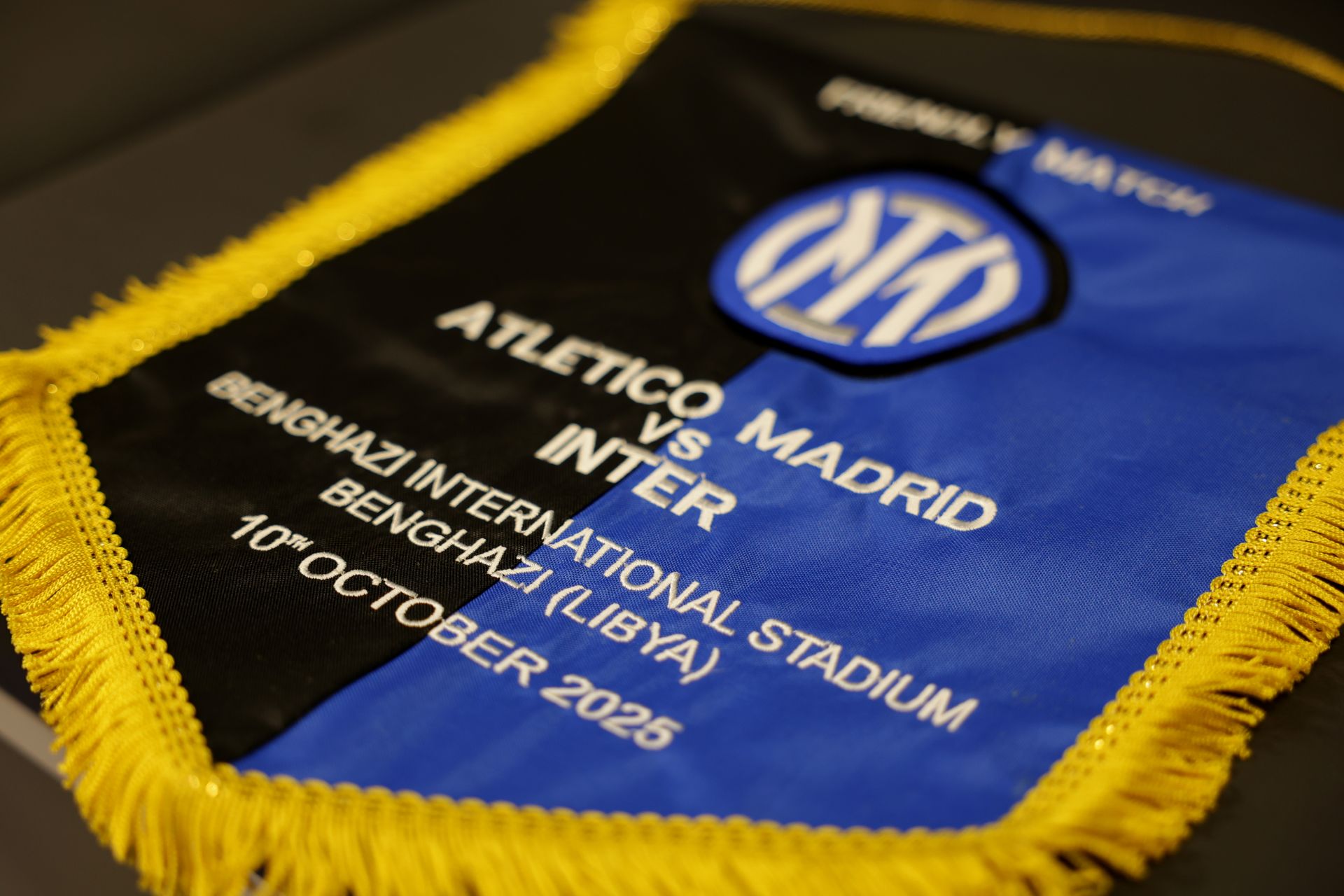
Benghazi, a city that gained notoriety in 2012 after an attack on the U.S. consulate that led to the death of Ambassador Christopher Stevens, recently hosted two major soccer clubs from the European Union.
The city, run by Field Marshal Khalifa Haftar, who rules much of eastern Libya in opposition to the U.N.-backed government based in Tripoli, has long been devoid of any appeal to Westerners. More recently, however, the Haftar regime has sought to legitimize its rule through soft power and attempts at sportswashing its legacy.
The major soccer event brought together former Spanish champions Atletico Madrid and Italian champions and European Champions League finalists Inter Milan to play a friendly match on the evening of Oct. 10. The game was held in Benghazi’s newly reconstructed stadium, and financed by the Libya Development and Reconstruction Fund under the leadership of Haftar’s son, Belqasim.
The friendly match saw the crowning of Atletico Madrid as champions of the “Reconstruction Cup” after securing a penalty shootout victory against Inter. The event will reportedly be held annually in Benghazi, bringing together two major EU clubs to compete against each other.
La Gazzetta dello Sport, Italy’s prominent sports paper, reported on the match, calling the experience “intense and surreal.” The report contained no mention of the Haftar regime’s record, and instead focused on the ostentatious spectacle. La Gazzetta declared the event an indication of Libya’s, and particularly the city of Benghazi’s, ability to open up to the West and host international events.
The Spanish paper, Mundo Deportivo, on the other hand, reported that legendary club Barcelona was planning to participate, but pulled out at the last minute due to security concerns, returning the 5 million euro participation fee, with Atletico Madrid replacing it. These security concerns might explain why Inter Milan and Atletico Madrid chose to arrive on the day of their match and depart immediately afterward, avoiding a hotel stay and a tour around Benghazi.
The match and the spectacle it generated exemplify the tools of soft power that the Haftars have been resorting to in recent years. It highlights the field marshal’s ability to adapt his rule to new challenges while diverting attention from a poor human rights record, which is being “sportswashed” by the grandiosity of events.
The memory of Haftar’s failed 2019 military campaign against the government in Tripoli, a Russian-backed effort that was fraught with numerous incidents of human rights violations, lingers. So, too, does the impact of mines left behind by Haftar-allied Wagner Group mercenaries, who planted the devices as they retreated from areas they had occupied, a possible war crime that has maimed and killed civilians, along with at least three deminers.
Members of Haftar’s Libyan National Army (LNA), whether or not they took part in the 2019 campaign, are banned from entering Tripoli. Many of the individuals I spoke with in Benghazi have expressed their discontent at not being able to visit the capital of their own country. Now Haftar’s campaign to portray Benghazi as a vibrant and attractive destination has further deepened the division.
Sportswashing isn’t new to Libya. Moammar Gadhafi, who ruled the country for more than 40 years, previously hosted the Italian clubs Parma and Juventus, which battled for the Italian Super Cup in 2002. Other countries in the region, particularly Saudi Arabia and Qatar, have also elicited accusations of sportswashing for hosting major sporting events like the World Cup.
“The event does not merely represent [soccer], but also the personification of Libya’s revived spirit that’s opening up to the world and unifying the masses through sports,” said Agila al-Abbar, who heads the international collaboration office of the Libyan Political Dialogue Forum, a body including both governments that is meant to lay the groundwork for a peace process.
Haftar’s pivot to sports gained steam as a major tool of influence with Mike Tyson’s first visit to Benghazi in March 2024. In Libya, soccer is the main sport, especially since boxing was banned under Gadhafi’s rule. Haftar’s approach has sought to revive boxing while simultaneously providing Benghazi with access to high-profile European soccer, rebranding his own image with the West and providing entertainment to his constituents. In a place where entertainment outside of sports is limited, investing in soccer or boxing is a win-win situation for both Haftar and his people.
At the time of Tyson’s visit, Benghazi hosted three Africa title matches for the World Boxing Association. The event was attended by more than 4,000 fans. Tyson was later pictured with Haftar as they crowned the Libyan boxer, Saad Fathi Saad, who won the light heavyweight title. Tyson would later make another appearance in Benghazi in August 2025, two months before the match between Atletico Madrid and Inter Milan.
Haftar’s ultimate strategy is to stay in power, and like any adaptive autocrat, he is mastering the art of manufacturing a different reputation for Benghazi and his regime, creating a modicum of Western appeal even as he maintains a relationship with Russia. Such a relationship has primarily focused on providing weapons and drones, as well as training for the LNA by Wagner forces.
The field marshal’s use of sports as a tool to win over the West and his own population is accompanied by a number of reconstruction projects led by Belqasim. One of the projects, which aims to rebuild the University of Benghazi, elicited a visit by the American charge d’affaires, Jeremy Brent, on Dec. 11.
Haftar’s other son, Saddam, occupies the role of LNA chief of staff. Saddam, alongside his father, hosted the U.S. Africa Command’s Gen. Dagvin Anderson on Dec. 2, with the aim of including some of their Libyan forces in the Americans’ annual special forces exercise, known as Flintlock 2026. Libya will host part of the exercise for the first time since its launch in 2005, bringing together the Libyan armed forces and some LNA members.
In addition to these efforts, Haftar hosted Asim Munir, Pakistan’s army chief, and the pair signed a bilateral agreement on Dec. 18. Conjoined Libyan and Pakistani flags were seen hung on poles in different parts of Benghazi to celebrate Munir’s visit. Flights were either canceled or postponed upon his arrival, with Benghazi’s Benina airport shut down throughout the day on Dec. 17. The new collaboration with Pakistan brings another major actor to play a vital role in Libyan affairs, and represents another win for Haftar’s regime.
Taken together, these outreach efforts and attempts at sportswashing the family’s legacy reinforce the Haftars’ claim to being the legitimate rulers of the eastern front of the country.
Locally, Haftar seems to be faring well with at least part of his population. Beyond the billboards that have been newly installed in Benghazi to commemorate the 11th anniversary of Haftar’s “Karama” (Dignity) Revolution, many locals are seemingly content with his attempts to highlight Benghazi on the world map. The numerous conversations I’ve had with locals revealed one common theme: the collective experience of fear during the revolution and relief at the security that followed Haftar’s victory against the Islamic State group. Some have cited the sporting events as an indicator of Benghazi’s newly established status as a safer city than Tripoli, Libya’s Western-backed capital. Many were proud of the “new Benghazi,” as they put it, contrasting it with the city of the past decade, which had seen rampant Islamic State activity.
A source from Legacy Marketing and Public Relations, a Libyan agency responsible for VIP invites to the soccer match, was reluctant to weigh in on their contributions to Haftar’s efforts and refrained from speaking about the matter on the record. One of the attendees, however, a graduate from Benghazi’s law school, recalled the event as “joyous” and “pleasing,” emphasizing that the “Benghazi of the recent years was fraught with human rights violations” and that it was “impossible to imagine the Benghazi of 10 years ago hosting these clubs.”
Hazem Adam, the law graduate, described Haftar as “a nationalist, who wants to positively affect Libya on a large scale.” Adam added that “there are a number of political issues that are still impeding Haftar’s progress toward achieving his goals of bringing about a positive change to the country.” It is difficult to tell whether such sentiments are genuine or if they are generated by a fear of dissent under Haftar’s rule. Nevertheless, the response by both Adam and other locals seemed supportive, and thus something could be working in Haftar’s favor.
Remnants of Haftar’s “revolution” against the Islamic State, a three-year urban warfare campaign to eliminate the group in Benghazi and other cities, can be seen in the damaged buildings, highlighting a different time that many thought would disqualify the city from hosting these major events and prominent figures. Haftar’s most recent attempt to draw further attention to Benghazi included hosting CNN’s Isobel Yeung for a report on the city’s new skydiving center. Roughly two weeks prior, the same journalist had made an appearance in the south of Libya to document the abuse of sub-Saharan Africans by human traffickers. The two reports contrasted Benghazi under Haftar’s rule and the reality on the ground in Libya’s south.
On the western side of the country, Prime Minister Abdulhamid Dbeibah still heads the government in Tripoli, but he is hobbled by the U.N.’s desire to facilitate a path for elections, which have been regularly postponed since 2021. Nonetheless, he remains open to Western support, as seen in a recent visit by Trump’s special envoy to Africa, Massad Boulos. He also approved of the recent proposal to include his forces in Flintlock 2026, hosting Anderson on Dec. 1 to further discuss military cooperation. Dbeibah is also pursuing a gradual path of opening up to the West, as evidenced by a major event for the reopening of Libya’s national museum on Dec. 12. Prominent guests included Egyptian-American satirist Bassem Youssef and the U.N.’s special representative in Libya, Hanna Tetteh.
Despite Western support for Tripoli’s government and the gradual effort to integrate the eastern part of the country, Haftar seems to be gaining more influence. His approach seems to be more creative, and his use of sports as a tool to win over hearts and minds is arguably working in his favor. He is positioning his rule as an adaptive autocracy, copying similar approaches by other regional actors and innovating when necessary. Haftar’s latest attempt to use sports as a tool to open up to the West is not a novelty in the region, but it certainly is in Benghazi.
Benghazi’s rising status under the leadership of Haftar is a redemption story that is gradually overshadowing the Western-backed government of Tripoli. Overall, it does not seem that these attention-drawing spectacles are coming to an end; they have only just begun. Aside from the annual Reconstruction Cup, investment in infrastructure projects is still strong, and the largest construction expo in North Africa is hosting its third gathering in Benghazi this coming April. Haftar’s efforts are gaining momentum, and the city’s reputation is slowly improving.
“Spotlight” is a newsletter about underreported cultural trends and news from around the world, emailed to subscribers twice a week. Sign up here.