

Hosted by Faisal Al Yafai
Featuring Rashid Khalidi
Produced by Finbar Anderson
Listen to and follow The Lede
Apple Podcasts | Spotify | Youtube | Podbean
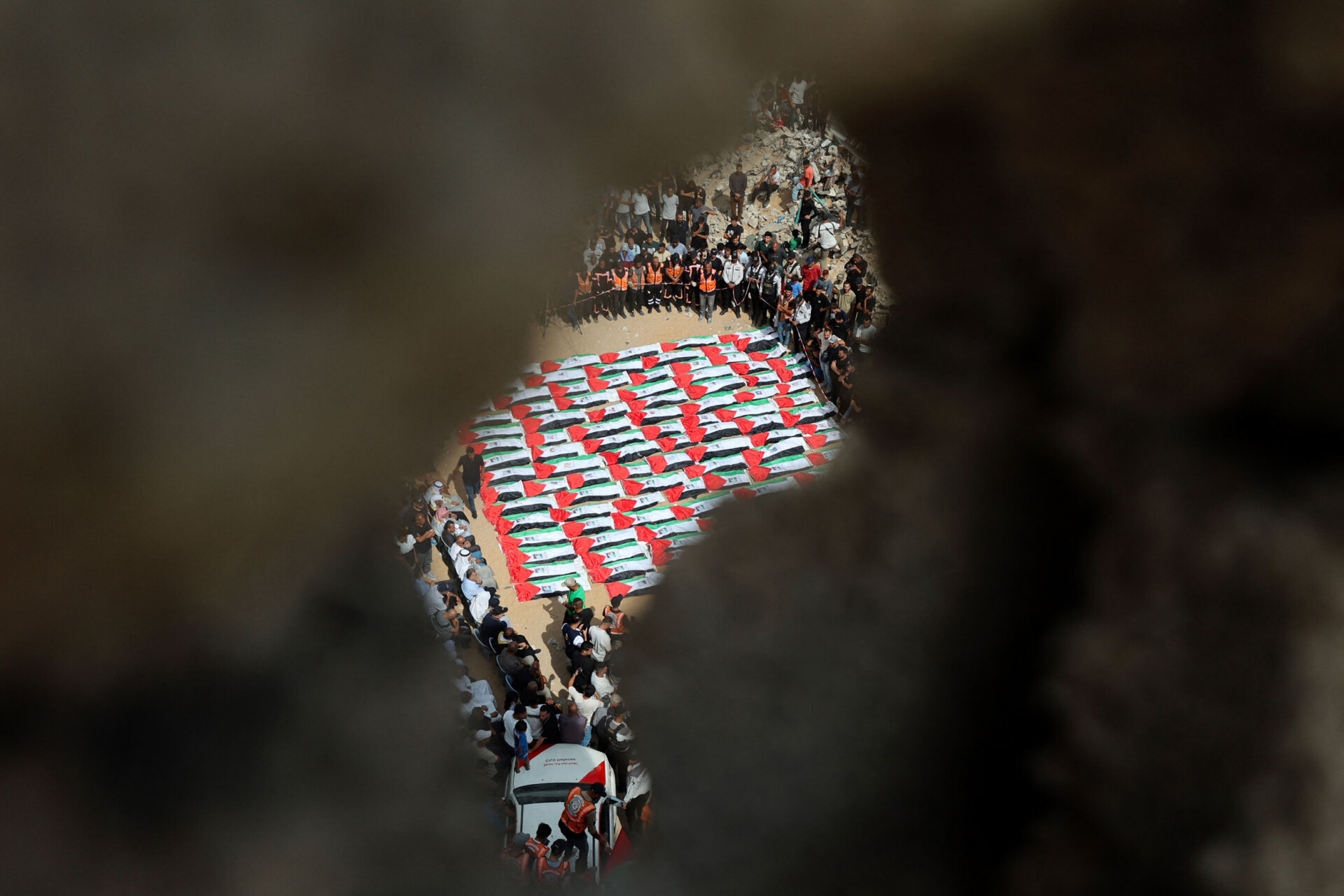
Something has shifted in the way the international community views Palestine, historian Rashid Khalidi tells Faisal Al Yafai. “It’s this device, the cellphone, social media and unmediated coverage of a genocide. And for a younger generation that is just addicted to their devices, they couldn’t not see this,” Khalidi says on his return to The Lede.
“In a couple of years, these searing images have shifted everything in a way that it took Zionist propaganda and American imperial interests more than a decade to establish,” Khalidi says. “I think that’s permanent, at least for this generation.”
“Public opinion by itself is nothing. It has to be translated into politics.”
Khalidi’s latest book, “The Neck and the Sword: Palestine’s Unfinished Struggle,” documents a series of three conversations with the intellectual and writer Tariq Ali, held from 2024 to 2026. The book begins with Khalidi’s argument that we should consider today’s violence in Gaza and the West Bank as originating in the Arab Revolt of 1936-39. “The whole thing is set well before World War II, and that’s the important thing,” Khalidi says. “Israel has an army before there’s Israel. … They are in a position to dominate the country long before the Holocaust.”
The extraordinary support offered by the British to the early Zionists set the stage for subsequent decades. “I am utterly convinced that the Zionists win both because the British crush the Palestinians and the British build [the Zionists’] military during the late 1930s,” Khalidi says, noting that tens of thousands of Zionist militia members were recruited into the British police as auxiliaries in that period and taught how to fight. “They are trained. They are armed. They are taught to kill civilians. They are taught to torch olive groves. They are taught to destroy houses. That’s the Israeli army doctrine learned from the British.”
Today, Khalidi says, Palestinian leadership inside Palestine is conspicuous by its absence. “We have no regime in Palestine right now…. We have a tiny little authoritarian regime in Ramallah which has no legitimacy, no power, no authority, no sovereignty, nothing. It just serves as an apparatus to do the civil administration parts that Israel doesn’t want to do and some of the repression that Israel needs to be done.”
The Nakba of 1948 destroyed the structures on which Palestinian society had rested for centuries, Khalidi says. “ Those cities that are overrun and emptied, Jaffa, Haifa, which are the two major centers of the Palestinian bourgeoisie, the population’s entirely scattered,” he says. “The rich, the poor, the middle classes, everybody.”
Ultimately, Khalidi says, although public opinion may be shifting regarding Palestine, that may not translate into an immediate change in policy from Israel’s powerful allies in Washington. “Public opinion has no influence on American foreign policy in 95% of [cases]. The mandarins do exactly as they please. They launch their wars, they overthrow governments, they impose stringent financial conditions and suck the wealth out of countries. Nobody pays attention,” he says. “Public opinion by itself is nothing. It has to be translated into politics.”