

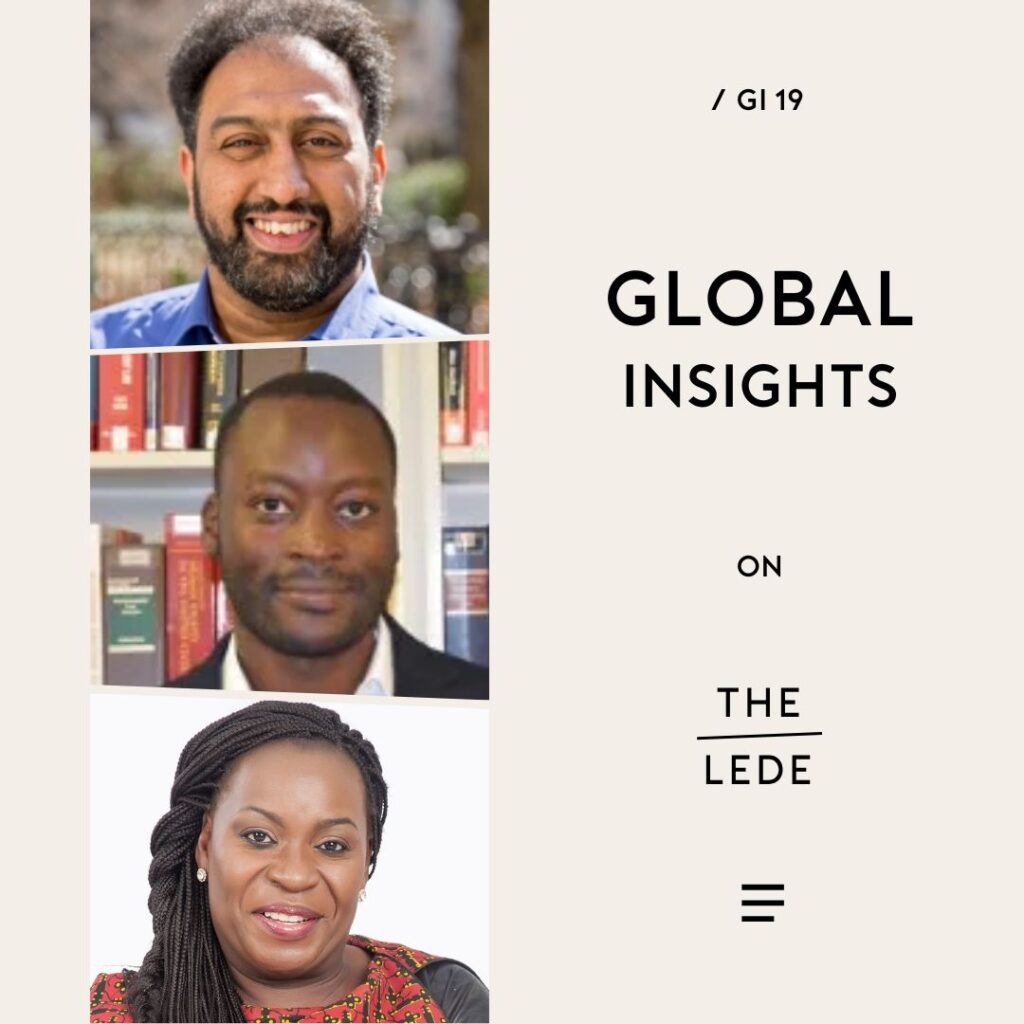
Hosted by Kwangu Liwewe Agyei
Featuring Isma’il Kushkush and Mutasim Ali
Produced by Finbar Anderson
Listen to and follow The Lede
Apple Podcasts | Spotify | Youtube | Podbean
It is just over 1,000 days since war broke out in Sudan in April 2023. Journalist Isma’il Kushkush and international law expert Mutasim Ali join host Kwangu Liwewe Agyei to discuss the conflict, for the first Global Insights on The Lede of 2026.
“Extreme violence has been a part of modern Sudan’s political history,” Kushkush says.
The Sudanese-American journalist remembers “the hope that was brought about in 2019 with the revolution, that the country’s political actors would finally come to a point where they could address the country’s problems.”
“Extreme violence has been a part of modern Sudan’s political history.”
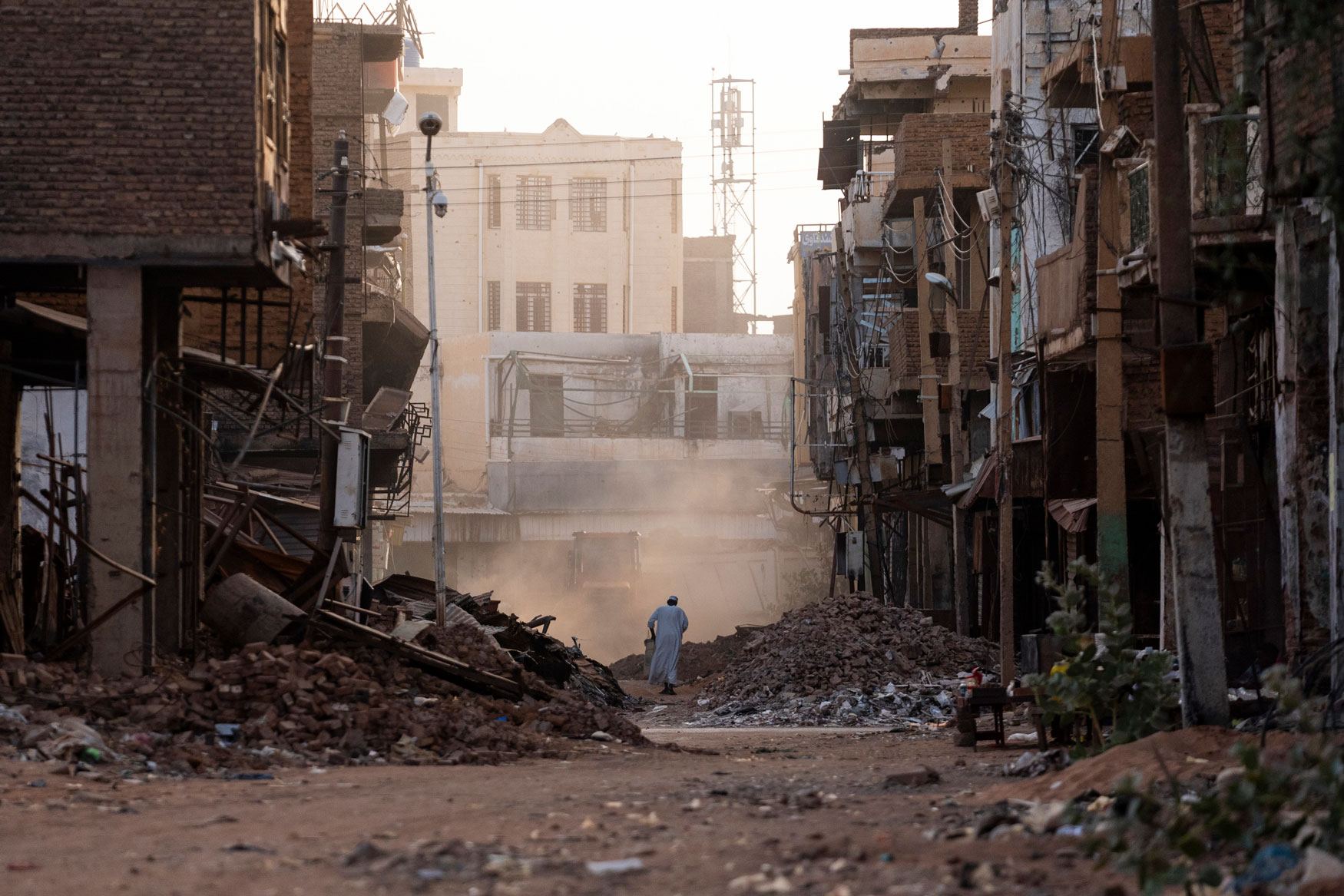
“The violence reaching Khartoum was the scenario that many of us dreaded, that we hoped would never happen,” says Kushkush, remembering his own flight from Khartoum in 2023. “The dread of seeing these places destroyed — that was a sinking feeling for me.”
The war is all-pervasive inside Sudan, Kushkush says. “There is not a single Sudanese family from east to west, north to south, that hasn’t been affected by the war one way or another.”
Kushkush is skeptical that refugees will begin to return to their homes. “There are many who question whether it is safe to return, what kind of livelihoods are available,” he says. “The other thing, of course, is security. That is the most important thing. I mean, is this war over? And it isn’t.”
Kushkush laments the conflict’s lack of visibility in the news cycle. “That phrase, the ‘forgotten war,’ is reflective of poor media coverage of the conflict in Sudan,” he says. “Sudan is a big country, and there are many actors, and it’s a complicated conflict, I understand. But nevertheless, the implications of not covering this war, I think, are detrimental and will have an impact regionally and globally.”
International law expert Mutasim Ali explains some of the regional politics that contribute to preventing the war’s conclusion. “Some of the actors involved in fueling the atrocities in Sudan are making profit from the conflict, “ he explains. “They’re benefiting from illicit gold trafficking, they’re interested in access to the ports in the country. We have seen similar actors in Libya, in Yemen and Somalia and the like.”
These actors, Ali says, “exploit the security situation and the lack of proper governance to smuggle these minerals, and so regrettably they would not cease unless there is a real, genuine will from the global community.”
Ali has been working in his capacity as a legal adviser at the Raoul Wallenberg Center for Human Rights to try to find state sponsors to help bring legal proceedings against some of the conflict’s malign actors to the International Court of Justice. “Regrettably, we haven’t been able to secure any sort of commitment from a state,” he says. Nevertheless, “we are committed and we are working with our partners to make sure that this is going to happen.”