



From the middle of December, across Central Asia, the Middle East’s Fertile Crescent, North Africa and Southern Europe, a very particular fruit starts to ripen. Green orbs slowly turn to orange, but you wouldn’t pick them off the tree for a refreshing snack, for these oranges are bitter, known in the West as Sevilles, though their origins are far from the Spanish town. Brought to the Mediterranean by the Arab conquest of Central Asia in the eighth century, they thrived despite their lack of sweetness — or even, perhaps, because of it. For the bitterness, when boiled up with sugar, makes the most delicious of concoctions: marmalade.
Going back to school after Christmas on the dark mornings of a British January was lightened in my youth by the smell of the house on my return every dark afternoon: My mother makes huge quantities of marmalade every year. We would get home to small dishes of the golden-orange spread ready to put on toast, the remnants of batches that didn’t fit into the newly sterilized jars. While we snacked, we would help stick the labels to the still-warm, glowing jars, and try to match up the lids (the mystery of marmalade making until this day is that there is always a leftover lid and jar that do not match, however careful you’ve been to keep pairs together).
Last year, I took a foodie friend back home with me, not only so my mother could teach him how to make it, but also to enter the Dalemain World Marmalade Awards. Steve had noticed the ad on a trip up to visit his mother in the Lake District, and found a category called “Generations Together,” so here we were. It wasn’t until we got back to my house and got to work on the submission that we realized quite what we were in for. Once the name was chosen, the label designed and the jar packaged up (each step requiring extensive discussion), we turned to filling in the form, to find out that there were drop-off points not only in the upmarket London shop Fortnum & Mason, but also in New York and Tokyo. We looked at each, slightly horrified and also amused that we were entering such an international competition with a homemade jar from my mum’s kitchen, but we agreed we were committed now: Not only did we have a labeled jar ready to post, but we had an Airbnb booked in Cumbria for the festival itself.
So a few days later, I walked into Fortnum & Mason in St. Pancras, London, to hand over our packaged jar and to receive a free one in exchange. It was surreal; our entry felt too homely for the grand shop that charges £80 ($108) to have afternoon tea, the printed-off form too amateur. But it went smoothly. “Ah yes,” the shop assistant said, as if it was perfectly normal. “Have you paid your entrants’ fee?” I replied that we had, uncomfortably aware I had no proof, but no proof was requested. “And have you packaged it ready for posting?” Yes, with bubble wrap, I reply. He walks to the shelf, reaches for their breakfast variety, and hands it over, no more questions asked. I take a photo of him holding it as evidence of submission — for my friends as much as for the competition. (I take the free jar to my mum who declares it to be, “Lovely, but not as tasty as mine, it lacks the depth.” I agree; like so much mass-produced marmalade, there’s not quite enough bitterness to match the sweetness. It languishes in my cupboard, while others get finished.)
Months later, one spring evening at the end of April, in the heart of England’s beautiful Lake District, I walked from the tiny village of Dacre up to Dalemain Mansion, a 900-year-old stately home, inhabited by only three families in this long history: a very English home in a very English landscape. As I approached, glimpsing the house occasionally over the fields of grazing sheep and lambs, I suddenly came upon an extraordinary sight. Walking through a small wood in this pastoral idyll was a stream of Japanese monks in beautiful ceremonial quilted kimonos, walking in single file behind the food writer Dan Lepard, beloved in my family for his books on cakes. It was enough to stop me in my tracks. “Excuse me,” I called out, and Lepard genially turned around. “Is this Dalemain? Where the marmalade festival is?”
This serendipitous meeting turned out to be the perfect introduction to the extravaganza of the forthcoming weekend. The friendliness felt personal and warm, the setting unmistakably English, yet the reach and appeal of the festival was truly international. Last year’s overall winner, Hitomi Wakamura, is Japanese, like the monks in the wood who performed tea ceremonies as part of the festivities. Steve Martin’s personal chef flew in from New York to collect his multiple gold certificates. The “Marmalashes,” a competition between Australia and the U.K., not quite as fierce as its cricketing inspiration, is judged here. Paddington Bear is naturally in attendance, as is a representative of the crown, with a message from King Charles himself. From monks to diplomats, Paddington to the king, marmalade has proved to be a globally unifying passion. How did this staple of the British breakfast table become the focus of a competition hosting over 3,000 jars flown in from all over the world?
“Marmelo” is the Portuguese for “quince,” which was imported to Britain from the 15th century as a luxury paste — or “marmelada,” popular with monarchs from Henry VIII on. The name came too, but it became attached to the form of the product rather than the fruit, and was soon applied to other fruit pastes. In her recipe book of 1604, Lady Fettiplace instructs that marmalade be made from bitter oranges together with apples. There are similar versions throughout the 17th century, including in the recipe book of a previous inhabitant of Dalemain, Elizabeth Rainbow, along with variations using cherries, apricots, apples and quinces. Samuel Pepys records in his diary entry of Nov. 2, 1663, that he “left Mrs Hunt and my wife making marmalett of quinces.”
Most 17th-century versions followed the original form of marmelada that came from Portugal: Marmalade was still a solid paste, sometimes known as “bricks,” or as Sir Hugh Plat, in “Delightes for Ladies” (1605) put it: “It will cut like a hard egg.” The results were eaten in slices, often at the end of meals, like an after-dinner mint. At some point — at least by the time the unknown mother of a certain Rebecca Price, who copied “marmelett of oringes: my mother’s receipt” into her own recipe book in 1681 — marmalade became truly orange, losing the pippins, and also began to be potted rather than boxed and sliced (thus becoming more like a jam).
In the 18th century, printed recipe books routinely included this less solid, potted version of marmalade, with two basic versions from two different treatments of the peel: It could be beaten, making a smooth jelly, or shredded and included as “chips.” But all these versions, boxed or potted, clear jelly or with peel pieces, had one thing in common: The whole fruit of the orange was used — the segments, pith and peel. This is the crucial difference from jam, which does not use the bitter citrus peel; as a result, orange jam is far sweeter — too sweet for marmalade lovers.
And so the romantic marmalade origin story of an 18th-century shipwreck off the coast of Scotland — its cargo of oranges bought up by Dundee resident Janet Keiller and cooked up with her grocer husband’s stock of sugar — is clearly a myth, though an enduring one. Most recipe books in the country by this stage had a version of orange marmalade, and Keiller would have been spoilt for choice, if indeed she didn’t have her own family recipe to draw on. What is indeed the case is that she made so much they began selling it, and it was soon so popular they established the first branded, widely available marmalade: Keiller’s of Dundee, which existed right through until the late 20th century.
Marmalade was taken all over the world in colonial suitcases, but its international appeal really took off with the publication, in 1958, of the book “A Bear Called Paddington.” Paddington came, as so many of us now know, from deepest darkest Peru, where his Aunt Lucy made marmalade and packed off her small nephew to London with marmalade sandwiches in his suitcase, and a label on his coat saying “Please look after this bear.” The internationally successful film franchise turbocharged the fame of the bear and his marmalade sandwiches. The image is so iconic that Paddington was part of Queen Elizabeth’s diamond jubilee celebrations: In a video, he offers her a marmalade sandwich from his hat, after destroying the cream cakes laid out for tea. The queen opens her handbag to show she carries them with her, too. They happily munch on their marmalade together.
This long history of personal recipes, together with the wide popularity boosted by Paddington films, means that marmalade was a good choice for a festival. It all began 20 years ago, when foot and mouth disease had ripped through the area, limiting human access to the land, a disaster for the tourism industry of this scenic locale which inspired so many writers: Wordsworth “wandered lonely as a cloud” here, Beatrix Potter created Peter Rabbit and friends (and enemies), Arthur Ransome wrote of idyllic childhood adventure holidays, sailing and hiking on and between the lakes that give the national park its name.
Jane Hasell-McCosh of Dalemain Mansion wanted to do something to combat the critical loss of income the region was facing. Why marmalade, I asked her. As I do when I think of marmalade, she went right back to her childhood — and that January fragrance. “The aroma of marmalade, which is very particular, has been in my aroma memory for a very long time. And that’s really important in terms of heritage,” she said, gesturing around the large kitchen where so many batches are made, including with her children.
And so they began the Dalemain Marmalade Festival, now grown so large it dominates both the family’s year and the local area. The nearest train station, Penrith, pronounces your arrival in the “Marmalade District.” During April, the shops of the town are all decorated orange, with prizes awarded as part of the festival. From florists to nail bars, grocers to toy shops, charity shops to newsagents: Over 50 shops were celebrating the weekend that “Penrith goes Orange!” This even extends to Dalemain sheep, 20 of which were orange for the weekend, to celebrate the 20th anniversary of the festival.
The local community not only celebrates it, but underpins its success. “This whole event completely relies on a huge generosity of people,” Hasell-McCosh explained. “It’s now well over a hundred people who give their time in lots of different ways.” First comes the unwrapping of the thousands of jars, “which is terribly, terribly cold, because it’s in January and it’s down in the medieval hall, where there isn’t much heating.” Then there’s the logging, the admin, the displaying and the work during the festival itself, much provided by locals. The local flavor was reinforced by the choice of a Cumbrian hospice charity as beneficiary of all proceeds (to date, this has almost reached £350,000 or about $470,000), and there is even an annual performance of a specially written marmalade song by the local primary school. The Sunday of the festival weekend sees a “marmalade service” at the local church.
But there’s an unmistakable national element to the festival, too, from the sponsorship of Fortnum & Mason through to the monarchy. The Lord-Lieutenant Alexander Scott is the king’s representative in Cumbria, and told the assembled crowd at the opening of the festival: “I know, as I’m sure you all do, of his majesty’s well-known fondness for marmalade and his affection for this festival, and all that it represents for our rural economy.” The king had been involved before even ascending the throne, so Hasell-McCosh had long known that he enjoyed marmalade the way she herself did: with sausages. He couldn’t come to the celebration, but he sent “his heartfelt, warm, good wishes to all those who will be present and hopes you have a most enjoyable day.”
His speech was followed by the deputy chief of mission for the Japanese Embassy, and then the deputy high commissioner for Australia, the country first to follow Dalemain’s example and inaugurate its own marmalade competition and festival. There was also a minister-counselor from the Spanish Embassy in London — the place of origin of so much of the fruit, boiled and bottled, that was present at the festival. Local, national and international elements were all strongly present from the moment of its opening.
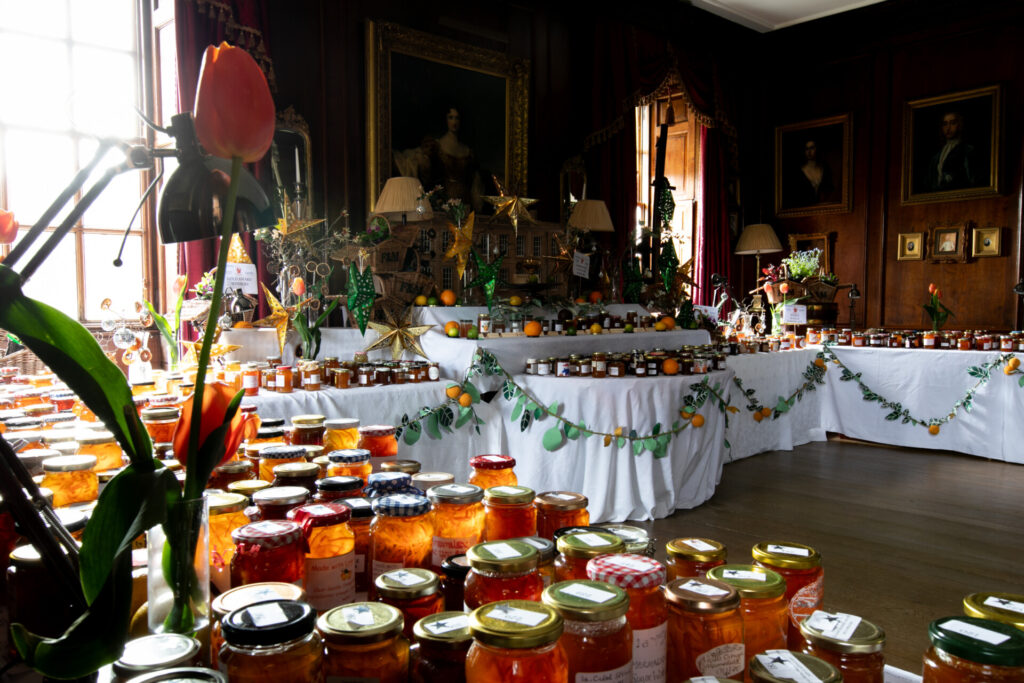
As I waited in the courtyard for the doors to open, VIPs started to appear — among them the Japanese monks I’d seen the evening before and a life-size Paddington, waving genially, though quickly whisked away round the back. We’re ushered in, and I am overwhelmed at the sight of row upon row of glowing marmalade jars, shades ranging from pale yellow to the richest orange, on table after table. “I now see what I was up against,” I say to someone. “You’ve seen nothing yet,” came the reply. “This room has a few hundred or so jars. There are 3,000. You need a stately home just to display them all.”
This was Tony, the husband of Karen Jankel — the daughter of Michael Bond, who wrote the Paddington books. She’s not just a patron of the competition but also a judge. I asked how she could possibly taste 3,000 jars without severe symptoms of sugar overdose. “We don’t all taste all of them, but often have to taste the top entries more than once,” she explained, adding that sparkling water and crackers are used between tastings to cleanse the palate. Another judge tells me: “I don’t even like marmalade, but it doesn’t matter, because the rules are very clear, with objective elements to check for like peel distribution and so on.”
I find our jar among the throng and am very pleased with the comments. “Loved the label — marmalade good colour and peel distribution. Give us a full jar next time. Slightly overcooked — set very firm — good potential for next time.” Altogether, we scored 14 out of 20, gaining us a certificate of merit — and only just missing out on bronze. My mother, however, was not so happy. In fact, she was outraged, offended beyond redemption. “I am never giving them another jar again!” came her response. “I have never overboiled marmalade in my life!”
I raise the point in a Q&A session about marmalade later in the day. It’s always a delight to uncover a subculture entirely unexpected and unknown. I would have guessed that lots of people love marmalade, and I know lots of people love Paddington, but this session was another level of geeky. Questions of straight-sided and angled pans were raised, advice on the amount of time left between boiling and jarring sought, and a discussion was had on the trickiness of achieving a good set if alcohol is being added (the so-called “tipsy” category of marmalade, which is very popular). Refractometers (to measure sugar content, I learned from Google) were discussed. “If I go above 62% sugar, my set is good, but the marmalade tends to go opaque,” one man opened with. “Would that be an issue in the overall marks?” Apparently not, he was assured, though questions were raised about the potential quality and age (relating to water content and acidity) of the oranges and lemons being used. This opened up into questions of suppliers, with the surprising advice carefully squirreled away for our future entries that the supermarket Sainsbury’s had the best supply chain for organic Seville oranges — at least among those easily obtainable; some makers order direct from the source.
This question of supply is entirely different for the makers from countries with the climate to grow their own. What’s your secret? I asked Andy Olson, the personal chef of Steve Martin and a veteran of the competition, who last year garnered no fewer than six certificates: three gold, two silver and a bronze. He has been on a mission for years to find the perfect fruit, saying that Sevilles from Florida are good, but the Californian-grown fruit has a better color, thanks to the cold snap lacking in Florida. But a real game-changer was that a friend out in the desert of Palm Springs offered grapefruit and lemon from their own trees — guaranteed organic, guaranteed fresh, guaranteed picked at the perfect moment of ripeness, and sent straight to Olson in New York. His first entries, two years ago, won him a silver and a bronze, but his trip to the festival and seeing the combinations spurred him to experimentation. “People would put just the oddest flavors together. There was one that was lemon and horseradish!” He went home mulling it over and thought, “Well, that would actually be really good with cheese on a cracker.” This train of thought led him to one of this year’s breakthroughs: lemons straight from the friend’s trees in Palm Springs with dill pickle. “Which sounds weird, and it is weird, but it tastes great!” This is just one of his three golds of the year, but I can’t taste it because the tasting jars ran out on the first morning. I resolve to get straight to tasting next year, instead of letting the initial crowds dissipate, and realize I’m becoming one of the subculture geeks.
Olson’s approach has inspired us to pursue fresh citrus, too. From a trip to Monaco in early summer, I brought back the unique species of lemon from Menton, which made delicious lemon marmalade (a jar was set aside as an entry). And now the Sevilles are ripening again, and I will be packing my suitcase from Palestine, where I’ve come for Christmas, with the bitter fruit, exempted from customs restrictions on food and drink. (Is it that the U.K. government has recognized how important it is to keep the flow of citrus going, for the sake of the nation’s breakfast tables?) The dark January will once again be filled with the fragrance of marmalade, once again I will make my way to the luxury of Fortnum & Mason to drop off our jars and once again we will be in the Lake District to hear the judgment, in the spring, among the aficionados from all over the globe.
Sign up to our mailing list to receive our stories in your inbox.