


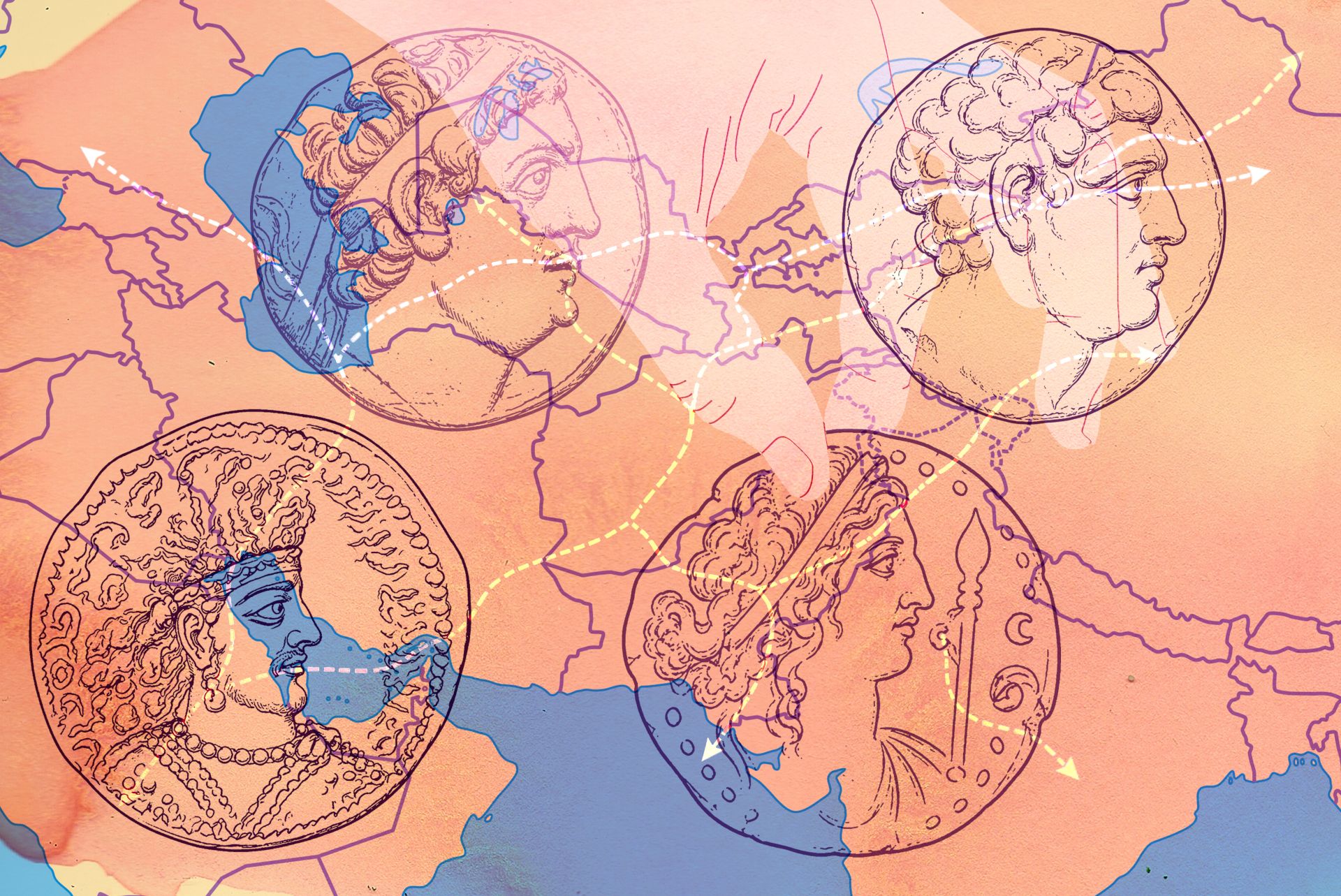
The coins are smaller than I expected. That’s my first thought as the curator carefully places the velvet-lined tray on the table in the British Museum’s study room. I’ve waited three weeks for this appointment, filling out forms, explaining my research interest, providing references. All to see a collection that once belonged to Alexander Burnes, a Scottish officer and diplomat who traveled through Afghanistan in the 1830s, mapping territories and peoples for the East India Company while the Great Game between Britain and Russia was just beginning to take shape. I’ve been fascinated by Burnes for years, Afghanistan’s T.E. Lawrence, as I call him, though he came a century earlier and met a far more brutal end, hacked to death by a Kabul mob in 1841. But it’s not Burnes himself I’ve come to see today. It’s what he carried in his pockets.
The curator, a soft-spoken woman who specializes in Central Asian numismatics, gestures toward the coins with a gloved hand. “He collected these during his travels through Sindh, Kabul, Balkh and Bukhara,” she explains. “Most were acquired between 1831 and 1838.” There are perhaps 25 coins in total, arranged chronologically from left to right. Greek letters catch my eye first; then Bactrian script, an Eastern Iranian language written in a modified Greek alphabet, used across northern Afghanistan and southern Central Asia from roughly the first to the ninth centuries CE; then Pahlavi, the Aramaic-derived script of Middle Persian, in use from around the second century BCE through the 10th century CE and the official script of the Sasanian Empire.
Some are gold, most are silver, a few are bronze or copper. Many are worn smooth at the edges, the inscriptions barely legible. These are not collector’s pieces that sat in treasuries. These are coins that moved through hands, that bought bread and horses and passage across mountain ranges, that traveled along trade routes connecting the Mediterranean to China.
What strikes me most is the weight of what these small metal discs represent, not their monetary value, but the civilizations they encode. Each one is a fragment of an empire, a snapshot of a moment when power and culture flowed through the region we now call Afghanistan. And yet most of these empires, Graeco-Bactrian, Kushan, Parthian, Sasanian, exist only as footnotes in popular consciousness, if they exist at all. When we talk about Afghanistan today, we talk about the Taliban, about the Soviet invasion, about the American withdrawal. But these coins tell a different story, one that complicates every simple narrative about the region. They tell of a place that was once the center, not the periphery. A crossroads, not a backwater. A place where empires rose and fell and left their marks in metal.
Alexander Burnes was 26 years old when he first entered Afghanistan in 1831, ostensibly leading a mission to deliver gifts from King William IV to Maharaja Ranjit Singh in Lahore, the founder of the Sikh Empire, whose Punjab kingdom controlled the overland route between British India and Afghanistan. But his real purpose, as everyone understood, was reconnaissance. The East India Company wanted intelligence about the lands beyond the Indus, about the routes to Central Asia, about the strength of local rulers and the possibility of Russian influence. Burnes was perfect for the job: brilliant, ambitious, fluent in Persian and Hindustani, and possessed of that peculiar combination of genuine curiosity and imperial calculation that characterized the best, or most effective, of the company’s political officers.
He traveled in traditional Afghan dress, adopted local customs, and wrote extensively about the peoples he encountered with what seemed like genuine respect and fascination. His 1834 book, “Travels into Bokhara,” became a bestseller in London, full of vivid descriptions of bazaars and mountain passes, of conversations with merchants and mullahs. He was knighted at 31. The Royal Geographical Society awarded him its gold medal. He was being compared to Marco Polo.
But Burnes was also mapping territory for conquest, assessing military vulnerabilities and cultivating informants. When the British decided to invade Afghanistan in 1839 to install a puppet king, Burnes was there, serving as the chief political officer in Kabul. Two years later, when the occupation collapsed into disaster, he was among the first to die, his house burned, his body mutilated beyond recognition. His decade-long adventure in Afghanistan had ended.
The coins he collected reveal this same tension between genuine intellectual curiosity and imperial extraction. He bought coins from merchants in bazaars, received them as gifts from local rulers, perhaps dug some up himself at ancient sites. He kept careful notes about where each coin was found, what it depicted, what it might reveal about the region’s history. In his letters home, he wrote with excitement about discovering evidence of Greek kingdoms in Central Asia, of Buddhist influences, of trade networks that once connected the Mediterranean to China.
Yet he was also literally pocketing Afghanistan’s heritage, removing these artifacts from their context and sending them back to London, where they would end up in museum collections. The irony is almost too neat: a man working to extend British imperial control over Afghanistan while simultaneously uncovering evidence of the region’s long history of resisting simple imperial narratives. His coins map something far older and more complex than the Great Game he was playing. They map layers of empire, trade routes, cultural exchange and synthesis that complicate every attempt to define Afghanistan as simply one thing or another.
The first coin in the tray is Graeco-Bactrian, dating from the late third century BCE. The curator points to it carefully, a silver tetradrachm showing a diademed head in profile on one side. “That’s Euthydemus I,” she says. “Burnes found this one in Bukhara. Euthydemus ruled Bactria around 230 to 200 BCE and successfully defended his kingdom against Antiochus III, the Seleucid king who tried to reconquer the region. He’s one of the most important Graeco-Bactrian rulers. He established the dynasty that would last for generations.”
I stare at the coin, trying to imagine the hands that held it over 2,000 years ago. The Greek letters around the edge are still legible: “ΒΑΣΙΛΕΩΣ ΕΥΘΥΔΗΜΟΥ” — “of King Euthydemus.” The portrait shows a strong-featured man, his hair bound with a diadem, the royal headband. On the reverse, Heracles sits on a rock, holding his club, rendered in the classical Greek style. The coin’s journey, from a mint in ancient Bactria to a bazaar in 19th-century Bukhara to a museum in 21st-century London, speaks to the layers of history compressed into this small piece of silver.
The Graeco-Bactrian kingdoms emerged from the fragmentation of Alexander the Great’s empire after his death in 323 BCE. While most people know about the Ptolemaic dynasty in Egypt or the Seleucid Empire in Syria, fewer remember that Greek rulers also established kingdoms in Central Asia, in the region the Greeks called Bactria, which today roughly comprises northern Afghanistan and southern Uzbekistan. These weren’t just military outposts. They were sophisticated Hellenistic states with cities, mints, trade networks and a remarkable synthesis of Greek and local cultures.
Euthydemus himself was a usurper, a Greek from Magnesia who seized power around 230 BCE. When Antiochus III invaded Bactria in 208 BCE, attempting to reassert Seleucid control, Euthydemus held out for two years before negotiating a peace that recognized his independence. His argument, according to the historian Polybius, was that he and Antiochus should unite against the nomadic peoples threatening both their kingdoms from the north. It worked. Antiochus withdrew, and the Graeco-Bactrian kingdom survived for another century, eventually expanding south into what’s now Afghanistan and Pakistan.
The coins reveal this history in miniature. Early Graeco-Bactrian coins are purely Greek in style, indistinguishable from those minted in Athens or Antioch. But as the decades pass, you can see the influence of local artistic traditions, the incorporation of Indian religious symbols, the addition of inscriptions in Kharosthi script alongside Greek. Some later coins show Greek kings wearing Indian dress or adopting Buddhist iconography. This wasn’t cultural imperialism in the simple sense. It was adaptation, negotiation, the creation of something new.
What strikes me most is how thoroughly this history has been forgotten in modern narratives about Afghanistan. When we talk about the region’s relationship with the West, we usually start with the British invasions of the 19th century. But here’s evidence of Greek kingdoms that lasted for centuries in the heart of Central Asia, of cities where Greek philosophy was debated and Buddhist texts were translated, of trade routes that connected the Mediterranean to the Silk Road. The historian Frank Holt has called Bactria “the crossroads of Asia,” and these coins prove it.
The sites of Graeco-Bactrian cities like Ai-Khanoum in northern Afghanistan were excavated by French archaeologists in the 1960s and 70s, revealing Greek theaters, gymnasiums and libraries. But decades of war have made further excavation impossible. How many other sites remain unexplored, their stories still buried? How much of this history has been lost not just to time but to our own selective memory, our tendency to impose simple narratives on complex pasts?
The Kushan coins dominate the collection; there are more than 10 of them, most showing the emperor Kanishka I. The curator handles them with particular care, pointing out details: the fine portraiture, the variety of religious imagery, the evidence of long-distance trade. The Kushans, a nomadic people from Central Asia, established an empire in the first and second centuries CE that stretched from the Aral Sea to the Ganges, controlling the heart of the Silk Road at its peak.
One coin shows Kanishka in profile, bearded and wearing a long coat and boots: Central Asian nomad dress. On the reverse is an image of the Buddha, standing with one hand raised in blessing, with the Greek inscription “ΒΟΔΔΟ” — “Boddo,” a transliteration of “Buddha.” Another coin shows the Iranian god Mithra. Another shows the Greek god Heracles. The Kushans, it seems, were religious pluralists, or at least pragmatic enough to put multiple gods on their coins.
Kanishka ruled in the second century CE and is remembered as one of the great patrons of Buddhism. Under his reign, Buddhism spread from India to Central Asia and eventually to China. The Gandharan school of Buddhist art, which depicted the Buddha in Greco-Roman style, flourished under Kushan patronage. But the coins also show Zoroastrian deities, Hindu gods and Greek heroes, evidence of a cosmopolitan empire comfortable with multiple religious traditions.
The Kushan Empire represents a high point in the region’s history, a moment when Afghanistan was truly the center of the world. The Silk Road trade was at its peak, connecting Rome to China, and the Kushans controlled the key routes through Central Asia. Their cities — Begram, Bamiyan, Taxila — were cosmopolitan centers where merchants from across Eurasia met and traded. Archaeologists have found Roman glassware, Chinese silk, Indian ivory and Greek sculptures at Kushan sites, evidence of a truly global trade network.
Kushan coins and inscriptions used Greek, Bactrian, Sanskrit and Prakrit, reflecting the empire’s multilingual character. This was a hybrid culture, resistant to simple categorization. The coins themselves are evidence of this synthesis: Greek letters spelling out Iranian god names, Buddhist imagery rendered in Hellenistic style, Central Asian rulers adopting Indian titles.
Looking at these coins, I think about the Bamiyan Buddhas, the massive sixth-century statues that the Taliban destroyed in 2001. Those statues were part of the same cultural tradition that the Kushan coins represent, a Buddhism that was influenced by Greek art, patronized by Central Asian rulers and connected to trade networks spanning continents. Their destruction was presented as an act of Islamic iconoclasm, a rejection of idolatry. But it was also a rejection of this history of cultural synthesis, this evidence that Afghanistan was once a place where different traditions met and merged rather than clashing.
The Kushan coins raise uncomfortable questions about what we choose to remember and what we choose to forget. These coins are evidence of a different Afghanistan, one that was wealthy, cosmopolitan and culturally confident. What would it mean to take that history seriously? What would it mean to see Afghanistan not as a perpetual periphery but as a place that was once central to world history?
The final coins in the collection are Persian: one Parthian, several Sassanian. The curator picks up the Parthian coin first, a silver drachm showing Vologases III, who ruled from 105 to 147 CE. “The Parthians competed with the Kushans for control of the eastern trade routes,” she explains. The coin shows the king in profile, wearing a distinctive pointed tiara, with a Greek inscription around the edge. On the reverse, the king sits on a throne, receiving a palm branch — a symbol of victory borrowed from Hellenistic iconography.
The Sasanian coins are smaller and thinner, struck in silver with a distinctive style. The Sasanian Empire, which succeeded the Parthians in 224 CE, controlled parts of Afghanistan from the third to seventh centuries, competing with the Kushans and their successors for control of the Silk Road trade. The coins show Sasanian kings in profile, wearing elaborate crowns, with fire altars on the reverse, symbols of Zoroastrianism, the state religion.
One coin shows Khusrau I, who ruled in the sixth century and is remembered as one of the greatest Sasanian kings. The portrait is remarkably detailed despite the coin’s small size: The king’s beard is carefully rendered. His crown is topped with a crescent moon and star. On the reverse, two attendants flank a fire altar, and there’s a Pahlavi inscription giving the king’s name and titles. Another coin shows Shapur II, who ruled for an astonishing 70 years in the fourth century.
What’s interesting about these Persian coins is how they reveal the limits of imperial control. The coins struck in eastern provinces often show local variations, different crown styles, different reverse designs, sometimes even different scripts. This suggests that Sasanian control was more nominal than real in many areas, that local rulers maintained significant autonomy while nominally acknowledging Sasanian suzerainty. The coins also show evidence of long-distance trade: Sasanian coins have been found in hoards across Central Asia, in China, in India, even in Scandinavia.
The Sasanian period also saw the continuation of religious diversity in the region. While Zoroastrianism was the state religion of the Sasanian Empire, Buddhism continued to flourish in Afghanistan, and there’s evidence of Christian, Jewish and Hindu communities as well. This wasn’t a region where one religion or culture dominated. It was a place of coexistence, sometimes peaceful, sometimes tense, but always multiple.
I think about how this history complicates modern narratives about Afghanistan and Iran, about Persian and Pashtun. The borders we draw today, between Afghanistan and Iran, between Central Asia and South Asia, are modern constructions, products of 19th- and 20th-century geopolitics. These coins reveal a different geography, one organized around trade routes rather than nation-states, around cultural zones that overlapped and interpenetrated rather than neat boundaries. The Sasanian Empire included parts of modern Afghanistan, Iraq, Iran and Central Asia. The Kushan Empire included parts of modern Afghanistan, Pakistan, India and Uzbekistan. These were not nation-states with fixed borders. They were networks of cities and trade routes, zones of influence that expanded and contracted, cultural spheres that blended into each other at the edges.
I’m back in the present now, in the British Museum’s study room, staring at these 30-odd coins laid out on velvet. The curator has left me alone for a few minutes to examine them more closely, to take notes for my research. The room is quiet except for the hum of the climate control system. Through the window, I can see the gray London sky, the tourists gathering in the museum’s Great Court below.
There’s something deeply ironic about seeing Afghanistan’s history preserved here, in London, in the British Museum of all places. These coins were collected by a British officer during the first Anglo-Afghan War, removed from their context and sent back to the imperial metropole. They’re part of a larger pattern of extraction and appropriation, of the West taking and keeping the cultural heritage of the rest of the world. The British Museum is full of such objects: the Elgin Marbles, the Rosetta Stone, the Benin Bronzes.
And yet, I can’t help but feel grateful that these coins survived. How many others didn’t? How many were melted down for their metal, lost in wars, buried in hoards that were never recovered? Afghanistan has been at war for more than 40 years now: the Soviet invasion, the civil war, the Taliban, the American intervention, the Taliban again. How much has been destroyed? How many archaeological sites have been looted, how many artifacts have been lost to the black market, how much history has simply been erased?
I think about the National Museum of Afghanistan in Kabul, which was shelled during the civil war in the 1990s, its collections looted and destroyed. I think about the Bamiyan Buddhas, dynamited by the Taliban. I think about the Mes Aynak copper mine, where a major Buddhist monastery complex is being destroyed to make way for Chinese mining operations. I think about all the sites that have never been excavated, all the coins and artifacts and inscriptions that remain buried, all the history that we don’t know because we’ve never had the chance to look for it.
Afghanistan is one of the most archaeologically rich regions in the world, a place where layer upon layer of history is literally buried in the ground. But it’s also one of the least explored, one of the least studied. The French excavations at Ai-Khanoum in the 1960s and ’70s revealed an entire Graeco-Bactrian city, complete with Greek inscriptions, a theater, a gymnasium and a library. But the site was looted during the Soviet-Afghan War and has been inaccessible to archaeologists ever since. How many other sites like Ai-Khanoum are out there, waiting to be discovered?
The coins in front of me represent a tiny fraction of what must still exist. Burnes collected these in the 1830s, buying them in bazaars and receiving them as gifts. He wasn’t conducting systematic excavations. He was just picking up what was available, what local people had found and were willing to sell. If this much history was available in bazaars in the 1830s, how much more must still be buried? And how much of it will we ever have the chance to recover?
What these coins reveal is a history that complicates every simple narrative about Afghanistan, about Islam, about the relationship between East and West. They show a region that was once wealthy and cosmopolitan, that was central rather than peripheral, that was a place of cultural synthesis rather than clash. They show Greek kingdoms in Central Asia, Buddhist empires on the Silk Road and Persian influence in the Hindu Kush. They show a history that is multiple, layered, complex, a history that resists the simple stories we like to tell about the region.
But this history has been largely forgotten, or at least marginalized. When we talk about Afghanistan today, we talk about terrorism and war, about the Taliban and al Qaeda, about failed interventions and humanitarian crises. We don’t talk about Graeco-Bactrian kingdoms or Kushan emperors or the Silk Road. We don’t talk about a time when Balkh was one of the great cities of the world, when Bamiyan was a center of Buddhist learning, when Herat was famous for its poets and artists. We’ve reduced Afghanistan to its present crisis, forgotten its deep past, lost sight of the complexity that these coins reveal.
And yet the coins remain, these small metal objects that have survived for centuries, that have passed through countless hands, that have traveled from Afghan bazaars to British museums. They remain as evidence, as testimony, as fragments of a history that refuses to be completely erased. Alexander Burnes carried them in his pockets as he traveled through Afghanistan in the 1830s, mapping territory for the British Empire while simultaneously uncovering evidence of empires far older and more complex. He died violently in Kabul in 1841, his body burned beyond recognition, his mission a failure. But his coins survived, and they continue to tell their stories.
I gather my notes, thank the curator, and make my way out of the British Museum into the London afternoon. The coins remain behind, locked in a storage room, available by appointment. They’ll probably stay there for the foreseeable future, part of the museum’s permanent collection, part of the vast accumulation of objects that the British Empire gathered from around the world. Whether they should remain there, whether they should be returned to Afghanistan, is a question I can’t answer. What I know is that they represent something important, something that shouldn’t be forgotten: evidence of a history that is richer and more complex than our current narratives allow.
Become a member today to receive access to all our paywalled essays and the best of New Lines delivered to your inbox through our newsletters.