



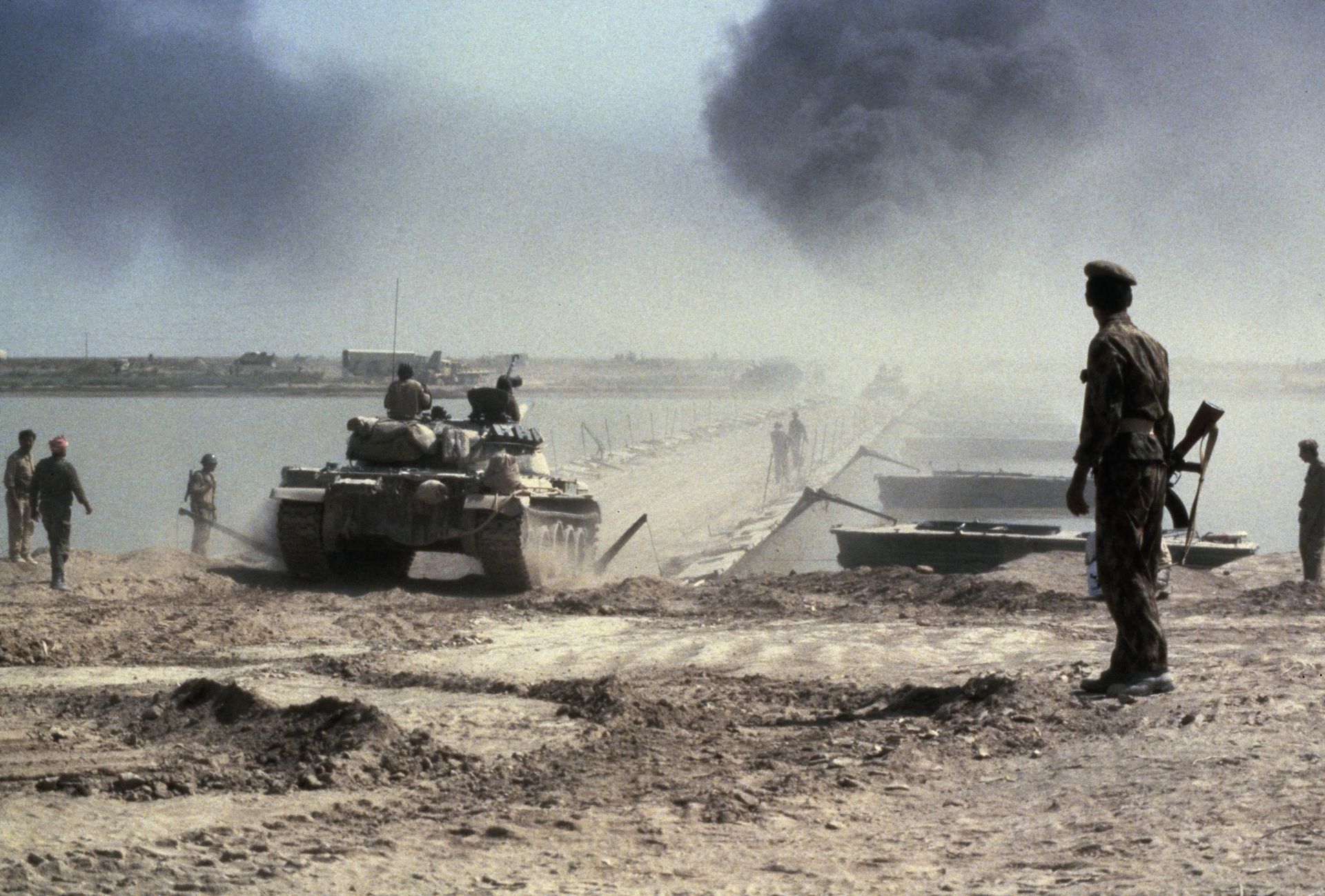
This isn’t the first time the Islamic Republic has been under siege. Indeed, it was attacked a mere 18 months into its existence, in September 1980, and fought an almost decade-long war with its neighbor to the west — the longest war between states of the 20th century. The Iran-Iraq War shaped postrevolutionary Iran in profound and enduring ways. The scholars Arang Keshavarzian and Nida Alahmad have argued that the war is “every bit as important as the revolution, if not more so,” for understanding the trajectory of the Islamic Republic. And its effects are relevant to Iran’s present war with the U.S. and Israel.
Saddam Hussein, then president of Iraq, thought he could capitalize on internal Iranian disorganization in the aftermath of the revolution. And for a time, he was right. Iraq occupied parts of Iran and gained territory, benefiting from more advanced weaponry and a more professionalized army. But Iran fought back, throwing soldiers and conscripts into the war and mobilizing religious devotion. The result was an extraordinarily bloody conflict, which lasted for eight years, most of them stalemated. By 1988, both countries were drained, and by some estimates 2% of Iranians were dead.
The Iran-Iraq War is “currently the most important experience influencing Iran’s national security strategy,” Annie Tracy Samuel, author of “The Unfinished History of the Iran-Iraq War: Faith, Firepower and Iran’s Revolutionary Guards” (2021), told New Lines. Iran’s leaders interpret the present conflict with the United States, she said, as a continuation of the hostility Iran confronted during its war with Iraq.
“Above all,” she noted, the war taught Iranian leaders “that their foremost goals must be establishing effective deterrence and ensuring Iran’s independence and self-sufficiency,” a lesson that makes the Islamic Republic “very unlikely to capitulate completely to foreign pressure or to accept demands that jeopardize its security and independence” to this day.
For the regime, the lived memory of the Iran-Iraq War “activates a well-worn repertoire of wartime governance — rallying the population around sacred sacrifice, delegitimizing dissent as treachery and drawing on institutional muscle memory built through eight years of total war mobilization,” Hussein Banai, co-author of “Becoming Enemies: U.S.-Iran Relations and the Iran-Iraq War, 1979-1988” (2014) and “Republics of Myth: National Narratives and the U.S.-Iran Conflict” (2022), told New Lines.
Many of the Islamic Republic’s military and security leaders earned their stripes during the Iran-Iraq War. It was on the battlefields of that conflict that the late Qassem Soleimani cut his teeth, an experience that propelled him to the leadership of the Quds Force of the Islamic Revolutionary Guards Corps (IRGC). Indeed, the IRGC was essentially born out of the Iran-Iraq War.
On Tuesday, Iran appointed Mohammad Bagher Zolghadr to replace Ali Larijani, who was killed in an Israeli strike last week, as Iran’s top national security adviser. The new secretary of the Supreme National Security Council was among the principal commanders of the IRGC during the Iran-Iraq War. Zolghadr subsequently rose up the IRGC’s ranks, becoming chief of staff the year after the war ended.
The Iran-Iraq War was a “proving ground” for figures such as Zolghadr, enabling their rapid ascent within Iran’s military and political establishment,” Mehrzad Boroujerdi, co-author of “Postrevolutionary Iran: A Political Handbook” (2018) and a past president of the Association for Iranian Studies, told New Lines. “The war left an indelible imprint on these men’s ideological outlook, pushing them toward a siege mentality that rejected caution and risk aversion,” Boroujerdi said. In its place, they embraced a new ethos — “one defined by sacrifice, self-reliance and a willingness to punch above their weight.”
And that ethos lives on today, as does some of the lexicon that developed amid the war — phrases like “imposed war” (imposed by Saddam Hussein’s invasion of Iran); “sacred defense” (the holy, existential struggle to protect Iran against foreign aggressors); and “faith and firepower” (the idea that its deep religious devotion would allow the Islamic Republic to prevail over its enemies despite their military superiority).
That last aspect is perhaps the most important. The long Iraq-Iran War is not much remembered in the West, eclipsed by memories of the 1991 and 2003 wars with Iraq. But in Iran (and Iraq), the memory of the war looms large. It is regularly commemorated in parades and iconography and remains one of the foundational events of modern Iran.
The language of the war is present today in Iranian state media, Amir Moosavi, author of “Dust That Never Settles: Literary Afterlives of the Iran-Iraq War” (2025), told New Lines. “I even saw one video (probably AI-produced) that essentially trolls the Americans, featuring somebody rapping the phrase ‘sacred defense’ repeatedly.”
The iconography of the mourning ceremonies and pro-regime protests “definitely hark back to the 1980s war years,” he said. “In a sense, the slogans and chants never really went away — they just evolved for whatever the present challenge was,” be it the war in Syria, mourning for Soleimani following his assassination or the aftermath of the 12-day war this past June.
“This is a war which the Islamic Republic has been anticipating and preparing for for several years,” Mehran Kamrava, the director of the Iranian Studies Unit at the Arab Center for Research and Policy Studies in Doha and author of such books as “How Islam Rules in Iran: Theology and Theocracy in the Islamic Republic” (2024), told New Lines.
Iranian military strategy, Kamrava noted, is informed not only by the legacy of the Iran-Iraq War but also by the U.S. invasion and occupation of Iraq and the war in Syria. Many of the commanders now running the IRGC are the very same officers who served in Syria.
Those commanders, he said, are “far less likely to yield to threats from the United States, and much more eager to hurt U.S. interests in the Persian Gulf region.” They see the current war, Kamrava said, as “the war to end all wars” against Iran. They “want to inflict such heavy costs on the U.S. and Israel, and any of their allies, that there won’t be another war in a few months or years,” he said.
The key lessons the Islamic Republic took from the Iran-Iraq war, Kamrava said, are that “Iran is strategically alone and needs to be self-reliant for weapons production,” and that “given a chance, the Arab states of the Persian Gulf will not hesitate to align themselves against Iran.”
Another parallel between the Iran-Iraq War and the present involves the Islamic Republic’s massive campaign of repression in the 1980s. While the new regime was at war with Saddam Hussein’s forces, it was also jailing, torturing and killing members of various leftist movements — many of whom had participated in the 1979 revolution alongside the Khomeinists. This wave of repression culminated in what became known as the 1988 “prison massacre”: largely secret executions of several thousand political prisoners — many of whom had already been tried and were serving sentences — in September 1988, the month after the Iran-Iraq War ended.
Many fear that a repeat of this ghastly chapter in Iran’s history could be in the works. On March 19, three young men who had been arrested for participating in the January protests — Saleh Mohammadi, Saeed Davoudi and Mehdi Ghasemi — were publicly hanged in the city of Qom after being convicted of “waging war against God.” This was a “chilling signal of what may lie ahead,” Karen Kramer and Esfandiar Aban of the Center for Human Rights in Iran (CHRI) recently wrote in The Washington Post.
Iran’s judiciary chief, Gholam Hossein Mohseni Ejehi, put it bluntly in a recent interview. “Individuals who collaborate with the enemy in any manner are considered part of the enemy’s forces and will be dealt with accordingly,” he warned. The Islamic Republic has long defined “collaboration” so broadly as to encompass virtually any form of dissent — doctors who treat wounded protesters, lawyers who defend political prisoners and journalists who criticize the regime’s human rights violations, for example.
CHRI believes that tens of thousands of Iranians who were arrested amid the December-January protests may still be in custody. They are all “at grave risk of fast-tracked prosecutions that result in death sentences,” Kramer and Aban wrote, explicitly invoking the regime’s 1988 executions of political prisoners.
The Iran-Iraq War cast a very long shadow, one that looms over the current conflict and continues to shape the strategic culture of the Islamic Republic and the ideological disposition of its leaders. It created both the siege mentality prevalent in Tehran and many of the institutions fighting this war. Most of all, it created the idea of faith and firepower. Weeks into the current war, Iran has not run out of either.
Become a member today to receive access to all our paywalled essays and the best of New Lines delivered to your inbox through our newsletters.