




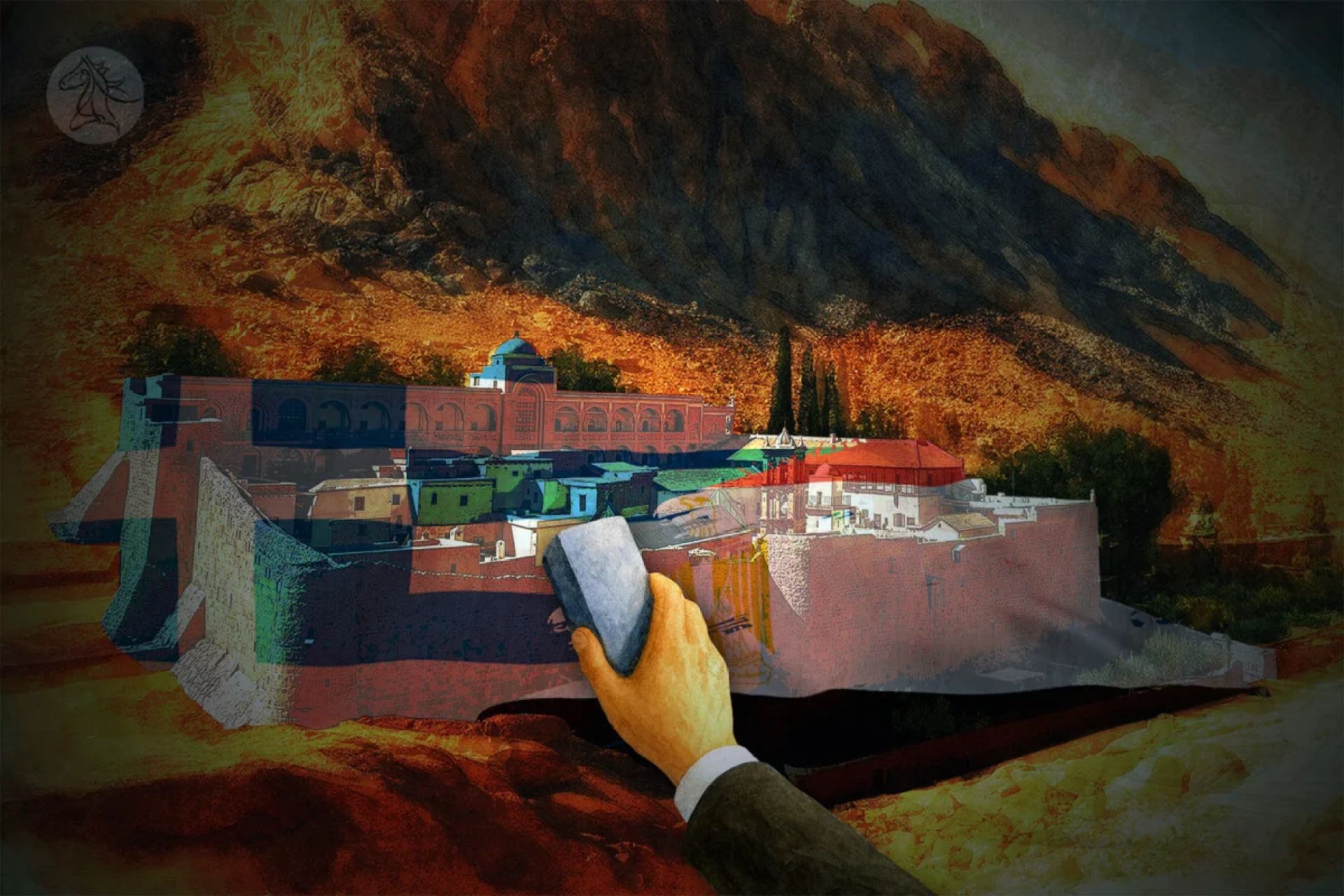
On the evening of Aug. 26, 2025, the calm of the Greek Orthodox Monastery of St. Catherine gave way to one of the most dramatic nights the ancient site had seen in centuries. That night, the abbot, Archbishop Damianos of Sinai, returned unexpectedly from Greece to put a stop to a long-planned gathering of the monks: a synod meant to amend the monastery’s bylaws, set an age limit for the abbot, change the procedure for his ordination and ultimately elect a new head of the monastery. To the elderly bishop, it looked like rebellion, or rather an outright ecclesiastical coup, and he came in person to crush it.
What followed went far beyond church disputes. According to a clerical source who spoke to us, Damianos did not enter the monastery alone. He “stormed in” flanked by 10 to 15 masked men, who forced the dissenting monks out beyond the walls and locked the gates behind them. In a video we obtained, Father Acacius is seen leading the masked men from one cell to another, dragging 13 monks out by force. Some refused to leave, and doors and windows were smashed before they were hauled barefoot into the night. In the footage, one monk can be heard crying out in Greek, “Brothers … leave me be!” as the intruders bark at him in Egyptian Arabic, “Yalla, get out!” before shouting in English, “Go, go!”
It was the climax of a crisis months in the making. Three months earlier, an Egyptian court had ruled that the state owned all the monastery’s nonreligious lands — its farms and the buildings upon them — ordering the abbot and his monks out of those properties and confining their activity to rituals within the ancient walls. That ruling pushed the conflict beyond monastic boundaries and into the realms of politics and law, echoing from Cairo to Athens.
What might at first have looked like a quarrel over land and buildings quickly spiraled. Damianos, who holds both Egyptian and Greek citizenship, turned to the Greek Parliament for legislation granting the monastery legal status under Athens, which would manage its assets in place of the monks. Cairo, meanwhile, launched legal, diplomatic and economic maneuvers to enforce the court ruling and assert sovereignty, putting the monastery and its surroundings at the heart of its flagship tourism project, “The Great Transfiguration on the Land of Peace.”
Caught between a court ruling seizing its historic lands and a Greek law extending Athens’ authority to its assets, St. Catherine’s found itself transformed into a prize in a fierce contest between the two countries. Its gates have been shut time and again to pilgrims and tourists in recent months as rivalries deepened, the monastery turned into a bargaining chip in economic negotiations and sovereignty over it became contested, all threatening to erode a spirituality that has endured for 15 centuries.
On the slopes of Mount Sinai, where it is claimed that the burning bush from which God spoke to Moses still stands, lies St. Catherine’s Monastery, once known simply as the “Monastery of Mount Sinai.” It is among the oldest and most renowned monasteries in the world. In the fourth century, Empress Helena, mother of Constantine, the first Roman emperor to embrace Christianity, built a small chapel beside the bush. Two centuries later, Emperor Justinian I ordered the construction of the monastery on its present site, enclosing the bush within what is still called the Church of the Burning Bush. The monastery bears the name of St. Catherine of Alexandria, martyred in 307 after Emperor Maximinus condemned her to torture and death for her steadfast Christianity and rejection of paganism. According to tradition, angels carried her remains to the summit of Mount Sinai five centuries later. Today, only her skull and one hand bone remain, preserved in a reliquary inside the church sanctuary.
Jews, Christians and Muslims alike have long made pilgrimages to St. Catherine’s. Through waves of conquest in the Sinai, from the Crusaders and the Tatars to the French, the British and later the Israelis, religious rituals within the monastery never ceased.
In his 1916 book “The History of Sinai and the Arabs,” the historian Na’um Shuqair called it “the most famous building in the peninsula.” He attributed its endurance in the desert, where the monks differed from the local population in faith, ethnicity and custom, to three main factors: the fortress-like security of its location; its sanctity shared by followers of all three Abrahamic religions; and the so-called “Prophetic Covenant,” a charter of protection for Christians and their churches attributed to the Prophet Muhammad. Shuqair noted that when Sultan Selim I conquered Egypt in 1517, he relocated the original covenant to Istanbul, leaving behind an Ottoman translation that is still preserved in the monastery.
Coexistence, however, went further than documents. During Fatimid rule in the 12th century, the monks built a mosque within the monastery walls, where Bedouins and Muslim visitors continue to pray to this day. Over the centuries, the monastery also developed reciprocal ties with the surrounding community, employing the poor in its farms and benefiting in turn from the influx of pilgrims and tourists.
Monks of many origins have called St. Catherine’s home, including Syrians, Greeks, Armenians, Abyssinians, Catholics from Western Europe and Egyptians. The Armenians dominated in the eighth and ninth centuries, followed by the Catholics, before the Greeks reestablished their primacy. At the start of the 20th century, Shuqair recorded 60 monks in residence, all of them Greek. That number has dwindled over the past 125 years to just a few dozen, still largely Greek, according to one monk who spoke to us.
Today, the monastery flies the Greek flag. At the heart of the dispute are 71 plots of land: the ground on which the monastery itself is built, surrounding farmland and open desert, and sites containing chapels, shrines and hermitages of unique archaeological value scattered across Mount Sinai, Mount Catherine, Mount Moses and the ranges known as Transfiguration and Supplication.
Recognizing its historic and spiritual importance, Egypt successfully petitioned UNESCO in 2002 to inscribe the monastery, Mount Sinai (also known as Jabal Musa), and the surrounding area as World Heritage Sites. A framework was set up for cooperation between the monastery and Egypt’s Supreme Council of Antiquities on matters of maintenance and restoration, while acknowledging the monastery’s affiliation with the Greek Orthodox Church and its right to self-governance under ecclesiastical law. That balance was upended by a recent court ruling that confiscated nearly half of the monastery’s lands.
On May 7, 2025, standing beside Greek Prime Minister Kyriakos Mitsotakis in Athens, Egyptian President Abdel Fattah el-Sisi brushed aside speculation that Egypt might move against St. Catherine’s. Such rumors, he said, “contradict Egypt’s principles and tolerance.” He stressed that Egypt remained bound by the “eternal covenant” linking it to the monastery, which holds the relics of St. Catherine herself, and vowed not to let “malicious rumors” jeopardize relations with Greece.
Three weeks later, the picture changed dramatically. On May 28, the Ismailia Court of Appeals ruled that the monastery and its lands belonged to the Egyptian state. The judges declared that the monastery’s spiritual affiliation to the Greek Orthodox Church conferred no legal privileges inside Egypt. Greece was mentioned only once in the ruling, as a passing reference: Just as Greece guarantees freedom of faith and spiritual affiliation, so does Egypt.
The court’s reasoning rested on the absence of any legal title proving ownership by the abbot, and the fact that the lands had never been registered after Law 147 of 1957 was passed, which barred acquiring state lands through long possession. The failure to register, the court said, amounted to implicit recognition of state ownership; the abbot held the land only in his religious capacity, under the decree that appointed him bishop and granted him Egyptian citizenship in 1974.
The ruling divided the disputed properties into four categories. The first, 11 rocky desert plots beyond the monastery walls, was folded into the St.Catherine Nature Reserve under the Environmental Affairs Agency. The second, 29 plots within the monastery’s grounds, including the main compound, churches and shrines, was left in the monks’ “religious possession” for residence and worship, though formally designated as state property under the Supreme Council of Antiquities. The third, 17 plots with small chapels and monastic facilities, was covered by preliminary contracts with the local authorities, which the court judged as agreements of mutual obligations, not ownership.
The fourth category, and the most contentious, included 25 agricultural plots the court labeled “expulsion lands.” Here, the judges ordered the abbot evicted, ruling that he had seized them “by force.” Service to the monastery, they wrote, could not justify breaking the law or usurping state property, and the abbot, of all people, should set an example of respecting the law.
With that judgment, the court entrenched the Egyptian state’s ownership of lands that the monks had used since the sixth century, granting them only limited rights of use and religious possession under the direct oversight of Egyptian authorities.
The contradiction between President Sisi’s assurances in Athens and the subsequent court ruling, which was described in Greece as reducing the monks to “temporary guests” in their own home, was seen by one monk inside the monastery, speaking anonymously, as evidence of a “sudden political shift” in Egyptian-Greek relations. He claimed that Cairo had in fact reached an agreement with Athens guaranteeing the monastery’s ownership of its lands, with the terms due to be signed by the South Sinai governor and the abbot just two days before the ruling. But at the last moment, he said, Egypt pulled back, only to surprise both Greece and the monks with the court’s decision.
Archbishop Damianos himself pointed to this reversal in remarks to The National Herald two days later. “An agreement had been reached with the Egyptian authorities, especially in South Sinai, with the involvement of the Greek government,” he said. “A Greek delegation came, and we agreed on a text that gave the monastery greater freedom and recognized certain rights. Life cannot rest on the spirit alone, material needs exist. Without land, how could we survive on donations alone? But after the agreement, they altered the text and handed us something entirely different.”
Greek officials quickly amplified their criticism. Archbishop Ieronymos of Athens and All Greece called the ruling “a scandal, an expropriation and confiscation of the monastery’s property.” In a May 30 statement published in Greek newspapers, he accused the Egyptian government of seeking, “with the stroke of a pen, to erase the monastery’s existence and abolish its worship, spirit, and culture,” despite earlier pledges. Archimandrite Porphyrios Frangakos, the monastery’s representative in Athens, echoed that charge, saying that the ruling turned the monastery into a museum and violated an agreement reached with Egypt in December 2024. He revealed details of that deal: “We negotiated an amicable settlement out of court with authorized representatives of the Egyptian government. Egypt recognized the monastery’s ownership of all 71 plots. Both sides accepted it, and it was ready for signature. The document circulated among ministries for months. We were prepared to sign at any moment. And then, suddenly, the ruling came and contradicted what had already been agreed.”
Cairo, by contrast, hailed the ruling. The presidency and the Foreign Ministry called it a “historic achievement,” marking the first time the monastery’s legal status had been formally defined in a way that, they argued, safeguarded its unique religious standing.
The gap in perceptions only deepened the monks’ anger. Damianos told the Greek press that Egyptians “claim to love the monastery, but in reality, they are strangling it,” blasting the scrapping of the agreement on “flimsy” grounds despite, he insisted, Sisi’s “clear” willingness to sign. The issue, he said, was of international concern.
Against this fraught backdrop, the Italian daily Corriere della Sera published a report on June 1 casting the property dispute as part of a broader Egyptian-Greek bargain. Citing Greek diplomatic sources, it said Cairo was seeking to fold the monastery’s surrounding lands into a tourism project in exchange for advancing a strategic deal with Athens: a 600-mile submarine cable to transmit clean electricity from Egypt to Greece and onward to Europe, the so-called “electric interconnection project” billed as an alternative to Russian gas.
That project was hardly new. In October 2021, the two countries had signed a memorandum of understanding to build the massive cable, dubbed “GREGY,” and it had figured in virtually every joint statement and official exchange since, touted as a centerpiece of strategic cooperation.
A former Greek official revived this narrative to explain Egypt’s sudden turn. Markos Poularis, once deputy foreign minister for culture and church relations, alleged a “secret diplomatic deal” in which the monastery was used as a bargaining chip in the energy talks, with the “elderly abbot” drawn in. In a Facebook post, he accused the Greek government, which he described as “diplomatically weak and devoid of national feeling,” of trading away the monastery and deceiving the public with a scheme to create a “Sinai Monastery” in Greece, without informing the monks, “with only the token signature of an elderly abbot who had no mandate from the mother monastery.”
The legal battle over the monastery’s lands began in 2012, when a retired army general, Ahmed Ragai Attia, filed 72 complaints against St. Catherine’s in a single day. The move followed a verbal spat with a monk over his wish to pray outside the designated areas of the monastery. When his request was refused, the monk reportedly retorted: “This is Greek land,” pointing to the Greek flag flying overhead. Attia took it as an insult and launched a sweeping legal and media campaign that lasted until his death in 2021.
Throughout that campaign, Attia accused the Greek monks of seizing some 20% of South Sinai’s land and building “Greek colonies” there. In 2014, he published a book titled “The Protocols of Catherine’s Monks,” calling for the land to be reclaimed and renamed with Egyptian and Islamic titles. His claims were later echoed by figures close to the state, including a former head of the Bibliotheca Alexandrina, Mustafa al-Fiqi, who labeled the monastery a “foreign colony” and urged that it be placed under the Egyptian Orthodox Church.
At first, the Egyptian government sided with the monastery, with its lawyers urging the court to dismiss Attia’s suits for lack of standing. But the state soon changed course. In 2015, the governor of South Sinai and the head of the local authority in St. Catherine filed their own case demanding the eviction of the abbot from 29 parcels of land and their return to state control, along with 5 million pounds in compensation. The following year, the Ministry of Tourism and Antiquities and the Environmental Affairs Agency joined the case, doubling the compensation claim to 10 million pounds and expanding the dispute to 42 more plots, bringing the total to 71.
The legal process produced two landmark rulings. In May 2022, the South Sinai Primary Court ordered the abbot’s expulsion and the handover of the land to the state. In May 2025, the Court of Appeal softened that ruling, granting the monks usufruct rights, meaning use without ownership. The final word now rests with the Court of Cassation, the highest court in Egypt, which is expected to decide one of the longest-running property disputes in modern Egyptian history over a site of rare spiritual and cultural weight.
Even before that ruling, Egypt and Greece had sought to end the litigation through a comprehensive deal. The agreement, never finalized, was meant to close the court cases and reconcile broader disputes while upholding UNESCO’s designation of the monastery and its properties as a World Heritage Site. But the eight clauses of the draft deal, revealed to us by Greek officials, leaned heavily in favor of the monastery, granting clear advantages to the Greek side while asking little in return.
Under its terms, the monastery would be recognized as the owner of all 71 plots, confirmed as belonging to the Greek Orthodox Church. It would retain autonomy in managing its religious and administrative affairs under the authority of the archbishop of Sinai, who is formally recognized by Egypt. Maintenance and construction would fall under joint supervision by Egyptian authorities and the monastery, with strict safeguards for the site’s historic and spiritual character. The agreement also nodded to the “Great Transfiguration Project,” a sweeping development plan unveiled by President Sisi in 2020, pledging that surrounding areas would be managed in line with Egypt’s obligations as a World Heritage custodian.
That deal was frozen when the appeals court ruling came down. The judges granted the monks usufruct rights over 46 plots but ordered them evicted from 25 others. Afterward, Cairo hinted that the agreement could return to the table. On Aug. 8, during a visit to Athens, Foreign Minister Badr Abdel Aty said an understanding with Greece was imminent and that a signing ceremony was “very near.” His Greek counterpart, Giorgos Gerapetritis, voiced confidence that Egypt would honor its commitments.
Still, the dispute soon circled back to the courts. In late August, both the monastery and the Egyptian government filed appeals with the Court of Cassation. As one Antiquities Ministry lawyer told us on condition of anonymity, the fate of the monastery’s lands now hangs on the court’s ruling.
The Ministry of Antiquities entered the dispute belatedly, in 2016, after receiving direct instructions to take a position. According to a ministry official who spoke to us, the ministry formed a committee to survey the boundaries of the monastery’s historic lands, documented violations in areas protected by antiquities law, and asked the court to rule on the status of the 71 plots claimed by the abbot. The official added that as the supervisory body responsible for archaeological sites, the ministry had been monitoring irregularities at the monastery since 2010, ranging from agriculture to new construction, and had issued demolition orders that, for the most part, were never carried out.
A government source in South Sinai, also speaking anonymously, argued that “the current crisis boils down to Archbishop Damianos’ desire to own the monastery’s lands in South Sinai.” He revealed that in 2004 the bishop formally applied to the local authority for ownership of monastery lands and surrounding areas that he said he had purchased from local Bedouins. The source called it “a grave mistake” since those lands — including the monastery itself — had been registered as archaeological sites and nature reserves since the 1990s. By law, neither monks nor Bedouins can own them; at most, locals may use the land under a usufruct system applied in Sinai for strategic reasons.
The same source said the contracts cited by the monastery were “mere preliminary deeds issued by the city council for small plots of 50 to 75 square meters,” covering only a fraction of the disputed land. Much of the property, he added, was little more than a scattering of ancient olive trees near the monastery, Mount Sinai and the plateau of Elijah’s Basin, not the broad farms portrayed in public debate. As for the legal situation, he insisted the latest court ruling did not touch the monks’ presence or the bishop’s position: “The ruling was clear: Live in the monastery, perform your rituals, and enjoy full use of the land. But it is not yours.”
This insistence on sovereignty and the prohibition of monastic ownership has been backed by Mohamed al-Kahlawi, a member of the Cabinet’s Higher Planning Committee and head of the Arab Council of the Union of Arab Archaeologists. He told us that St. Catherine’s falls squarely under Egyptian sovereignty and that the monks’ security is already guaranteed by an existing “document of protection.” Greece, he added, “has never historically protected the monastery at any stage.” For reasons of sovereignty, he argued, Greek monks could never be granted title to its lands.
Al-Kahlawi recalled an incident after the Camp David Accords when a senior Israeli general and his wife were killed in a car accident during a visit to the monastery. He was buried on the grounds, and Israeli tour groups began flocking to the site, threatening to turn the grave into a shrine. President Hosni Mubarak intervened, ordering the removal of the burial to prevent it. For al-Kahlawi, the episode is a warning: Israel, he said, has never ceased eyeing Sinai, and “we are facing an enemy waiting for its chance.”
Former ambassador Bilal al-Masry shares this view. In a June 2025 study titled “The Crisis of Sovereignty Over St. Catherine’s Monastery: An Egyptian National Security Issue,” he stressed the exceptional importance of Sinai as Egypt’s military and security fulcrum. That, he argued, requires full subordination to Egyptian sovereignty and close monitoring of all foreign elements, whether monks at the monastery or members of the Multinational Force that has been deployed in Sinai since 1982, numbering about 1,700 soldiers plus 15 American civilian observers.
Allowing the monks to own the monastery outright, al-Masry warned, would place them outside Egypt’s security framework, turning the monastery into “a widening security hole” that could eventually undermine control over the peninsula. The danger, he added, is compounded by talk of Saudi Arabia opening Tiran Island for an American base serving both U.S. and Israeli interests, an arrangement that would place St. Catherine at the heart of the region’s security equation.
Inside St. Catherine’s Monastery, the scene was no less tangled than Egypt’s shifting official stance. While Cairo had pulled back at the last minute from an agreement to grant the monastery’s lands to the Greek Orthodox community, the latest court ruling laid bare deep rifts between the monks and their abbot, Damianos — splits driven by overlapping religious, political and financial disputes.
After the court handed ownership of the monastery’s lands to the Egyptian state, Damianos traveled to Greece. Two months later, on July 28, 2025, he stood before the Greek Parliament, thanking the Education and Religious Affairs Committee for passing a bill that would grant the monastery legal recognition in Greece and the status of a public institution. Two days later, the monks struck back. In a statement we obtained that was signed by 15 monks, they declared the dismissal of their 91-year-old abbot. They also notified Patriarch Theophilos III of Jerusalem, who holds ultimate authority over the monastery’s appointments, calling on him to formally ratify the decision.
One monk told us from inside the monastery that both the Egyptian court ruling and the new Greek law were “the final straw,” pushing the monks to act in order to save the monastery’s independence as a religious institution with a special status, “much like the Vatican.”
Damianos himself had visited only briefly three days before his speech in Athens, on July 25. He spent just a few minutes in the monastery before retiring to the adjacent hotel. His lawyer addressed the monks about the proposed law in passing, but the monks insisted the full text be presented to the monastery’s synod before any vote. Some also requested a meeting with the abbot to challenge his removal of three monks and their replacement by others. That meeting took place on the evening of July 26, attended by Damianos’ lawyer, and lasted only minutes. The monks demanded that he resign, or face dismissal.
Back in Athens, the abbot pressed ahead. On the same day that he spoke in Parliament, the monks wrote to the Greek Minister of Education, rejecting a law they had never even seen. Parliament gave its final approval on July 29. The next day, the monks announced their decision to depose Damianos.
The monk added, “The monastery and its monks are paying the price for the gradual deterioration of the archbishop’s health and the resulting administrative and spiritual vacuum that has opened the door for infiltrators who have exploited the monastery’s affairs in illicit ways, amid direct interference from a sovereign Egyptian apparatus and the clear indifference of the Greek state.” He said that the archbishop has been residing almost permanently in Greece for years, visiting the monastery only a few times a year for short periods, and often residing outside the monastery, absent from major celebrations and occasions, including the feast of St. Catherine, which he did not attend in 2022 and 2023. He attended in 2024 but left the monastery immediately after.
According to one monk, “the Egyptian authorities want to take control of the monastery’s lands, while the archbishop is trying to shift its center of gravity to Greece.” He called the Egyptian court ruling “catastrophic,” leaving the monks in a far weaker position than other monasteries in Egypt. Only the archbishop holds Egyptian citizenship; the rest are foreign monks on annual residence permits that can be revoked at any time. Several have already been denied renewals, paving the way for the gradual disappearance of the Sinai brotherhood, whether by refusing renewals for current monks, granting permits to replacements or eventually halting permits altogether. In that scenario, the monk warned, the monastery could be turned into a “museum piece” by decree. But he considered the Greek law passed in August 2025 at Damianos’s request even more dangerous: It created a public institution in Athens named the Independent Greek Orthodox Monastery of Mount Sinai, vested with broad authority over the monastery’s finances, donations and pilgrimages.
The monk went on to accuse Damianos of financial mismanagement. He said the archbishop had failed to secure revenues from the monastery’s properties and institutions in Greece, effectively handing “the whole monastery and its assets to Greece on a silver platter.” In 2024, for example, the Athens branch reported revenues of 539,000 euros. The monastery itself received only about 61,000 euros, barely more than a handout, while Damianos personally took in 63,000 euros. The fate of the remaining funds, he said, is unknown.
The monastery, he added, has fallen into disarray for lack of a higher authority to oversee its monastic, spiritual and administrative life. Damianos, he charged, has chased “worldly gains,” selling off monastery property without informing or seeking approval from the synod. In recent months, he sold two monastery-owned buildings in Athens and Thessaloniki, in direct violation of the very regulations he instated when elected archbishop of Sinai in 1973.
The monk also recalled a deal Damianos struck on his own in 2017, after the monks had rejected it, granting the University of California rights to digitize the monastery’s rare manuscripts without any oversight from the monastery itself. In 2020, Egyptian authorities at Cairo Airport arrested the son of the archbishop’s secretary on charges of embezzling digitized materials, including computers and hard drives, an incident that badly damaged the monastery’s reputation in Egypt and halted digitization projects. Egyptian authorities are still investigating, following official complaints from the monks. We have not been able to confirm the results.
The split soon gave rise to competing political readings. Greek commentator Nikos Meletis, writing in Proto Thema on Aug. 3, 2025, criticized the monks’ stance, arguing that it played into Cairo’s hands. A supporter of both the abbot and the Greek government’s position, Meletis warned that an “internal coup” could weaken Greece’s position and hand Egypt another bargaining chip. The monks, for their part, insisted that they opposed both the Egyptian ruling and the Greek law, seeing each as an attack on the monastery’s independence and an encroachment on its property.
Damianos, however, refused to budge. From Athens, he branded his opponents traitors, while the monks who remained inside the monastery in South Sinai pressed on with legal and diplomatic efforts to overturn the law and began moving toward electing an interim leadership.
Then, in late August, the balance shifted again. Damianos returned suddenly to the monastery, expelled his rivals, and declared in a video message that “the monastery has returned to legitimacy and church order.” Eight monks filed complaints with the Egyptian police, demanding to be allowed back in and calling for an investigation into assaults allegedly committed by the abbot’s entourage. Worship at the monastery stopped, and its gates were closed to pilgrims and visitors.
On Sept. 2, the Greek government dispatched its representative, Giorgos Kalantzis, carrying what looked like a formal signal of Athens’ readiness to see Damianos go. The proposal called for the Holy Synod to convene on Sept. 7 to elect a successor. Damianos did not respond. Kalantzis left empty-handed, while the Patriarchate of Jerusalem summoned the abbot to appear before it to answer for alleged violations inside the monastery. Damianos rejected that too, issuing a statement on Sept. 4 saying he had already begun the process of choosing his successor in coordination with other churches and with the knowledge of the Greek government.
According to two Egyptian officials, security services remained neutral, neither siding with the abbot nor with the monks. Behind the scenes, however, talks were underway between Egyptian officials, Damianos and the monks to defuse the crisis and reopen the monastery to tourists. The negotiations led to the withdrawal of the abbot’s bodyguards, paving the way for his departure. On Sept. 6, a private plane sent by Greece carried Damianos, his secretary and nine loyal monks back to Athens. The monastery reopened, the monks returned and the Damianos chapter effectively closed.
Yet two days later, Damianos resurfaced in Athens. In a Sept. 8 statement, he called on all the monks to unite in rejecting the Egyptian ruling and to elect his successor on Sept. 14. “I have made my decision to resign,” he wrote. “The elections must be a new starting point for a long journey in the life of the monastery.”
For his part, Girgis Hanna, a researcher in church and ecumenical affairs, told us that the departure of Archbishop Damianos, along with the Egyptian government’s neutral stance in his dispute with the monks, could open the way to finally regularizing the legal status of St. Catherine’s lands, which for centuries have lacked official title deeds.
Hanna added that the forthcoming agreement between Egypt and Greece would not interfere with the monastery itself or the continuation of worship within it. Instead, he said, it would strengthen the shared benefits, given St. Catherine’s unique religious, touristic and archaeological standing worldwide. The choice of a new archbishop, he noted, will be a crucial step toward an agreement between Cairo and Athens that sets clear boundaries for each side’s rights over the monastery, while leaving it to the monks themselves to negotiate with the Greek side on how its assets are managed.
Amid the tangled disputes over St. Catherine’s, Mohammed Abdel Maqsoud, former secretary-general of the Supreme Council of Antiquities, summed up the heart of the crisis: The Egyptian state, he said, is determined to press ahead with its “Three Religions Complex” project. First floated during Anwar Sadat’s visit to Sinai in 1979, the plan has reemerged under President Sisi. The monks, meanwhile, remain adamant in their refusal to cede ground. For them, both the monastery and the surrounding lands are a sacred inheritance. As Abdel Maqsoud told us, “Dragging the monastery into investment projects is what ignited the crisis. The building itself is not in dispute; the issue is the surrounding land, which the state wants to fold into its tourism development plans for South Sinai.”
The project formally began in July 2020, when Prime Minister Mostafa Madbouly, on a visit to the monastery, announced that the president had ordered immediate work on developing St. Catherine City. He stressed that the project would respect the sanctity of the Holy Valley and its nature reserve. Two months later, Sisi unveiled its new name: “The Great Transfiguration on the Land of Peace.”
According to Maher Stino, a member of the Cabinet’s Higher Planning Committee and consultant for the project, the plan does not touch the archaeological heart of the monastery. “We never approached the closed archaeological or environmental zones,” he told us. “We worked only within the ruined town. Not a single brick was laid inside the monastery or its immediate surroundings.” For decades, Stino said, St. Catherine was a “forgotten city” attracting only a trickle of tourists who climbed Mount Sinai and glanced at the monastery before leaving, often leaving behind piles of waste that harmed the local environment. The town itself offered no real tourist services, and its agriculture had collapsed under drought and dwindling rain.
The new project was designed, Stino explained, to make use of the site without erasing its spirit or its fragile environment. Plans include a 200-room eco-lodge buried underground, a 150-room mountain hotel, a visitor center and a “Peace Square” able to host more than 400 people. To preserve the landscape, all of it would be built beneath the earth. The asphalt road in Wadi al-Arbain would be torn up and replaced with a camel path. Seven thousand olive trees would be planted under the supervision of the monks. Seven miles of pedestrian walkways would be laid out, with only electric vehicles allowed inside the zone.
The project also aims to improve the lives of locals. Old markets would be preserved, main roads turned into pedestrian streets, and new sewage, water and electricity networks installed, including a pipeline with six times the old capacity, plus a new desalination plant.
As for criticisms about the use of concrete, Stino dismissed them: “Integration with the environment doesn’t mean building domes. It means hiding the structures underground, blending them into the terrain.” He stressed that the project had already won the approval of the monks, UNESCO and the local community.
Like other players in the dispute, UNESCO has wavered in its stance on the St. Catherine development project. In August 2023, during a visit to Cairo by regional director Nuria Sanz, the organization praised the Egyptian government’s efforts, describing the project as furthering environmental conservation and sustainability. The interventions underway since 2020, it said, were “ambitious” and enhanced the visitor experience while respecting the site’s natural and spiritual character.
By July 2025, however, the mood had shifted. Ahead of the annual meeting of the World Heritage Committee in Paris, the watchdog group World Heritage Watch accused UNESCO of being overly lenient with Egypt and called for St. Catherine’s Monastery to be placed on the list of endangered sites.
Under this pressure, UNESCO recalibrated its tone at the Committee’s 47th session, voicing clear reservations about the project. It demanded a full assessment of its heritage and environmental impacts, a freeze on new interventions until the study was complete, and the drafting of an integrated plan for tourism management and cultural protection. It also required Egypt to submit a detailed progress report by Feb. 1, 2026.
Even so, Saleh Lamei, a UNESCO restoration expert, told us he doubted the recommendations would translate into real outcomes by the committee’s next session. The project was already nearing completion, he said, with presidential orders pushing for an opening in the near future.
Between court battles still unresolved and a new abbot only just finding his footing, St. Catherine’s Monastery now stands on the edge of uncertainty. For 15 centuries it has withstood invasions and shifting regimes, keeping the flame of worship alive within its walls. Its leadership has long walked a tightrope between Cairo and Athens, seeking to safeguard its autonomy before, in the end, leaning toward Greece as Egypt pressed ever harder to assert its sovereignty. Today, with governments changing their positions to match their interests and heritage bodies wavering between endorsement and alarm, the fate of this ancient monastery hangs suspended, caught between politics and history.
Become a member today to receive access to all our paywalled essays and the best of New Lines delivered to your inbox through our newsletters.