


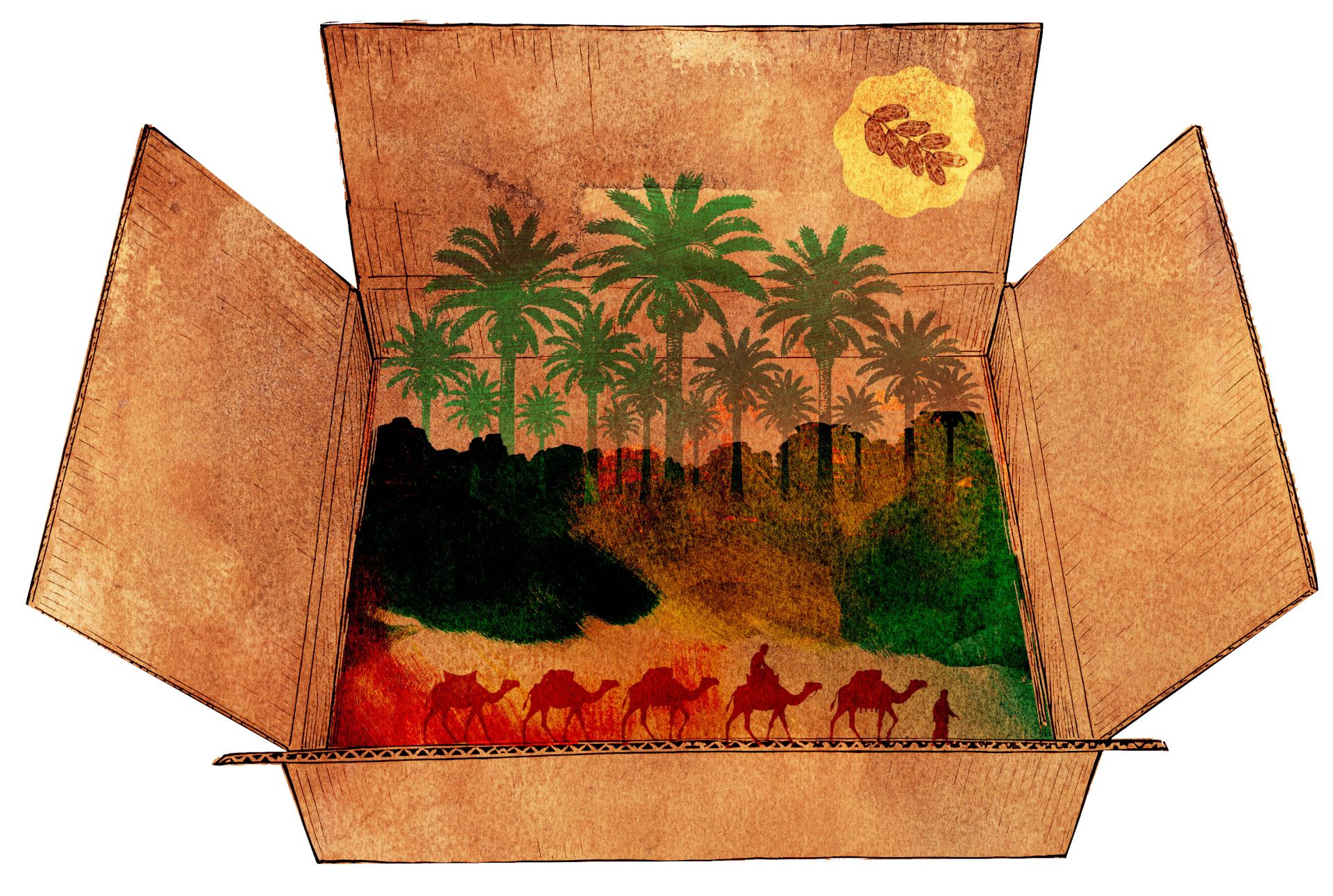
There is something about living abroad that makes familiar foods feel like anchors to home. They awaken memories in ways few other things can. For me, nothing evokes Saudi Arabia more than dates — especially “khalas,” the prized variety long associated with the oasis of Qatif.
Across the oases of al-Ahsa and Qatif in eastern Saudi Arabia, dates are more than food. They are part of the region’s social memory and cultural identity. Qatif, a coastal oasis overlooking the Persian Gulf, has historically been associated with fishing and agriculture, while today it is also closely tied to Saudi Arabia’s oil industry, with major facilities in the area linked to the state-owned oil company, Aramco. About 100 miles to the south, also close to the sea, lies al-Ahsa, an expansive oasis region historically known for agriculture, handicrafts and trade, whose governorate extends eastward toward the Gulf coast. Among the hundreds of Saudi date varieties, none is more closely associated with eastern Arabia than khalas. In al-Ahsa, it remains the oasis’s signature variety, accounting for roughly 15%-20% of its palm trees.
That is why, when I first began searching for khalas dates in Arab grocery stores across New England, I expected to find dates from al-Ahsa or Qatif. Instead, I kept finding boxes labeled “Qassim khalas.” Located just north of the center of Saudi Arabia, Qassim lies roughly 430 miles from al-Ahsa and 500 miles from Qatif. An inland region long known for agriculture, particularly date cultivation, Qassim is also historically associated with trade and merchant networks that connected central Arabia to markets far beyond the peninsula.
It was not an isolated discovery. The same pattern appeared in neighborhood grocery stores, online retailers and even care packages sent by Saudis to relatives abroad. Over time, “Qassim khalas” became the variety I encountered most often — and, ironically, the one that most frequently eased my homesickness.
The experience left me with a question that refused to go away. How did dates from Qassim become the most visible Saudi variety in international markets, despite the fact that al-Ahsa and Qatif possess older agricultural traditions and more favorable conditions for cultivating khalas dates?
Many have found the explanation in state policy over the 20th century, which encouraged some areas over others, but I came to see something else entirely. Qassim’s dates succeeded commercially because of the region’s long history of trading. While al-Ahsa and Qatif gradually shifted away from agriculture as other sectors of the economy — especially the oil industry — expanded, Qassim built on its history of trade and the skills this had embedded in its culture. For centuries, its merchants traveled across the Middle East, connecting central Arabia to markets in Iraq, Greater Syria, Palestine and Egypt, developing extensive trust-based networks. The merchants cultivated credit arrangements, risk-taking, investment and long-distance commerce that persisted after the camel caravans disappeared. They adapted as Saudi Arabia modernized, giving Qassim a merchant culture capable of bringing its agricultural products to wider markets. More than any single natural advantage or government policy, this economic history helps to explain how Qassim’s dates traveled far beyond the region — eventually reaching the shelves on which I encountered them in New England.
Two very different studies, by two very different researchers, point to the idea that the fate of these oasis societies in the 20th century was not primarily driven by the state, and offer answers to my questions about the dates I was eating in America.
One is by the American physician and missionary Paul Harrison, who wrote about the oasis communities in his 1924 book “The Arab at Home.” Harrison could be sharply critical of oasis society. He portrayed its farmers as having little ambition to expand their agricultural holdings beyond what was necessary to secure a livelihood, and described them as generally reluctant to pursue opportunities beyond the requirements of immediate subsistence. He also regarded what he saw as the inhabitants’ excessive kindness and accommodating character as weaknesses that could leave them vulnerable in their economic relationships. Harrison did not explain the limits of agricultural expansion as a result of state policy. Instead, he pointed to a combination of historical, social and economic conditions that had developed within the oasis communities themselves.
One factor in this development was persistent insecurity. Cultivating new palm groves beyond established settlements exposed farmers to considerable risk, as more distant plantations were particularly vulnerable to Bedouin raids and theft. Harrison noted that agricultural expansion therefore depended partly on whether a village could provide protection beyond its immediate surroundings. The danger was not merely theoretical: He described farmers losing their lives in Bedouin attacks and having the fruits of their palms stolen. Under such conditions, expanding cultivation beyond the security of existing settlements could become both an economic and personal gamble, discouraging farmers from pushing agriculture into new areas.
Nearly a century later, the Qatifi dissident intellectual Hamza al-Hassan edited and introduced Harrison’s observations on the two regions in the 2011 Arabic volume “Oasis Society in Qatif and al-Ahsa.” He introduced Harrison in order to substantiate various arguments against the Al Saud dynasty — specifically regarding their attempts to erase the local identities of al-Ahsa and Qatif and replace them with a Najdi identity. He drew on Harrison’s work to explain the region’s agricultural identity, which has since faded away. While he successfully demonstrated many points, even a dissident could not prove that the state had had a detrimental effect on agriculture.
Harrison’s conclusions are reinforced by a very different body of evidence. Drawing on Ottoman archival records, a Saudi historian from al-Ahsa, Mohammed Musa al-Quraini, shows that before al-Ahsa’s incorporation into the Saudi state in 1913, it suffered from weak administration, burdensome taxation, land disputes and inadequate legal protections for property rights. These structural problems long predated Saudi rule and constrained the broader economic environment on which agricultural development depended.
What makes Harrison’s and al-Quraini’s work especially compelling is that they arrive at similar conclusions through entirely different methods. Together, they suggest that the challenges facing agriculture in al-Ahsa and Qatif were shaped by forces that long predated modern Saudi policy. Over time, these conditions also shaped attitudes toward agriculture itself, gradually making farming a less attractive livelihood for many in the region.
The discovery of oil in eastern Saudi Arabia in 1938 only accelerated this trajectory. As employment opportunities expanded in the petroleum industry, many residents of al-Ahsa and Qatif shifted into occupations that offered greater stability and higher incomes than farming. Date cultivation remained economically important, but the commercial ecosystem necessary to transform agricultural production into a large-scale export industry never developed to the same extent as it did in Qassim.
Historically, al-Ahsa and Qatif developed as oasis societies whose economies were organized around agriculture. Qassim, by contrast, evolved during the 18th century into a merchant society in which long-distance trade became a central organizing principle of economic life, even though agriculture remained an important part of the regional economy. Farming existed in all three regions, but it occupied different positions within their respective economic structures. In the Eastern Province, agriculture remained the foundation of the local economy. In Qassim, however, it became embedded within a broader commercial system shaped by merchants, caravan trade and expanding market networks.
This connection between agriculture and commerce goes back at least a century, and possibly two, though the sources vary on this. One paper in the Qassim University journal of Arabic Sciences and Humanities traces the merchants from Qassim, known as the Aqilat, back to 1709, but the evidence really firms up in the 19th century. In his 2015 book “The Aqilat and Their Commercial Role With the Hejaz,” Mansour bin Suleiman al-Sharida documents how, as early as 1847, the Aqilat were engaged in transporting goods between their region and the Hejaz, in what is now western Saudi Arabia. Their trade extended well beyond dates: They exported livestock, including camels, horses and sheep; agricultural products such as dates and grains; and animal products such as clarified butter and dried yogurt. They then returned to Qassim carrying goods needed in their home region. Dates, in other words, were already part of a much broader system of long-distance trade in which Qassimi merchants did not merely sell local products but developed experience in transporting goods between markets. In this sense, Qassim’s modern success in selling dates beyond the region has much older roots. Generations of its merchants had already developed the networks, knowledge and experience required to move agricultural products into distant markets.
That distinction matters because economic success is rarely determined by production alone. In Qassim, commercial success was rooted in a culture of trade. Through generations of long-distance commerce, Qassimi merchants built networks of trust, accumulated market knowledge, and learned to manage risk — making commerce a durable part of Qassim’s social and economic culture. Far more than itinerant traders moving goods between Najd, Iraq, Hejaz and Syria, the Aqilat embodied a society in which commerce had become a way of life rather than simply an occupation.
In his detailed, six-volume work “The Aqilat,” Abdulatif Al-Wuhaibi, a historian from Qassim, describes the Aqilat not as a tribe or single family but as a professional community of merchants, most of whom came from the cities of Buraydah and Unayzah in Qassim. What began as the trade of camels, horses and livestock gradually expanded into one of the Arabian Peninsula’s most extensive commercial networks, stretching across Iraq, Greater Syria, Jordan, Palestine and Egypt during the 19th and early 20th centuries.
Their caravans carried camels, horses, clarified butter and other products from central Arabia northward, returning with coffee, sugar, tea, textiles and manufactured goods. By the late Ottoman period, the Aqilat had become some of the region’s most important long-distance traders.
Yet their historical significance lies not in the scale of their commerce, but in the culture that commerce produced. Long-distance trade demanded far more than buying and selling. Merchants had to manage capital over journeys that lasted months, navigate volatile markets, negotiate with tribal leaders, organize security, evaluate risk and cultivate relationships across territories separated by thousands of miles. Success depended as much on judgment and reputation as on financial resources.
This explains why trust became one of the Aqilat’s most valuable economic assets. Many trading expeditions were financed by investors who entrusted their capital to merchants solely on the basis of personal reputation. Profits were divided only after the caravan returned. In the absence of modern banks or formal credit institutions, credibility itself functioned as capital. A merchant’s reputation determined not only whether others would finance future ventures but also whether he could expand his commercial network.
The Aqilat eventually earned such a reputation for honesty that, in parts of Greater Syria, the expression “be an Aqili” became synonymous with being trustworthy in business. Their caravans carried more than merchandise. They also transported books, ideas, news and commercial practices across the region. After the establishment of the Saudi state, many descendants of these merchant families moved into government administration, education, diplomacy and modern business, extending the influence of networks that had originally been forged through caravan trade.
Seen from this perspective, the Aqilat were more than successful merchants. They revealed how a regional society transformed commerce from an economic activity into a durable social institution. If Qassim’s dates eventually reached international markets, one reason is that they emerged from an environment that had spent generations developing the trust, commercial knowledge, financial relationships and market networks necessary to move products far beyond their place of origin.
While the history of the Aqilat explains how Qassim’s merchant culture emerged, it does not explain why that culture survived long after the caravans disappeared. For that, sociology offers an important insight. The French sociologist Pierre Bourdieu argued that wealth is transmitted across generations in many forms. Beyond their finances, families also inherit social networks, habits, values, practical knowledge and reputations — what Bourdieu called social, cultural and symbolic capital. These intangible forms of capital often outlast money itself, shaping how later generations think, make decisions and pursue opportunity. Viewed through this lens, the Aqilat were not simply successful merchants. They accumulated and transmitted a commercial culture that was reproduced across generations. Their reputation for honesty, their extensive trading networks, their knowledge of regional markets and their experience in managing risk became forms of capital that endured long after the caravan era had come to an end.
This perspective also helps explain why the influence of Qassim’s merchant families did not disappear with the end of caravan trade. As Saudi Arabia modernized, many of these families moved naturally into new sectors of the economy — banking, industry, finance, corporate management and public administration. While the institutions changed, many of the commercial habits that had developed through generations of trade remained remarkably resilient.
In a 2022 interview, the Saudi businessperson Lubna al-Olayan, whose family traces its roots to Qassim’s merchant tradition, was asked why her home appeared surprisingly modest despite her immense wealth. Her answer was revealing. “We don’t think of ourselves as owners of the company,” she replied. “We’re simply entrusted with it.” Asked why she had never built a larger house, she answered just as simply: “I don’t need a bigger one.”
Al-Olayan’s remarks illustrate how a commercial culture can shape attitudes toward wealth across generations. In her account, wealth is less a symbol of personal status than a responsibility to be managed, invested and preserved — a mindset that echoes many of the values historically associated with merchant communities. This is precisely Bourdieu’s point. Economic cultures are not inherited genetically, nor are they determined by geography alone. They are reproduced through families, institutions, social expectations and everyday practices that teach successive generations how wealth should be understood and used.
Seen in this light, the rise of many Qassimi business families in modern Saudi Arabia was not simply the product of individual entrepreneurship or political privilege. It reflected the persistence of a commercial tradition that had been developing for generations before the emergence of the modern Saudi state.
The story of how Qassim’s dates traveled to my local shops in New England, therefore, is ultimately about much more than agriculture. It is about how local commercial traditions can survive profound economic change, adapt to new institutions and continue shaping a nation’s economic life long after old ways of doing business have vanished.
None of this is to say that Qassim dates are somehow superior to those from al-Ahsa or Qatif, nor does it seek to diminish the historical importance of either of those regions. Al-Ahsa remains the world’s largest natural palm oasis, and both al-Ahsa and Qatif have played indispensable roles in Saudi Arabia’s agricultural and economic history.
But the success of an agricultural product cannot be understood through government policy alone, just as it cannot be explained solely by the quality of the product itself. Between the farm and the marketplace lies an entire commercial ecosystem: networks of trust, access to capital, market knowledge, entrepreneurial experience and institutions capable of carrying products across regions and generations. These assets are not created overnight. They emerge gradually from the commercial culture of a society.
Today, whenever I stand in an Arab grocery store in the United States and reach for a box of Qassim Khalas, I no longer see only a package of dates. I see a Saudi legacy of a merchant tradition that began centuries ago — one that transformed a regional product into a global commercial brand and, in the process, helped to shape aspects of Saudi Arabia’s modern economic culture.
Become a member today to receive access to all our paywalled essays and the best of New Lines delivered to your inbox through our newsletters.