


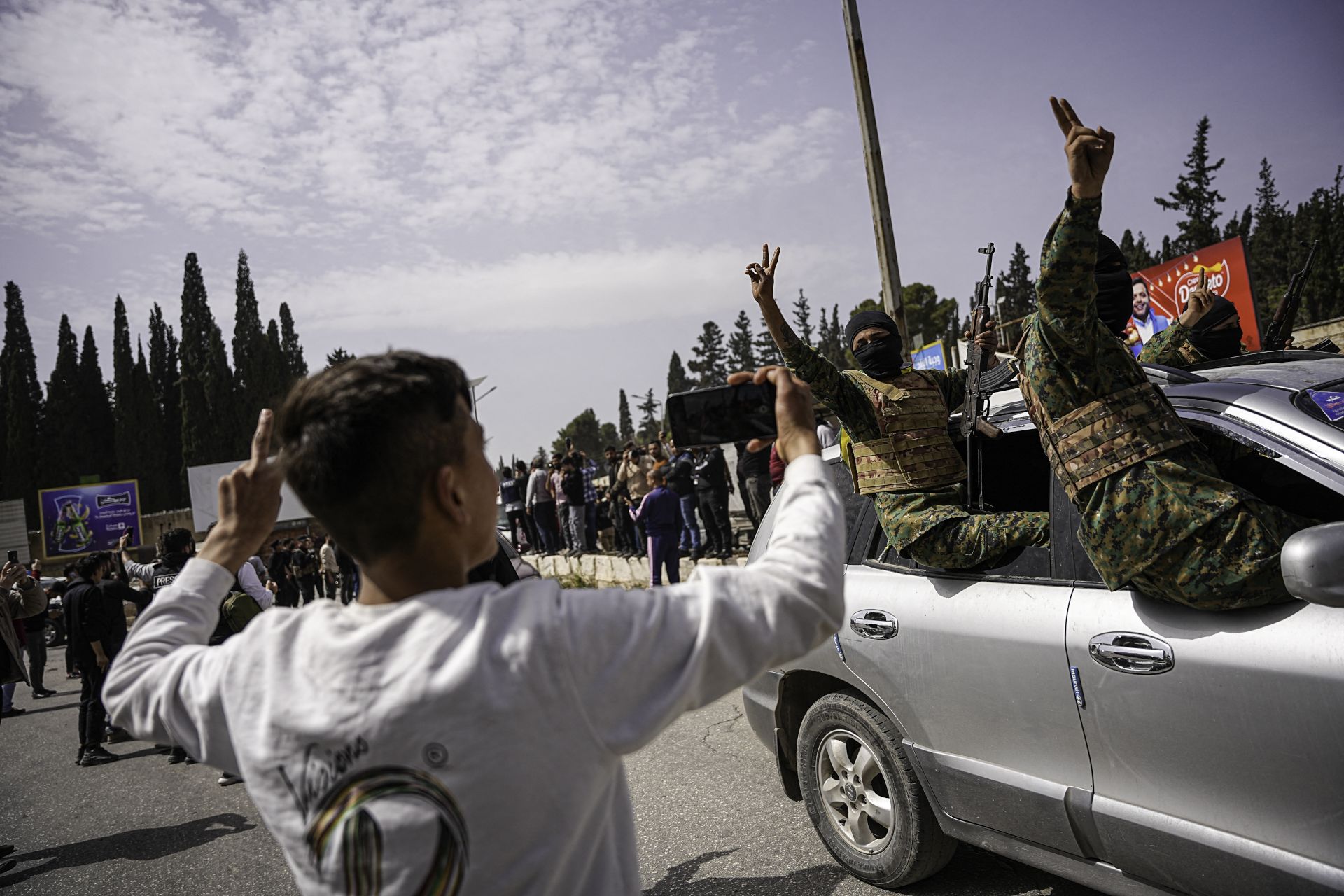
Two men who began their respective journeys as militants in Iraq are now deciding the future of Syria. The current president, Ahmad al-Sharaa, started his in Anbar, and the Kurdish leader Mazloum Abdi in Iraqi Kurdistan. Both returned to Syria in 2011, each to lead his own movement. Today, al-Sharaa rules from Damascus, while Abdi runs the country’s northeast. Whether Syria remains one country may well depend on whether these two leaders find common ground, which would be no small feat. If they succeed, they will have resolved a century-old issue, a problem that has remained at the heart of modern-day Syria.
Since World War I and the fall of the Ottoman Empire, Syria has been torn between a central authority attempting to enforce a singular identity on the one hand, and the various social and cultural groups orbiting Damascus and striving for recognition on the other hand. That split, first articulated at the 1928 Constitutional Assembly, has resurfaced since the fall of Bashar al-Assad on Dec. 8, 2024.
From the Kurdish perspective, the new authorities in Damascus represent a vision focused on centralization and rejection of pluralism, a vision shared by Islamists, Salafists and Baathists alike. These present themselves as guardians of a strong, unitary state grounded in religious jurisprudence or, in the case of Baathists, a secular, singular national identity. Yet the country’s various religious and ethnic communities that feel marginalized continue to push for political recognition and legal guarantees for pluralism. Unless that tension is addressed, Syrians will keep enduring crises, mass violence and extreme repression.
In the days after Assad’s fall, heavy fighting broke out near Tishreen Dam, on the Euphrates, between Turkish-aligned factions and the Kurdish-led Syrian Democratic Forces (SDF). During one of many emergency meetings held by Kurdish leaders in Qamishli at the time, Kurdish figures assessed that this would be Ankara’s last push to crush the SDF, and that any further war would violate an emerging international red line against incursions into the Kurdish-dominated areas in the northeast.
The immediate outcome of the situation was a trade-off. The SDF relinquished control of the city of Manbij, which it liberated from the Islamic State group in 2016, but maintained its positions west of the Euphrates. This led to a deal signed on March 10, 2025, by al-Sharaa and Abdi. The agreement faced internal Kurdish opposition, however. Critics questioned its timing, because it came just three days after the Alawite massacres along the country’s Mediterranean coast, and some Kurdish elites even accused their leadership of being “paid off” to overlook these atrocities.
In reality, the agreement established a baseline for political engagement. The Kurdish faction pledged not to leverage their self-administration in the northeast as a base for a broader alliance opposed to al-Sharaa. There was also an acknowledgment that the SDF would need to be reformed to be more reflective of local communities, through a “corrective path” rather than a complete overhaul.
The understanding between the SDF and Damascus almost collapsed shortly after it was signed. Damascus issued a constitutional declaration that disregarded fundamental aspects of the March 10 agreement, primarily recognition of Kurdish rights. The charter excluded Kurds, despite constitutional guarantees being central to their demands. This move by Damascus completely flipped the situation, from a promising understanding to tension and escalation.
What was initially seen by the Kurds as a compromise quickly became perceived as a trap. Damascus reinterpreted the agreement as a demand for the SDF’s surrender and dissolution by the end of the year. This new interpretation was further solidified by U.S. envoy Tom Barrack, whose statements suggested a complete victory for Damascus and an end to the conflict for all other parties. In July, he said Washington supported a unified Syria under one flag, one army and one government, and would not back the establishment of federalism.
This situation was exacerbated by a series of snubs against the Kurds. They were excluded from the victory conference on Jan. 29, when commanders of all armed groups gathered to confirm al-Sharaa as president. They were also not represented in the electoral commission and Cabinet. Al-Sharaa’s rhetoric echoed the Assad regime’s position, emphasizing the Arab majority in eastern Syria to deny Kurdish autonomy. This, coupled with intensified online attacks from pro-government influencers against Kurdish claims, led the Kurds to believe that no genuine change was forthcoming from Damascus.
The Kurdish leadership viewed Damascus’ stance as a major factor in the failed mid-July assault on Sweida, when the government tried to establish control of the Druze-majority province. The government forces were dealt a defeat, after Israel’s intervention, that exposed their inability to impose their agenda without inviting foreign interference. This military defeat was a heavy blow to the authorities in Damascus and to their hopes of keeping up momentum and bringing the rest of the country under their control by force.
For the Kurds, this setback for Damascus undermined the hawkish and rigid interpretation of the March 10 agreement by the authorities in the Syrian capital. Before Sweida, the Kurds faced a stark choice: war or capitulation to the Damascus government’s demands. The unsuccessful offensive changed that, and inadvertently prevented a new civil war in the east. From the Kurdish perspective, the Sweida events shifted the discussion of the northeast issue away from the pro-Damascus U.S. envoy and back to U.S. Central Command (Centcom), which leads the anti-Islamic State coalition. Shortly thereafter, Centcom’s commander, Adm. Brad Cooper, visited Damascus and began facilitating a reconciliation process.
Currently, talks are underway about the SDF falling under the Defense Ministry, though the Kurds prefer the term “joining” (“indhimam”) over “integration” (“indimaj”). Rather than dissolving the SDF and integrating it directly into the Syrian army, the Kurds are proposing to fold three of its divisions into a new military council that would report directly to the Syrian General Staff in Damascus. These talks are in the early stages, and both sides are prepared for direct military conflict should an agreement falter.
A military conflict would be disastrous for Syria, regardless of the political outcome. The SDF would transform into a revolutionary opposition, changing its agenda from self-preservation to the overthrow of the Damascus government using all means necessary, potentially including the support of Israel-backed Druze and Alawite separatists.
According to Kurdish interpretations of American strategy, Centcom favors an alternative approach: using the SDF to unify Syria. With their current de facto alliance with the Druze and Alawites, the Kurds would facilitate the reintegration of these two substantial minority groups into the state and help normalize relations, especially between Alawites and Damascus. But the specifics of this reunification plan remain unclear. For instance, how would the SDF integrate Druze units into state structures, and under which command?
From the Kurdish perspective, Damascus has exhausted the “unify by force” approach. A window for dialogue with the Kurds still exists, but it is rapidly shrinking. Damascus appears to be torn between two visions: one influenced by Turkey, aiming for a unified Syria under a single, Turkish-aligned rule, and the other by the Gulf states, prioritizing a stable union. The Turkish viewpoint is well-developed and likely to lead to escalation, advocating for a state built on a victorious majority and vanquished minorities. The Gulf states’ view is generally less fervent, prioritizing unity and peaceful coexistence (even if the Gulf countries’ stance on diversity and pluralism is ambiguous). The Kurds prefer a unity agreement that aligns more closely with the thinking of the Gulf states.
The Damascus leadership operates under the belief that it is the sole legitimate authority, with all power concentrated in the capital. As an Arab tribal chief in eastern Syria recently put it, “Whoever rules Damascus rules Syria.” This view, however, fails to acknowledge the central government’s long-standing inability to build a national consensus. The Kurds are hopeful that Damascus will adopt a new approach to unity, one that recognizes the limitations of the old centralized system. Historically, effective governance in the country has depended on forming alliances with surrounding and peripheral regions. Otherwise, as the Kurds and Druze aim to show, whoever rules Damascus will rule only Damascus.
The core issue in Syria is deeper than decentralization or the form of governance. It touches upon the very existence and character of the state. For groups like the Kurds and Druze, the existing governmental structure is perceived as rigid and biased, rather than impartial. Their continued exclusion from participation — whether real or perceived — will lead to a fractured state, making the country vulnerable to widespread unrest.
The current crisis with the Kurds, mirroring the Baathist approach, is particularly ironic given the new government’s Salafist jihadist origins. Its approach to the Kurdish issue is a continuation of the legacy of the pan-Arab nationalist agendas that dominated the country over the past few decades. Despite their divergence on almost everything else, Islamists and pan-Arabists hold the same view about the identity of the Syrian state as Arab, encapsulated by the new rulers’ insistence on adopting the Baathist monikers for the country (the Syrian Arab Republic) and for the army (the Syrian Arab Army).
The push for self-rule by Kurds, Druze and Alawites continues a long-standing tradition of resistance against the authoritarian tendencies of Damascus since the French mandate. These calls for decentralization challenge the core principle of the postcolonial Levantine nation-state, which perceives plurality as an existential threat rather than a necessary and normal mode of politics for a modern state in the 21st century.
Syria’s current divisions echo its early mandate period, when it was fragmented into an Alawite state, a Druze state, and two larger states administered from Damascus and Aleppo. During that time, Kurds, Syriacs and Armenians in Upper Mesopotamia (today’s SDF country) explored the possibility of a shared political entity with each other.
In 1928, the Constituent Assembly, chaired by Hashim al-Atassi and comprising 70 members, convened at the high commissioner’s invitation and, over several weeks of brainstorming, drafted a constitution. The French authorities that governed the country at that time, however, vetoed six of the proposed articles, including those pertaining to presidential powers and Syria’s natural borders.
During the deliberations to draft the constitution, notables representing the Kurds and the Sanjak of Alexandretta area in northern Syria each petitioned the French for special status, and their requests were officially recorded. Kurdish delegates at the founding conference submitted a paper calling for self-rule in eastern Syria that would include Arabs, Kurds and Christians. The French scholar Michel Seurat summarized the document in his book “Syria: The Barbarian State,” writing that it was indeed part of the Constituent Assembly’s records. If it was filed among the papers, it’s likely on the two missing pages of the published edition (pages 98-99). Seurat probably had the complete minutes of the sessions.
The debates and controversies within Syria’s national assembly a century ago, including over the oath taken by its members, mirror those of today. Back then, the seemingly innocuous proposed oath — “I swear by God and by my honor to stay faithful to the national cause, preserving the rights of the nation, and striving to achieve its aspirations” — sparked disagreement. Some members advocated for a “homeland” or “pan-Arab national pact” in place of the local “national cause.” The pan-Arab framing referred to “natural Syria” (Greater Syria), and was therefore a point of contention for non-Arab minorities.
Fayez al-Khoury, a Christian legal expert, questioned the oath’s validity given Syria’s undefined borders, arguing against swearing allegiance to an unknown entity. He said, “We don’t swear an oath of loyalty to a homeland whose borders we don’t know.” In the end, a majority backed Khoury’s view that Syria wasn’t yet a final homeland and that the oath should be to the “national cause.” That view, while a legal compromise, pleased the pan-national deputies, because it defined Syria as a project always reaching to restore its missing parts. That arguably helped turn the country, step by step, into a one-dimensional homeland with a singular and exclusive identity.
Despite objections from Christian deputies, a clause in the constitution established Islam as the religion of the head of state. Influential Sunni Arab figures such as Ibrahim Hananu, Fakhri al-Baroudi and Saadallah al-Jabiri championed an Arab-Islamic identity, opposing a secular and pluralistic state. This constitutional language became a cornerstone of modern Syria, subsequently contributing to multiple crises.
Following the complete French withdrawal from Syria in 1946, Syrian national elites increasingly embraced Islamic ideals. Najib el-Rayyis, editor of the Al-Qabas newspaper from Hama, articulated this sentiment in his essay, “This Country Is Not Ours Alone.” He wrote: “If this land were for Muslims alone, they’d be free to impose their religion on themselves, their governments and their rulers. But the country isn’t ours alone. It belongs to us and to others.”
By the close of the 1928 conference, Christians were pushed out of Syrian nationhood on the grounds that the state was Islamic. The same happened to the Kurds, because the state was Arab. The Druze, Alawites and Ismailis were out because “there are no sects in the state.” Although the French stepped in and suspended that constitution, they eventually approved it after the Syrian elite placated them with a clause recognizing the legitimacy of the French mandate. But the question of pluralism wasn’t France’s anymore, even at the height of its power in Syria.
Nicolas Janji, an Armenian deputy, advocated for plural representation and a broader definition of nationality, ideas that, if adopted, could have potentially altered Syria’s future. The assembly also mismanaged the situation in Alexandretta. A sanjak deputy’s concerns about neglected regional representation and local staffing were dismissed by parliament’s vice president, Kamal Bek al-Ghuzzi, as “a trivial and secondary matter, compared to what the nation was facing,” a dismissal that inadvertently paved the way for Alexandretta’s eventual annexation by Turkey.
Repeated attempts by the Kurds to establish a pluralistic entity in Upper Mesopotamia were thwarted by the French. Eager to stabilize Syria, the French made agreements with Sunni elites in Damascus and Aleppo. These elites then systematically suppressed any signs of plurality, extending even to sports and the arts. For instance, a Kurdish club in the town of Amuda, an important outpost in the Kurdish northeastern parts of Syria, was shut down in 1939 and never allowed to reopen. A French officer attempted to justify this move to Kurdish leader Hajo Agha and poet Cigerxwîn by stating that “France has entered the war, and this isn’t the time to open clubs. We all have to take up arms now.”
Desperate for change, Hajo Agha made an unusual offer: He volunteered 10,000 Kurdish fighters to the Free French Provisional Government to fight against the Nazis. Hoping to gain favor with the French, and with naive optimism, he joked to his poet friend Cigerxwîn: “Hey, Fatty, the day you talked about has come, so be ready.” However, as Cigerxwîn relates in his memoirs, a French captain in Ras al-Ain responded with cold pragmatism: “What would France gain from ten thousand unarmed Kurds if it only rallied Turkish, Iranian, Iraqi and Syrian troops to the other side?”
Hajo Agha then posed a question reflecting what would become something of a lasting sentiment — the disappointment and, at times, despair that can define modern Kurdish politics: “What shall we do, Cigerxwîn?”
In Syria today, Kurdish politicians and officers are gathering to ensure they no longer have to ask that question. Syria is once again at a crossroads, facing the choice between reproducing centralism and opening new possibilities for cohesion and unity. The country’s future hinges on whether it can move beyond the century-old center-periphery legacy and, finally, build a shared pact that can endure without dividing the country and creating domestic enemies. For Syria’s sake, the right choice cannot be military action. It must be plurality, etched and protected constitutionally and structurally.
Become a member today to receive access to all our paywalled essays and the best of New Lines delivered to your inbox through our newsletters.