


On a recent morning in Asmara and several other towns in Eritrea, recruitment notices went up again, demanding that men report to their local administration immediately. Soldiers went from house to house looking for young recruits and draft dodgers. Across the border, Ethiopian Prime Minister Abiy Ahmed was on stage, reprising a now-familiar theme — that Ethiopia’s destiny demands a route to the sea. The chief of staff of the Ethiopian armed forces, Birhanu Jula, reiterated Abiy’s message: “Today we are 130 million; in 25 years we will be 200 million, and 2 million people cannot determine the fate of those.” The “2 million” reference is to Eritrea’s markedly smaller population, which in 2025 is estimated to be around 3.6 million. Danger lurks behind the recent moves in both countries: Eritrea’s president, Isaias Afwerki, governs with a siege mentality and by leveraging proxies; Abiy is turning geography into ideology as he eyes access to the Red Sea.
At the heart of the conflict is the port of Assab in Eritrea’s far south. It is about 40 miles from the Ethiopian border at its closest point and between 50 and 55 miles from Ethiopia’s Afar Region along the old main road that passes through Kombolcha. The port of Assab is too close to Ethiopia for the Ethiopian government to consider engaging in conflict there, while its position also makes it hard for Eritrea to defend it effectively. For Isaias, losing Assab would shatter the myth of invincibility that sustains his rule, after he led the defeat of one of the strongest armies in sub-Saharan Africa during Eritrea’s 30-year liberation war against Ethiopia. For Abiy, capturing it would crown his promise to restore Ethiopia’s maritime future and establish a naval force.
Modern Eritrea’s roots lie in colonial and postcolonial realignments. Established as an Italian colony in 1890, Eritrea remained under Italian rule until 1941, when it came under British administration following Italy’s defeat in World War II. In 1952, a United Nations resolution federated Eritrea with Ethiopia, in a structure that Addis Ababa gradually dismantled over the following decade. In response, Eritrean nationalists launched an armed struggle for independence in 1961 — a conflict that would last three decades and ultimately culminate in Eritrea’s liberation in 1991. In the aftermath of Eritrea’s independence, relations between the Eritrean People’s Liberation Front, which assumed control of Eritrea, and the Ethiopian People’s Revolutionary Democratic Front (EPRDF), which governed Ethiopia, remained cordial. However, the absence of a clearly defined border settlement during this period of goodwill left critical territorial disputes unresolved. These tensions ultimately erupted into a full-scale border war between the two countries that lasted from 1998 to 2000. Relations between the two countries remained tense until Abiy came to power in 2018.
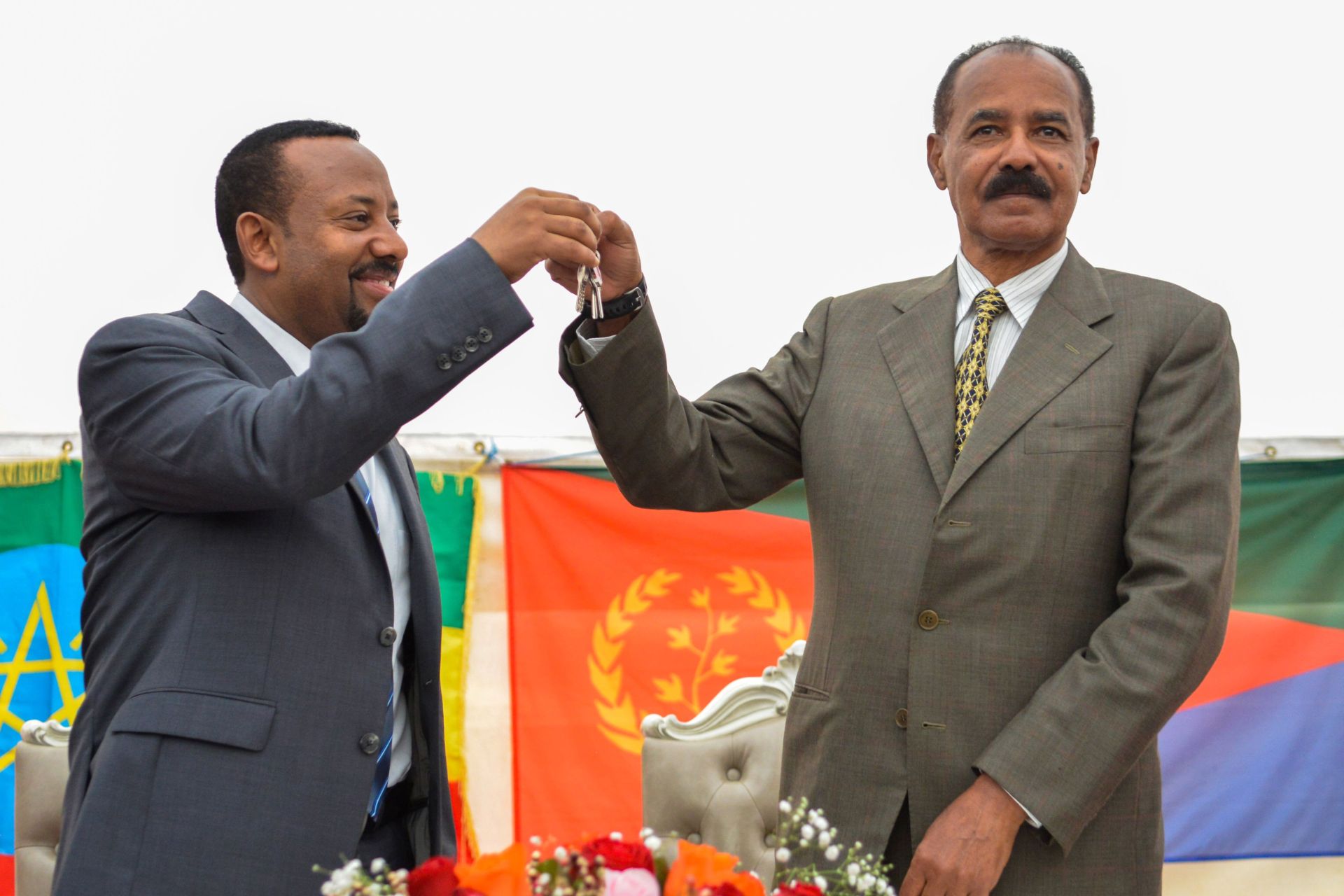
In 2018, Abiy and Isaias embraced, declaring an end to 20 years of hostility. Flags fluttered, embassies reopened and the Nobel committee applauded. Two years later, the alliance descended into a joint war against Tigray, fought in secrecy and ended by the inconclusive Pretoria Agreement. As the guns fell silent, Abiy turned inward — to insurgencies in Amhara and Oromia — while Isaias fixated on preserving leverage along his borders.
By late 2023, Abiy began framing Ethiopia’s landlocked status as a historic injustice. His memorandum of understanding with Somaliland, hinting at a naval base, widened his options — and his list of enemies. Somalia saw a violation of sovereignty, Djibouti felt bypassed and Egypt recalibrated around a new Red Sea flash point. For Isaias, it confirmed his greatest fear: Ethiopia’s return to the sea might run through Assab, a port city in the southern Red Sea region of Eritrea.
Both the Eritrean and Ethiopian governments prioritize the survival of their regimes more than anything else. If one of them feels threatened enough, that would be the trigger for war. A shooting war is not the most likely scenario. Still, the Horn of Africa is laced with trip wires — a perceived existential threat in Addis Ababa or Asmara, a brief opportunity around the port of Assab, or a misinterpreted militia clash along the Afar-Tigray-Sudan border.
A retired Ethiopian general, who spoke on condition of anonymity from a cafe in Addis Ababa, told New Lines by phone: “Both Abiy and Isaias want war, but their own limits trap them.”
The former general, a Tigrayan who retired in 2017, outlined the calculations. Despite Ethiopia’s enormous military resources, it faces three constraints. First, it is politically fragmented and militarily overstretched in the Amhara and Oromia regions. Many areas in both regions are not under government control. The authority of the regional government in Tigray remains weak and incomplete. Second, any new war would overextend Addis Ababa and could trigger rebellion. Isaias might exploit Ethiopia’s weakness by forging tactical alliances with disaffected Ethiopian actors such as Fano militias, the Tigray People’s Liberation Front (TPLF) or the Oromo Liberation Army. Third, the Red Sea arena is crowded — Saudi Arabia, Egypt, the United Arab Emirates and Sudan all see opportunities to expand influence. “Isaias knows this,” the general added. “He’s waiting. If Ethiopia collapses through a proxy war, he won’t need to fight.”
The general said he was aware of reports of Saudi-mediated contacts between the United States and Eritrea, which suggest shifting regional alignments that could isolate Addis Ababa. He concluded that Abiy’s government risks international isolation, economic decline and loss of internal cohesion if it starts a war. He added that, without solid external backing — particularly from partners such as the United Arab Emirates — any military move toward Eritrea is considered unlikely.
The 2022 Pretoria Agreement officially concluded the two-year war in northern Ethiopia. Brokered by the African Union, it committed both sides to an immediate and permanent ceasefire and to the restoration of federal authority and services in Tigray, with the TPLF laying down its weapons. It also called for free access for humanitarian aid and for foreign and nonfederal forces (especially those from Eritrea) to withdraw, while restarting constitutional governance within Ethiopia’s federal system.
The agreement, while halting hostilities, left deep political fractures. There are also economic constraints. An October 2025 World Bank report argued that the Ethiopian economy is fragile: Poverty has risen sharply — from 33% in 2016 to a projected 43% in 2025 — while inflation, debt, drought and heavy military spending have eroded earlier gains.
Eritrea is constrained by its small population, depleted military and an aging autocracy sustained by fear and indefinite conscription. Facing isolation and what it perceives as encirclement, the regime is intensifying its recruitment efforts and repression. A dire humanitarian situation, military demands and increased repression are driving the country’s youth to flee the country.
In the Kenyan capital Nairobi, 17-year-old Habte sat at the registration desk of the United Nations High Commissioner for Refugees. His parents used their savings to smuggle him from Eritrea to Tigray and then through Addis Ababa to Kenya. “They said I must leave before the soldiers come,” he told New Lines. His older brother was conscripted in 2020 and never returned. At the registration center, a U.N. worker estimated that more than half the new arrivals from Eritrea are minors. The Eritrean state calls conscription “national service”; defectors call it indefinite bondage.
A former artillery recruit living in Oslo, Norway, who fought during the 1998-2000 war, recalled being 15 when his colonel ordered the clerk to record his age as 18. “We lost many boys,” he told New Lines when we met in person. “Now they are taking even younger ones and the elderly.” The regime’s manpower crisis is evident in its renewed call-ups, remobilized veterans and closed borders. Eritrea’s army is aging and underpaid. “They can fight defensively,” the ex-recruit said, “but not for long.” A Western diplomat in Asmara put it bluntly: “Eritrea has weapons, experienced mechanized units and some determined fighters — but could not sustain a long war.”
The Ethiopian general noted that the Eritrean regime lacks the strategic incentive to start a war; its enmity toward Ethiopia’s ruling Prosperity Party is more emotional than calculated. He added that the Eritrean regime viewed the TPLF resurgence, when it recently controlled the Tigray Interim Administration, as an opportunity to pressure Ethiopia and restore Eritrea’s regional leverage. “That optimism has since faded as Eritrea and the TPLF faction led by Debretsion Gebremichael realized that the majority of the TDF [Tigray Defense Forces] have no intention of aligning with Eritrea after their bitter experience with Asmara during the 2020 war.” Though both can engage in proxy wars, he saw no possibility of a direct war.
It is not only Eritrean youth who flee their country. Though their reasons may be different, many young Ethiopians take a dangerous route from Djibouti to Yemen through boats organized by traffickers. The police commissioner for southeastern Tigray, Abrha Werede, told Tigray TV that in the last three months alone, some 300 people were detained in human trafficking cases. He added that the most worrying of all was that some of those to be trafficked were under 12 years old. In August this year, at least 68 migrants died, and 74 others remain missing, most of them Ethiopians, after a boat capsized off the coast of Yemen, according to the U.N. migration agency.
For both leaders, war remains paradoxical — too costly to fight but too politically beneficial to abandon. The result is a tense equilibrium of pressure without invasion, where each side tests the other, signaling, probing and building leverage for a crisis yet to come.
Eritrea, under the dictatorship of Isaias, has fought wars with all its neighbors: Ethiopia, Sudan, Djibouti and even Yemen across the Red Sea, directly or through proxies, which seem to be its weapon of choice.
A former Eritrean army officer now in Sudan described how his unit trained militia fighters in Ethiopia’s Amhara region in 2021. “Isaias wants everyone to be entangled,” he said. “If Ethiopia is busy with its own fires, he sleeps safely.”
That is Eritrea’s doctrine — deterrence by entanglement. For three decades, Asmara has cultivated proxies rather than allies: Afar factions, Sudanese militias and Ethiopian exiles. Under the previous ruling party in Ethiopia, the EPRDF, Eritrea hosted armed opposition groups. When Abiy came to power, many returned home, but the intelligence officers from Asmara still move through Afar and eastern Sudan, trading information. “Eritrea’s president believes chaos is safety,” said a former military intelligence officer who is now in exile. “If neighbors are unstable, no one unites against us.”
War in the Horn of Africa rarely follows a schedule; it follows a trigger. The question is not when but what — what event, threat or miscalculation might turn brinkmanship into combat?
A perceived existential threat, persuading him that inaction is more dangerous than action, would be the first trigger for Abiy. Leaders facing internal decay often externalize crisis, and Ethiopia is no exception.
Ambassador Kassa Woldemariam, a former senior Ethiopian diplomat close to the Tigray leadership, told New Lines that Addis Ababa might see war as a cure for its political paralysis. “The current equilibrium cannot continue as it is,” he said. “One side must take action to change the equation.”
Eritrea has its own mirror version of that logic. If Asmara interprets Ethiopian troop rotations in Afar or Tigray as encirclement, or if the Tigray faction it quietly courts begins to weaken, it could strike first under the language of “preemption” and “defense.”
If Ethiopia concludes it can degrade Eritrea’s capabilities — or seize a bargaining chip like Assab — at a tolerable military cost, and if regional actors signal acquiescence, risk tolerance will rise. Foreign support and encouragement will also be crucial. Multiple open-source investigations have alleged Emirati military support for Addis Ababa during the Tigray war, and there are reports that similar support continues. Along the fractured frontier between Afar, Tigray and Sudan, command lines blur easily. Any incident — a drone straying, a militia ambush wrongly attributed to the wrong patron or an escalating convoy interdiction — could spiral. Such minor accidents have ignited larger wars before.
As Professor Kjetil Tronvoll, a scholar of the Horn of Africa, observed, Eritrea believes another conflict would threaten its very existence. At the same time, Kjetil told New Lines that Ethiopia argues the opposite — that its survival depends on escaping landlocked isolation. When both sides see self-preservation in opposite directions, the ground between them becomes a minefield. The danger is not design but drift: a handful of triggers, converging in time, that no leader can stop once they start.
On the map, Assab is a dot; in both capitals, it is destiny. For Ethiopia, the port represents a lost limb — proof that landlocked status can be reversed. For Eritrea, it is the fortress of sovereignty. A dockworker who spent years working at the base leased by the UAE at Assab recalled the day Emirati ships left in 2021. “They took everything — cranes, tanks, even the air conditioners,” he told New Lines. “Since then, the port sleeps.”
The withdrawal stripped Eritrea of a wealthy patron. The UAE turned east toward Somaliland and Sudan, drawing closer to Addis Ababa with loans, drones and currency deals.
The Afar-Tigray-Sudan triangle bristles with shifting loyalties. Command lines blur easily. In Tigray, a silent coup by some army generals in October 2024 replaced the Tigray Interim Administration with a hard-line TPLF faction led by Debretsion, who is allied to Eritrea. Young TDF members demonstrated for five days in a row in various towns, demanding higher pay and improvements to their livelihoods. They blocked roads. “We are not the TPLF’s army,” some of them shouted. To observers in Asmara, such unrest signals a lost opportunity — and that Tigray might not fight with Eritrea against Addis Ababa in a new war.
There has been a recent escalation of the conflict between the TPLF and the Afar region, where forces loyal to the TPLF faction led by Getachew Reda and supported by the federal government had established themselves. The Afar regional government accused the TPLF of crossing the border illegally on Nov. 6 and entering the Afar region, occupying several districts, while Debretsion’s faction denied any wrongdoing. Debretsion, for his part, wrote a letter to the U.N. secretary-general the next day, accusing the federal government of carrying out drone attacks on his forces, causing casualties and destroying property.
Across the Afar border, residents tell a different story. “There is no troop buildup now,” said Dahilon Yassin, an Afar civil activist in the diaspora. “People are tired. They don’t want their land to become someone else’s battleground.” He added, “Many ordinary Afar are more deeply concerned with entrenched corruption, pervasive nepotism and the persistent clashes with the Issa/Somali communities in Ethiopia’s Afar region more than anything else.”
Yet alliances shift quickly. Haji Ibrahim Osman Aliyu, a senior Afar commander and cousin of Ethiopia’s defense minister, defected to Eritrea in April with a contingent of special forces. Eritrea has also mended ties with the TPLF, highlighting the fluidity of loyalties. Ethiopia, for its part, hosts the Red Sea Afar Democratic Organisation, an Eritrean opposition group operating from the Afar region. Ibrahim Haroun, the group’s leader, addressing a recent graduation of a new batch of fighters following more than three months of intensive, advanced military training in the Afar Regional State, said, “The leadership is working to establish a trained and well-equipped naval force in line with current political and military demands.” He reaffirmed the organization’s unwavering commitment to defending the rights of the Red Sea Afar people in Eritrea and achieving their full right to self-determination — including the right to secession, if necessary — and to protecting the community from forced displacement and ethnic cleansing.
At Samara University, a recent panel titled “The Two-Water System and Ethiopia’s Strategic Autonomy” laid bare local frustration. “They talk of ports, not schools,” an Afar participant said. “They want our ports, not our people.”
Tensions along the Sudan-Eritrea-Ethiopia border remain volatile as the war between the Sudanese Armed Forces and the Rapid Support Forces turns eastern Sudan into a hub for militia recruitment. Eritrea’s involvement with groups there is seen in Addis Ababa as a potential flanking threat in any future conflict. An Eritrean-backed SAF offensive could prompt Ethiopia to reinforce border defenses and heighten air surveillance around Assab. Meanwhile, the al-Fashaga border dispute — over fertile land reclaimed by Sudan during the Tigray war, allegedly with Abiy’s tacit approval — remains unresolved and a significant source of resentment among Amhara communities, adding another flashpoint to the region’s instability.
For all the noise, both governments know the limits of their power. Ethiopia’s military is overstretched by internal rebellions, and the country’s economy is collapsing from exhaustion, with a currency in free fall, soaring inflation and plummeting investor confidence. Another war would risk international sanctions, further scaring off investment and exacerbating humanitarian crises already afflicting the Amhara and Oromia regions.
Eritrea governs through control and with little slack. Its population is small, its economy thin and its isolation nearly total. A prolonged conflict with a much larger neighbor could drain the regime’s manpower and invite intervention from actors it cannot manage — Egypt, the Gulf states or even Western powers drawn by Red Sea security concerns.
Both leaders understand that miscalculation could internationalize overnight. A single clash around Assab would ripple through insurance markets, shipping lanes and food import corridors from Port Sudan to Djibouti. In the Horn of Africa, logistics are politics, and every container ship is a hostage to stability. For now, the logic of restraint holds — not from goodwill, but from exhaustion and arithmetic.
If the Horn of Africa avoids another war, it will owe that survival not to heroism but to unglamorous statecraft. A diplomat in the region told New Lines, “The maritime dispute must be frozen into structured negotiation, perhaps under the IGAD [Intergovernmental Authority for Development] or the African Union — turning access into economics rather than ideology. The principle is simple: Access is negotiable; sovereignty is not.”
Along the Assab corridor, minimal guardrails could help: mutual notification of troop movements, monitored hotlines and a no-strike buffer around infrastructure. External actors should quietly support these mechanisms; public grandstanding only hardens positions.
Inside Ethiopia, the cure for proxy warfare is governance, ending punitive campaigns in Amhara and Oromia, restoring trust in Afar and narrowing the space that insurgencies exploit. For Eritrea, the ask is steadiness: verifiable restraint from aiding militias, balanced by credible engagement on border trade.
None of these developments is dramatic. But in a region wired for miscalculation, dull diplomacy is safety.
Become a member today to receive access to all our paywalled essays and the best of New Lines delivered to your inbox through our newsletters.