


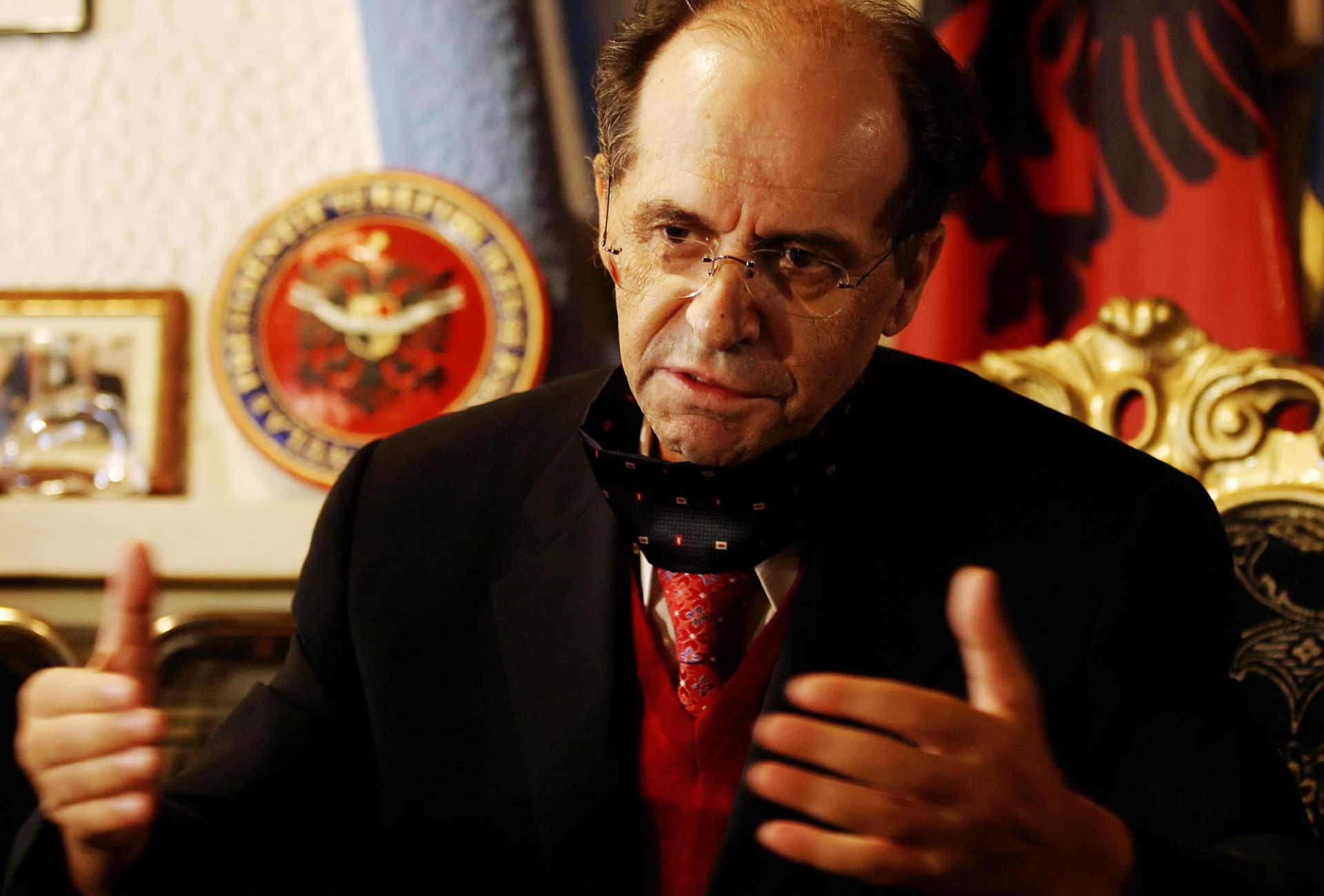
In the early 1990s, Kosovo’s President Ibrahim Rugova was wont to give precious stones to foreign dignitaries and politicians as signs of gratitude for their contribution to his cause. One of those, a hefty, gilded quartz crystal, unearthed from the storied Trepca mines in northern Kosovo — site of one of the most sweeping protests in defense of Kosovo’s autonomy in 1989 — was reserved for the kind of historic visit scarcely imaginable a decade earlier. On May 29, 1998, Rugova presented the gift, large enough to have to hold with both hands, to then-President Bill Clinton, with an appeal for the United States to intervene to put a stop to the escalating violence back home. In the preceding months, tensions had reached an unprecedented apex with the summary execution of civilians and the infamous killing of Adem Jashari, co-founder of the Kosovo Liberation Army, at his home, along with 56 members of his family.
The crystal, fondly referred to as the “Rugova stone” in the White House, gestured toward a symbolic kinship between Clinton’s home state of Arkansas, known for its geological richness, and Kosovo, by way of the Trepca mining complex, which accounted for 70% of Yugoslavia’s mineral wealth in the 1980s. A friendship cemented between the U.S. and Kosovo at the height of the campaign for Kosovar self-determination persists to this day, as Washington remains one of Pristina’s closest allies, continuing to hold a military presence in the country through a NATO-led peacekeeping force: KFOR (Kosovo Force).
This year marks the 20th anniversary of the death of Rugova (1944-2006), the leader of Kosovo’s nonviolent resistance movement and its first democratically elected president. Kosovo, Europe’s youngest country — with an overwhelmingly pro-American bent — has made tremendous strides since Rugova’s death, building democratic state institutions from the ground up. Local efforts at reckoning with the past, too, have gained momentum, evident in the establishment of new museums like the Reporting House in Pristina, where visitors can watch looped footage of the Yugoslav wars from a number of Western and local news outlets, and in the newly established Institute of Crimes Committed During the War in Kosovo, the first public institution charged with documenting the war’s crimes.
Though he hails from a small, landlocked country of fewer than 2 million citizens, Rugova’s legacy extends far beyond Kosovo, embedding him in global debates around human rights, diplomacy, civil disobedience and social justice. His role as the architect of the nonviolent resistance movement and his enduring legacy of peace in the region hold important lessons for a world rife with extremes, increasingly inured to the shock of political violence.
Rugova was known for his even-keeled demeanor and his advocacy for human rights at a time when virulent nationalism and rampant violence were roiling Yugoslavia. His unique intellectual profile as a literary scholar, however, is little known. It has received only passing mention in his official biographies, overshadowed by his role as the figure who prudently ushered Kosovo to statehood and won the diplomatic support of the U.S., the United Nations and NATO. Yet Rugova’s career as a literary scholar was the lifeblood of his first act, central to his worldview and, ultimately, his approach to politics. A sensitivity to language, the signs and myths that permeate our lives and a literary sensibility formed on the basis of Albanian and world literature afforded him what many of his contemporaries lacked: moderation, rhetorical dexterity and a commitment to deeply held humanist, universal values. It was an ethos cultivated through years of scholarly practice and engaged citizenship. Rugova’s training in literature and literary theory undeniably shaped his political philosophy, furnishing him with the tools to successfully dismantle the myths perpetuated by ultranationalist authorities and internationalize the case for Kosovar self-determination and independence from Serbia — a country that, to this day, contests Kosovo’s sovereignty.
An only child, Rugova was raised by a single mother after his father and grandfather were executed by the Yugoslav Partisans, the communist resistance, at the tail end of World War II. He was a month old, and his mother, Sofë Rugova, was widowed at age 23. Impoverished and still recovering from the shock of these deaths, Sofë held off on sending her son to school, enrolling him at the age of 9 instead of the customary 7, so that he could make the mile-long trek from his village of Cerrce to his school in Istog, a small town in northwestern Kosovo, accompanied by his cousin.
At the time, illiteracy rates were high, and despite efforts to expand education in the province, there was still a shortage of Albanian teachers. Given these constraints, the path to becoming one was also evidently looser. Rugova’s first grade teacher, Mynavere Gucia, was just 15 years old when she was appointed to the role, having just completed her own limited training. Despite his late start, Rugova excelled in school and would discover the classics — including Balzac, Shakespeare, Kafka and Dostoyevsky — once he got to secondary school, Yugoslavia being among the first communist countries to authorize translations of these works. He went on to enroll at the University of Prishtina to study Albanian language and literature, and served as editor of the student newspaper, Bota e Re (“The New World”), an organ of popular dissent.
Kosovo’s history is dotted with discontent and state-sanctioned violence. The latter years of Rugova’s education coincided with the Ranković era (named after Aleksandar Ranković, chief of the secret police), characterized by terror and mass surveillance of the Albanian population. Looking back on this time, Rugova noted the fear he felt given the fate of his father and grandfather, and the examples of his own schoolmates, imprisoned for adolescent expressions of dissent.
A series of protests broke out in 1968, with students calling for an Albanian-language university, paving the way to the founding of the University of Prishtina in 1969. In 1971, Rugova published “Lyrical Traces,” a peculiar collection of vignettes referencing great world poets such as Rabindranath Tagore, Pablo Neruda, Jacques Prévert and a slew of others in the Albanian tradition. These prose poems alluded to the radical English Romantic poet Percy Bysshe Shelley, who championed the cause of Irish independence, and whom Rugova characterized as a challenger of tyranny — “the poet is the soul of humanity, tyranny its foulest whip” — and others, like the Spanish anti-fascist poet Federico García Lorca, who summoned the courage to speak truth to power. The collection betrayed his own affinity and reverence for poets who bravely took on the mantle of political engagement in their art.
Recognizing the importance of education for the masses, Rugova began his career serving as a teacher in a local village just outside of Pristina. Although the village was in the vicinity of a large power plant, the community had no electricity and lacked books, so he developed a library, an act that drew scrutiny from the authorities, who accused him of spreading nationalist propaganda. Later, he joined the Institute of Albanology, where he worked as a research assistant.
In 1974, in line with decentralization measures, Yugoslavia adopted a new constitution that gave autonomy to Kosovo as a province of Serbia, including representation at the federal level and the right to issue its own constitution. Aside from that, the constitution granted the right to the free expression of Albanian language, culture and history, which also led to the translation of new works into Albanian. This measure, however, fell short of Albanian demands for equal status via a republic.
A commitment to peaceful resistance and civil disobedience in the face of pervasive police brutality and arbitrary repression, and the establishment of a wide-ranging parallel state system, earned Rugova the moniker “the Gandhi of the Balkans” and comparisons to Nelson Mandela. His choice to abstain from violence was remarkable given the near-total recourse to violence as Yugoslavia broke apart and descended into war. At his core, Rugova was an idealist with a mild-mannered sensibility, at a sharp remove from the crop of self-aggrandizing politicians who operated in the name of exclusivist, nationally defined visions of the future. A chain-smoker with an unassuming demeanor and a penchant for drinking — soft-spoken and measured — Rugova built a career as a poet, literary theorist, professor and longtime researcher at the Institute of Albanology in Pristina.
Despite being a neophyte in politics, he knew its language well and leveraged this to become a savvy political leader. Coming under the influence of French literary circles as a graduate student, Rugova became fascinated with the relationship between knowledge and power. While in Paris, he studied literary theory under the supervision of the hugely influential literary theorist and cultural critic Roland Barthes during the 1976-1977 academic year, a period that coincided with the latter’s appointment as chair of literary semiology (the study of signs and their meaning) at the College de France and the height of his career as a public intellectual. Barthes’ essay “The Death of the Author,” published in 1967, revolutionized the understanding of a text’s meaning, shifting the focus of interpretation away from the author and toward the reader, and helped usher in post-structuralism, associated with the belief that meaning is unstable. A text was no longer to be read and interpreted through authorial intention, nor a definite structure of language that found expression in the author’s work, but rather via the reader’s approach to the multiplicity of meanings each text contained.
On Jan. 7, 1977, Barthes presided over a packed lecture hall at the College de France. Among those in the audience were two titans of modern French thought: the historian-philosopher Michel Foucault and the structuralist anthropologist Claude Lévi-Strauss. In this lecture, Barthes zeroed in on power, locating it in all facets of life, from the organs of the state to social class to sports and fashion. But above all, he concluded, it was to be found in language. His oft-quoted line “language is legislation, speech is its code” propounded the belief that power is inscribed in language.
Later that year, having absorbed Barthes’ lectures, Rugova got to work on a book, “Toward Theory,” which helped to introduce Albanian-speaking audiences to the latest innovations in Barthes’ work as a way of plugging them into global currents in theory and analysis. His introduction stressed the importance of critical inquiry and analysis and the reevaluation of established beliefs and values. “To reevaluate means to decline to accept, to call into question, to decline to accept a conventional value, and instead to make it a matter of debate,” he wrote. Whereas in the past Albanian intellectual products had been limited to oral and written literature, both of which served the needs of the Albanian national project, Rugova argued, now Albanian thought was developing into specific disciplines, which allowed literature to be consolidated as a separate enterprise, divorced from the needs of a burgeoning nation.
The idea of power being inscribed in language appealed to Rugova and his cohort because it implied that language and literature were also robust conduits for change. If power could be accrued and consolidated by means of language, it could likewise be eroded. Decades later, Rugova would reflect back on his year in Paris as the point at which he was “infected” with democracy, having witnessed debates among the disillusioned New Philosophers, a generation of intellectuals including Bernard-Henri Lévy and André Glucksmann, who broke with Marxism, deeming it inherently totalitarian. The atmosphere of open and free debate seemed to broaden the horizon of possibility for Rugova, who hoped that literary theory might be one means to dismantle a declining system back at home.
Not long after his return from Paris, Rugova began teaching Albanian literature at the University of Prishtina. In 1978, he published his translation of “Aesthetic Notions,” a 1925 book by the Parisian philosopher Charles Lalo, who had served as chair of aesthetics at the Sorbonne. The book aligned with Lalo’s efforts to establish aesthetics as an independent field of study and had already appeared in a Serbo-Croatian translation, but Rugova believed in the importance of bringing significant academic works to an Albanian-speaking public with little direct, unmediated access to the world of ideas. Access to literary criticism was severely lacking. In 1980, he published a collection of essays, “Strategy of Meaning.” A prelude to his forthcoming “Aesthetic Refusal,” the book expressed a faith in art and literature as the only areas that cultivated what he termed a “positive strategy,” freed of ideological constraints and tied to universal humanity.
Another eruption came in the spring of 1981, a year after the death of Josip Broz Tito, Yugoslavia’s longtime leader. Student complaints over miserable conditions in the cafeteria and dormitories of the University of Prishtina grew into mass demonstrations against social inequities and Kosovo’s status as a province within the Yugoslav federation. Chants calling for a republic led to armed clashes between students and police, resulting in the death of 11 people. During this critical interlude, Rugova was engrossed in the completion of his authoritative study of 17th-century Archbishop Pjetër Bogdani’s “Cuneus Prophetarum” (“The Band of Prophets”), the earliest prose work originally written in Albanian, which he analyzed to reveal its underlying philosophical principles and to understand the context in which the author was writing.
In 1984, he received his doctorate from the University of Prishtina, with a dissertation on Albanian literary criticism. Though Rugova would later describe himself as largely apolitical prior to his formal entry into politics, the admission seemed more of a self-reproach from the vantage point of the charged mid-1990s than an apt designation, particularly considering his own nuanced understanding of the realm of art, or culture, as a site carrying the potential for political contestation. Looking back, he settled on the term “compensation” for the work he pursued amid the tumult: one of two paths for the engaged intellectual, indirect and direct.
Two years before the revocation of Kosovo’s autonomy, Rugova published his final work of criticism, “Aesthetic Refusal.” Despite its focus on language and literature, the eponymous opening essay reads like a political-philosophical treatise on how to combat oppression. Like Barthes’ landmark lecture, it was an exploration of the operation of power within society. Rugova began by defining refusal simply as a rejection, or the refusal to accept what is imposed upon you. The most pointed, or “real,” kind of refusal was that based in conviction and rooted in argument, which could be marshaled by an individual or a collective. As he saw it, life’s most intimate moments — experiencing joy, bitterness or love in the face of oppression, subjugation or coercion — could also be understood as manifestations of refusal.
From there, he reasserted the significance of literature as the embodiment and realization of humanity in the truest sense, understanding “aesthetic refusal” to be an inherent virtue of fine, well-wrought literature whose value and influence persist far beyond its initial creation and dissemination. He cited the German writer Johann Wolfgang von Goethe and the Spanish painter Francisco Goya, who, even when in the service of courts and other benefactors, nonetheless managed to produce art unencumbered and untarnished by this uneven power dynamic. Within the Albanian context, he pointed to the national poet-priest, Gjergj Fishta, and the poet Naim Frashëri, both of whom were central figures of the Albanian national awakening and whose work had lasting significance beyond the initial context in which they were created.
According to the essay, literature holds within it the capacity and potential to refuse, much like direct, engaged political action does. Literature “not only counters imposition but it also refuses it, does not allow it,” he wrote. “There is refusal by means of silence, and active refusal on the plane of life. Literature has these two forms, but its greatest refusal lies in its very being and character, which we have called aesthetic refusal.” While refusal has a political variant, aesthetic refusal is realized purely through art that resists becoming a tool of ideology, an achievement reached through the use of literary devices and rhetorical techniques such as satire, sarcasm, irony and the grotesque.
Secondly, literature stages an act of refusal by building or defending its own reality, which suggests the kind of “world-building” and tenacity that is a natural part of imaginative literature, but also through its ability to generate varied readings, interpretations and effects on the reader. Such literature fundamentally resists imposition in that it affirms or creates an alternative reality, yet does so through subtle, hidden or unobtrusive means. To Rugova’s mind, power was something that could be, and ought to be, harnessed beyond the political realm. There was a robustness to refusal. Through aesthetic refusal, and critically by means of “indifference” to what it excludes or ignores, literature reinforces human dignity and raises cultural consciousness, cultivating an awareness that, in turn, may effect or inspire political action.
Literature, he supposed, ought to constitute a space of absolute freedom, from outside strictures and even from the self, or forms of self-censorship. Aside from introducing Rugova’s philosophy of literature and power, the essay was concerned with the role of the intellectual in society, reaffirming the French philosopher Jean-Paul Sartre’s belief in the engaged writer, tasked with defending and speaking for the oppressed.
In April 1987, Slobodan Milošević, then a party functionary within the League of Communists of Serbia, gave a rousing speech in Kosovo Polje, west of Pristina, in which he assured the Serb minority that “no one shall dare beat you,” with the implication that Serbs needed to be protected from their Albanian neighbors. This brand of skewed rhetoric was by now deeply entrenched in certain intellectual circles. In 1988, Rugova was elected head of the Kosovo Writers’ Association (AWK), an entity that became independent of the Association of Writers of Serbia in 1970, after Kosovo had gained some measure of autonomy, including its own university. The year that Rugova took over, the AWK was being attacked by the regime in Belgrade, as meetings grew more contentious.
At the two-day conference held at the University of Belgrade in late April 1988, where attendees set out to discuss Albanian-Serbian relations, Rugova delivered a speech titled “Negative Strategy,” in which he called out the inaccuracies in the prevailing narrative that these two ethnic groups were inherently opposed and had an entrenched history of animosity. Instead, Rugova argued, the interethnic conflict was directly imposed from above, a product of propagandizing forces. Such distortions, disseminated through mass media and politics, had vilified and cast the average Albanian citizen as, in his words, “a threatening, exotic bogeyman.”
Rugova ended his speech with an appeal to shift toward positive solutions, on the basis of mutual understanding and respect among nations and nationalities. He implored his audience to lean on democratic rather than repressive means to improve relations between Albanians and Serbs. One concrete action he requested was the rehabilitation of political prisoners, a reference to the 1981 protesters, guaranteeing their right to an education and to work regardless of political leanings.
By 1989, Milošević had risen through the ranks and now helmed Yugoslavia as president. In March that year, following another of his fiery speeches — marking the 600th anniversary of the Battle of Kosovo, a highly mythologized, epic battle that ended in the defeat of a Serbian-led coalition of Balkan forces by the invading Ottoman Turkish army of Sultan Murad I — Kosovo was stripped of its autonomy and direct rule was imposed by Belgrade. A million-strong crowd came to hear Milošević’s address, which presented a well-worn narrative of Serbian victimization at the hands of the Albanian majority, but would soon implicate other ethno-national groups within a crumbling Yugoslavia. Later that year, in December, a group of writers and intellectuals founded the Democratic League of Kosovoand appointed Rugova — a literary critic with no political experience — as its chair, a post he held alongside the presidency of Kosovo (elected in 1992 and 2002) until his death in 2006. The AWK became the center out of which the political movement was born.
Within a month, the league had amassed nearly 200,000 members. In 1990, the group issued a declaration of independence and adopted a constitution. Rugova faced some pushback from the opposition within his own community, which insisted on taking up arms. This faction went on to found the Kosovo Liberation Army. Yet there were others from within Rugova’s ranks at the University of Prishtina working along similar lines. The folklorist and literary scholar Anton Çetta, for instance, undertook the monumental task of suspending blood feuds — a traditional practice with roots in medieval customary law mandating tit-for-tat vendettas following a murder as a way of restoring honor to the aggrieved family —in Kosovo. Recognizing the imperative of internal solidarity and the establishment of a united front as the state ramped up its policing of the population, Çetta oversaw the forgiveness of blood feuds in massive, public reconciliation sessions in which some 2,000 families agreed to put aside their grievances.
Conditions for Albanians continued to deteriorate. Discriminatory government policies went into effect, including the summary closure of Albanian media. By April 1989, 200 Albanian intellectuals were arrested and tortured. Rugova took to the Slovenian press to denounce the climate of terror and intimidation. Between 1990 and early 1995, 130,000 Albanians were dismissed from their jobs. Before Albanian-language education from elementary school to university was shut down in the fall of 1990, there were separate teaching sessions for Albanian and Serbian children. In March and April of the same year, 7,600 children mysteriously fell ill with headaches, stomach pain and nausea, an event of mass poisoning that has never been fully addressed and was dismissed at the time as mass hysteria. Bilingual street signs were removed from public buildings and replaced with signs written in Serbo-Croatian. Albanians, who constituted the majority in Kosovo, were effectively shut out of social and political life.
To resist the system of apartheid that was taking shape, various political strands in Kosovo came together under Rugova’s leadership to form a parallel state consisting of underground schools confined to private homes, shops and barns, and a parallel healthcare system. These efforts were largely funded by the Albanian diaspora abroad and a 3% voluntary tax on Kosovar Albanians. Repressive measures became more coordinated and a policy of ethnic cleansing eventually drove hundreds of thousands of Albanians from their homes. In September 1991, months after declarations of independence from Yugoslavia by Slovenia and Croatia, Kosovo’s Albanian population mobilized at the polls: Of the 87% of eligible citizens who showed up, 99% voted in favor of an independent Kosovo in the referendum.
As the situation grew more tense, Rugova’s theory of aesthetic refusal evolved into political refusal. His strategy of disciplined resistance took the form of parallel institutions meant to fill the vacuum left by the Serbian government and to resist the oppressive measures that sought to limit freedom of expression and movement, and civil and political rights. The absence of confrontation was an active choice of refusal, not a resigned, acquiescent capitulation. It was a philosophical principle and stance that carried from his literary work and activism within the AWK to his political career. Rugova’s carefully calibrated campaign restored dignity to the Kosovar Albanian community, which had been dehumanized, degraded and demonized by the Milošević regime and its propaganda machine. He also appealed to the international community for protection, calling for Kosovo to be placed under a demilitarized protectorate, and for help in managing its transition to a sovereign democracy with guarantees for Serbian and other minorities.
In 1995, the Dayton Peace Accords ended the war in Bosnia, but made no mention of the situation in Kosovo, dealing a serious blow to the cause and to Rugova’s reputation. He didn’t respond to his critics in the Albanian intelligentsia, who claimed that the resistance had been slow and ineffectual. Those critics included members of the literary-intellectual class: Adem Demaçi, a writer and political dissident, Rexhep Qosja, a writer and literary critic, and Ismail Kadare, who had established an international reputation as a writer whose work spoke directly to the relationship between art and power under totalitarianism.
In 1996, Rugova was awarded an honorary doctorate from the University of Paris, which he dedicated to his former mentor, Barthes. By 1997, the Kosovo Liberation Army had emerged. In 1998, he was awarded the prestigious Sakharov Prize for Freedom of Thought, given by the European Parliament, for his tireless commitment to nonviolent resistance. This put Rugova in a league of like-minded human rights advocates such as Mandela and the Soviet dissident Anatoly Marchenko, who were jointly awarded the inaugural prize in 1988. Demaçi, a fellow writer who had spent 28 years in a Yugoslav prison, was awarded the Sakharov Prize in 1991.
In his acceptance speech, Rugova addressed his audience in French and quoted Barthes, stating that “our desires should be invested in politics and in action as desires are parts of people and parts of nations.” He also praised the strength of character of the Kosovar people and lauded them for managing to build a “true civil society” and democracy in spite of the systematic oppression and violence to which they were subjected.
Civil resistance came in the form of election boycotts and peaceful protests that remained silent so as not to incite violent reprisals. On March 16, 1998, following a series of raids and massacres in the Drenica region of central Kosovo, 10,000 women carrying loaves of bread marched from Pristina to Drenica to deliver aid to displaced families under siege, cut off from food and basic necessities. This protest came just a few days after Rugova had reiterated his cautious, nonviolent approach in an interview with The New York Times. “You build nothing positive by destroying others, by using language that inflames a crisis,” he said. On Jan. 15, 1999, 45 ethnic Albanian civilians, including a 12-year-old boy, were killed by Serbian forces in the Racak massacre, an event that galvanized the international community. During the Kosovo War, which lasted from February 1998 to June 1999, 850,000 Albanians were driven out of Kosovo into neighboring Macedonia, Montenegro and Albania. That same year, following the 78-day NATO-led bombing campaign, Kosovo became a U.N. protectorate, an intervention that Rugova had begun calling for since the early part of the decade. By August, nearly 90% of those who had been forced out of their homes had returned to Kosovo.
While Rugova’s detractors claim that his nonviolent resistance movement was less a principled approach than a pragmatic necessity for an unarmed people with few other means of resisting, Rugova’s intellectual work tells a different story. For him, an independent, neutral Kosovo, integrated into Europe and friendly toward its neighbors, was the only way forward.
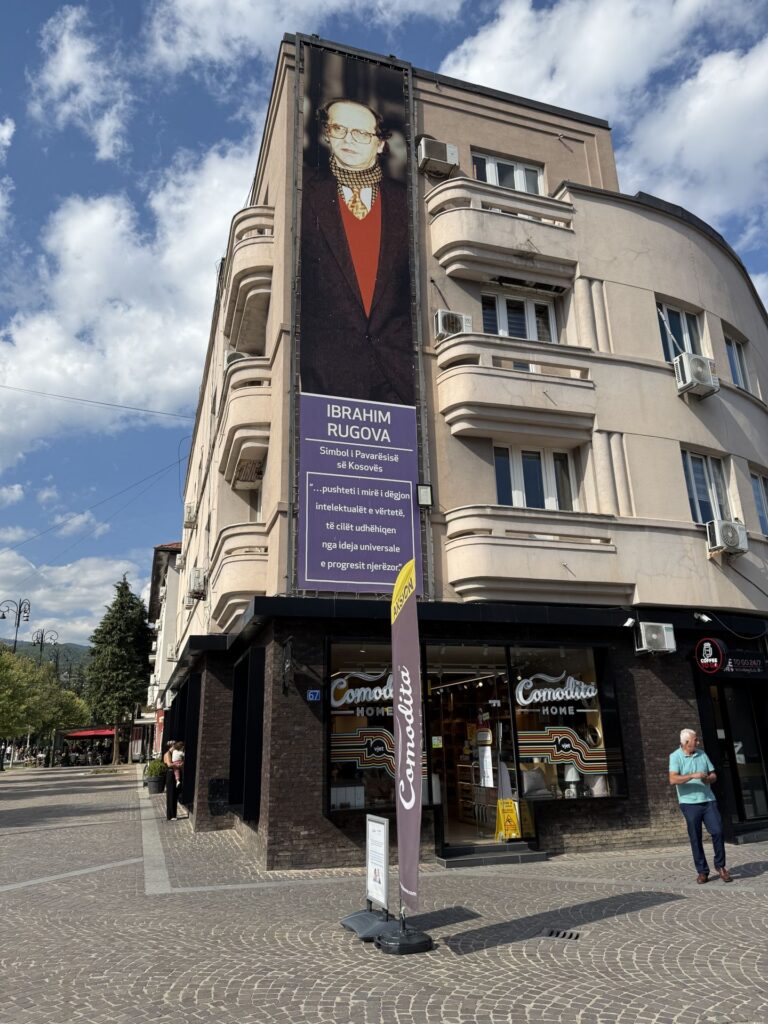
Rugova is omnipresent throughout Kosovo. He is commemorated in a statue that stands in front of the recently erected Mother Theresa Cathedral, and in the northern town of Peja, surrounded by the Rugova Mountains, for a generation that is now too young to have known him.
A placard hangs in Peja’s central square, where Rugova attended secondary school. He is pictured in his signature garb, bespectacled, wearing a red pullover with a silk scarf draped around his neck, one that he reportedly vowed to keep wearing until his dream of Kosovar independence was realized. While he never got to witness Kosovo’s independence, which was achieved in 2008, two years after his death, his political acumen and vision of such a future were pivotal to its fulfillment.
Become a member today to receive access to all our paywalled essays and the best of New Lines delivered to your inbox through our newsletters.