


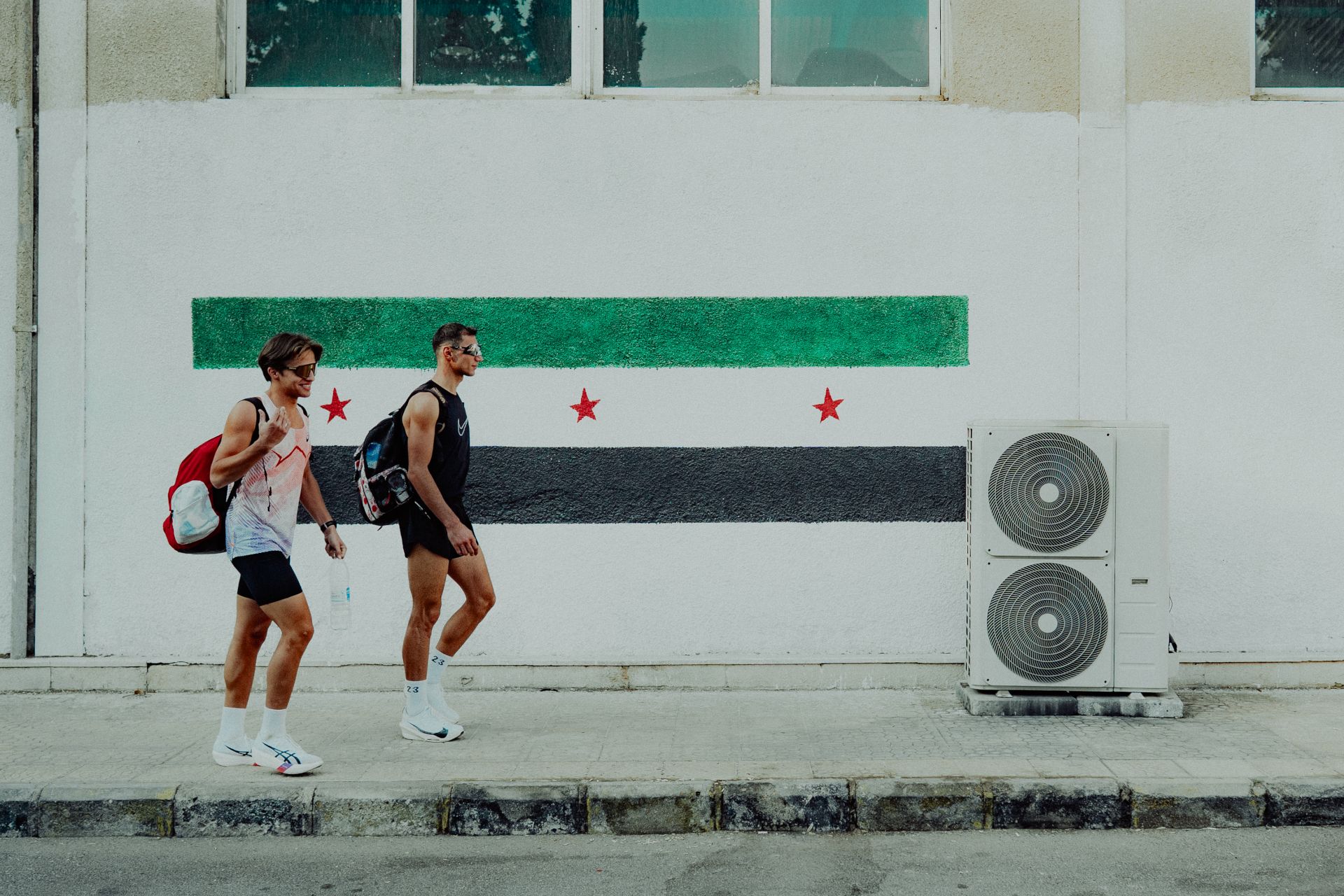
The scene catches Syrian drivers off guard on this mild autumn morning. Along a wide stretch of the Mazzeh highway — one of Damascus’ main arteries — a swarm of police officers forces cars into the left lane only. To their right, men and women are running and cycling at full speed through a thin layer of pollution.
One turn and a few hundred yards further, the entrance of the Dunes Boutique luxury hotel in the Syrian capital comes into view. The resort’s pool is serving as the starting point for the Syrian national triathlon championships.
On this day in early November, unlike on many other days, there are no diplomats or business executives in sight in the lobby. Instead, nearly a hundred triathletes from across the country have gathered to compete for the title.
Wearing a black spandex suit printed with “Syria,” Ehab Khallouf, 25, catches his breath after crossing the finish line, arms lifted toward the sky as he breaks through the red ribbon. Drops of sweat still run down his face, partly hidden by large sunglasses. He isn’t euphoric; in truth, no one is surprised he won.
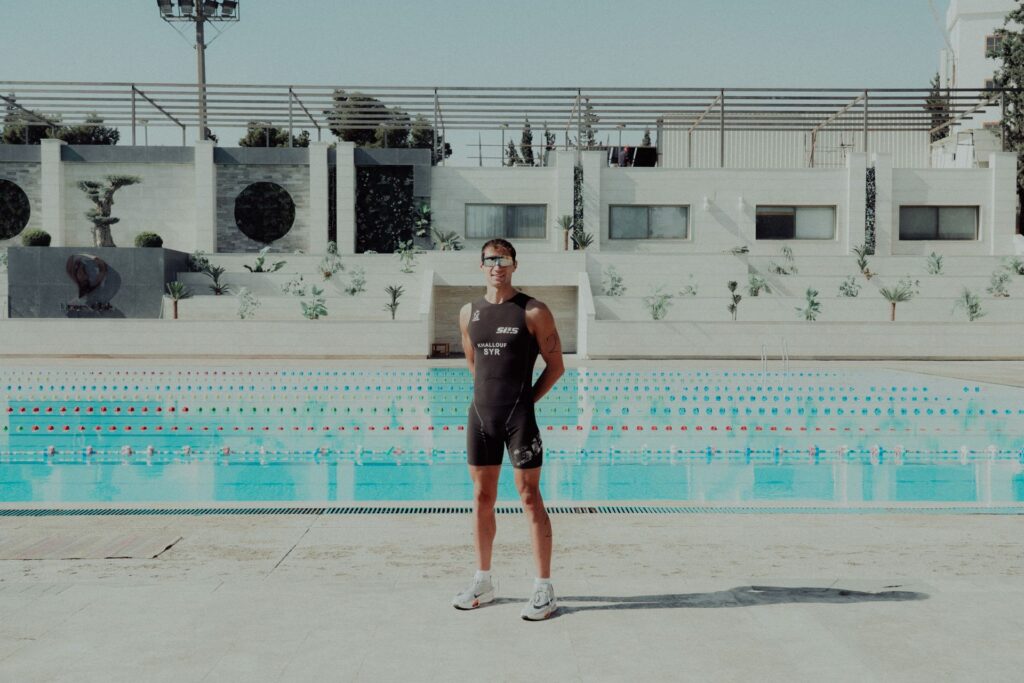
“I feel proud, but the national championship is easy when you’re the strongest athlete in the race,” he tells New Lines with a smile. “Honestly, my goal isn’t a national title. I’m aiming for the Asian championship and the world championship.”
Last year, Khallouf won the World Triathlon Development Regional Cup in Aqaba, Jordan, a competition designed to support federations and athletes from countries where the triathlon competition is still developing. Under Bashar al-Assad’s rule, sports institutions received little support unless they served the interests or propaganda of the Baathist regime. Corruption was rampant, and virtually no initiatives to promote triathlons were ever put in place.
“No equipment was ever provided to us. We once organized a one-month training camp in the UAE and had to cover every expense ourselves,” Khallouf recalls. “I also remember a race in Saudi Arabia. We took a bus for three days. I barely slept, and my legs were full of lactic acid when we arrived barely an hour before the start.”
For the new government of Ahmad al-Sharaa, whose forces overthrew Assad in December 2024, sports are not exactly at the top of the priority list, but efforts are being made to improve conditions for athletes. This is on display in the interactions of athlete and event organizer Dana Shubat, also known as “Dr. Dana,” who calmly gives instructions to the staff overseeing the smooth running of the championships. That the police were mobilized to secure the race along one of Damascus’ main highways is largely thanks to her.
“The national federation’s executive board has always been made up of older people with outdated ideas. They never wanted to hold a race in Damascus because it meant too much work,” sighs Shubat, herself a former Syrian champion, who was elected head of the new federation last July. “I wanted to show them that our sport can’t grow unless we hold events in the capital and get everyone — the police, the ministries — working with us.”
Barely three months into her mandate, Shubat had already reformed the federation and rewritten its regulations. She maintains close ties with key figures, such as former Minister of Youth and Sports Muhammad Sameh Hamed, as well as Prince Fahad Bin Jalawi Al Saud, president of the Asian Federation, who facilitated the participation of two young Syrian triathletes in an international competition in Bahrain last October by providing competition-grade bicycles.
Little by little, Shubat is breathing new life into Syrian triathlons, notably by requiring coaches across the country to present as many women athletes as men during competitions.
While the first signs of change are already visible, the task ahead remains enormous. It will likely take years before a new generation of Syrian triathletes can compete at the highest international level, with the ultimate goal of qualifying for the Olympic Games. In the country’s history, only two triathletes have ever represented Syria: Omar Tayara in Beijing in 2008 and, more recently, Mohamed Maso in Tokyo in 2021. Neither, however, was trained in Syria. Tayara was born and raised in Spain, and Maso sought refuge in Germany in 2015.
For the 2028 Los Angeles Games, the horizon therefore appears especially distant for those triathletes who have remained in the country. Yet amid the ruins left by more than 14 years of war, two athletes have emerged, carrying the hopes of Shubat and the broader Syrian triathlon community: Khallouf, the current national champion, and Adnan Zaki, already a six-time titleholder at just 21 years old.
Khallouf discovered the triathlon at the age of 17, when he followed a friend to Aleppo’s municipal swimming pool in his hometown. He didn’t know how to swim and preferred playing basketball. “I immediately loved the discipline. A year later, I won my first triathlon race,” recalls the young man from Aleppo, whose family has little interest in sports.
By contrast, Zaki, whose father is an accomplished swimmer and whose mother is an amateur table tennis player, grew up with water sports from a very young age. “My parents were waking me up every day to swim. I didn’t like it, but now I know it was worth it,” he recalls. His potential as an athlete was quickly noticed, and he won the first of his six Syrian championship titles at only 15 years of age. That would be followed by four gold medals at the Arab Championships and a West Asian championship title in 2023.
“At first, when I didn’t have any medals, no one would finance my races except my parents. So I had to win to make sure they didn’t lose money, that was a motivation, too,” explains Zaki, whose mother is a homemaker and whose father runs a school supply store.
The family chose to remain in Damascus during the war but could not escape its consequences. “One day, during Eid, my dad got shot. He survived, but I will never forget this moment. There was a lot of shooting and tanks in our streets, so we fled to my grandpa’s house,” he recalls. Zaki, too, had to endure the abuses inflicted by the former regime.
In March 2024, when he was 20, he was out on a bike ride and was arrested shortly after passing an army checkpoint, where he had just given his ID. “About 500 meters after they let me go, a car pulled up with four armed men. They took me, but they didn’t know how to fit the bike in the car. So, ironically, I ended up helping them load it,” he says now with a mocking laugh.
The guards eventually released him after three hours of questioning. But another threat continued to loom over the young triathlete’s ambitions: He was due to begin his mandatory military service. Khallouf had been exempted under a long-standing Syrian law because he is his mother’s only son. Zaki, however, has a brother, so they are both required to serve. He had already received orders to report to his military barracks on Dec. 18 when, serendipitously, the regime collapsed just 10 days prior.
Zaki felt as if he had regained a future that had been hanging in the balance. But in the months following Assad’s fall, all sports facilities remained closed, and he didn’t feel safe enough to train in public. Uncertainty gripped the country despite the euphoria of the brutal regime’s collapse. It took the young man a few months before he felt safe enough to get back to training.
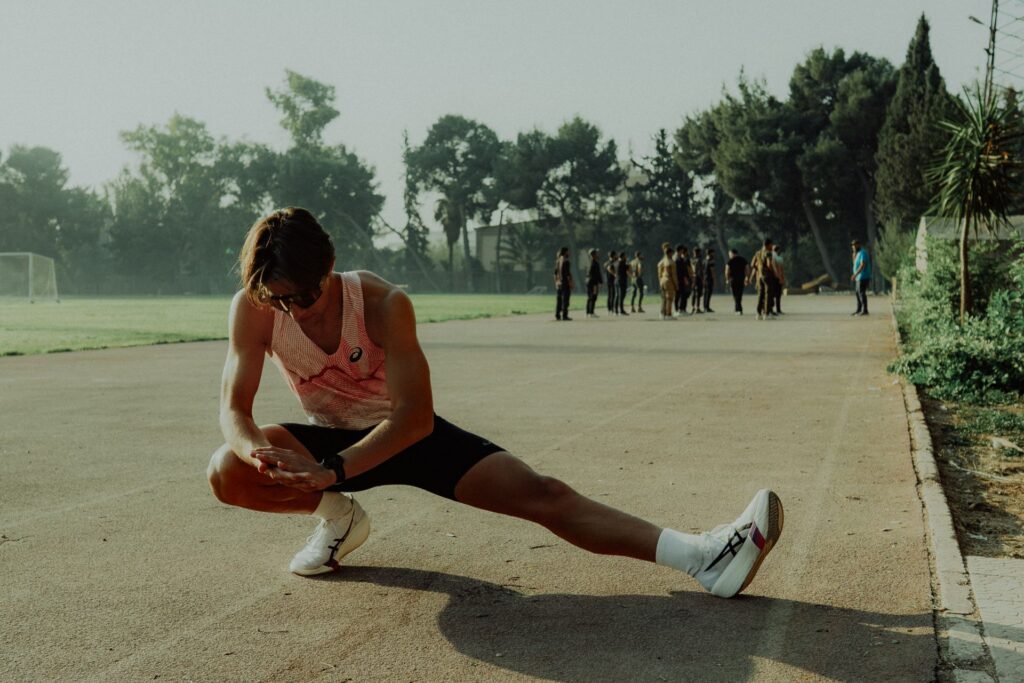
On Nov. 9, as the athletes stretch and prepare to race, the scene appears as ordinary as things have become in a postwar country still struggling to stabilize. The morning light reveals the constant veil of pollution that hangs over Al-Fayhaa Stadium in northern Damascus. A few state security guards with Kalashnikovs stand watch at the entrance. Nearby, a half-destroyed building still bears the scars of war.
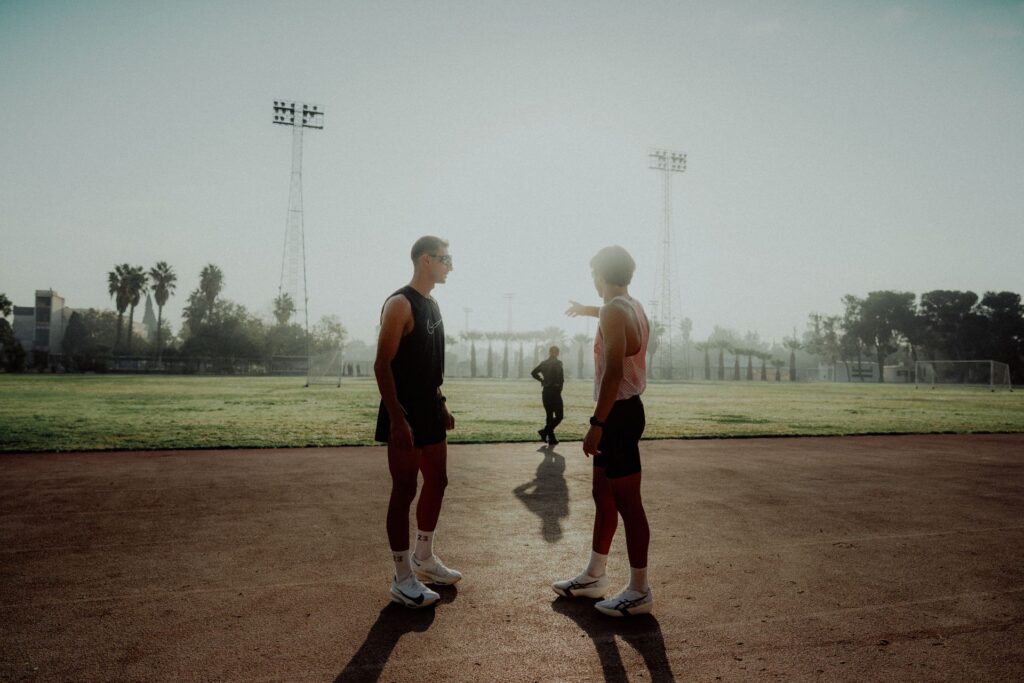
On the track, about 20 Syrian Army recruits rotate their arms and begin their laps, despite the watchful eye of a state security general who takes an interest in Khallouf and Zaki. “You see who our training partners are today?” Zaki says with irony.
Khallouf has come from Aleppo this weekend, specifically to train with his friend, four years his junior. The two talk through the morning’s program as they stretch. Zaki explains the routine that his coach, who is based in Turkey, has prepared for him. Khallouf, by contrast, has no coach. He can’t afford one, and neither can the federation.
Most of the time, the two triathletes train on their own. “I last trained with professional athletes in 2019, in Thailand. Since then, I’ve been working out on my own. I occasionally join cycling, swimming or running groups, but that’s not the ideal way to train,” Zaki says.
A few yards away, sitting on a decrepit bench in the stadium, where faded images of Damascus are plastered on the walls, Khallouf chimes in. “There’s a small team in Aleppo, but most of them are in their 50s. It’s not exactly my level,” he jokes.
In Syria, improving in each of the triathlon’s disciplines requires not only time and family support but also an extraordinary level of perseverance. Aspiring athletes have to adapt, jostling for space at the pool, sharing the track with soldiers or navigating traffic on the highway. The federation tries to help with what little it has. It recently provided Khallouf with a pair of shoes costing a few hundred dollars for an international race, but it remains largely unable to supply proper equipment. Its stock of bikes is a glaring example: It owns about 10, all dating back to 2015. And there are daily challenges.
“Cycling isn’t only about the roads and their bad conditions. Drivers often go the wrong way, and the dust and car fumes make it tough. When I went for a race in Kazakhstan, I finally got to feel what clean air was like,” Zaki says, recalling a trip he had made.
For Khallouf, one of the biggest challenges has been maintaining a consistent swimming routine. “During winter, if the pool was open, I could only train for one hour a day, and the water was freezing. With the new government, we finally got access to a heated pool in Aleppo, but now it’s way too warm,” he laughs.
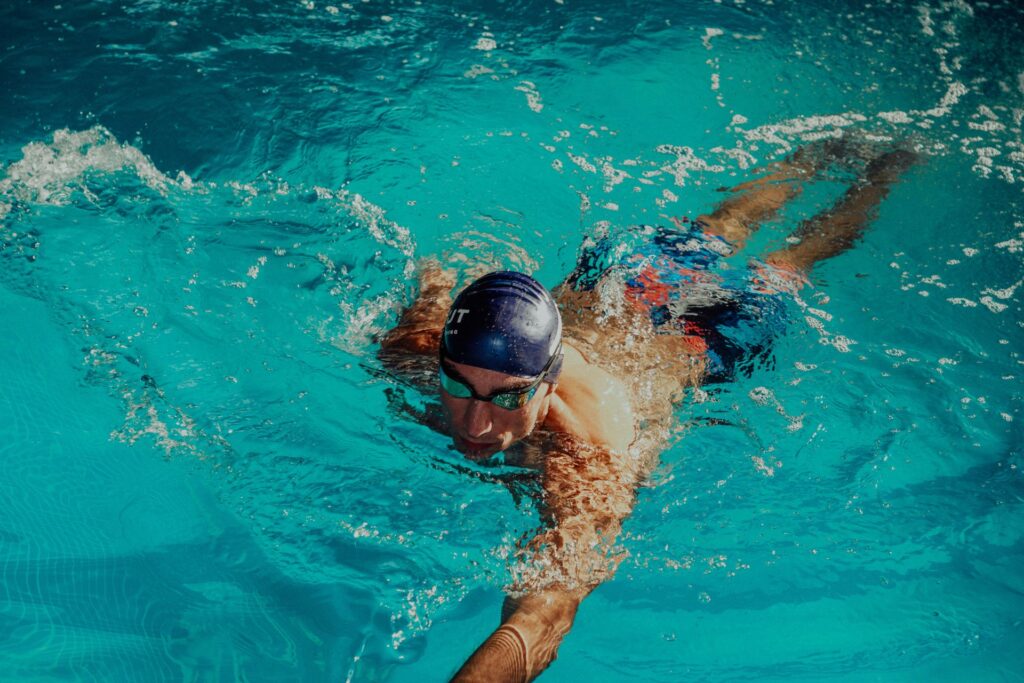
A few laps later, the two athletes pack up their gear and head to the pool at Al-Fayhaa Stadium. They have one hour to train before the pool switches to women-only hours. With towels wrapped around their hips, they discreetly slip into their swimsuits and mandatory swim caps. Rust stains on the ceiling speak to the facility’s age and decay. In the water, about 10 men in their 50s are trying to shed their love handles or learn to swim with flotation belts. The two triathletes manage to find a lane with no swimmers and begin racking up laps.
Another major obstacle is obtaining visas. Under Assad, Zaki and Khallouf were often prevented from competing abroad. “We missed many races outside Syria because of visa problems, and we only have three races a year. And those races don’t give qualification points, so everything is harder,” Adnan explains. “On top of that, the regime wouldn’t grant visas for Europe because they were scared we’d flee the country and seek asylum.”
The war and the massive flow of refugees have also cast a new, often mistrustful, sometimes hostile light on them. “In Arab countries, as soon as they saw our passport, they rejected us. It’s also an issue of racism,” Khallouf laments.
Since the fall of the Assad regime, Damascus Airport has reopened, making international travel easier for the two Syrian triathletes, who previously had to transit through Beirut. But they will now have to carefully choose the races they enter — and, above all, string together strong performances — if they hope to have a chance at qualifying for the 2028 Los Angeles Olympics.
In early November, Khallouf traveled to compete at the Islamic Solidarity Games, held in Riyadh, Saudi Arabia, through Nov. 21. Zaki, meanwhile, remained in Damascus. He is suspended until November 2026 after testing positive for DMHA, a substance prohibited by the World Anti-Doping Agency (WADA), and he is barred from all official races until then. He was therefore unable to defend his Syrian national title this year.
Zaki insists he never intentionally took the stimulant, which enhances performance and reduces fatigue. “I was only taking supplements, maybe some bad ones. You never really know where they come from. There’s also the possibility that someone set me up,” he says. Steroids and doping have been very common among Syria’s gym-goers, perhaps as a ripple effect from the Assad regime’s trade in illicit substances like Captagon, and the popularity of steroid use among the regime’s thugs and special forces. During a visit to any gym in Damascus, it is not uncommon to find men with very large muscles — too grotesque to be natural and drug-free.
Despite several appeals to WADA, the suspension was upheld because Zaki “was unable to demonstrate that he had not taken the substance in question,” according to a source close to the case.
But on the day after his suspension is lifted in November, Zaki will compete in his first qualifying race for the Los Angeles Games. He will need to race relentlessly to reach his goal, but the 21-year-old’s track record speaks volumes about his ability.
Khallouf also hopes to gather enough points for California. “This is my moment to qualify for the Olympics,” he says.
Both athletes hope to follow in the footsteps of Man Asaad, Syria’s most recent Olympic medalist, who brought home bronze from the Tokyo 2021 Games. His portrait, faded by time, can be seen posted at the exit of Al-Fayhaa Stadium as the two athletes wrap up their training session. The image serves as a reminder to Zaki and Khallouf: They are embarking on a journey that, despite its many challenges, could make them among the greatest athletes in Syrian sporting history.
“Spotlight” is a newsletter about underreported cultural trends and news from around the world, emailed to subscribers twice a week. Sign up here.