


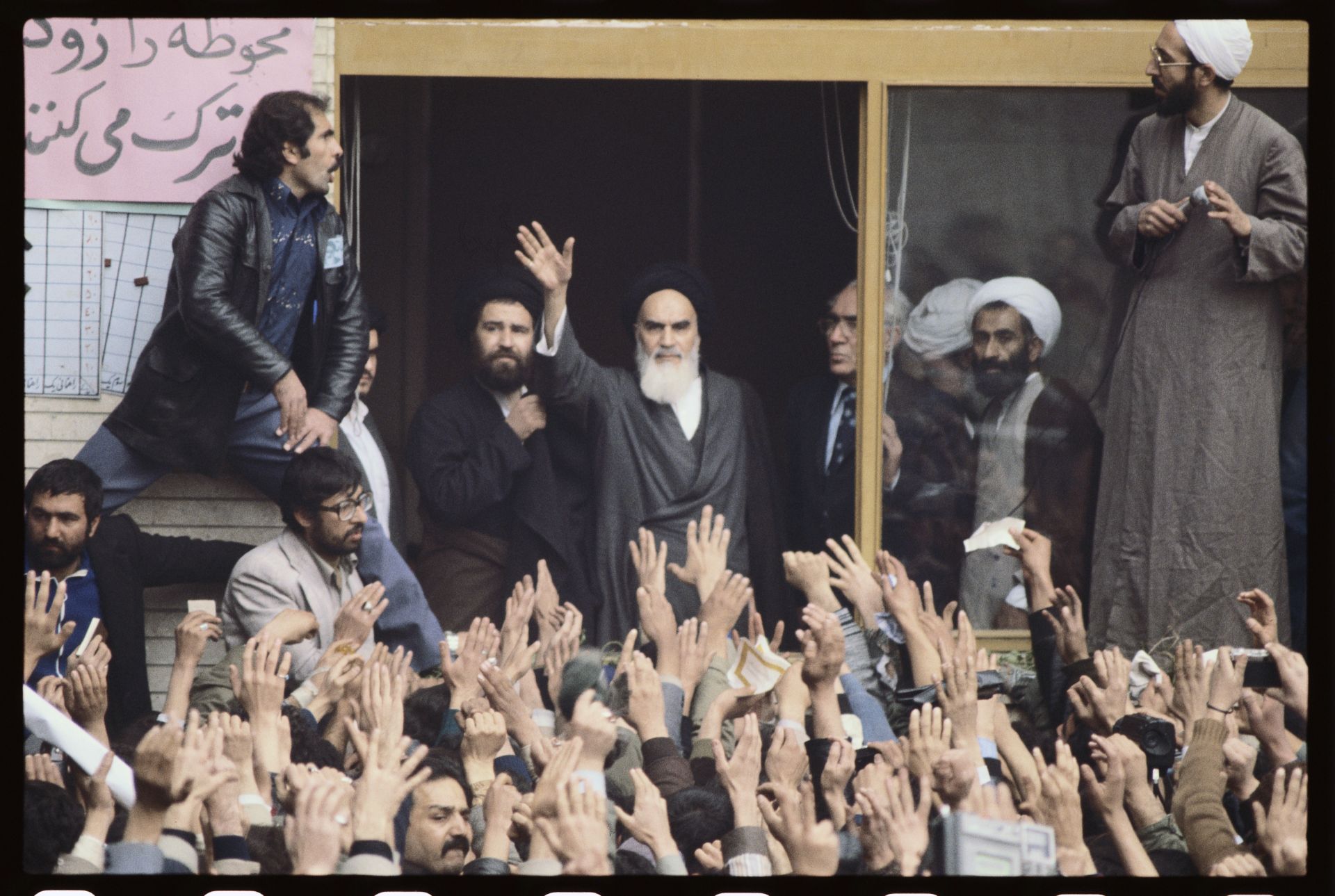
Forty-seven years ago today, as a revolution in Iran swept away what remained of the country’s monarchy, Iranians had good reason to hope that they had won not only political freedom, but economic justice as well.
The leader of the revolution, Ayatollah Ruhollah Khomeini, spoke repeatedly of the “mostazafin,” or the “oppressed,” the barefoot masses whom his new government would serve first and foremost.
Khomeini made specific promises, like free electricity, water and buses for the poor. Iran’s new constitution promised nothing less than “uprooting poverty and deprivation” and the provision of housing, employment, food, health care and education for all citizens. The new government began confiscating properties and businesses belonging to those it claimed supported the previous regime, and handing them over to “bonyads” — foundations whose stated goal was to serve the poor and the families of those who had been killed in the fight against the shah.
Many of the confiscations carried out by the new state were haphazard and unjust, and almost as soon as he took power, Khomeini dismissed the idea that economic betterment was a motivation behind the revolution, insisting instead that the revolution had been for the cause of Islam.
But even within the deeply flawed system that was taking shape in the 1980s, there were high-level officials who genuinely believed the Islamic republic could and should deliver a dignified life to those with the least in society. Iranian officials, aware of the ways the shah’s flashy lifestyle had alienated his people, eschewed showy consumption and adopted an outwardly humble presentation.
Fast forward to today: Iranian elites with connections to regime officials can get fabulously wealthy through rentier schemes that add nothing to the economy, and enjoy privileged access to bank loans unavailable to ordinary people. Conglomerates controlled by Khomeini’s successor, Ayatollah Ali Khamenei, crowd out legitimate private businesses and expand their empires through explicit or implicit threats. Khamenei’s son, Mojtaba, has built a global property empire, according to a recent investigation by Bloomberg News; meanwhile, nearly 10 million Iranians sank into poverty between 2011 and 2020, according to the World Bank.
In short, Iran has adopted a system of clerical crony capitalism that has steadily closed off opportunity to the vast majority of ordinary Iranians, who are instead left to contend with an increasingly worthless currency, double-digit inflation and outdated, decrepit infrastructure that can no longer reliably supply them with electricity or water.
“The way in which the economy is organized and the way in which resources are distributed is now no longer intended to limit inequality but is actually now the source of economic inequality,” said Esfandyar Batmanghelidj, head of the Bourse and Bazaar Foundation, an economic think tank. “People feel like the rich are getting richer and the poor are getting poorer and that’s the way that the system is rigged.”
It’s unsurprising, then, that of the four major rounds of protest that Iran has experienced since late 2017, three of them were sparked by explicitly economic grievances, and were driven by segments of society — the lower-middle classes and, most recently, traditional merchants — that were previously seen as the bedrock of the Islamic republic’s popular support. When the rial spiraled to 1.45 million to the U.S. dollar in December, it kindled mass demonstrations that the government suppressed by killing thousands of protesters.
This is an outcome that, not so long ago, regime supporters viewed as deeply dangerous.
“The day [the impoverished] are no longer standing behind the velayat, flee the country,” Saeed Ghasemi, a retired Islamic Revolutionary Guard Corps general, warned hard-line university students in 2009, using a term for Iran’s cleric-led system.
In 2019, in the midst of economic protests sparked by an overnight increase in gasoline prices, Khamenei offered a redefinition of the word “mostazafin” that seemed to make explicit the government’s abandonment of those it had previously claimed as its priority. The “mostazafin” were not the poor or vulnerable, he told militia commanders in a speech that year. “No! This is not how the Quran defines mostazafin,” he said. “Mostazafin means potential imams and leaders of mankind.”
My forthcoming book, “Stolen Revolution: Betrayal and Hope in Modern Iran,” co-written with the journalist Bozorgmehr Sharafedin, explores much of this history. Over five years of research, through interviews with 130 sources, we identified two key dynamics that help explain the economic disaster that Iranians are now experiencing.
The first is that the Islamic republic has consistently prioritized its ideological aims over economic growth. Those aims have included independence from world powers, opposition to the United States and Israel, and the export of the government’s Shiite Islamist ideology abroad.
The country’s nuclear program, ballistic missile program and support for militant groups in the Middle East — all efforts framed within Iran as critical to the country’s independence and dignity — have been met with round after round of Western economic sanctions, which have cost Iranians in the form of lost foreign investment, isolation from an increasingly connected world economy and the inability to sell their country’s oil and gas at competitive prices.
Iran Open Data, an independent outlet that obtains and analyzes data on Iran, estimates that the nuclear program cost Iran between $900 billion and $3 trillion via sanctions and lost growth potential over just 15 years.
This is a trade-off that even politicians within the Islamic republic have publicly identified, while repeatedly trying and failing to convince key decision-makers, Khamenei foremost among them, to choose a different path.
“It’s been the economy that pays for the politics,” said former President Hassan Rouhani, in the months before Iran reached its short-lived nuclear deal with the United States. “It would be good for once to act in reverse and have internal politics and foreign policy pay for the economy.”
The other dynamic we document is the formation of an economic system that simply has no tolerance for the flourishing of individuals or sectors that are seen as anything less than loyal and subservient to the state and, specifically, to Khamenei.
That instinct has hobbled independent businesses with great potential that could have delivered middle-class lives to many Iranians, while scaring away countless potential entrepreneurs, many of whom decided to take their talents elsewhere rather than risk their businesses being eventually seized in their homeland.
Over and over during interviews for the book, we heard a similar refrain among Iran’s business class — that as soon as you reach a certain level of success in the country, you can expect a knock on the door from a shadowy figure connected to the regime, asking for a cut. Implicit in that ask is that, if you say no, your business is at risk of confiscation or destruction. Even if that expectation is not literally borne out in every case, the very existence of that fear is an invisible brake on Iran’s economy.
One example illustrates this dynamic vividly. In May 2004, Revolutionary Guards drove armed Land Cruisers onto the runway of Tehran’s brand new international airport to block the landing of the inaugural flight. After much pleading from Iran’s transport minister at the time, that flight was eventually allowed to land, but fighter jets intercepted a second flight full of civilians and threatened to shoot it down if it did not turn away from the airport immediately, according to the account of the former transport minister, Ahmad Khorram.
The Revolutionary Guards’ justification was that the Turkish-Austrian firm hired to run the airport posed a national security risk. But Khorram suggested publicly that the real reason behind the dramatic intervention was that Iranian companies run by the Revolutionary Guard had bid for the tender, but were rejected because their prices were higher.
The Revolutionary Guard had no legal control over contracting, yet had managed to decide the fate of a landmark national infrastructure project. It faced no consequences, and its influence and control over the economy have only grown in the decades since. Last year, I reported for The Washington Post on the Revolutionary Guard’s attempt to push the founder of a popular Iranian tech company aside as a prerequisite for the company entering the Tehran Stock Exchange.
The same instinct — an unwillingness to allow anyone but those seen as most loyal to the regime to flourish economically — can be seen in the government’s response to the latest round of protests. After a popular chain of cafes went on strike in solidarity with demonstrators last month, the government closed the cafes, arrested the proprietor, Mohammad Saedinia, and said his assets had been seized. Celebrities who have spoken out in support of the protesters have also seen their assets frozen.
Meanwhile, the economic despair that drove Iranians to the streets in December has only worsened. The prices of key staples like eggs, meat and cooking oil, which had already increased steeply for months last year, have spiked by double-digit percentages since the protests began in late December, according to government statistics and interviews with Iranians.
History shows that Iranians’ economic complaints are unlikely to be stifled for long, no matter how many protesters are shot dead in the streets. During research for our book, I was astonished to come across this view, expressed in the early 1980s to the sociologist Asef Bayat, by a factory worker angry at Khomeini’s stated disdain for improving Iranians’ material living standards.
“They say we have not made revolution for economic betterment! What have we made it for, then?” the worker said. “They say for Islam! But what does Islam mean then? We made it for the betterment of the conditions of our lives.”
“Spotlight” is a newsletter about underreported cultural trends and news from around the world, emailed to subscribers twice a week. Sign up here.