


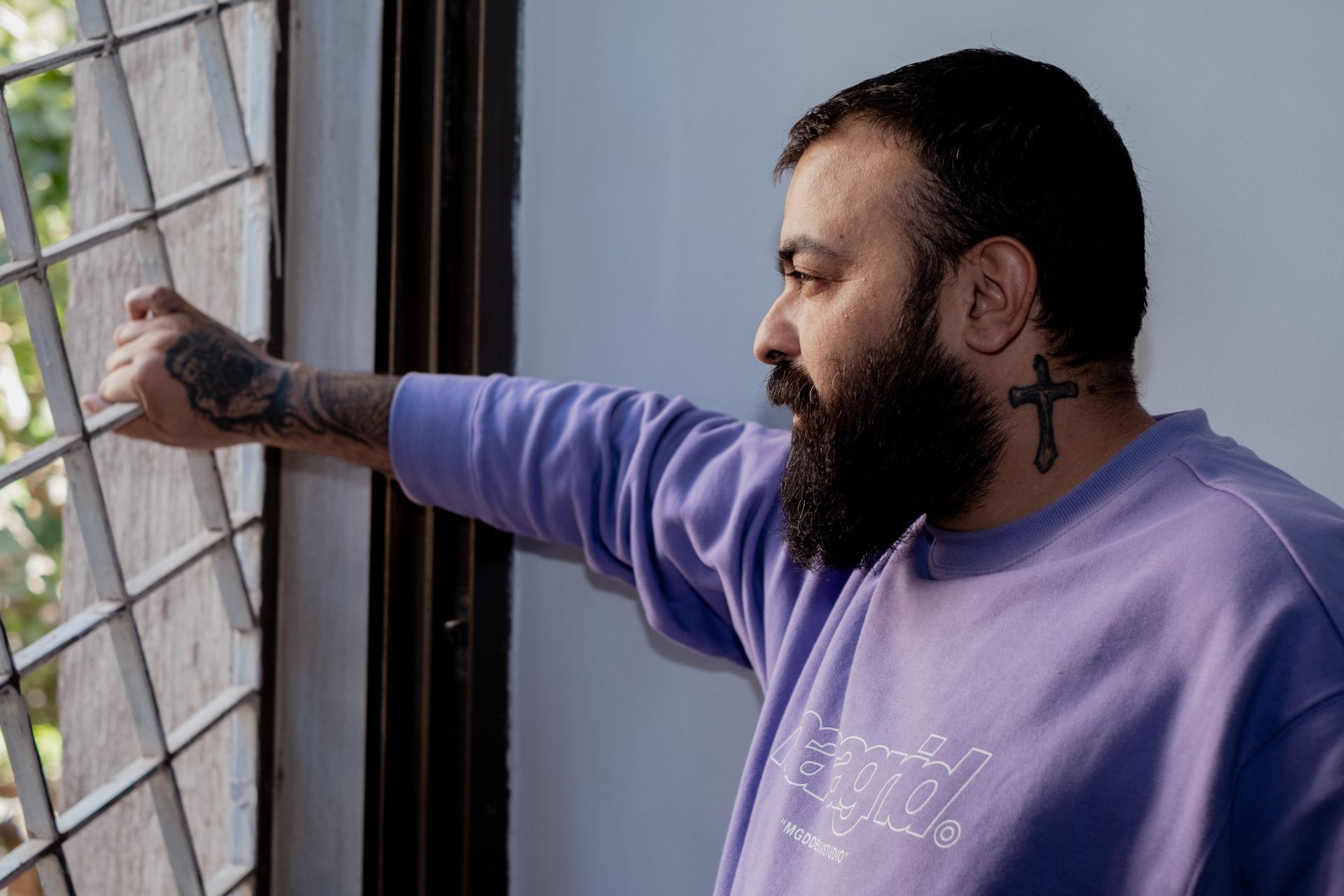
Iyad Akari, 33, broad-shouldered and tattooed from neck to wrist, is wearing a lilac sweater with pastel tones. He’s from Hama, and spent four years in the nightmare of Syria’s prisons, while no word of him reached his family. He had completely disappeared. But on Dec. 8 last year, he returned.
He is telling his story for the first time. The normalcy he exudes somewhat contradicts what he’s been through. There is a kindness in his eyes. He smokes, drinks coffee and rarely goes out.
In his hands is the script of “Barely a Number,” a film he’s working on, an attempt to come to terms with the experience that still lingers in his mind. He lives in a small room provided by an organization he’s a part of: the Association of Syrian Revolution Detainees, created in January by former prisoners in Damascus. His room looks like a cell, with a metal door identical to those of the prisons, a single small window high up providing a stingy sliver of light and a thin mattress under a floral sheet. “I am freed from Assad’s bars, not from life’s bars,” he says.
Before the war, he was a makeup artist for TV and a cosmetic surgeon. On his phone, he shows plumped lips he injected, photos from his workshops, actresses and students. Success radiates from the images.
Then came the revolution. From 2014 onward, he secretly transported weapons, hidden in gasoline canisters, between Hama and Damascus for the rebels. Then a video circulated of an operation he took part in that led to the killing of an Iranian officer, and he became a wanted man.
He was arrested in March 2021 in al-Mazzeh, an upscale neighborhood in Damascus, when he was lured into a trap set by someone who had invited him to a purported work meeting. He was met with guns, and his T-shirt was pulled over his head, followed by blows to the neck. He was taken first to Branch 215, a military intelligence detention facility, where he was kept in solitary confinement for 28 days, before being moved to the notorious Palestine Branch, where torture was routine, until the Assad regime fell.
“I was accused of killing an Iranian officer and forming a terrorist group against Bashar al-Assad’s regime,” he says. “They hung me from the ceiling from 11 at night to 10 in the morning. Hung me by the genitals for two hours. Tortured me with water bags and electric shocks.”
He heard a guard say, “Don’t move him for the executions, it will be done in the branch.” But, he says, “They wanted me alive, conscious.”
They repeatedly injected something into his leg, causing the flesh to swell. It still hurts, and today the ankle is swollen, the veins protruding. “I feel like one leg is shorter than the other.” That injection, he says, killed many prisoners. He still takes medication for his battered heart that endured numerous electric shocks.
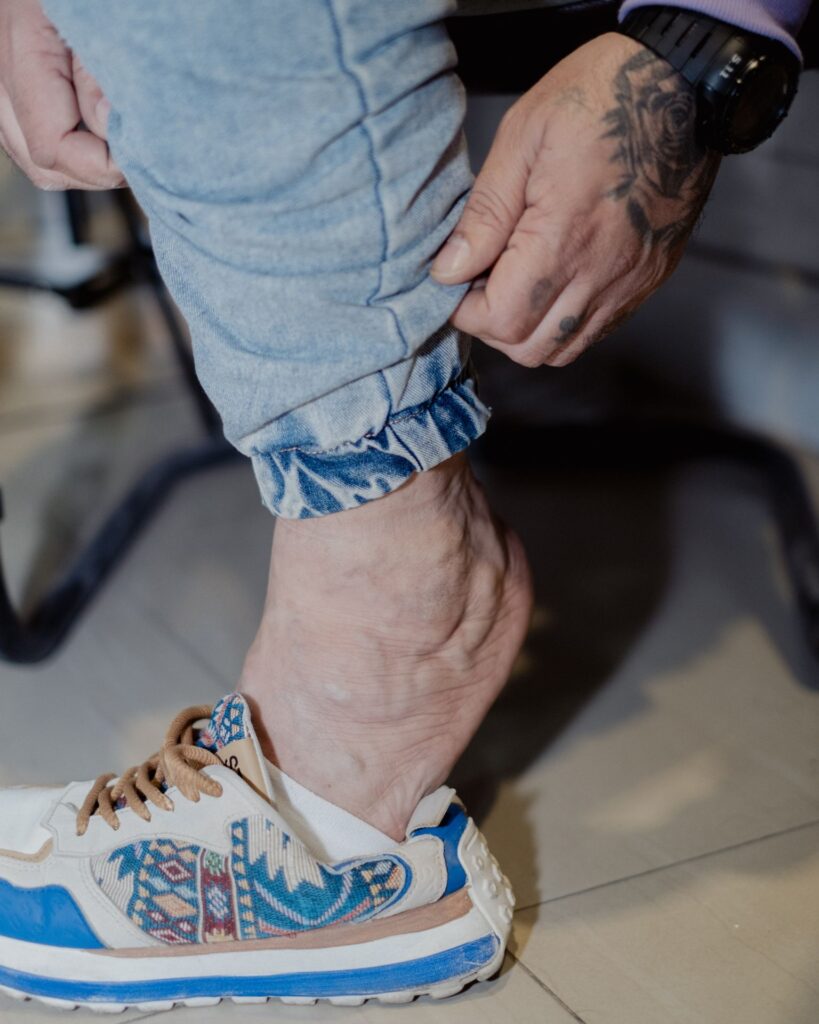
A guard called him “the tattooed one.” He has a cross on his neck; he’s Ismaili, a minority Shiite sect with a strong esoteric tradition, for which the cross can be a sacred symbol. His faith helped him endure: “It makes it easier to bear pain and humiliation. It gives you patience.”
He remembers one image that never leaves him: the guard laughing as he strikes, the green iron cylinder used for water smashing into his neck. The protocol was three days of quiet, then the torture would begin anew. “You can be stronger than their smile. The pain … after a while, you don’t feel it.”
His liberation was not a scene of jubilation. The regime fell after an offensive by Hayat Tahrir al-Sham, the rebel group whose leader now serves as Syria’s interim president. But for Akari, the fight for life was just starting. He emerged thin, broken, alive — nothing more. “My son didn’t recognize me. I, his father, had died in 2021,” he says.
He called his mother. She cried; she had also believed him to be dead. Then he was told his wife had left for Dubai without a trace, abandoning their two children while they visited their grandmother.
“She sold our house, everything was in her name, and she left,” he says. Now his children live in a house with an aluminum roof. “My mother and my children are in there. There isn’t even space for me.” Cham, 12, and Hosam, 13, his daughter and son, are top of their classes and are excellent at math. “They are my whole world.”
He describes his daily routine in the office room that doubles as his bedroom: “I wake at 7. A pot of coffee, a cigarette, I sit until 9. Five or six days a week, I don’t even go out. Except to buy cigarettes, film, or do paperwork. I’m always here. I love the silence. I can’t stand people talking about stupid things.”
The shoot inside Palestine Branch for the movie he is directing was led by him, in the very place where he’d been imprisoned. The cast is made up entirely of former detainees. Returning was painful but necessary for him. “It’s hard to go back, but I want to tell what I lived there. What stayed in my head? Everything. I’m making this film so it comes out,” he adds. “Passing on the pain we received … no one really manages that.”
He pauses, then goes on to explain his experience further. “In cell 8 … I was number 4. ‘Cell 8, prepare number 4 for interrogation.’ You’re not a man anymore. You’re a number.”
He dislikes the word “liberation.” “I didn’t return to life. I’m still in prison, somewhere. Everything was stolen: my house, my center, my work. Real freedom is when you get a salary again, a purpose. I don’t feel capable of building a house, finding work. I’m not the young man I was. The situation is below zero for me — I don’t start from zero, I start from negative.”
He gestures toward a window overlooking a courtyard. “In the Palestine Branch, it was the same window. Now, just going to buy cigarettes, I feel like I’m taking a trip. You can’t explain that.” He breathes slowly, then adds: “The prison walls were nothing compared to what I face now.”
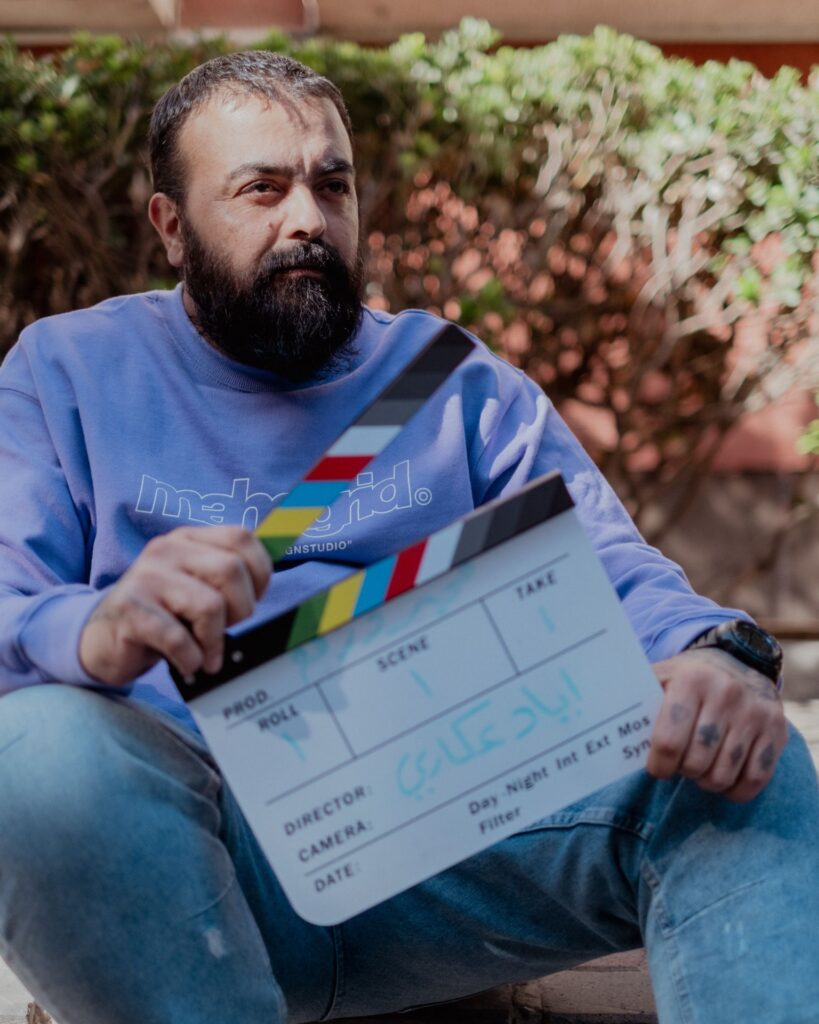
His film is now also his child. He holds a clapperboard that bears smiley faces and “Palestine Branch” written in marker ink. At the end of the film, he stages the arrest of the former prison director: “It’s a message to the authorities. They should comfort the hearts of the detainees’ mothers, arrest the officials — all of them — not just Assad.” He shows the first images, proud. “Prison is also my strength.”
His daily life remains haunted by his past. In a decaying building of the Damascus University Faculty of Sciences, he occupies an office borrowed from the new authorities: yellowed walls, faces of the disappeared pinned everywhere. He spends his days there, seeking quiet.
Next door, volunteer lawyers, more than 70, reconstruct the legal status of ex-prisoners, recover confiscated property, erase absurd accusations and help families regain administrative existence after being declared dead. Many have lost a brother, a son or a parent. Others are ex-detainees.
Hassan Saleh, a law professor in a perfect suit, lost his brother six months after the latter’s wedding; his daughter, now 12, never met her father. Further on, Naissa, 55, in immaculate makeup and wearing a silver ring, directs the legal office. She is a former detainee herself. “Help the oppressed,” she repeats.
When she recounts her 2014 arrest that led to four years in jail, her voice cracks; she collapses onto the table. The others gather around, teasing to lift her spirits.
In the last room are Hussama, 32, and Walid, 31, both freed on Dec. 8 last year. They fill out forms for each ex-prisoner: name, parents, arrest location, confiscated property, disabilities. On their screens scroll the faces of the disappeared.
Between 2011 and the fall of the Assad regime, an estimated 100,000 to 180,000 people were forcibly disappeared — one of the deepest wounds of post-Assad Syria. Tens of thousands of families still live without answers.
Here, hearts are burned alive by absence. Here, people try to patch together what remains of a country. And among these ghosts, Akari searches for a way to begin again. They’ve suggested marriage to him, but he smiles back, saying he’s not ready.
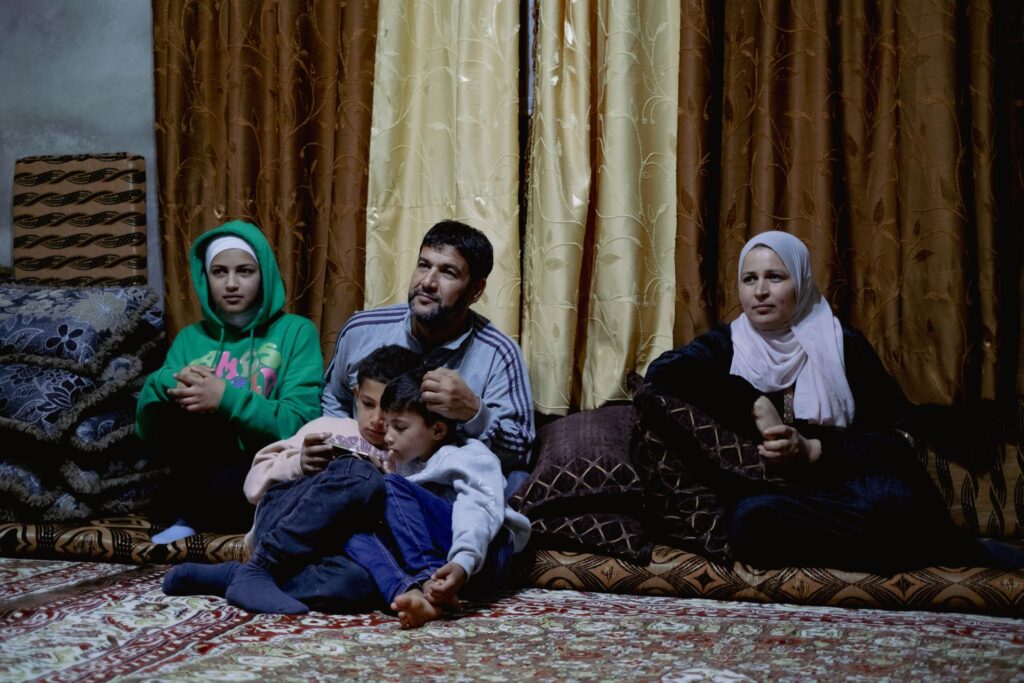
Across the corridor, another man moves constantly in and out: Mohammed Nasser Kheirallah, 42. His journey is different — a father who came back from the dead, fighting to reclaim his place in a family that had learned to live without him. Two of his children cling to him like baby kangaroos, as if they are afraid he’ll vanish again. He has four children: Isra, 13, Noor, 12, Ahmed, 10 and Mahmoud, 6. He visits the office once a week; the rest of the time, he’s in Quneitra.
In Quneitra, southern Syria, in their living room, the children chase moths as Kheirallah speaks. He’s a doctor. From 1993 to 2012, he lived in Russia, studying and practicing medicine. He holds his red passport as he speaks. He returned to Syria in 2012 for the revolution.
“Our state couldn’t help us; we are the ones who could help it,” he says.
In 2014, he opened the only medical center in his village, providing medicine and care to 270 patients. He was arrested in Damascus on March 2, 2019, accused of dealing with Israel and treating rebels. Like many prisoners, he was dragged from one place to another: Branch 215, Palestine Branch, Branch 248.
Then he arrived in Sednaya, in the so-called “red sector,” as former detainees call it — the section for political prisoners, considered one of the most brutal spaces in Syria’s carceral system.
Sednaya, a Y-shaped gray building, was a machine of torture and death under Assad. Amnesty International called it a “human slaughterhouse.” After it opened in 1987, Sednaya was central to Assad’s repression — first against political opponents, then, after 2011, as an instrument of terror.
His trial lasted only minutes. During a visit, his brother managed to signal that he had received 20 years.
Inside, he lived in a world of rumors — Aleppo, the revolution, battles. Nothing was ever certain behind Sednaya’s walls. He once heard about fighting from a new prisoner.
But he says he will never forget the scene of the prison’s fall: Prisoners’ ears pressed to the walls, the noises, “Allahu akbar” (“God is great”), exploding doors, young revolutionaries shouting, “The regime has fallen. You are free.”
Life in prison, though, was no life at all. “We were among the dead,” he says. He met nobody who had survived more than six or seven years in Sednaya. Some died on their first day. He remembers inmates prepared for execution at 5 a.m., people killed before his eyes.
At the time of the first family visit, he had contracted tuberculosis. It was months after his arrest, and he was down to 110 pounds, his face almost blue-tinted from illness. He was shocked to see a baby in his wife’s arms, whom she had named Mahmoud, a variation of the root of his father’s name. She hadn’t known she was pregnant when he was taken. “That’s when I felt my heart beat again,” he says, his eyes shining.
His wife, Amira, wearing a pink veil and a gentle smile, describes the visits to Sednaya every 45 days: “We drove five hours, arrived the day before, left the next day. He was behind a wall. I couldn’t even hold him.”
Recalling the day he was freed, Kheirallah says, “I ran. I was afraid they would take me back.”
But as the reality of his return to freedom began to settle in, he began feeling ashamed that he was coming home with no job or means to provide for his family. Hundreds of people gathered to celebrate the liberation in his village, and from noon until night he was kissed and embraced. When everyone slept, he stared at himself in the mirror: “Bald, thin. I didn’t recognize myself.” He took his first shower, and everything felt strange. He was not sure he was safe.
“Absent five years,” says Kheirallah. Amira corrects him: “Five years and 10 months.”
The children withdrew, then came close, then recoiled again. “At home, I was a stranger,” he says. The children were scared of him. Mahmoud spoke only to his mother. Long conversations followed with his wife. Kheirallah knew his son had to “adapt to my presence.” Slowly, he reclaimed his place.
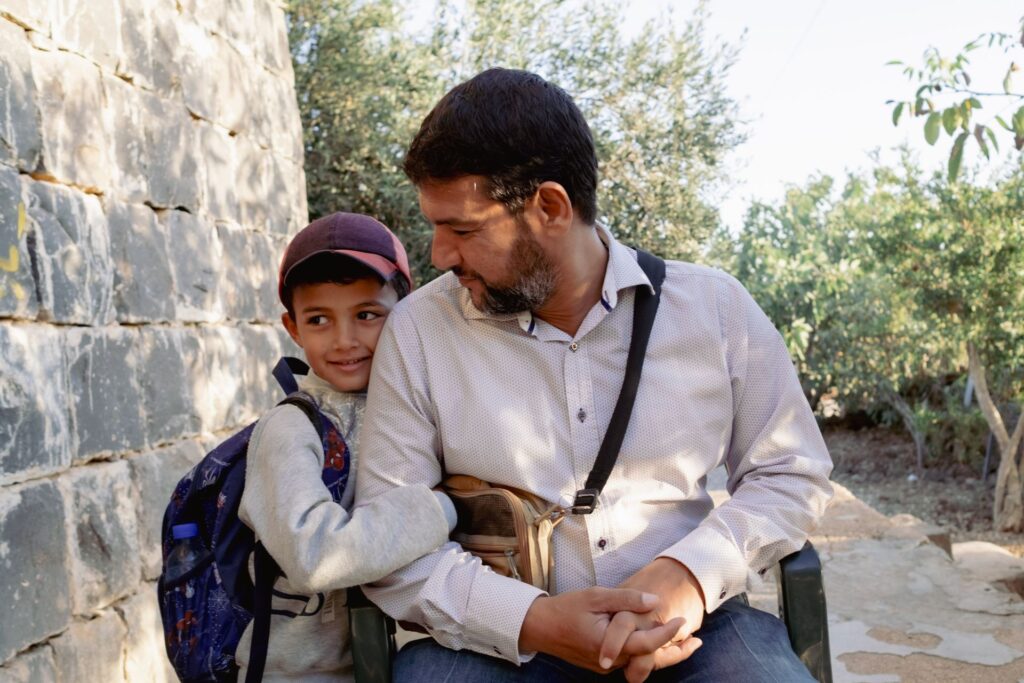
“I came out a different man,” he says. To his daughter, he was “frightening and dangerous.”
“It tortured me,” he says. It took time, effort and patience to restore the image of the father he once was, while accepting a new reality. For one of his daughters, he had become “a mysterious person whose next move was unknown.”
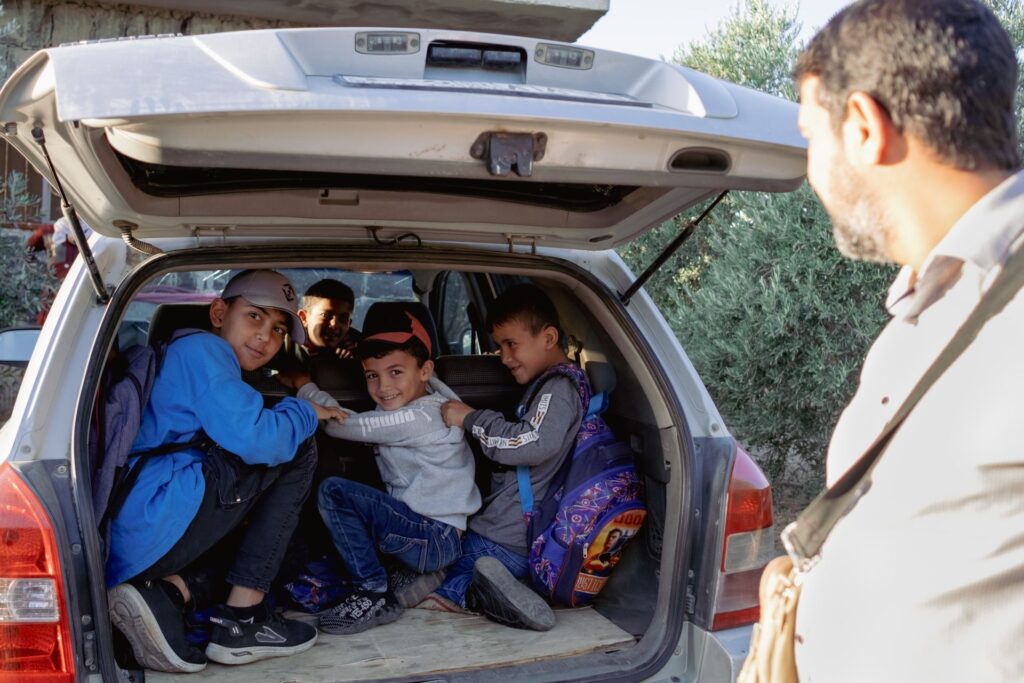
He eventually found a job with the United Nations. He remembers the first smile of little Mahmoud — three months after his release — when he took him to school for the first time. He looks like the happiest man in the world as he drives them to school, his own children and the cousins, too. The car is packed with kids, even in the back, where three of them sit. Some other children walk to school, but he insists on taking them himself. He watches them with a quiet, proud smile.
He says he had the tools to repair his family, but not everyone does. He quotes an Arabic proverb: “A dead man cannot help another dead man.” He speaks of other ex-prisoners: some crushed by poverty, their partners gone. He knows his happy ending is an exception. He stays in touch with other detainees. Some feel like burdens, jobless and isolated. One believed someone had cast a spell, a “black eye,” and wanted it removed.
“I consider them my friends. We know each other better than our own families — 24 hours a day together. We didn’t know if we’d get out alive, so we confided our last wishes to each other, so there would be a witness,” he says.
For Kheirallah, as for Akari, the bonds forged in prison remain a lifeline. Tal al-Malouhi shares one thing with them: a life to rebuild and the void after release. But she says she wants “nothing more to do” with detention or with other ex-prisoners. She dreams only of leaving Syria, of cutting all ties.
She was arrested on Dec. 27, 2009. Her face became known across the country. As a teenager, she kept a blog — poems, personal reflections, texts on Palestine. She was described as “the youngest prisoner of conscience in the Arab world.”
Among her writings were poems about emotion, freedom, identity and solidarity, such as this one: “O my master / I wish I had the power / if only for a single day / to build the republic of feelings.” She published the poems while living under Assad, before the revolution.
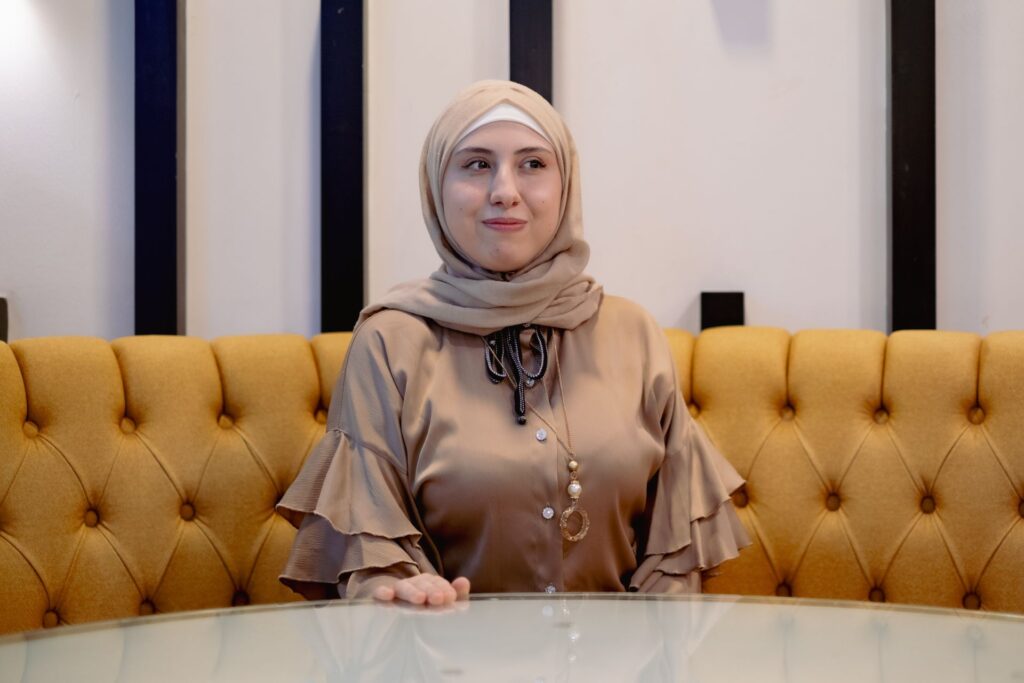
She was sentenced for “espionage” and “sharing information with a foreign state.” She was released on Dec. 8, 2024, when the doors of the prison were flung open, 15 years after her arrest. She still looks 17, in her eyes and in her gestures, sitting in this cafe in central Homs in early November. She wears beige clothes and a beige veil. She’s discreet, but people still recognize her.
She was in a “civilian” prison, Adra, on the outskirts of Damascus, so conditions differed from “military” jails. She had phone calls, some contact with the outside and conditions that she calls “easier.” She speaks quickly, her mind racing through memories. She describes readapting to normal life. Walking in the street still often feels unreal, she says, and so does buying something without asking permission, eating without waiting, embracing her mother “without chains.”
Her three sisters had lived, studied, married and had children. She hadn’t. When she returned, she found many in Homs waiting for her. She was a face of the regime’s repression.
“They saw me as a hero,” she says. But she oscillates between joy and suffocation. Sometimes she walks masked. Sometimes cafes protect her by filtering strangers. “Some people wouldn’t shake hands with my family, and now they welcome me back,” she says. Many under Assad’s dictatorship were afraid and would avoid the families of detainees.
“Cut everything, cut it all,” she says. She cut ties with anything that reminded her of Adra.
In the prison, she was made to sign pages blindfolded. They placed her among financial offenders, prostitutes and those who had committed honor crimes. Pro-Assad music looped endlessly. She spent three years in solitary confinement, in a cell that measured some 20 square feet.
In 2011, when the Arab Spring began, she knew nothing. In late 2013, hearing about “terrorists” on TV, she understood that “terrorists” meant “revolutionaries.” New prisoners arrived, and piece by piece she realized something was happening outside.
When she was freed from prison amid Assad’s fall, she found her file in the director’s office and read it as she walked out. She was accused of weakening national sentiment, undermining the prestige of the state and spreading sensitive information about Hama, the scene of the Assads’ bloody massacre in the 1980s. When she called her father, he asked, “Are you Tal?”
She remembers little of the celebrations, though some memories linger of arriving in Homs. There, people gathered in Clock Square, where the first protests in the city were crushed in 2011. As she walked there, she smiled and flashed the victory sign with her two fingers forming a “V.”
Today, rumors, news and social media drain her. She deleted everything from her phone.
A dentist had asked for her hand in marriage while she was still inside in 2018, not knowing whether she would ever emerge. They had spoken on the phone. He is a Palestinian with an Israeli passport. People whisper about ties to Israel, but she ignores it. They got engaged in Jordan. He has a clinic in Germany, and she wants to join him and become his assistant. What she wants, she says, is a life far from Syria. “I want to leave Syria,” she says. “Leave everything behind.”
Homs is no longer the city she knew. She discovered this only when she left prison. She mourns the time lost in there: “It makes me sad, and I try not to look back. It affects my psychology, I’m destroyed inside.”
She says she never got a chance to have an adolescence: “I didn’t live it. I was a teenager following the news, journalism, blogging, politics, the liberation of Palestine. I was never tired. I threw myself into the mouth of death.” Then, simply: “Today, I only care about my personal life. I was a girl, and I became someone else. I had never lived a love story before.”
What would she tell the 17-year-old Tal? She does not hesitate: “I had a second chance in life. I hate the memories before prison. I consider myself someone born a second time. I want to live everything: as a lover, as a child, as someone loved, as a wife. I want to make up for everything I lost. I would tell her: ‘live.’”
“Spotlight” is a newsletter about underreported cultural trends and news from around the world, emailed to subscribers twice a week. Sign up here.