


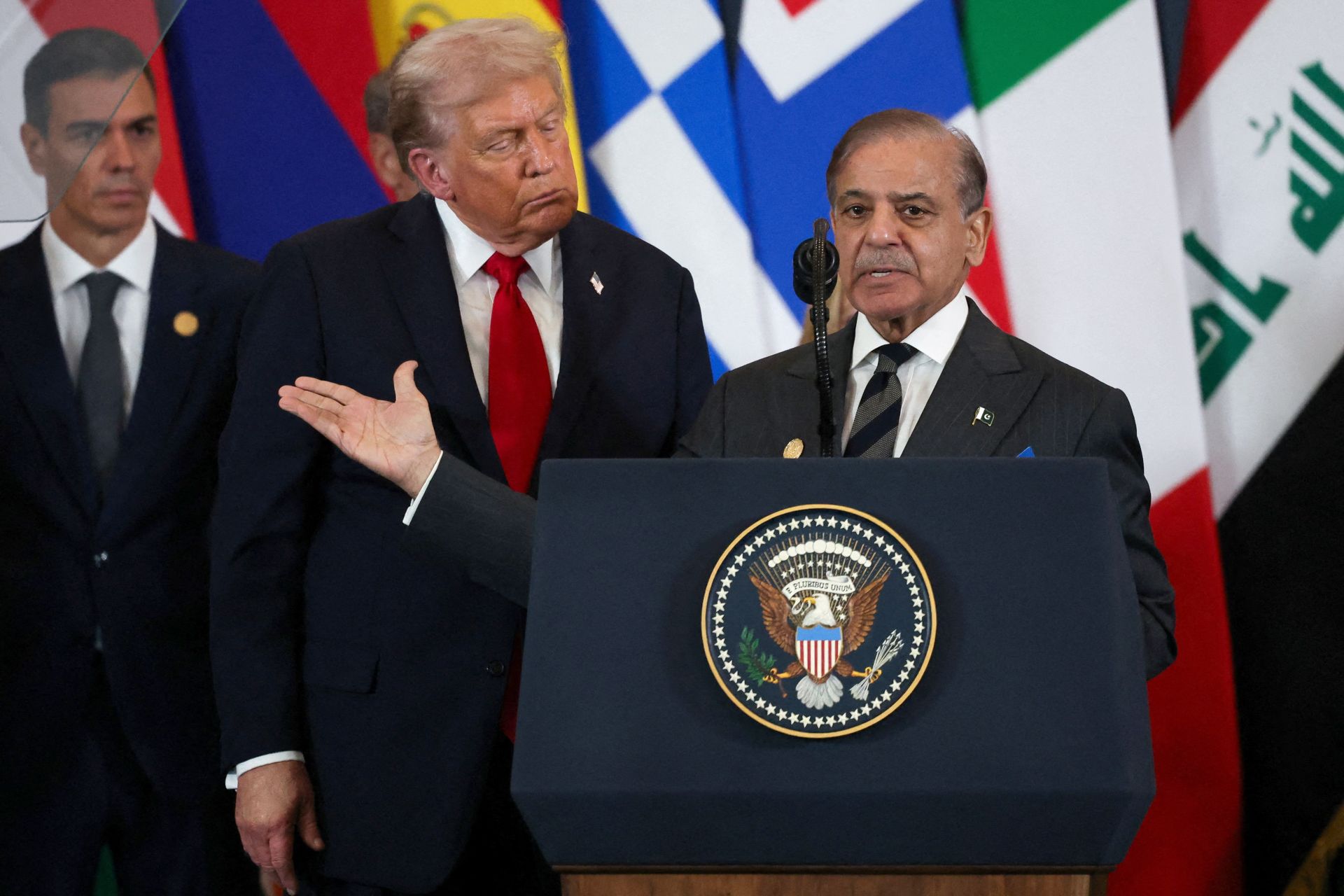
Since the Iran war began in late February, Pakistan has been walking a tightrope, balancing its ties with the neighboring country, with its economic and defense partners among the Gulf states, and with the United States.
On Tuesday, when Pakistan’s Prime Minister Shehbaz Sharif announced a ceasefire in the war and stepped forward to host talks between Washington and Tehran, he provided an off-ramp for the warring parties. Pakistan’s role as a mediator also represented a rare diplomatic win for the South Asian nation and an opportunity to reclaim strategic relevance after the U.S. withdrawal from Afghanistan in 2021.
Amid criticism of Islamabad’s authoritarian regime, Pakistani citizens celebrated the government’s diplomatic efforts, and what they perceived to be a shift in how the world looks at their country — from a place associated with extremist violence to, now, a player in peace negotiations.
“When we think about countries that have leverage with Iran, Pakistan is one of very few. Additionally, its field marshal, Asim Munir, has cultivated strategic equity with this White House administration,” Fahd Humayun, an assistant professor of political science at Tufts University who has written extensively on Pakistan’s foreign policy, told New Lines.
Although Pakistan’s role in the conflict surprised some observers, Kamran Bokhari, a resident senior fellow at the Middle East Policy Council, recalled that its engagement with the Middle East dated back decades.
“Pakistan has always — going back to the ’70s and ’80s at least — had a defense partnership with the Saudis, which became formalized last September in the form of a strategic mutual defense agreement,” Bokhari told New Lines. Under the defense pact, both countries committed to treat any act of aggression against one as an act against both.
Bokhari also highlighted Pakistan’s role in the wider region, including during the 1970-71 Jordanian civil war, known as “Black September,” when it supported King Hussein against the Palestine Liberation Organization and its allies. “Pakistan sent a whole brigade to fight PLO insurgents who were trying to overthrow the Jordanian monarchy,” he added.
Pakistan has also helped mediate between Washington and its adversaries. In the 1970s, it served as a secret backchannel between the United States and China during the Nixon administration. “In fact, Henry Kissinger went to Beijing through Pakistan. So this is an old relationship that has been rekindled,” Bokhari said of U.S.-Pakistan ties.
Today, with Iran facing a trust deficit in the region, Americans see Pakistan — one of the few countries to maintain relations with Tehran — as a credible intermediary. “Pakistan’s relationship with Iran is probably the least troubled among Iran’s neighbors. … The Iranians have little choice but to trust them as well,” he said.
He also pointed out a broader shift on the part of the United States. “The 80-year-old system built after World War II, where the U.S. did the heavy lifting globally for security and stability, is being replaced by a new doctrine under the Trump administration, based on burden-sharing and burden-shifting,” he said. “That is also shaping this situation. Facilitation and mediation with Iran [are] happening through Pakistan. Pakistan saw the opportunity and was eager to do it.”
The obligations of the Saudi-Pakistan defense pact may have also pushed Islamabad to take a more active role in trying to end the war, to avoid being entangled in it. “The assumption is that if Iran would escalate against Saudi Arabia, it could force the Saudis to call on Pakistan under their mutual defense agreement,” said Bokhari. “From what I’m hearing is that the Pakistanis conveyed this clearly to the Iranians: Don’t force us to choose. You’re attacking our ally, and we have an agreement with them. We don’t want to get involved, but if you continue, we may have no choice and then you lose us as well.”
While some experts believe that Pakistan’s neutrality in the war put it at risk, Humayun argued that Pakistan’s stance allowed it to maintain credibility as an impartial mediator. “Pakistan was careful in its statements, even when criticizing Iranian strikes in the Gulf,” he said. “In hindsight, the GCC [Gulf Cooperation Council] countries will likely be grateful Pakistan played this role, as they would have faced significant fallout if the conflict had escalated.”
Escalation could have also threatened Pakistan directly. Its entire western border, about 560 miles of it with Iran, and its long frontier with Afghanistan, which Pakistan recently bombed, could have become active conflict zones, said Abdul Basit, a security expert and senior associate fellow at Singapore’s S. Rajaratnam School of International Studies. “Add to that ongoing tensions with India on the eastern front. No country can afford to have three out of four borders ‘hot’ simultaneously,” he told New Lines. Insurgencies in Balochistan and Khyber Pakhtunkhwa, which share borders with Iran and Afghanistan, respectively, further complicate the security picture.
“There’s also the sectarian dimension,” noted Basit. Pakistan, home to the second-largest Shiite population after Iran, had spent decades containing Sunni-Shiite violence. “Had Pakistan taken sides [in the Iran war], it could have reignited sectarian conflict. We’ve already seen how quickly tensions can flare.” He was referring to the attacks on the U.S. consulates in Pakistan after Ayatollah Ali Khamenei’s killing, which resulted in significant unrest and more than 20 deaths.
This mediation effort has also highlighted Pakistan’s elevated relationship with the administration of the U.S. President Donald Trump. After struggling to reopen channels with Washington, Islamabad found its opportunity during the brief military conflict with India last May.
While New Delhi was reluctant to publicly acknowledge Trump’s role in brokering the ceasefire, a hesitation that strained bilateral ties, Pakistan and its leaders embraced the U.S. president enthusiastically, even nominating him for a Nobel Peace Prize. “This opened the door for Pakistan to reintroduce itself to Washington,” said Humayun. “Pakistan’s behavior during that conflict was appreciated by the Americans,” said Bokhari.
Trump, in turn, described Munir, Pakistan’s army chief, as his “favorite field marshal.” The two met at least three times over the past year, and Pakistan also joined Trump’s Board of Peace, overseeing the Gaza ceasefire. “I think Pakistan read the room. The U.S. is looking for partners, and Pakistan presented itself accordingly. They latched onto that need,” said Bokhari.
“The conflict [with India] also demonstrated Pakistan’s defense preparedness and restraint, which surprised many. It highlighted Pakistan’s strategic value to other countries observing the region,” added Humayun.
Pakistan also courted the Trump administration through “crypto diplomacy.” In January, the country’s leadership rolled out the red carpet for Zachary Witkoff, the son of Trump adviser Steve Witkoff and chief executive of World Liberty Financial, the crypto platform co-founded by Trump, during his visit to Islamabad to explore partnership opportunities.
“Because of crypto, doors have opened … new conversations have opened, trust has been built. We have gotten an opportunity to rebrand,” Bilal Bin Saqib, a self-described “crypto bro” and chair of Pakistan Virtual Assets Regulatory Authority, told Bloomberg in a recent interview.
“Pakistan played its limited cards carefully, positioning itself as a useful intermediary while maintaining ties with multiple sides,” said Basit, who added that Pakistan’s long-term interests remain aligned with China. “Right now, it has found some diplomatic space with the U.S., partly because the Trump administration is less institutionally driven and more personality-based. That reduces structural pressure on Pakistan, especially regarding China,” he said.
But Humayun believes that Pakistan has maintained a balance. “It’s close to China, but it can’t afford to be in any camp. Since the U.S. withdrawal from Afghanistan, the Pakistani military has been making a concerted effort to broaden its relationship with Washington.” The move has come as U.S. policy on China has been shifting toward accommodation rather than confrontation.
Basit also explained that since the U.S. appears to be recalibrating its Asia strategy, slightly reducing India’s centrality, it has opened some space for Pakistan. “Still, this is likely a temporary phase, a purple patch. Pakistan knows Trump is unpredictable and that this alignment may not last,” Basit added.
With the delegations arriving Friday and talks scheduled for Saturday, Pakistan’s role as a guarantor will be critical. “It’s a heavy responsibility, but an important one,” said Humayun.
“Spotlight” is a newsletter about underreported cultural trends and news from around the world, emailed to subscribers twice a week. Sign up here.