


The shocking murder of the influential conservative activist Charlie Kirk is prompting heated debate about rising political violence in America. Over the past few days, public discussion has centered on the role that political rhetoric plays in promoting such violence and what the assassination means for civil debate. Yet loose speculation about the alleged killer’s ideological motivations has overshadowed another dimension. The viral spread of the killing transformed the violence into spectacle, with video and images of the gruesome murder quickly spreading online — and persisting still, popping into the feeds of users without warning.
Messages Kirk’s alleged killer left on shell casings indicate that the murder was committed with precisely this reaction in mind. He didn’t just want to commit a violent act; he did so within the context of a digital ecosystem. In this way, Kirk’s alleged killer is similar to contemporary mass murderers, most notably the Christchurch, New Zealand, shooter who livestreamed his attack, a tactic that several subsequent mass shooters have sought to replicate. While Kirk’s alleged killer did not film his actions, video and images have nonetheless spread further and persisted longer than in other cases where perpetrators consciously sought to broadcast their attacks. In many ways, the social media virality of the Kirk assassination paints an even grimmer picture of how violence has become a form of performance in America.
At a news conference on Tuesday afternoon, Utah County Attorney Jeffrey S. Gray announced charges against Tyler Robinson, 22, for Kirk’s murder and said that his office would seek the death penalty.
Gray said that Robinson messaged his partner on Discord to let her know that he had left a note under her keyboard, which read, “I have the opportunity to take Charlie Kirk out and I’m going to take it.”
The shell casing of the round used to kill Kirk had an engraving that referenced an online copypasta, a satirical image or piece of text that goes viral and spreads across the internet. This specific line — “Notices bulge OwO whats this?” — originated from a comic satirizing online furry communities (a fandom based around a shared interest in anthropomorphic animals). The engravings indicate that the alleged killer is likely a hyperonline individual, but also, crucially, that his participation in these kinds of online spaces shaped how he approached the attack. The assassination was meant to go viral after the fact: both a murder and a meme.
When his partner asked why he did it, Robinson messaged, “I had enough of his hatred. Some hate can’t be negotiated out. If I am able to grab my rifle unseen I will have left no evidence.”
Last Friday, Utah’s Republican governor, Spencer Cox, said three unspent shell casings were found by police, one reading “Oh bella ciao bella ciao bella ciao ciao ciao,” a reference to the Italian folk song that became a mid-20th-century anti-fascist anthem. Another read “Hey fascist! Catch!” followed by the symbols of an up arrow, right arrow and three down arrows, a macabre reference to the button sequence used to call in an airstrike in the popular video game Helldivers 2. This overlap between a well-known anti-fascist song — a reference that, given Kirk’s views, the alleged killer knew would be interpreted a certain way — and a more esoteric video game reference that only people in the know would get, speaks to a very particular, largely online, audience. The engravings hint at the political motivations of the alleged killer, but also reveal the broader ecosystem that influenced his understanding of politics.
According to Gray, Robinson’s family told police he had become interested in politics over the last year and had mentioned Kirk’s upcoming Utah visit in conversation with family members. But in addition to the alleged assassin’s political motivations, the engravings illustrate a well-documented commonality across high-profile murderers: a need for recognition from witnesses to their crimes. In the case of Kirk’s alleged killer, that recognition was oddly specific. Whereas political violence is often accompanied by statements or manifestos intended to explain the violence, in this case the messages seemed to stem from a need to demonstrate belonging — to indicate to a watching audience that the alleged shooter was one of them. His identity is defined, not by any particular political affiliation, but by how he engaged with the digital world. The engravings employ references from a variety of relatively niche online communities and were likely intended to be read in the wake of the attacks. One unspent shell casing was engraved with the message, “If you read this you are gay lmao,” a juvenile message born out of online shitposts, which intentionally derail conversations or look to draw a reaction with little effort.
In this sense, the engravings highlight how the alleged killer carried out the assassination with an audience in mind, with messages left behind to troll investigators and the public, essentially leaving a “made you look” style taunt on the tools he used to assassinate Kirk. This reflects a specific kind of nihilism that finds humor or amusement in heinous circumstances.
The engravings certainly appear to have found an audience, with much of the reaction from those engaging in digital punditry on social media aimed at deciphering the ideological motivations of the assassin, seemingly for no other reason than to prove that the killer was not part of their political tribe.
Users on left-leaning social media platforms like Bluesky seized on his background to insist that he is a “Groyper,” a term that originally described a group of hyperonline, typically younger, white nationalists but is now used more broadly — and inaccurately — as a catchall for any antisocial young white man active in online spaces. Yet the anti-fascist messages indicate that the alleged killer viewed Kirk as a fascist and believed that his murder somehow constituted a righteous act. Discussions on social media demonstrate reluctance by users on left-leaning social media platforms like Bluesky to acknowledge that Robinson may have viewed himself as anti-fascist.
Meanwhile, prominent right-wing voices are assigning blame to anyone who describes Kirk’s politics as anything other than “conservative,” treating them as responsible for his murder. An anonymously run website devoted to compiling a list of people accused of celebrating Kirk’s death, charliesmurderers.com, recently appeared but is offline as of the time of writing. Several of those listed on the website began receiving death threats, as first reported by Wired. Many leading political figures have made statements condemning political violence in the wake of Kirk’s assassination. Still, it is not difficult to find posts online celebrating or justifying the murder. Even if these are not from high-profile political figures, they have nonetheless been shared in right-wing circles online and have helped to form an understanding on the right that Kirk’s death is being widely celebrated by those on the left.
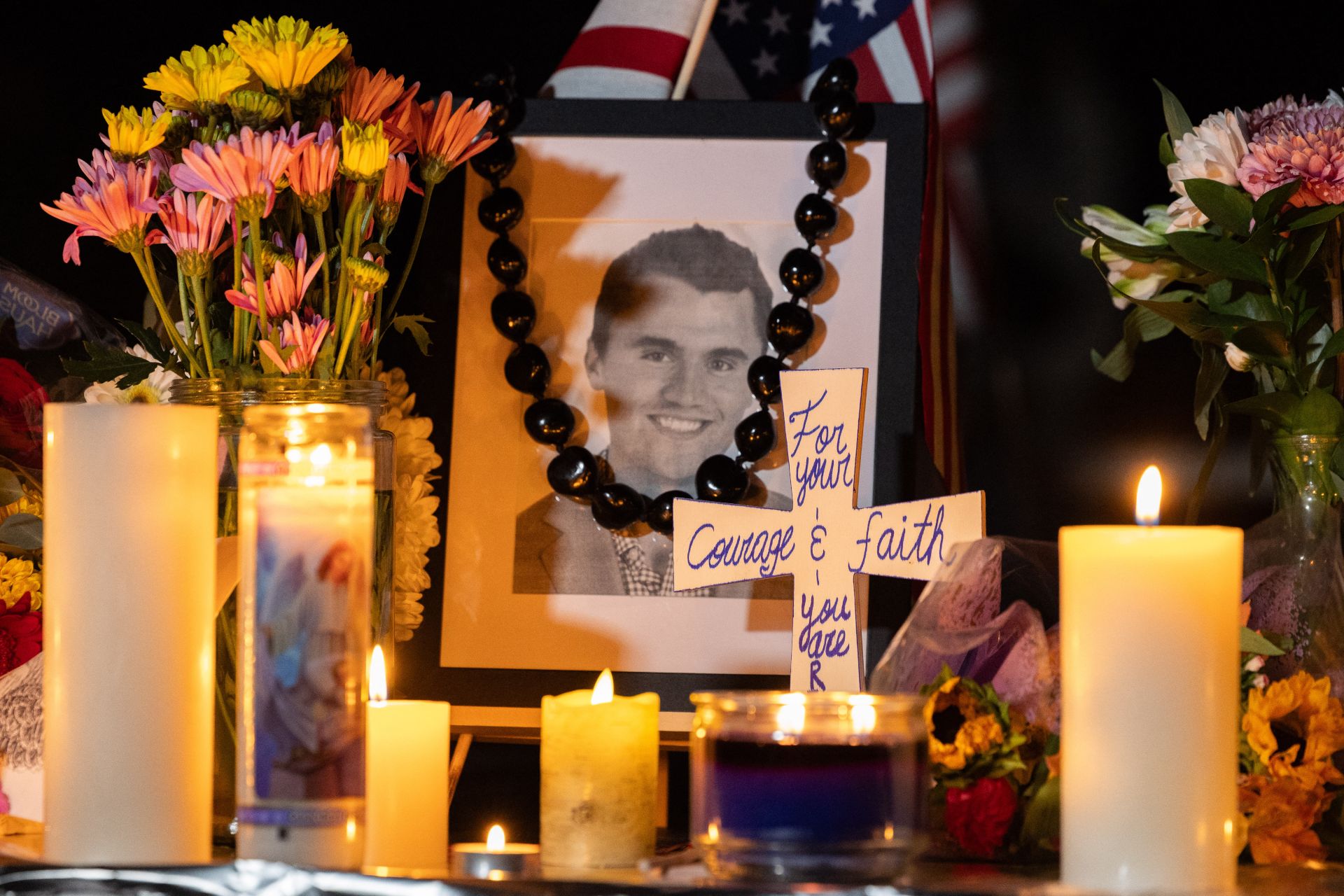
A 19-year-old was recently arrested for vandalizing a memorial for Kirk outside Turning Point USA’s headquarters in Phoenix, Arizona. Similarly, a fight broke out during a vigil in Idaho when a man yelled “Fuck Charlie Kirk,” and one person was hospitalized when a fight broke out in Pensacola, Florida, after someone vandalized a mural of Kirk. Across the country, hate groups have mobilized around Kirk’s death as well. Members of the white nationalist group Patriot Front marched through Huntington Beach, California, chanting, “White man fight back!” The atmosphere following Kirk’s murder remains very tense, with anger reaching a fever pitch.
The official line from President Donald Trump and Vice President JD Vance is that conservatives are under attack from the left. Prominent voices on the right have responded to the assassination of Kirk with calls for violent retribution. Steve Bannon, whose broadcast network “Real America’s Voice” features two different shows hosted by Kirk and Jack Posobiec, a self-described “colleague and friend” of the Turning Point USA founder, described Kirk as “a casualty of the political war.” He added, “We are at war in this country, and you have to have steely resolve.”
The reaction reflects a long-standing sense of grievance and a perspective that views conservatives as under constant threat of violence from the left. A report from the CATO Institute estimated that members of far-right groups were responsible for 11% of politically motivated murders in the United States since 1975. Victims of the 9/11 attacks make up 83% of those killed by politically motivated violence, while 2% of politically motivated murders since 1975 were committed by left-wing attackers, the report found. Despite this evidence, Vance, hosting Kirk’s show alongside White House deputy chief of staff Stephen Miller on Monday, decried calls for unity.
“While our side of the aisle certainly has its crazies, it is a statistical fact that most of the lunatics in American politics today are proud members of the far left,” Vance said. This Manichaean framing, which fixates solely on whose team a killer belonged to, fails to fully capture the dangers and very real problem of political violence in the U.S.
The sense of persecution conveyed by Vance is pervasive in the most authoritarian corners of the right. Authoritarian ideology requires its adherents to feel an eternal sense of victimhood, in part to justify the violence essential to their worldview.
Kirk’s political activism involved a similar theme: that college campuses were hostile environments for conservatives. Part of how he sought to demonstrate that was through his events at colleges, which created a confrontational environment that would go viral online. The events fit neatly into a bevy of “social justice warrior owned” compilations, which involved clips of college students expressing outrage at some inflammatory remarks made by a campus speaker. This genre of YouTube videos presents figures on the right as calm and collected compared to the outraged liberal or left-leaning subjects caught on film. The content pioneered a style of political content that formed the basis of an emerging right-wing media ecosystem. This ecosystem translates outrage into views and positions Kirk and those who styled themselves after him as level-headed debaters looking to engage in dialogue with outraged and irrational liberals.
This perspective forms the ideological basis of the 2024 book “Unhumans,” co-authored by Posobiec, who uses the term to position his political adversaries as an existential threat to humanity itself — as literally unhuman. As Hannah Gais wrote for The Baffler, “To [Posobiec], leftists are enemy combatants — a nuisance to be done away with, not understood.” “Unhumans” found popularity, Gais wrote, after being endorsed by the now-vice president, who described the book as a guide on “what to do to fight back.”
This extremely tribal nature of the contemporary political realm facilitates and benefits from outrage and despair, as do the social media platforms that play an increasingly prominent role in shaping public discourse. When polarization becomes so extreme that the term “political disagreement” sounds euphemistic, and condemnations of violence feel like they create a false equivalence, the outrage machine is spinning out of control.
College campuses have historically served as hubs for political activism and as a space for confrontational politics. This has made Kirk’s murder while speaking on campus all the more shocking and abhorrent.
While shock sites hosting graphic imagery and videos have always been present online, they have historically been confined to certain corners of the web. The prevalence of violent imagery is creeping closer and closer to mainstream platforms. Prior to Kirk’s violent murder, which can still be easily found on major platforms like X and TikTok, another graphic video went viral of a woman stabbed in North Carolina. Both videos contained graphic violence and are only some of the most recent high-profile examples of a phenomenon that has become increasingly common. Wired magazine described the situation around Kirk’s killing as a “post-content-moderation world.” The danger of platforms no longer attempting to moderate content published online becomes brazenly clear when these platforms flood users’ feeds with graphic violence without their consent.
“We are not wired as human beings to process those types of violent imagery,” Cox said at the Friday press briefing. “This is not good for us. It is not good to consume.”
The threat is mass desensitization. While young folks like Kirk’s alleged killer often find themselves immersed in niche nihilistic communities that celebrate violence and suffering, the absence of content moderation threatens to turn the whole internet into these kinds of spaces.
Cox finished his press briefing with a plea to the nation’s youth that illustrates the unique political context surrounding Kirk’s assassination. “You are inheriting a country where politics feels like rage.” Cox said. “It feels like rage is the only option. We can choose a different path.” Cox emphasized that this different path must be taken. “At some point, we have to find an off-ramp or it’s going to get much, much worse,” Cox said.
The Manichaean worldview that Cox warned against is not the exclusive domain of youth or of either the left or the right. At the scene of Kirk’s assassination, the suspect first detained by police was 71-year-old George Zinn, who was yelling that he was the killer (when he later told authorities that he made the claim to distract the police from finding the actual killer, he was arrested for obstruction of justice).
On the right, House Speaker Mike Johnson said the labeling of anyone as fascist inherently promotes violence against them. Taken at face value, these words reflect the willingness of Republican officials to leverage Kirk’s killing in the pursuit of their adversaries. At the same time, even without direct celebrations, an alarming sentiment from certain quarters of the left declared that Kirk had it coming. Other reactions online, like the reluctance to acknowledge the murderer’s political motivations, demonstrated a certain level of left-wing defensiveness.
Politics in the age of social media is algorithmically driven. Outrage is wielded as a means to go viral, and politics becomes, increasingly, a realm of belonging and identity. The style of college debates found online exemplifies this — they are performative, meant to attract views but also to feed on and cultivate identification with a particular political tribe. Viewers choose which side to sit on, which shapes how one feels about the person being “owned.” Polarization arises in part from a lack of content moderation, but is also facilitated by the wider political environment and its ties to group identities, which social media absorbs, hardens, and sends back into the world.
Increasingly antagonistic, what goes viral transforms into a kind of melodrama, escalating from confrontational to violent. This, in turn, risks mass desensitization and the attention of prospective mass killers, who see how easily violent imagery spreads online. Political violence has itself become more tribal and performative. Kirk’s killer sought to create a spectacle that would reach a wider audience while also signaling his affiliation with, or opposition to, a particular audience.
Kirk’s public assassination highlights a shocking new reality in America: political violence as spectacle. With waning content moderation and algorithms that promote a tribalistic form of politics, social media has brought images of the murder into the mainstream, threatening to desensitize us all to its horror.
“Spotlight” is a newsletter about underreported cultural trends and news from around the world, emailed to subscribers twice a week. Sign up here.