

Long a Cause of the American Right, the Holy Land’s Christians Face Israeli Restrictions Alone
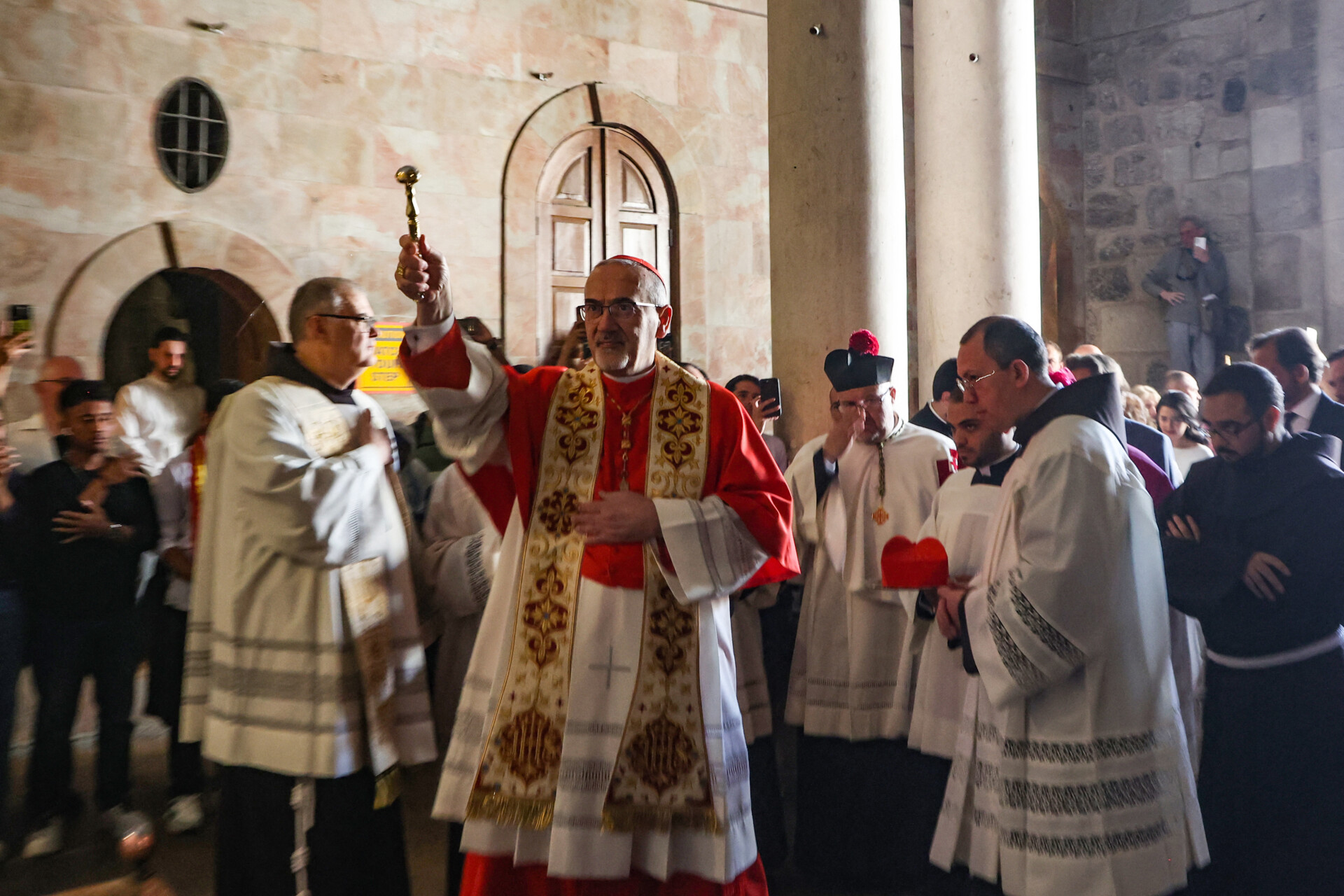
March 29 was Palm Sunday for millions of Christians around the world, a day that commemorates the entry of Jesus into Jerusalem around 2,000 years ago, riding on a donkey and greeted by people waving palm branches. (The Orthodox calculate the dates a little differently; their Palm Sunday, and therefore their Easter, too, is a week later.)
The week between Palm Sunday and Easter Sunday is known as Holy Week, the holiest of the year, and Jerusalem is the holiest place to celebrate, treading in Jesus’ footsteps. But this year, according to a statement from the Vatican, “for the first time in centuries, the Heads of the Church were prevented from celebrating the Palm Sunday Mass at the Church of the Holy Sepulchre.” Cardinal Pierbattista Pizzaballa, Head of the Catholic Church in the Holy Land, and Father Francesco Ielpo, the official Guardian of the Church of the Holy Sepulchre, were stopped en route by Israeli police, ostensibly for security reasons due to the ongoing attacks from Iran.
There are, of course, security concerns, with frequent sirens warning of Iranian attacks, but the Vatican argued that this was “a manifestly unreasonable and grossly disproportionate measure,” given that church authorities in Jerusalem had already complied with all restrictions imposed by the Israeli police, banning gatherings and attendance at the church and instead arranging to broadcast the celebrations.
Israel’s action drew criticism from across the Christian world, achieving the astonishing feat of uniting previously fractured communities — nowhere more divided than in Jerusalem itself. The Church of the Holy Sepulchre, which I visited at Christmas, shown around by Greek Orthodox archbishop of Gerassa, Theophanes, is shared between Latin Catholics, Greek Orthodox, Armenian Orthodox, Syrians, Copts and Ethiopians, complicating decisions over everything from services to renovations (actual punch-ups have been documented). But far broader implications are evident in the global response, which included a rare rebuke from U.S. Ambassador to Israel Mike Huckabee, a Christian Zionist.
Huckabee’s immense capacity for ignoring Israel’s actions came through in a recent interview with Tucker Carlson, the far-right commentator who hosts an influential YouTube show. Both are committed and outspoken Christians, but Carlson split from the MAGA mainstream when he publicly opposed U.S. support for Israel’s war on Gaza after Oct. 7, 2023. The pair spoke for well over two hours, during which Huckabee pleaded ignorance about a host of issues, claiming no knowledge of criminals fleeing America and seeking sanctuary in Israel despite an extradition treaty, for example, or of the numbers of deaths in Gaza, or the influence of Israel in the White House from the invasion of Iraq to the (then-impending) war with Iran.
This clear reluctance to express criticism of Israel made Huckabee’s recent comments all the more notable. On X, he called the Israeli police action on Palm Sunday “an unfortunate overreach already having major repercussions around the world,” pointing out that the four Catholics were well under the 50 permitted by current Israeli security instructions. “For the Patriarch to be barred from entry to the Church on Palm Sunday for a private ceremony is difficult to understand or justify,” he wrote.
This sentiment is more aligned with Carlson than with the Huckabee who appeared on the commentator’s show. But Carlson himself is yet to comment, along with other prominent figures on the American right. Catholic convert JD Vance, who has been largely quiet over the war with Iran, has remained so on this issue. More unusually, influential theologian Douglas Wilson and his protege, Secretary of Defense Pete Hegseth, have also failed to support their brethren in religion.
The question is, why. Why did Huckabee feel impelled to speak out, against his usual practice, when others have remained quiet, against theirs? The Iran war has been waged in the name of religion by Hegseth and others, drawing veiled criticism from Pope Leo, also on Palm Sunday. In preaching that Jesus was the king of peace, “whom no one can use to justify war,” the pontiff went on to quote a biblical passage from Isaiah — “even though you make many prayers, I will not listen: Your hands are full of blood.”
Is this the reason that most American Christians have not spoken out in support of Catholics trying to worship in Jerusalem? Are they sore from the Pope’s scolding? Was his very public opposition to the war a reason for Israel to thwart the Catholic mass in Jerusalem? Such squabbles might not matter, were it not for the real violence unleashed in the name of this religion.