

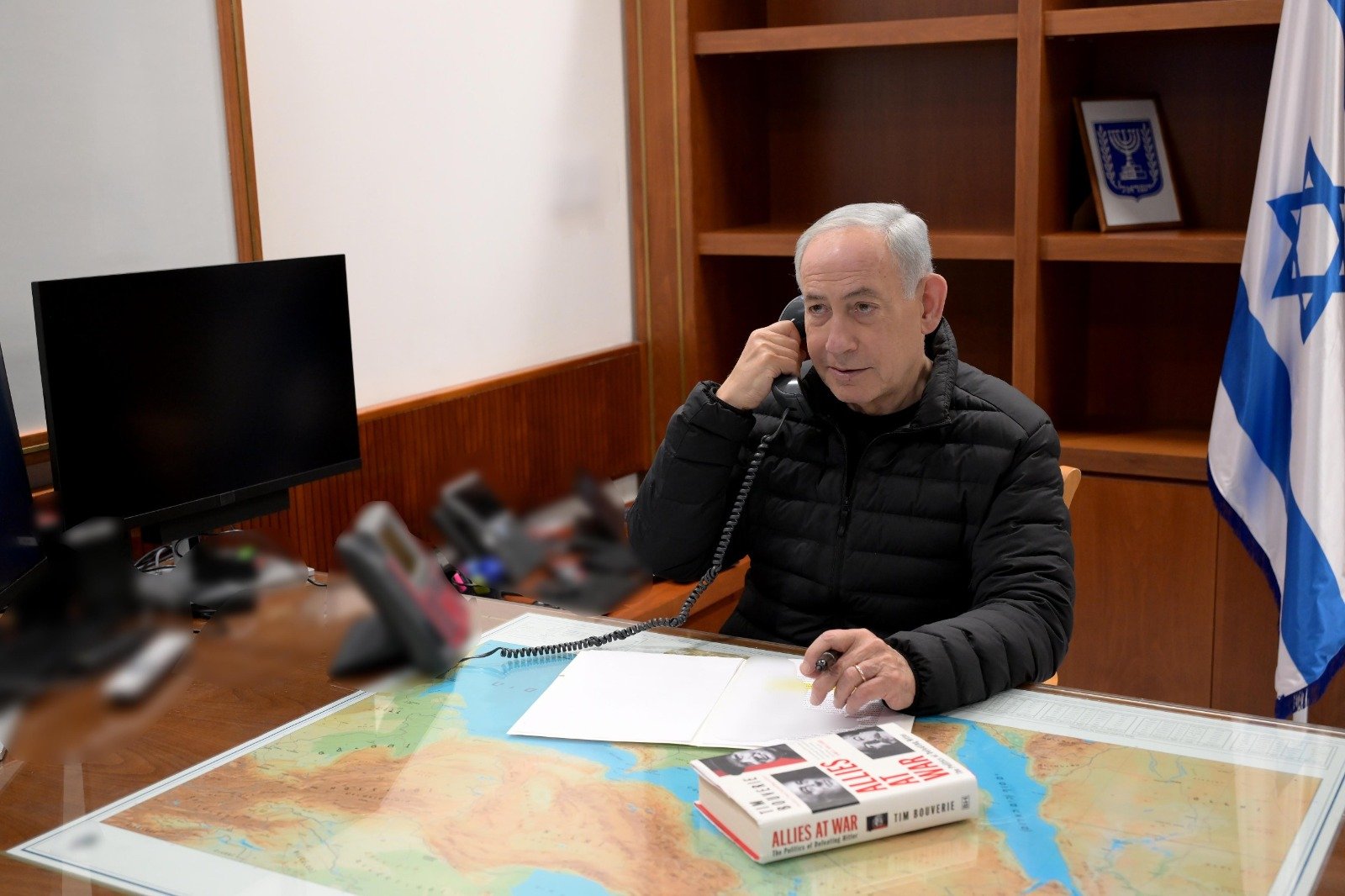
As the United States and Israel launched Operation Epic Fury on Feb. 28, Benjamin Netanyahu’s office released a photograph of the Israeli prime minister sitting alone at a desk while speaking on the phone with U.S. President Donald Trump. In front of Netanyahu lay a two-dimensional map of the Middle East, presumably to aid his discussion of war strategy. Resting on top of the map was British historian Tim Bouverie’s 2025 book “Allies at War: How the Struggles Between the Allied Powers Shaped the War and the World,” angled to display the title. The choreographed placement of the book appeared to suggest that Netanyahu had interrupted his weekend leisure reading to launch a war. But the image also suggested a link between World War II historiography and Israel’s campaign to remake the Middle East since Oct. 7, 2023.
In “Allies at War,” Bouverie places Winston Churchill at the center of the historical drama of World War II. Bouverie depicts Churchill’s single-minded efforts to “drag” the United States into the war for the sake of Britain’s survival. His eventual success established the “special relationship” between his country and the United States. The image of Bouverie’s book in front of the Israeli prime minister as he coordinates military operations with the U.S. president, then, suggests that Netanyahu aspires for Israel, not Britain, to possess the most “special relationship” with the U.S. today — and is singularly determined to make that so. Remarkably, while Churchill required Pearl Harbor and Hitler’s declaration of war on the United States to finally achieve his goal, Netanyahu may have won out by merely appealing to Trump’s pretensions to world-historical status, convincing him of the ease with which he could topple the Iranian regime and stoking his desire for vengeance.
Given Netanyahu’s long-standing interest in U.S. support for war against Iran, his appropriation of Bouverie’s book for this performative gesture was fitting. The titles of Bouverie’s two books — “Appeasement” and “Allies at War”— perfectly capture the dual lessons Netanyahu wishes to draw from history. In “Appeasement,” Bouverie chronicles Europe’s failure to stand up to Hitler’s regime in the 1930s, a retelling of British Prime Minister Neville Chamberlain’s disastrous policy. In “Allies at War,” Bouverie narrates the making of the Grand Alliance and the diplomatic history of the Allies during World War II. In doing so, Bouverie adopts a self-consciously old-fashioned approach, focusing on high diplomatic history and on the “great men” who led their nations in the war and shaped the postwar peace. Bouverie’s narrative places the victors at the center, with long, vivid scenes of interaction among Churchill, Franklin Roosevelt, Josef Stalin and top aides and advisers haggling over war strategy and maneuvering for national advantage, while eating Russian caviar, drinking wine and making witty asides in smoke-filled rooms. This historiographical approach perfectly suits Netanyahu’s understanding of his own exercise of power.
A historian’s son, Netanyahu has used allusions to the historian’s craft to bolster his political goals throughout his career. For example, he claimed that when he was Israel’s ambassador to the United Nations in the mid-1980s, he demanded access to the U.N. archives. Poring over documents, Netanyahu confirmed his original suspicions: The Allied leaders had known in detail about the Holocaust from the early 1940s, yet they did nothing. In particular, Roosevelt failed to direct bombers of nearby strategic targets to also bomb the railways leading to Auschwitz, thereby enabling the genocide.
In his quest to persuade multiple U.S. administrations to wage war against Iran before the Islamic Republic could launch a catastrophic attack against Israel, Netanyahu’s message is obvious: In the ongoing drama of Jewish history, every American president had a choice. He could either be a bystander, like Roosevelt, in what Jews perceive as an ongoing campaign to eliminate them, or he could learn from history and attack Iran militarily. Apparently, Trump learned from history.
But Netanyahu’s use of this World War II counterfactual coexists with a more triumphalist account of Allied leadership that runs through Netanyahu’s narrative. Churchill, rather than Roosevelt, is the key figure in this image — not only Churchill the prime minister, but also Churchill the historian. In his wisdom, Churchill recognized that “playing it safe” in the face of the “gathering storm” of the Nazi regime would be disastrous. In a 2009 speech at the U.N., Netanyahu invoked Churchill’s lament about the “confirmed unteachability of mankind,” failing to learn from history and the “unfortunate habit of civilized societies to sleep until danger nearly overtakes them.” What gave Netanyahu “inspiration” from Churchill, he told a biographer, was “his ability to correctly identify threats, together with his resolve, wisdom and clear-headedness.”
Many commentators on the current war have observed a lack of clarity in the U.S.-Israeli alliance about how the war will end. It is here that the World War II metaphor offers little. While Trump demanded Iran’s “unconditional surrender” without identifying any plausible means of enforcing it, Netanyahu appears to favor perpetual preemption of Israel’s enemies with or without the United States, driving the logic of Churchillian wisdom to an absurd conclusion.