

Do the political leaders of Israel’s opposition parties care more about winning the next election or about keeping the parties that represent Palestinian citizens out of power?
The question is a reasonable one, following a remarkable April 26 press conference at which the leaders of the largest opposition parties announced they were joining forces in a bid to oust Prime Minister Benjamin Netanyahu in the upcoming election.
Naftali Bennet, who joined archrival Yair Lapid to form a party called Beyachad (Together), said at the press conference that he would not agree to bring any of the so-called Arab parties (parties that represent Palestinian citizens of Israel) into a governing coalition. Bennet and Lapid later asked Gadi Eisenkot, the popular former chief of staff of the army, to join their party.
The date for the election has not yet been set, but according to term limits law it must be held by Oct. 27, 2026.
But prominent analysts say that without the Arab parties, the opposition does not have a path to form a coalition, which requires a 61-seat majority in the 120-seat Knesset (parliament).
No single party has ever won a clear majority in Israeli elections. The leader of the party that wins the most seats, or which has the clearest path toward forming a coalition, cobbles together a government with smaller parties, usually in exchange for pork-barrel concessions that further their mandate. The process often takes many weeks.
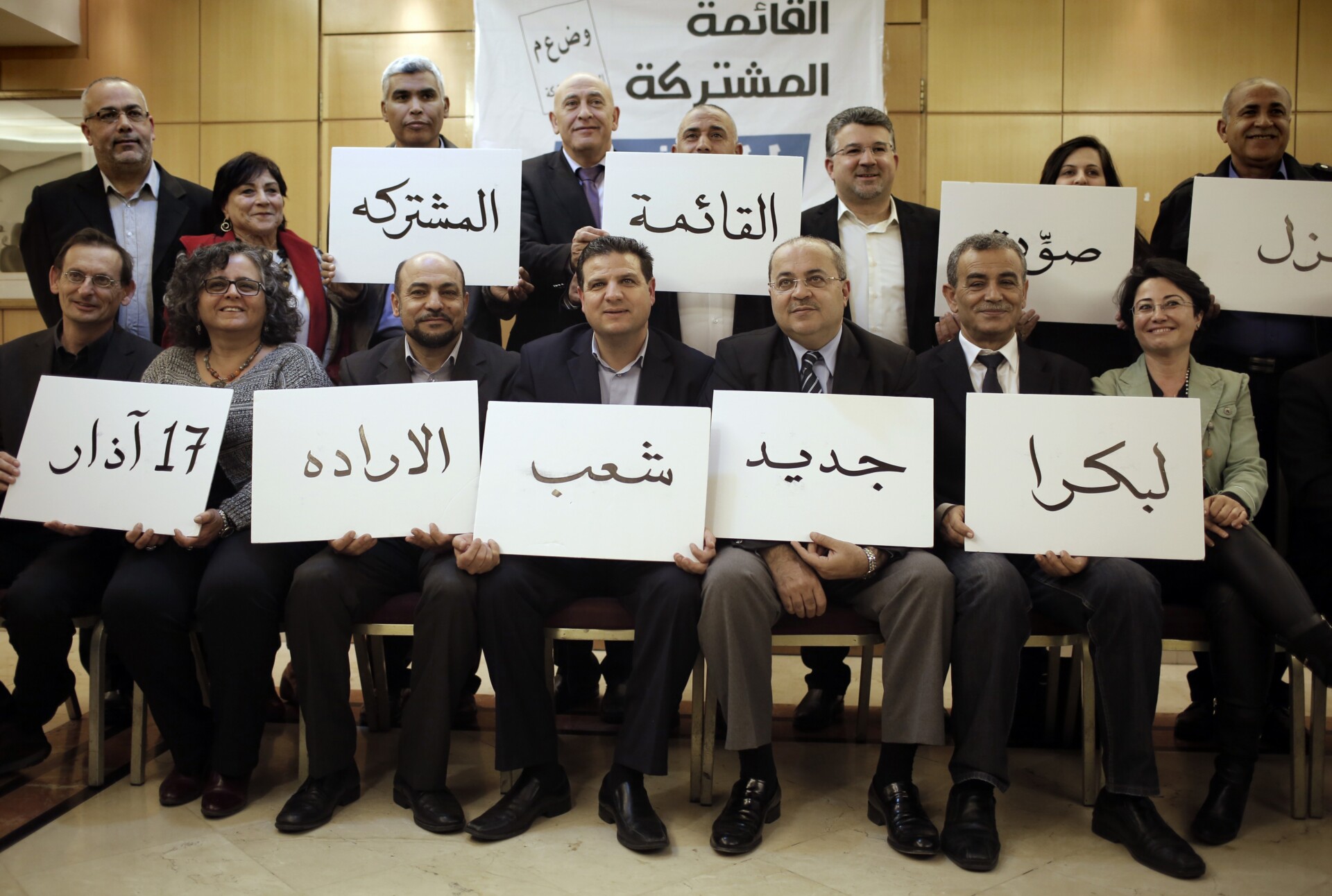
Palestinian citizens make up 20% of Israel’s population. The parties that represent them run the gamut from Islamist to Palestinian nationalist to communist and usually win between two and five seats each. In 2015, Ayman Odeh, head of the Arab-Jewish Democratic Front for Peace and Equality party (al-Jabha in Arabic, Hadash in Hebrew) brought them together into a single but short-lived party called the Joint List, which won 15 seats and was briefly the third-largest party in the opposition.
Jack Khoury, a journalist for Haaretz who is a Palestinian citizen of Israel, wrote in his analysis of Bennett’s “no Arab parties” announcement that, while it might simply be a tactic to attract disaffected Netanyahu supporters, “behind this tactic lies a deep, troubling truth that reveals how successful the right-wing delegitimization campaign against Israel’s Arab public has been, and how afraid the remnants of the left are of responding to it.” Imagine, he wrote, if a political leader in any other country said he would not form a government with Jews. He described the de facto disenfranchisement of Arab-Palestinian citizens as “untenable.”
Lapid, who leads the party called Yesh Atid (There Is a Future), represents Israel’s centrist voters, while Bennett, whose current party is called Bennett 2026, has for years been a prominent figure in the pro-settler, nationalist right. But they are united in rejecting Netanyahu’s corruption and his ongoing project of ending the independence of the judiciary by making it subservient to the Knesset.
Netanyahu, who is 76, has been in power since 2009, except for a brief window in 2021-2022 when Bennett was prime minister.
Bennett, the son of immigrants from the U.S., served as an officer in an elite combat unit and then made his fortune in the technology sector before turning to politics. As head of the right-wing Jewish Home party, he joined Netanyahu’s coalition in 2012 and was given a ministerial post. He attracted international notoriety in 2013, when he said at a Cabinet meeting that he advocated extrajudicial killing for “terrorists.” When another Cabinet minister told him this was illegal, Bennett doubled down, boasting offhandedly: “I have killed lots of Arabs in my life — and there is no problem with that.”
Lapid, a former journalist and actor, is the son of Tommy Lapid, a Hungarian-born Holocaust survivor and former journalist who led a radically secular party that was notable for its antagonism toward the religious parties. As a politician, Lapid has been notably hawkish on issues related to the rights of Palestinians in general, specifically in Gaza and the West Bank.
Dahlia Scheindlin, a longtime political consultant and pollster, confirmed to New Lines that “every credible survey shows the opposition does not have 61 seats without the Arab parties.” She added the caveat that the Israeli political environment is currently undergoing rapid changes and that polls cannot predict the future.
That said, Scheindlin noted that the polling conducted since the announcement of the Bennett-Lapid merger “really does not show a significant shift.” The polls of Jewish Israeli voters show a 50-50 split between supporters of the Netanyahu coalition parties and supporters of the opposition bloc.
While confirming that attitudes toward the Arab parties among Jewish Israeli voters “have hardened” since the Hamas-led attacks on Oct. 7, 2023, Scheindlin pointed out that the political leaders in the opposition bloc had not consulted voters before making the decision to exclude them. “I think it’s a fairly safe speculation that the majority of opposition voters would be prepared for a coalition with an Arab party,” Scheindlin said.
Rida Abu Rass, a political scientist in Canada who is a Palestinian citizen of Israel, responded by email to questions sent to him by New Lines. He observed that the right-wing parties of the opposition bloc were trying to appeal to disaffected Netanyahu voters with their position on the Arab parties, describing this as “a losing strategy.”
Despite the national trauma of Oct. 7, which happened on Netanyahu’s watch, Abu Rass wrote that the prime minister “maintains a strong and loyal support base.” Besides the traditional Bibi base (Bibi is the prime minister’s popular nickname), which has made him the leader of a personality cult, Netanyahu’s “clientelist, symbiotic alliance” with the ultra-Orthodox parties “seems unshakable,” particularly since the opposition is not willing to work with them.
“Most importantly,” wrote Abu Rass, Netanyahu’s “consistent and growing right-wing nationalism, and the alliances with popular far-right politicians like [Itamar] Ben-Gvir and [Bezalel] Smotrich, allow him to ‘outbid’ his opponents at every turn. He’ll always be better positioned to appeal to the right’s nationalism, accusing his opponents of disloyalty, and inciting against Arabs. He can do this directly or, conveniently, through Ben-Gvir and Smotrich.”
Khoury, the Haaretz columnist, wrote that Lapid’s promise of a “new Israel” post-Netanyahu would only be more of the same old Israel if it was “founded on the basis of the exclusion of 20% of its citizens.”
There is one more interesting fact to note. In 2021, Bennet and his partners invited Mansour Abbas, an Islamist who heads the United Arab List party, to join their coalition in order to make up a governing majority. They predicated their invitation on Abbas rejecting Palestinian nationalism and instead keeping his party’s mandate focused narrowly on domestic issues that affect his constituents. Abbas agreed to this condition and joined the government. Last week, Ravit Hecht, who covers politics for Haaretz, said in the newspaper’s weekly Hebrew podcast that every single politician who had been a member of Knesset when Abbas was in the governing coalition, no matter what their political views, would confirm that the Palestinian-Israeli politician had been “an excellent dude.” She used a Hebrew slang word, “akhla,” derived from a Levantine Arabic word that means “sweet.”