

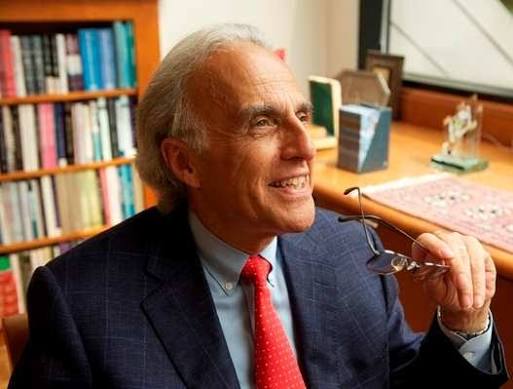
One way of thinking about John Esposito is as the anti-Bernard Lewis.
Although each had produced substantial and influential bodies of scholarship before 2001, they both shot to public prominence in the immediate aftermath of 9/11. But while Lewis claimed to explain “the roots of Muslim rage” and “what went wrong” in the Islamic world — and became a guru to and frequent dinner guest of Vice President Dick Cheney — Esposito made it his mission to sympathetically explain Islam and the Islamic world to his fellow Americans, and to challenge rampant Islamophobia in the Western world.
Esposito, who died Wednesday at the age of 86, had aspired to become a Catholic priest. He joined the Capuchin Franciscan Order but left the seminary before ordination to pursue graduate studies in Islam, which would become his life’s work. His output was staggering. The titles of his authored, co-authored and edited books convey a sense of his intellectual itinerary: “Voices of Resurgent Islam” (1983), “The Islamic Threat: Myth or Reality?” (1992), “The Oxford History of Islam” (1998), “Makers of Contemporary Islam” (2001), “Unholy War: Terror in the Name of Islam” (2002), “What Everyone Needs to Know About Islam” (2002), “Great World Religions: Islam” (2003), “The Islamic World: Past and Present” (2004), “Who Speaks for Islam?” (2008), “The Future of Islam” (2010), “Islamophobia and the Challenge of Pluralism in the 21st Century” (2011), “Ten Things Everyone Needs to Know about Islam” (2016) and “Shariah: What Everyone Needs to Know” (2018).
In addition to his own books, Esposito was editor-in-chief of the Oxford Islamic Studies Online project and the series editor of the Oxford Library of Islamic Studies. He also edited landmark multivolume reference works such as “The Oxford Encyclopedia of the Modern Islamic World” (2001), “The Oxford History of Islam” (2000) and “The Oxford Dictionary of Islam” (2003), and served as editor of the prestigious book series “Religion and Global Politics” for Oxford University Press.
But Esposito’s impact went far beyond the written page. He was “above all, an institution builder,” as the scholar H. A. Hellyer put it in a social media post. Esposito was the founding director of the Prince Alwaleed Bin Talal Center for Muslim-Christian Understanding and of the Bridge Initiative, a project to document and combat Islamophobia globally, both at Georgetown University, whose faculty he joined in 1993. “He did not simply describe prejudice against Muslims. He disrupted the machinery that produced it,” Junaid S. Ahmad, the director of the Center for the Study of Islam and Decolonization in Islamabad, wrote in a tribute.
Esposito also helped establish the Malaysia Chair for the Study of Islam in Southeast Asia and the Hasib Sabbagh Fund for the study of the Islamic world at Georgetown. He served as president of two leading academic bodies, the Middle East Studies Association and the American Academy of Religion.
Esposito believed that Western representations of the Islamic world were distorted not only by Orientalism and Islamophobia but by a pervasive secularism that trivialized the role of religion more generally. Esposito “astutely drew attention to a ‘secular bias’ that informed mainstream intellectual debates in the West on the relationship between religion and politics,” Nader Hashemi, who succeeded Esposito as the director of Georgetown’s Center for Muslim-Christian Understanding, recently wrote in a tribute to his predecessor. “These modernization theories purported to be universally applicable based on the assumption that religion was a relic of the past that no longer mattered in the modern world” — claims that were “based on a set of specifically Western experiences,” Hashemi wrote. Esposito, in contrast, “interpreted the politics of the Muslim world not from a Western normative framework but rather from the Muslim world’s own experience.”
Esposito was not without his critics. In 2001, the American-Israeli scholar Martin Kramer (a disciple of Bernard Lewis) authored a widely discussed jeremiad titled “Ivory Towers on Sand: The Failure of Middle East Studies in America.” In it, Kramer argued that “Esposito’s Islam” was a sugar-coated version that downplayed Muslim radicalization and the threat it posed to the West. Quoting from “The Islamic Threat: Myth or Reality?” Kramer wrote that the “camp led by Esposito assured America that ‘most Islamic movements are not necessarily anti-Western, anti-American, or anti-democratic.’” In battling the demonization of Muslims prevalent in Western discourse, in other words, Esposito was guilty of over-correction and presenting a sanitized portrait of contemporary Islam, according to Kramer.
Esposito cast a long shadow. “The legacy I will remember most is the community he nurtured,” Hellyer wrote. “Generations of academics, students, policymakers, and religious leaders found themselves part of a network that existed, in one way or another, because John had brought them into it.”
“Esposito built bridges where others were content to build civilizational barriers,” Anwar Ibrahim, Malaysia’s prime minister and a major Muslim intellectual in his own right, wrote in a social media post. “May his scholarship and the dialogue he spent his life building continue to bear fruit.”