


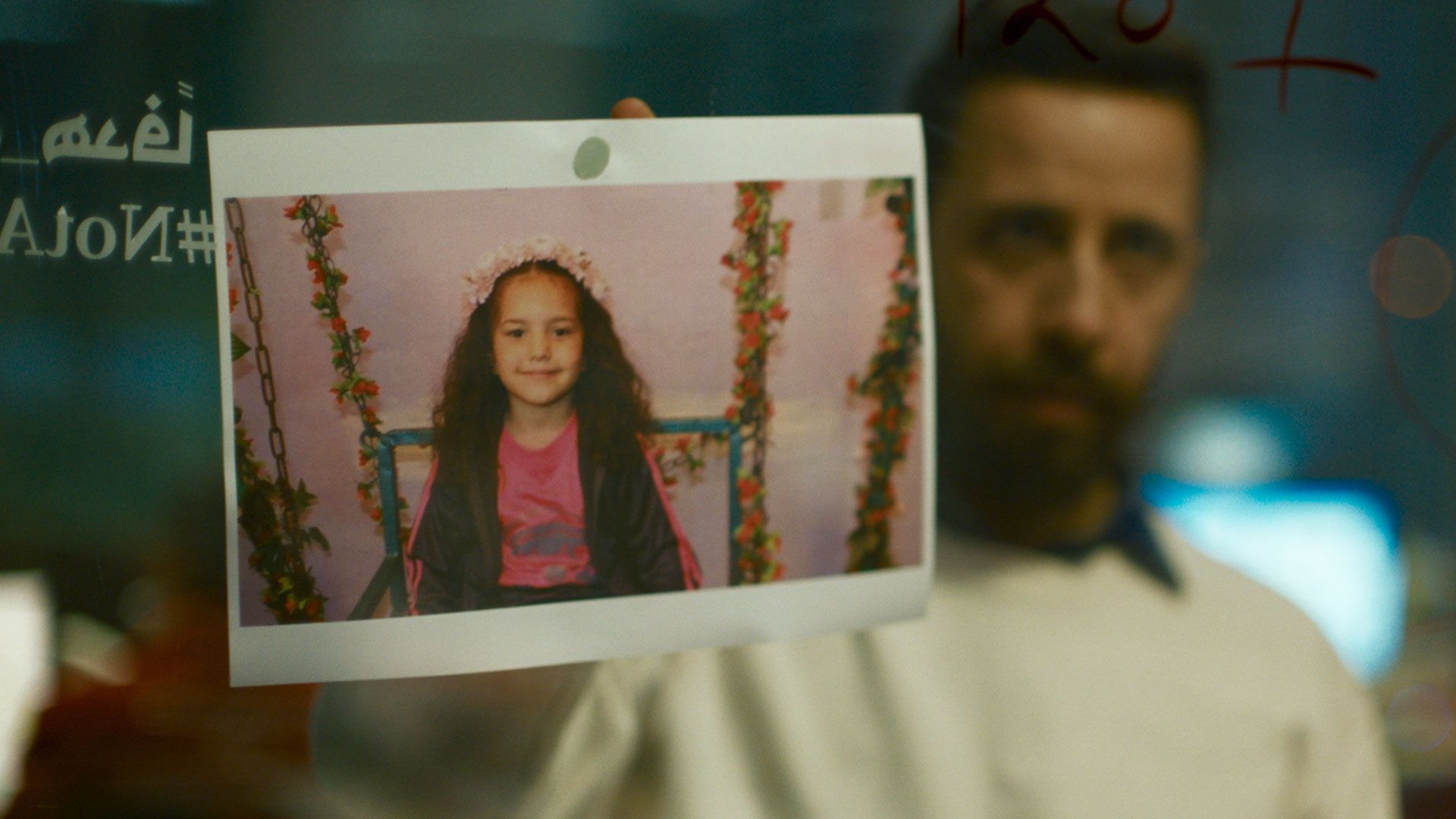
On the day Hind Rajab Hamada was killed with her six family members, the victims and their would-be rescuers did everything right.
In the early hours of Jan. 29, 2024, the Israeli military struck Gaza City with airstrikes and artillery fire. The Hamada family, who had been displaced from their home in the north, were living in the Tel al-Hawa neighborhood. Hind’s granduncle Bashar Hamada decided to drive the children to safety, while the adults, including Hind’s mother Wissam, would leave separately by foot. Bashar and his wife Anam bundled their four children — Layan, Raghad, Sarah and Mohammad — together with Hind and her younger brother Iyad into the back seat of their small Kia Picanto. But Iyad jumped out at the last minute to stay with his mother. The car headed north on the Arab League street.
The car hadn’t traveled a quarter mile before Israeli gunfire erupted. Wissam saw the car veer left and stop by a petrol station. It was 8:10 a.m. Wissam chose to believe that these were warning shots and that the car had parked for safety. At 9:32 a.m., the Israeli army issued orders for the evacuation of Gaza City’s western neighborhoods, including Tel al-Hawa.
Wissam called the car, but there was no response. Hours passed, and she kept dialing. At midday, Layan, 15, picked up. She told Wissam that everyone was “asleep.” Israeli troops had fired directly at the car and killed Bashar and Anam and their three children. Hind and Layan were the only survivors. Both were wounded and couldn’t move. Later, Layan was able to reach her uncle and tell him that they were surrounded, and the Israelis were shooting at them. Her uncle eventually reached the Palestinian Red Crescent Society (PRCS) in Ramallah at 2:30 p.m. The dispatcher, Omar al-Qam, called Layan.
“They are firing at us,” Layan told Omar. “The tank is next to us.”
Gunfire interrupted, Layan screamed, and the line went dead.
The call lasted less than a minute. Satellite imagery later obtained by Forensic Architecture shows 16 tanks in the vicinity, including five just 300 yards from the car. The 64 gunshots were fired at a rate consistent with a 7.62-caliber FN MAG machine gun mounted on an Israeli Merkava tank. Based on the sound analysis, Earshot — a nonprofit that analyzes audio recordings for human rights investigations — and Forensic Architecture concluded that the tank was positioned between 14 and 25 yards from the car. At such close range, the shooter would have had a clear view of the car’s occupants.
Omar called back, and a child picked up. It was Hind Rajab. Hind was three months shy of her 6th birthday. Tunisian filmmaker Kaouther Ben Hania’s Oscar-nominated film “The Voice of Hind Rajab” uses the subsequent conversation between Hind and the PRCS dispatcher to outline the story’s tragic arc. Many people have heard snippets of Hind’s voice. But these curated clips only capture critical moments in the conversation, paradoxically flattening the incident into an impersonal atrocity story. The virtue of Ben Hania’s film is that by using the whole conversation, she gives us Hind in all her vitality and vulnerability, her hopes constantly colliding with a world whose implacable cruelty her innocent mind can’t fathom.
Besides Hind’s voice, the most powerful element in the film is time. Journalists told us what happened; Ben Hania shows us what it felt like — to be on the receiving end of the call, summoning all your moral and professional resources to reassure and rescue a child, but failing all the same because of a savage occupation whose fetters won’t yield even to the pleas of a wounded 5-year-old.
“What is your name?” asks Omar.
“There is no one with me,” Hind replies.
“What’s your name?”
“There’s no one with me.”
She’s in shock. Her mind has erased her dead relatives to help her cope with the pain. Later, she says they are sleeping. But once the dispatcher plays along and speaks of her sleeping relatives, Hind corrects him and says they are all dead, as if she resents others intruding into her private illusion. She won’t be treated as a child by a world that won’t let her be a child. She tells them her name.
“Come get me!” she says.
“And your sister’s name?” Omar asks.
“Come get me!”
Despite all his training, Omar is overwhelmed. Rana Faqih, another dispatcher, steps in.
“Please stay with me until someone comes,” Hind asks Rana, “please don’t hang up.”
Hind is scared.
“The tank is next to me. It is getting closer.”
The car is fewer than 2 miles from the Al-Ahli Baptist Hospital. But the Red Crescent can’t risk sending an ambulance for fear of being shot at by trigger-happy Israelis. They frequently target ambulances (by the end of that year, the World Health Organization would record 161 such attacks). The Al-Ahli hospital was itself bombed in an earlier airstrike. The Red Crescent needs Israeli permission before proceeding with a rescue. But the coordination process is onerous. It goes through the Red Cross, which must communicate with the Coordinator of Government Activities in the Territories (COGAT), the Israeli agency overseeing the occupation, which in turn must clear it with military units on the ground. None of them shares the Red Crescent’s sense of urgency.
An hour passes. “Come get me quickly,” Hind pleads. The dispatchers try to distract her from the surrounding horror by asking her about her life, her school, her favorite color. She humors them but interjects: “Come quickly.” The Israelis keep stalling.
Another hour passes. The dispatchers try to reassure her. Rana tells her they are a family. Hind asks Rana why her husband can’t come and pick her up. Omar screams at everyone he can to try to get them to move faster. But the Israeli coordination system is painfully slow and designed to be obstructive.
“They are shooting at me,” says Hind. “I’m scared.”
Rana, too, is overwhelmed, wracked by guilt for all the empty promises she must make. Nisreen Qawas, the PRCS mental health specialist, takes over.
“We will be there soon.”
“Save me.”
“Of course, my treasure.”
“I’m dying.”
The words are uttered without pathos in the matter-of-fact voice of a child.
“My darling, you are fine. You are alive, you are breathing, and you are talking to me.”
“I’m dying.”
Hind is injured. She has been shot in her upper arm, back and foot. She tells her mother she is thirsty. She needs a toilet. Another hour passes.
“I’m scared. They’re shooting. Come get me, please. … Please, don’t leave me. I’m all alone.”
“We’re coming to get you.”
“Please, come. Please don’t leave me. I’m afraid of the dark.”
The sun sets at 5:14 p.m. Light fades fast.
But at 5:40 p.m., over three hours into the phone call, relief! The Israeli military has approved the rescue, and COGAT has sent a route map for the ambulance. The indirect route marked on a Google map is immediately dispatched to paramedics Yousef Zeino and Ahmed al-Madhoun, who are standing by at the Al-Ahli hospital. The dispatchers share the news with Hind. They stay on the line with the medics as their ambulance travels the 2 miles through blocked roads and rubble. They reach the location and proceed cautiously with flashing lights on. It is dark, but they finally spot the car.
“Oh, there it is!”
There’s an explosion, and the line goes dead. It’s 6 p.m.
Hind hears the blast. The dispatchers’ hearts sink. They patch her mother into the call so she can calm the child. Hind’s voice is getting fainter. She’s speaking less frequently.
“Hanoud, why aren’t you speaking?”
“Because my mouth is bleeding.”
“Wipe it with your hand and tell me if you’re still bleeding”.
“I don’t want to get my shirt dirty and trouble my mom.”
The dispatchers fear her battery will die. They have no options left.
“If night comes and we don’t come, close your eyes so that you don’t see the tanks.”
At 7:30 p.m., the line goes silent.
Twelve days later, on Feb. 10, when Israeli troops withdrew, the Red Crescent was finally able to reach the location. They found the ambulance destroyed by a Merkava’s U.S.-made 120 mm high-explosive shell. It lay 50 yards from Hind’s car. The Kia Picanto, a compact city car, had been riddled with 335 bullets.
These details are by now well known. The power of Kaouther Ben Hania’s reconstruction lies in focusing entirely on Hind’s voice and those heeding it. Both struggle against the same faceless, malevolent force that kills casually and revels in it. In the hours that the child spent in this hopeless reality, frozen in time and space, these voices were all the reprieve she had from the terror besieging her. If Hind’s voice is a reproach, then the humanity of her would-be rescuers is redemption, however inadequate. For the hours they spent with her — comforting and reassuring the child on one hand, berating and beseeching her tormentors on the other — they expiate our collective guilt. Like many, I had approached the film with trepidation. Like everyone, I cried through much of it. But in watching these heroic men and women move heaven and earth to save the child, there was also a sense of unburdening. Someone else had lifted the load from the grief that would otherwise crush any heart.
The film wastes no time debating politics. Its narrow focus heightens its charge. The strictures under which the rescuers are operating are taken as a given. They abide by all its rules, they painstakingly adhere to procedure. None of that makes the killers any more obliging. But if the film eschews commentary, a judgment is carried in Hind’s voice and the circumstances of her death. Throughout the hours of her final ordeal, Hind was always just 2 miles from a hospital — at 30 miles an hour, an ambulance could have reached her in four minutes. In a less cruel place, a car full of children wouldn’t have been shot at. A 70-ton Merkava tank has nothing to fear from a compact city car. If it was shot by mistake, then tanks wouldn’t have encircled the car and machine-gunned the survivors. If murder wasn’t the aim, a child wouldn’t have been left bleeding in the car after the Israeli army had been informed. If inflicting pain wasn’t the intention, an ambulance wouldn’t have been withheld for hours. And when the ambulance finally did reach her, destroying it merely attests to the callousness of the killers and to a system that enables, indeed encourages, such savagery.
The Hamada family and her rescuers did everything right. They abided by the occupier’s every diktat. They were killed all the same.
Gaza is Hind’s story multiplied thousands of times. That’s why it resonates. It is the story of Dina Abu Mohsen, 12, who lost a leg and her entire family to an airstrike before the Israeli military followed her to the hospital where she was recuperating and killed her with a tank shell fired directly into her room; it is the story of Amina Al-Mufti, 10, who was targeted and killed while bringing clean water for her wounded family; it is the story of Fadi Abu Assi, 8, and his brother, Jumaa Abu Assi, 10, killed by an Israeli drone while gathering firewood so their disabled father could make them breakfast. (The Israeli air force “eliminated the suspects to remove the threat,” the official Israeli military account bragged.) It is also the story of Anwar al-Ashi, 7, who died of kidney failure after waiting months for Israel to allow his medical evacuation.
There has been a tendency in much reporting to make these killings understandable if not excusable by prefacing every report of an Israeli atrocity with a reference to Oct. 7. But this war on children did not begin in 2023. A decade before Hind, there were the Bakr boys — Mohammed, 11, Zakaria, 10, Ahed, 9, and Ismail, 9 — whom the Israeli military killed with three missiles while they played football on the Gaza City beach; a decade before the Bakr boys, Iman al Hams, 13, was killed on her way to school by an Israeli commander even after she had been identified as a child. The killer then walked up to her and shot her 14 more times, point-blank, “to confirm the kill.” As with Hind, the Israeli military prevented an ambulance from reaching Iman. The commander later said at his trial that he would have done the same “even if she was 3.” He was found not guilty.
And this impunity, this contempt for truth, is the story of Israel, whose every atrocity is followed by denials that make no effort to be plausible. They are what the writer M. Gessen calls a “power lie.” Yes, we are lying, but what are you gonna do about it?
Hind’s death, too, was followed by lies. Israel investigated itself and found itself innocent. It claimed that the military wasn’t present in the area when Hind was killed and that no coordination would have been necessary for an ambulance to pick up the girl. Yet satellite images and the military’s own videos and press releases prove otherwise. At least three units of the Israeli army — the 401st Brigade, Shayetet 13 and the 52nd Battalion — were active in Tel al-Hawa at the time of the killing, and satellites show at least 16 tanks nearby while Hind was on the call with the PRCS (the Israeli military later deleted the press releases from its website).
On Jan. 6, 2026, the U.N. Office for the Coordination of Humanitarian Affairs (OCHA) released its latest report on Gaza, according to which Israel has killed 71,391 people in Gaza, including 20,179 children. The numbers are based on data collected by the Gaza Ministry of Health. For over two years, Israel and its apologists attacked anyone citing the ministry’s data, calling it “Hamas propaganda.” Media organizations obliged by prefixing every mention of the ministry with “Hamas-run” to signal that the numbers were tainted. But late in January 2026, the military briefed Israeli journalists that the numbers were “largely accurate” and that “roughly 70,000 Gazans were killed in the war, not including missing persons.” (At least 10,000 more are presumed buried under the rubble.)
The reality is much worse. Three independent studies show that the ministry’s numbers significantly undercount actual deaths in Gaza. A February 2025 study published in The Lancet used capture-recapture methods to combine three data lists — official hospital lists, a Ministry of Health survey and social media obituaries — to conclude that the ministry underestimated deaths by 41%. A large-scale survey of 2,000 households from Gaza led by Michael Spagat of Royal Holloway, published in July 2025, reached an estimate for violent deaths 35% higher than the Ministry of Health. A separate study by the Max Planck Institute for Demographic Research and the Center for Demographic Studies concluded that violent deaths in Gaza were in fact 37.3% higher than those reported by the ministry. This puts the death toll at roughly 100,000 — 1 in 20 of Gaza’s prewar population. These numbers are bad enough, but they exclude all the deaths from the indirect effects of war, including the lack of food, medicine and shelter.
Even going by the conservative Ministry of Health estimate accepted by Israel, the military killed one child in Gaza every hour in the 822 days between Oct. 7, 2023, and Jan. 6, 2026. Those injured suffer a fate far more painful, given the complete destruction of Gaza’s health care system. According to UNICEF, Gaza now has “the highest number of child amputees per capita anywhere in the world.” So many children have been left without any family that medical professionals introduced a new category: WCNSF, or “wounded child, no surviving family.”
Hind Rajab’s voice speaks for all of them. Like Hind, their lives, too, have been diminished, disfigured or destroyed. The terror and privations of the occupation are without mercy or discrimination. Her story embodies all these experiences. Sinned against, they were all sinless. In mourning her, we mourn them all. And “The Voice of Hind Rajab” collects its audience’s diffuse sense of loss and injustice and gives it focus. It is a permission to grieve — freely and without shame. And to find community in that grief. Her voice carries an indictment, and only those who have the humanity to be pricked by it, wounded by it, will have the motivation to strive for something better, a world in which a child can live a life so ordinary, so free from harm, that it won’t need commemorating in films.
We still don’t know when Hind’s life ended. She feared the dark, and for all the heroism and sacrifices of the PRCS, the darkness found her. One can only hope that she drifted gently into her final sleep rather than facing alone the darkness that terrified her. But the dying light failed to extinguish a vital force: her child’s voice. That voice was already in the air, its innocence forever preserved. It is now gaining strength and overpowering all attempts at denial and obfuscation.
Become a member today to receive access to all our paywalled essays and the best of New Lines delivered to your inbox through our newsletters.