

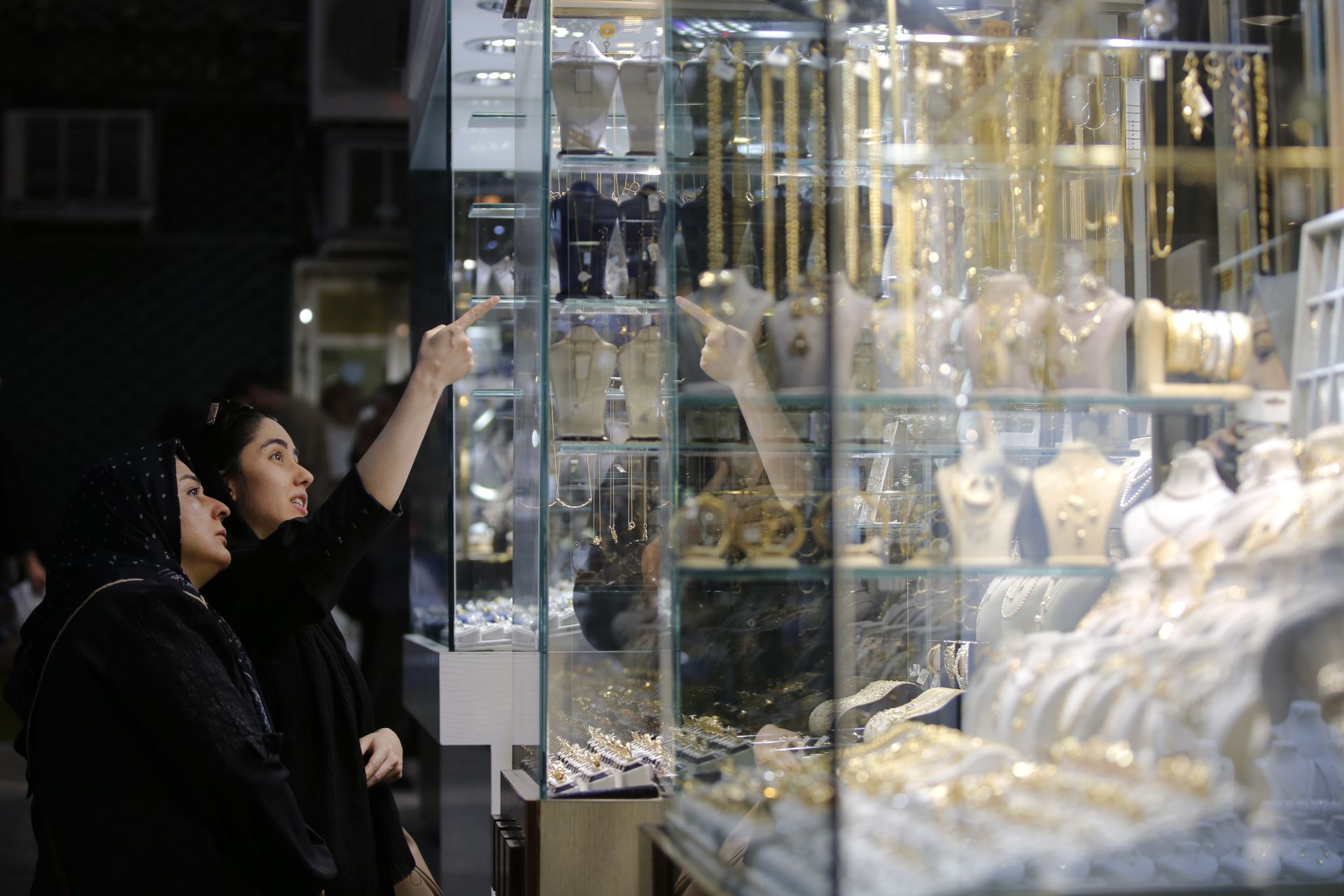
In an Iranian economy reeling from inflation, gold offers a form of financial security, and rising demand for the precious metal tells a story of fear and desperation. In 2016 — shortly after the signing of a nuclear deal between the U.S. and Iran — 1 gram of 18-karat gold cost $26, roughly one-eighth of the country’s monthly minimum wage. A decade later, that same gram sells for $110, while the minimum wage has fallen to just $80. Finished gold pieces are becoming an unattainable luxury, while what was once a small, reliable hedge for ordinary Iranian families is increasingly becoming a vital lifeline.
After the 12-day Israel-Iran war last June, and amid ongoing threats of conflict between Iran and the U.S. and Israel, a surge of panic buying pushed an already fragile market close to its breaking point. The Iranian rial is in the midst of a historic collapse, increasingly devaluing Iranians’ savings. In a radically unstable economy without a reliable currency, owning a bit of gold offers a psychological reprieve for people who increasingly feel that their salaries are being undercut by events outside their control.
“I always set aside 30% of my salary for savings, and I usually use it to buy gold. I hoped that by saving this way, I could one day take a step forward in life and buy a car or a small apartment,” said Faezeh, a young office worker in Tehran. “The stress and anxiety of watching the money I get at the beginning of the month melt away by the end, with no purchasing power left, bothers me so much that I can’t wait to save enough for 1 or 2 grams of gold. That’s why, as soon as I get any money, I buy a small piece of gold, or even a gold pin. That way, I feel like I’ve saved a little, and if an unexpected expense comes up, I can count on it.”
While gold prices are breaking new records worldwide, the boom in Iran has distinctive characteristics. Gold carries deep cultural significance in Iran, going beyond economic security. It is integral to family celebrations and remains the customary gift for nearly all occasions involving women and children. In wedding ceremonies, for example, gift-giving goes well beyond the purchase of rings: The groom is traditionally expected to buy at least three pieces of gold jewelry for the bride, and both families face intense social pressure to uphold this long-standing ritual.
Under Iran’s current economic conditions, however, such cultural practices have become near-impossible to sustain. Many families now seek less expensive pieces, rent gold jewelry for wedding ceremonies to preserve the symbolic gesture without incurring prohibitive costs, or substitute silver when gold has become unaffordable.
As these adaptations increasingly become the new norm, 18-karat gold, alongside the U.S. dollar and, to a lesser extent, the euro, has become one of the few trusted assets available to middle- and lower-income households, whose financial futures have been upended by U.S. and European Union sanctions, domestic corruption and economic mismanagement. In an unstable economy where the stock market can rise or fall by 30% to 40% overnight, many Iranians prefer, as a common saying goes, to “keep their wealth under their pillow.”
“These used to be newborn gifts, now everyone’s buying them,” said a local gold dealer in Tehran, referring to a large tray of pendants laid out in front of him, ranging from 300 to 600 milligrams. “And it’s not just these. We have a wide variety of items under 1 gram, ear and nose piercings, earrings and even gold pins. But most people prefer to buy a fractional gold coin, as it has a fixed price; only tax and a small transaction margin are added. That’s why most people choose them.”
This is a snapshot of today’s local gold market in Tehran. It’s not that people can no longer afford to buy a few grams of gold, decorative jewelry, or complete and half gold coins; those purchases still happen. Depending on what shopkeepers call the “traffic of the neighborhood and store,” gold dealers selling high-end jewelry still have the chance to make high-volume sales — sometimes even several hundred thousand dollars a day. But for smaller gold shops, the story is a bit different.
A dealer at a gold shop in a shopping center in the Jeyhoon neighborhood, located in the central-southern part of Tehran, said: “During the day, hardly anyone buys anything. We also don’t have the financial capacity to buy gold from others. Most transactions happen in the evening.”
The country’s widening class divide also influences the style of gold one might save for, with many individuals giving up on finished gold products and instead seeking makeshift solutions that still allow them to own some of the precious metal.
“Many people are looking for broken gold. Broken gold means jewelry that’s bent or damaged and no longer usable, so it’s traded at the price of raw gold,” the Jeyhoon dealer said. “People no longer even believe in buying used or secondhand gold; they want to buy broken gold directly.”
The country’s currency collapse — which has accelerated amid fears of war and an unending standoff with the U.S. and Europe — has driven people deeper into a frenzy to acquire as much gold as possible.
“This isn’t necessarily about their financial ability. Most people who buy gold for investment, which now includes almost everyone, first think about how they’ll get their money back when they sell it,” said a gold dealer in a local market on Enghelab Street in central Tehran. “Now that prices are rising by the hour, people are afraid they won’t be able to afford the same item tomorrow. So the moment they get money, they come and convert it into goods. And if that good is an investment, all the better. In fact, I should say that nowadays, everything is an investment, because even if you buy a rug, next year it’ll be worth more than what you paid for it.”
The situation described by gold merchants in Iran reflects a phenomenon known as “hot domestic money.” In this situation, inflation rises so rapidly, and price changes are so unpredictable, that people never want to hold on to cash. As soon as they receive money, they purchase assets.
According to the Statistical Center of Iran, inflation over the 12 months leading up to January 2026 never fell below 30%. The Central Bank reports that inflation throughout 2025 typically fluctuated above 35%. During this period, the interest rate for one-year deposits was around 20%. For longer-term deposits, such as those that mature in three years, the interest rate ranged between 22% and 25%, which is roughly 5% below the nominal inflation rate. This discrepancy effectively eliminates bank deposits as a viable investment option for small-scale capital.
Other alternative markets include real estate, automobiles, the stock market, foreign currency and, of course, gold. The housing and car markets are not attractive for small investors. The rising cost of apartment space has vastly outstripped wages, so it’s no surprise that small capital doesn’t flow into this market. The car market isn’t much better.
A domestically produced car, once an affordable vehicle for families earning minimum wage, is now priced at $5,000, making it inaccessible to small investors. The stock market, with its constant fluctuations and reputation for burning small investors, has also lost its appeal. This leaves foreign currency and gold competing to attract small-scale capital from ordinary Iranians desperate for a safe haven.
The influx of small-scale capital into the gold market isn’t limited to local sellers. These days, most Instagram pages that sell gold have a dedicated section for pieces under 1 gram, indicating that there is significant and widespread demand for small, low-cost gold items. But it’s not just goldsmiths who are benefiting from this trend.
Zahra, a housewife shopping for a fractional gold coin at the same store, explained the logic behind her decision. “I used to tell myself I should always keep some cash on hand in case the kids got sick, an unexpected guest arrived, or an emergency expense came up. But I don’t think that way anymore. I don’t keep any cash. As soon as I cover daily expenses, I convert the rest into gold. If we need to spend on something, we sell a piece of gold,” she said. “At the beginning of summer, gold was $60 per gram. Then it went past $100 per gram, and now they say it’ll reach $120. If I had held cash, I would have lost the equivalent of 50 fractional gold coins by now. It’s the same story today. Some people say not to buy because prices will drop. I say, in this country, nothing has ever gotten cheaper.”
Online gold-selling platforms, which just two or three years ago were limited to a couple of relatively unknown websites, mainly operating in smaller towns and attracting minimal investment, have grown rapidly in both number and the volume of capital they attract. This growth has prompted repeated public warnings from the Economic Crimes Police and the Cyber Police.
These platforms claim that people can buy gold at market prices with any amount of capital they have. The gold is usually not delivered physically to the buyer but remains as a credit on the platform and may yield a profit if prices rise, though it is primarily a stable savings method. Some of these platforms ask users to authorize monthly withdrawals from their accounts to invest in the gold market, a model that has expanded rapidly.
Despite repeated warnings from judicial authorities and police about fraud, and ongoing attempts by the police, the Central Bank and other institutions to regulate online gold sales, continued advertising by these platforms and their ongoing use show that fear of losing the purchasing power of the rial outweighs the fear of losing all one’s money in a potential Ponzi scheme. The idea of storing gold still trumps all other concerns about small-scale gold transactions, such as the platform’s inability to deliver the purchased gold upon request or the risk of impurities in broken gold.
The constant anxiety about losing the purchasing power of small savings not only prevents these funds from being pooled into infrastructure investments, but also harms society’s psychological well-being.
“Back when the banks held coin auctions, I borrowed some money and bought coins. I made a good profit. Since then, I’ve been constantly preoccupied with gold prices. The stress of thinking that if I don’t buy now, I won’t be able to afford anything tomorrow never leaves me. Our rent has gone from $100 to $180 a month in just one year,” said Zari, a young nurse with two small children. “We don’t earn enough to live comfortably. Don’t think we want anything extravagant; we haven’t taken a single trip since our two kids were born. We can’t even make it from the beginning to the end of the month. If we don’t buy these 300- or 500-milligram pieces, we’ll never be able to move forward.”
In a society where trust in the national currency — and, as a result, in banks themselves — has collapsed, Iranians who have turned to gold are now forced to bear the burden of being the physical custodians of their own life savings. The risks of this have been heightened as economic hardship drives an increase in crime, some of it targeting the homes of unsuspecting families who now store their own gold.
“A while ago, my child tore off a pendant that weighed less than a gram and dropped it. The vacuum cleaner sucked it up, and I tore through the entire bag hoping to find it, but I never did. Just like that, we lost about $100,” Zari said. “On top of that, I can’t leave the house unattended for even a minute. When I see how easily our neighbors’ homes have been broken into, I’m filled with dread that the same could happen to me, and everything I’ve worked for would vanish in an instant. This is what our youth has become. We once dreamed of doing great things. Now, those dreams have turned into stitching days to nights, patching seams with thread, and turning 300 milligrams into 400 so that we don’t fall behind in life.”
Even before the 12-day war with Israel last summer, economic security in Iran was already fragile. According to a Central Bank report, capital flight from Iran exceeded $20 billion in the first nine months of 2023 alone. All eyes were on the outcome of the final round of negotiations between Iran and the U.S., and the possibility of reaching a political agreement that could bring economic stability.
Since the war, the outlook for negotiations has become increasingly bleak. After the U.N. reinstated sanctions against Iran late last year, public distrust in the country’s economic future only deepened. The exodus of large-scale capital abroad and the diversion of small-scale capital into unproductive and speculative markets, such as gold and foreign currency, threaten Iran’s ability to rebuild infrastructure and invest in national development.
They also signal distrust in the future of the economy and the country itself. As the shadow of war still threatens Iran, more and more desperate Iranians are keeping their wealth under their pillows as they try to weather a crisis that shows no sign of abating.
Become a member today to receive access to all our paywalled essays and the best of New Lines delivered to your inbox through our newsletters.