


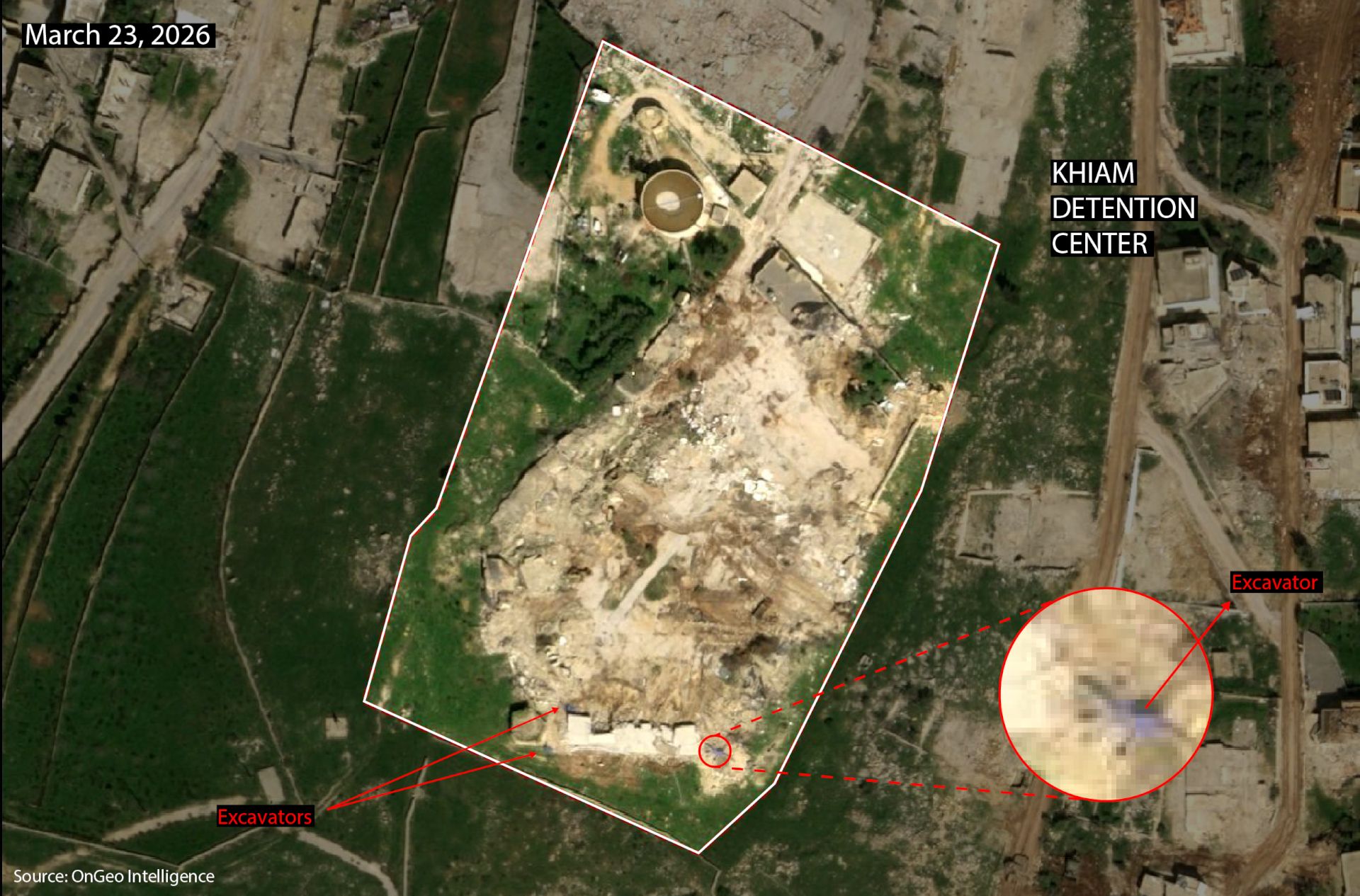
When I first saw the satellite image of Khiam in Lebanon, my immediate thought was not of the famous prison named after it; it was about the village. Khiam, the village in southern Lebanon that sits beside the detention center, and the other villages nearby had been emptied and damaged, and were now being wiped out entirely. The southern Lebanon I had driven through in 2019, its agricultural land, old stone buildings and olive groves, had been systematically taken apart.
In that context, the demolition of Khiam Detention Center is a secondary loss, perhaps even a tertiary one, after the human displacement and after the destruction of the environment. I want to be honest about that hierarchy before writing about the prison at all, because the tendency in a story like this is to treat the historical archive as the main event. It is not.
But the memory of the prison matters, and its erasure is not incidental. When Khiam appeared in the news, and reports began circulating that Israel had invaded it, I became curious about the fate of the detention center. I pulled Sentinel-2 imagery first, and even with its low resolution, it was enough to suggest that something had happened to the compound. To confirm it, I ordered a high-resolution image dated March 23, 2026, through OnGeo Intelligence. That’s when I saw tiny blue objects that resembled excavators tearing through the prison buildings, reducing the compound to bare earth. The surrounding area had already been leveled, but the satellite had caught the exact moment the prison itself was being taken apart.
Khiam Detention Center was built as a French military barracks, later used by the Lebanese army, and seized in 1985 by the South Lebanese Army (SLA), an Israeli proxy force. During 15 years of operation, it held more than 5,000 prisoners without arrest warrants, without records, without judicial process. The institution functioned, in practice, as a detention camp rather than a prison in any legal sense. Torture methods included electric shocks, prolonged suspension from the ceiling, solitary confinement, depriving prisoners of water, food and sleep, and the site’s most infamous instrument: the red box. A metal container measuring some 20 by 28 by 28 inches, it was located inside solitary cells and used to hold prisoners for extended periods with minimal food and a bucket for excrement. Guards would strike its surface regularly with their metal sticks, sending deafening reverberations through the metal and through the body of whoever was inside. The sound would also travel to nearby villages. Repeated pressure from the International Red Cross eventually forced the SLA to allow inspections and introduce reforms from 1995 onward.
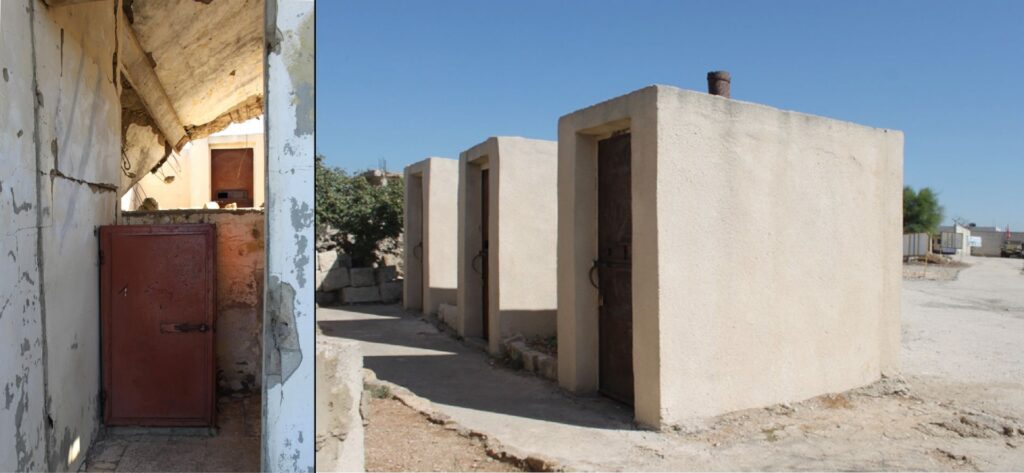
After the Israeli military withdrawal from southern Lebanon in May 2000, the Lebanese government announced its intention to transform the site into a memorial, preserving it largely in the condition it was abandoned, though in practice it was a volunteer committee of former detainees that maintained the site. Then, in the summer war of 2006, Israeli airstrikes destroyed most of the compound, leaving intact only the interrogation rooms, one of the four prison wings and the red box, which was still standing in the ruined cell block when I photographed it in 2019.
The question of how to represent Khiam had preoccupied others before me. In 1999, while southern Lebanon was still under Israeli occupation and no images of the detention center were publicly available, the Lebanese filmmakers Joana Hadjithomas and Khalil Joreige met with six recently freed prisoners to discuss their experience of detention and their relationship to art, looking into what modes of representation could adequately hold what had happened inside those walls. Eight years later, they returned to the same six prisoners, the conversation now filtered through liberation, destruction and the proposals to rebuild. Their film asked questions that have only become more pressing since: What are the roles of memory, reconstitution and the power of the image when the place itself is gone?
In 2019, I went to Khiam several times as part of a research project later published in Delft University of Technology’s Footprint journal, with the aim of building a virtual reconstruction of the prison before it was further altered or destroyed, believing even then that the site would not survive. What I failed to anticipate was the scale of it: not just the prison, but the village, the surrounding landscape, the olive groves, the people who had lived there for generations, all of it taken apart in ways that make the loss of a building feel like the smallest part of what was gone, and the documentation, however necessary, was nowhere near enough.
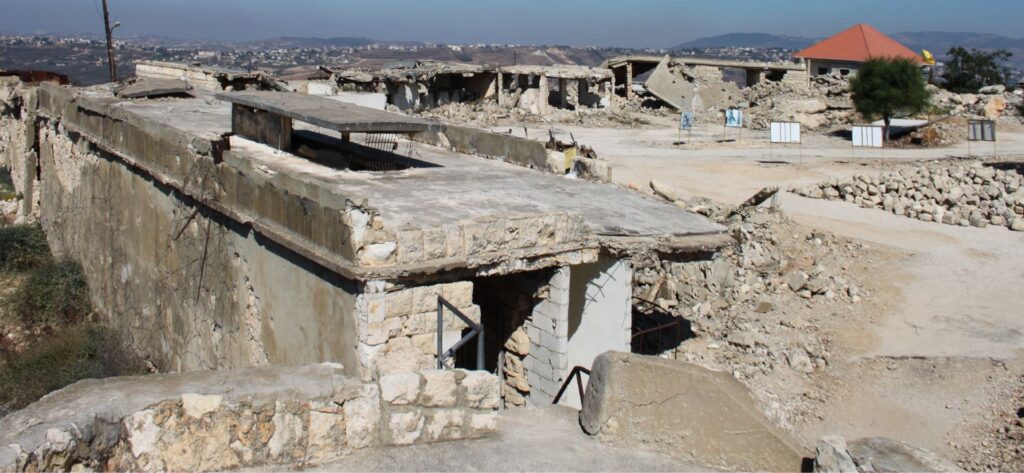
My guide was Abu Ali, the site’s caretaker and its last inhabitant, himself a former prisoner. He had been detained in the prison, and after liberation in 2000 he had decided to stay. When I met him, he limped heavily as he moved through the prison, recreating scenes of detention as we walked. His words filled corridors that were otherwise almost silent, taking on multiple roles simultaneously: survivor, witness, guide. What struck me most was the fact that he had willingly made this place his home.
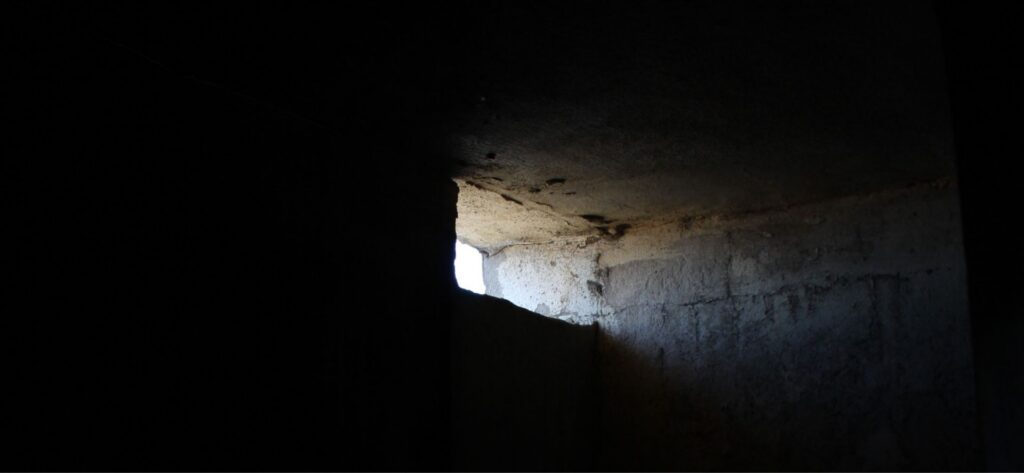
The prison was silent in a way that felt inhabited rather than abandoned, a silence accumulated over decades that made you lower your voice without deciding to, dense with the smell of damp earth and mold. Some of the corridors had almost no natural light, and what light existed came through fractures in the walls and ceilings, damaged by the 2006 airstrikes. Standing there, I kept returning to the same question: How do you document a place whose most essential qualities cannot be captured or measured, whose meaning lives, not in its dimensions or floor plans, but in the way it presses against your body, in the smell that stays in your clothes, in a quality of silence that no recording can hold?
The former prisoners I interviewed in 2019 described their incarceration primarily through sound, which had become their dominant sense under conditions of prolonged darkness and barely any movement. Deprived of sight for long periods, they learned to identify the purpose of a guard’s visit by the rhythm of their footsteps in the corridor, to communicate with prisoners in nearby cells through patterns of knocking on walls, and to associate the recurring sound of a helicopter passing overhead with a specific time of day: 11:30 in the morning.
One former prisoner described being subjected to a dripping tap, water falling into a metal bucket repeatedly for hours, a deliberately applied psychological torture that worked precisely because its monotony offered nothing to resist. She told me that she cannot now tolerate any repeated mechanical sound without being returned involuntarily to that cell, that the click of a rotating fan or the rhythm of a dripping pipe collapses the distance between the present moment and her detention. Sound, unlike a building, cannot be demolished or erased. It lives in the body of the person who heard it, retrievable by anything that resembles it, and in this sense the prison continues to exist in the people who passed through it.
When I visited in 2019, Hezbollah’s presence was visible in every corner of the prison. Flags were positioned throughout, security cameras lined the corridors, and the visit ended at a gift shop stocked with bullet-shaped lighters, Kalashnikov necklaces and Hezbollah memorabilia. The prison’s courtyard displayed Katyusha rocket replicas pointed toward Israel, alongside captured Israeli military equipment presented as spoils of war. Among the former prisoners I interviewed, those who did not belong to Hezbollah expressed frustration at the flags. The resistance against Israeli occupation in southern Lebanon had drawn from across the political and sectarian spectrum, including members of the Lebanese Communist Party, the Palestine Liberation Organization, Christians and unaffiliated civilians from the South, many of whom had been imprisoned in Khiam because of that resistance. Hezbollah’s flags over the prison asserted a retroactive ownership over a history that was not the group’s alone.
This informal curation was only a precursor to a far more ambitious plan. Hezbollah had announced its intention to reconstruct the site as the Khiam Resistance Museum, a full institutional intervention modeled on the Mleeta Resistance Tourist Landmark, inaugurated in 2010 on a strategic mountaintop in southern Lebanon where Hezbollah had fought Israeli forces during the occupation. Khiam Detention Center sits within territory under Hezbollah’s political control, but the site should legally belong to the Lebanese state, a distinction the proposal did not acknowledge. The reconstruction plan involved rebuilding two of the three damaged prison wings, maintaining one in its destroyed state as documentation of the 2006 Israeli attack, and constructing a panorama room near the entrance to host an official Hezbollah narrative of the site’s history, one in which the broader resistance would be absorbed into a single party’s account. The project was deferred indefinitely after the months-long series of civil protests against the Lebanese political elite that broke out in October 2019 (known as the Oct. 17 Revolution) and Lebanon’s subsequent economic collapse. It was definitively ended by Israel’s current ground offensive, which reached Khiam’s center in March 2026.
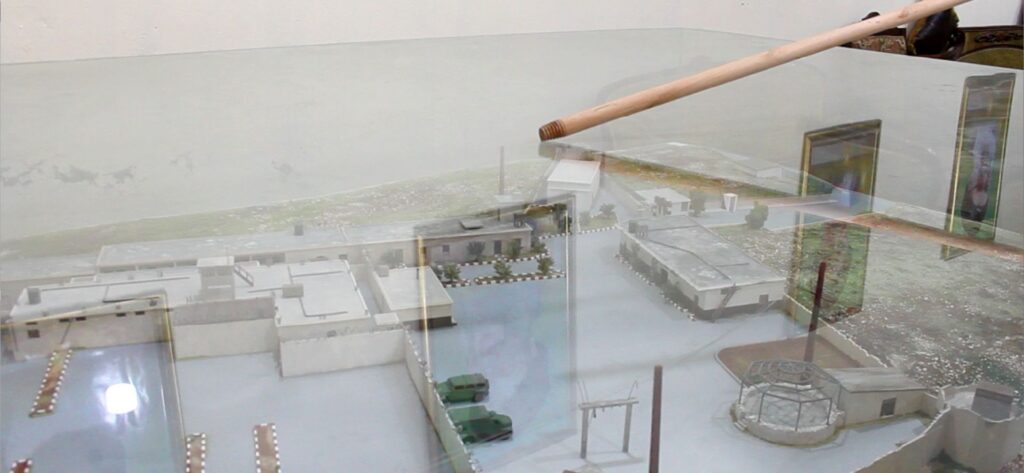
Former prisoners who opposed the reconstruction plan for precisely these reasons also expressed the view that the 2006 Israeli bombing had itself been an act of evidence removal, targeting the physical record of what had taken place inside the prison. The current demolition of the site is consistent with that interpretation. The intentions of Israel and Hezbollah toward the site were not equivalent: Where Hezbollah sought to absorb its history into a single party’s narrative, Israel sought to erase the physical evidence of that history entirely. Different methods, different aims, but the same outcome for the prisoners whose experiences belonged to neither faction: a site that no longer exists to bear witness to what happened inside it.
The virtual reconstruction was built as a supplement to the physical site, not a replacement for it. In its current form, it is a three-dimensional model of the prison as it existed before 2006, navigable from the perspective of Amer Fakhoury, the former warden known as the Butcher of Khiam, who fled the country alongside hundreds of other SLA members after the Israeli withdrawal in 2000, only to return in September 2019 and be detained upon entering Lebanon. He was acquitted six months later after a Lebanese military court ruled, under widely reported U.S. pressure, that the statute of limitations had expired. He died of lymphoma in the U.S. in August 2020 before a retrial could be pursued.
The choice to place the online visitor inside the warden’s body was deliberate: Fakhoury evaded justice in life, and the generated environment is in part a response to that evasion, a space where a version of him remains permanently trapped inside the prison he ran, unable to leave it. The project was always intended as a base from which to continue building, adding the soundscapes recorded inside the compound in 2019, the testimonies of former prisoners, the textures and atmospheric detail that a first iteration does not yet hold.
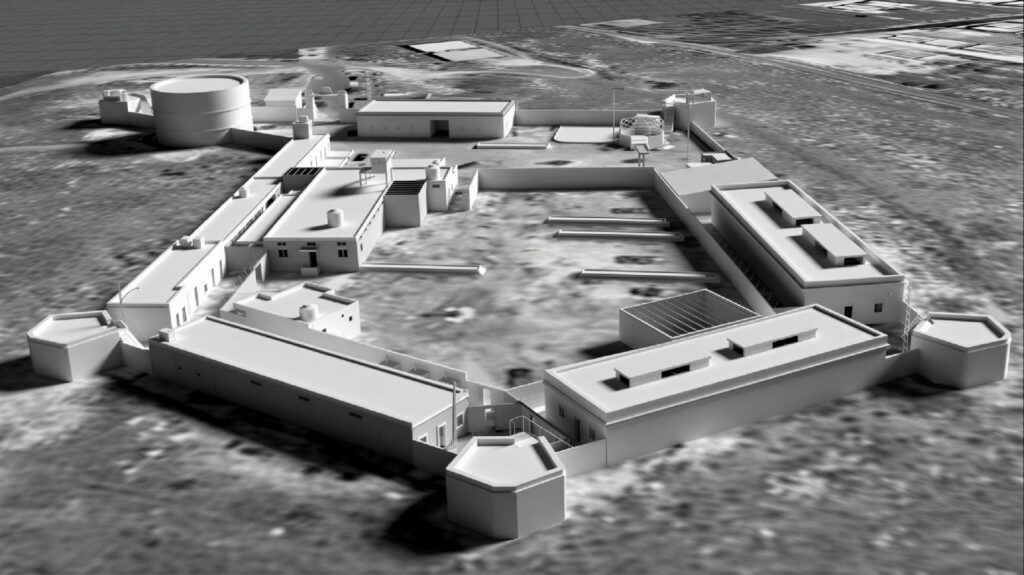
Looking at it now, knowing the site is gone, it feels suddenly and completely not enough, not because the work was wrong or the methodology failed, but because what the virtual model holds is geometry, and what the site held was something that no model can record. A model can reveal the dimensions of the red box but not the silence, the floor plan of the corridors but not the smell, or the quality of the fractured light, or the feeling of standing in a place where so much pain was felt and having it press against you from the walls — things that required the physical presence of the site, and the physical presence of the site is gone.
The blueprint remains, and the archive will continue to be developed, work that is more urgent now than it was when it was precautionary.
Abu Ali’s current whereabouts are unknown, as are those of the former prisoners I interviewed. The village that surrounded the prison, and the villages around it, have been devastated in ways that make the loss of a building feel like the smallest part of what has been taken. What remains is what those who worked to document this place managed to gather before it was gone: testimony, measurements, photographs, soundscapes, film and three-dimensional models of a place that no longer exists, which is not enough, and is also, at this point, everything there is.
Become a member today to receive access to all our paywalled essays and the best of New Lines delivered to your inbox through our newsletters.