



At nearly 104 degrees Fahrenheit and 80% humidity, Bandar Abbas was already an open-air sauna at 5 a.m., as fishers unloaded their fresh catch of shrimp and fish at the city’s wholesale fish market, right at the wharf. The intense tang of rotten fish residue was unbearable.
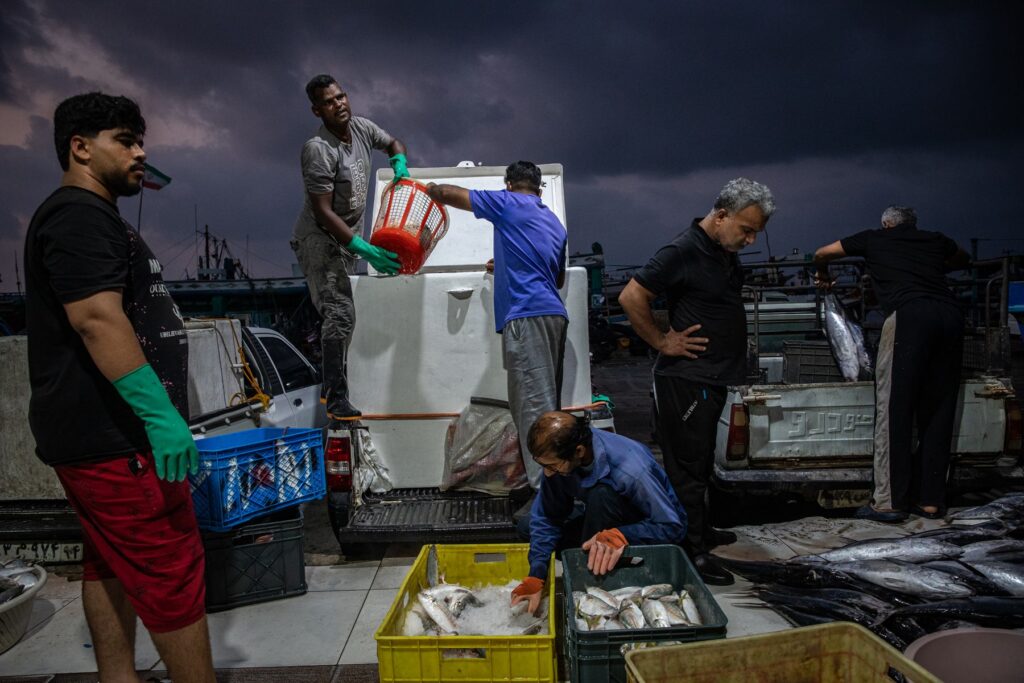
Elias Rahimi, like other wholesalers, had placed a tiny wooden desk in the middle of the covered marketplace. A calculator, a card reader, a notebook and a record of sales from recent days filled the desk, behind which he sat on a red plastic chair. Next to him stood a heavy-duty platform scale. Loads of tuna and queenfish lay in rows on the tiled floor around him.
Each day, clients show up at his desk, weigh fish, and make purchases or settle sales. Rahimi uses a phosphor-green highlight marker to strike the deal. Then the clients put their notebooks on his desk to have the payment confirmation stamped in them. The ritual acts make him resemble a judge. By 6 a.m. he had already sold 2 tons of fish.
“My sales have dropped by 30% since last year, but thank God the business is still running well,” Rahimi said, with the typical relaxed southern Iranian accent, elongating the words’ last vowel. In his view, the rapid inflation and loss of purchasing power of the population have contributed to the drop, in addition to the maritime siege initiated by the U.S. Navy, which means fishers “cannot sail into deep waters, resulting in smaller catches and less variety. Numerous times they’ve struck vessels when they went farther.”
By 7 a.m., as the humidity rose and the heat became unbearable, Rahimi locked up his chair and desk and left his mobile office at the country’s largest loading site for seafood, which is a major economic lifeline for southern Iran, with an estimated annual yield of more than 800,000 tons.
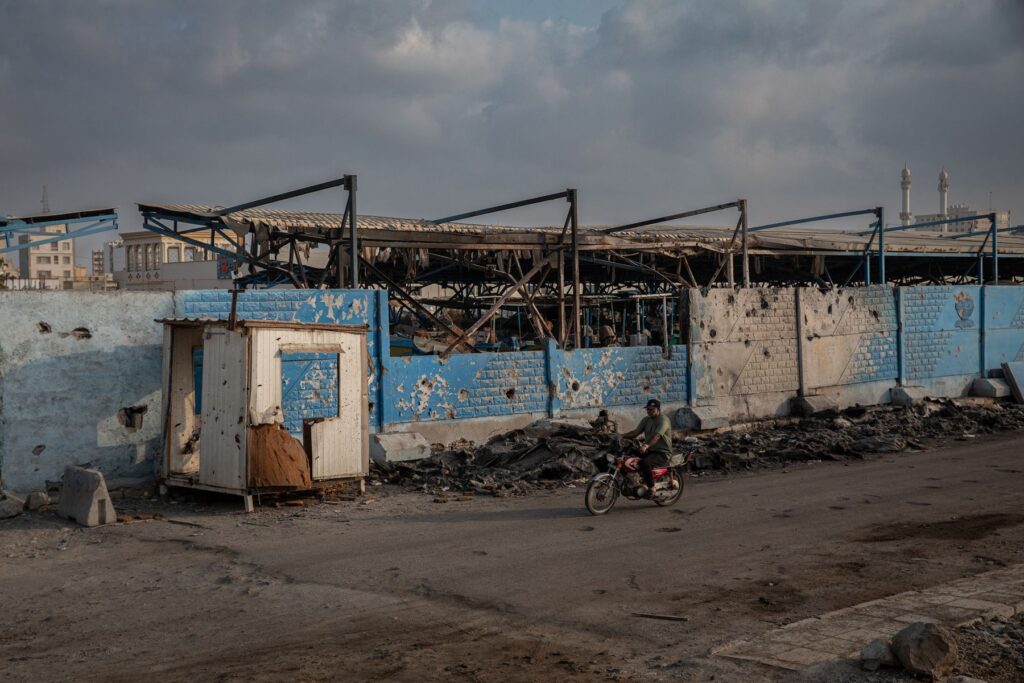
The marketplace is only a stone’s throw away from the parking space of a nearby vessel that was struck twice on July 8 and 9 this year. More than 30 boats and their fishing accessories were destroyed. While the half-ruined building is being used again, a burnt roof, cracked murals, melted fishing nets, torn ropes and flat cart tires vividly testify to the risks the fishers endure.
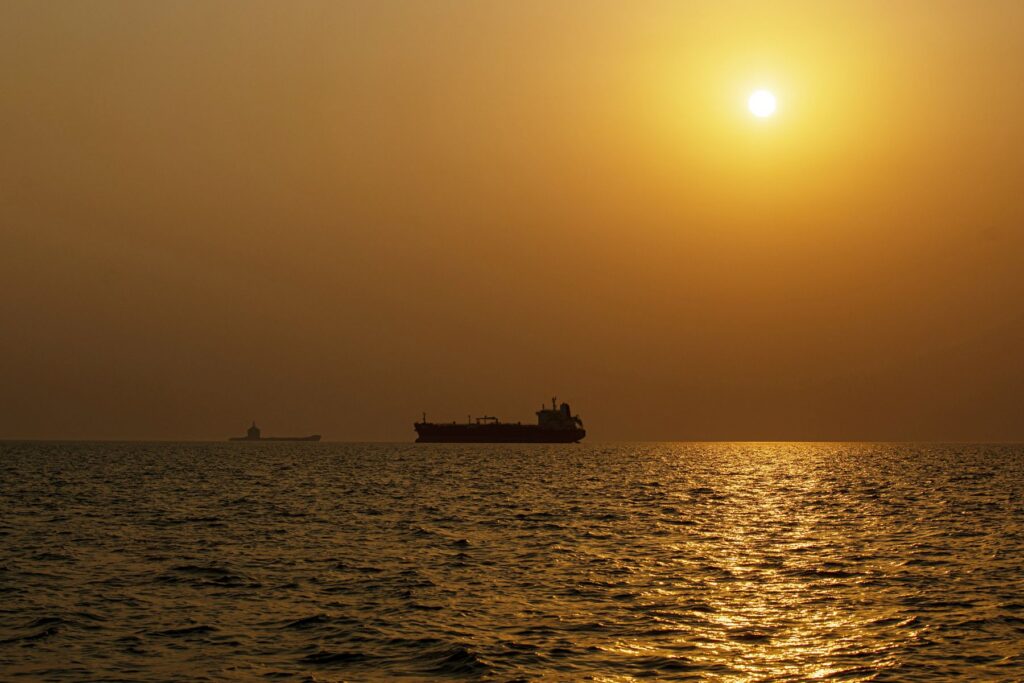
Less than 5 nautical miles from Bandar Abbas, arguably Iran’s main gate to the Strait of Hormuz, lie burnt Iranian navy frigates and container ships such as MSC Aries, its bridge bearing explosion marks. Most have been stripped of their valuable metals and cables by thieves. Buoys placed by the maritime authority mark the coordinates of sunken fishing vessels to avoid accidents in what local fishers refer to as “the graveyard.” According to official figures provided by Iran’s judiciary, at least 420 fishing vessels have been damaged or destroyed by U.S. strikes since it attacked Iran on Feb. 28, 2026.
Less than two hours’ drive away lies Minab. Before the war started on Feb. 28, it was mostly known for its delicious mangoes, which are often pickled. But ever since, in the Iranian collective memory and beyond, it has become synonymous with the heinous U.S. bombing of a school compound, which killed 123 schoolchildren and sparked calls by human rights groups to investigate whether the attack was a war crime.
At the edge of the local cemetery, surrounded by large mesquite and acacia trees, a section half the size of a football field, laid with synthetic lawn and scaffolded and covered with green nets to provide shade, is dedicated to the 157 victims of the massacre, which includes both the schoolchildren and adults who were killed.
A group of young girls had gathered around the grave of Setayesh Ali-Hosseini, who was killed by the strikes while attending school in fourth grade. They played with forest-green prayer beads and rubbed them against the gravestone for blessings.
They attend a different school, but Setayesh used to be their playmate from the same neighborhood. Twelve-year-old Fatemeh said, “When my mother picked up the books for the new school year, she learned that half of the pupils won’t attend,” an indication of how scared the families are for their offspring.
The scaffolded field at Minab’s graveyard has become a vibrant forum for the province’s second-largest city. For Minab’s residents, it’s a place to mourn and overcome; for visitors from near and far, it has become a pilgrimage site, and it functions as an event space for various government organs.
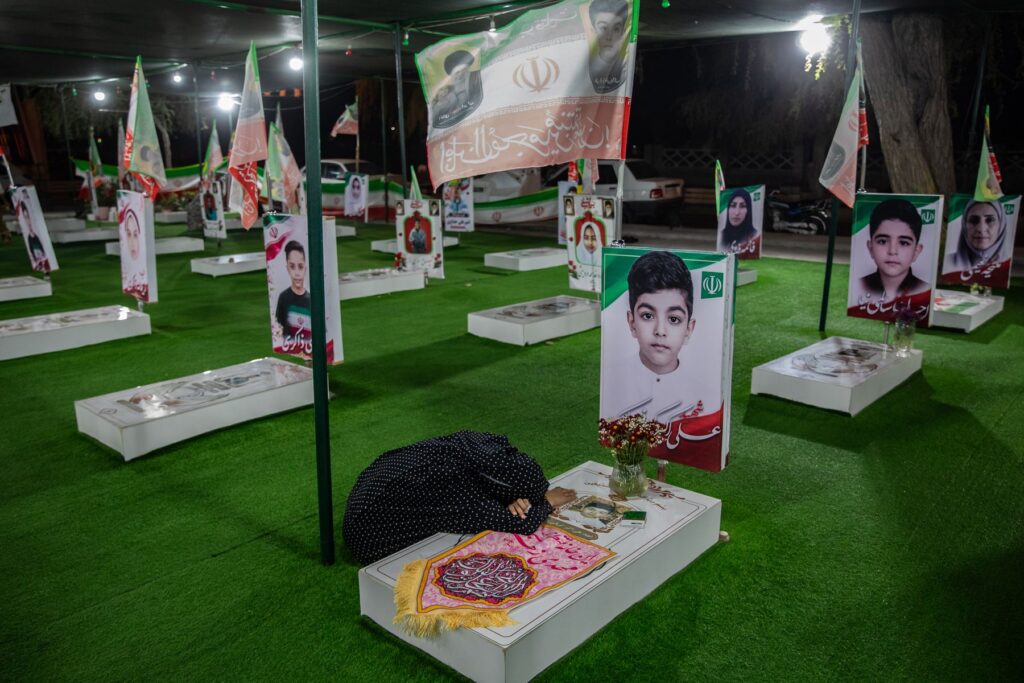
One such event was planned for the next day, Sept. 22; the judiciary’s spokesperson had shifted his biweekly press conference to the grave site to commemorate the 311 schoolchildren killed all over Iran through U.S. and Israeli strikes, on the occasion of the new school year, which in Iran traditionally starts at the onset of autumn.
Over the summer holidays, a group of donors and volunteers renovated and prepared a provisional school for the surviving pupils. It is a five-minute walk from the bombed school compound, on abandoned grounds rented from the local water company.
During the ceremonial school opening on Sept. 23, public officials rushed to reap the rewards. Tehran’s mayor, Alireza Zakani, showed up after an invitation from the volunteers. The presidential deputy for science and technology, Hossein Afshin, unaware of the former’s presence, also decided to come by. Once Afshin realized his political rival was present, his motorcade turned away from the new compound, leaving the field to Tehran’s mayor.
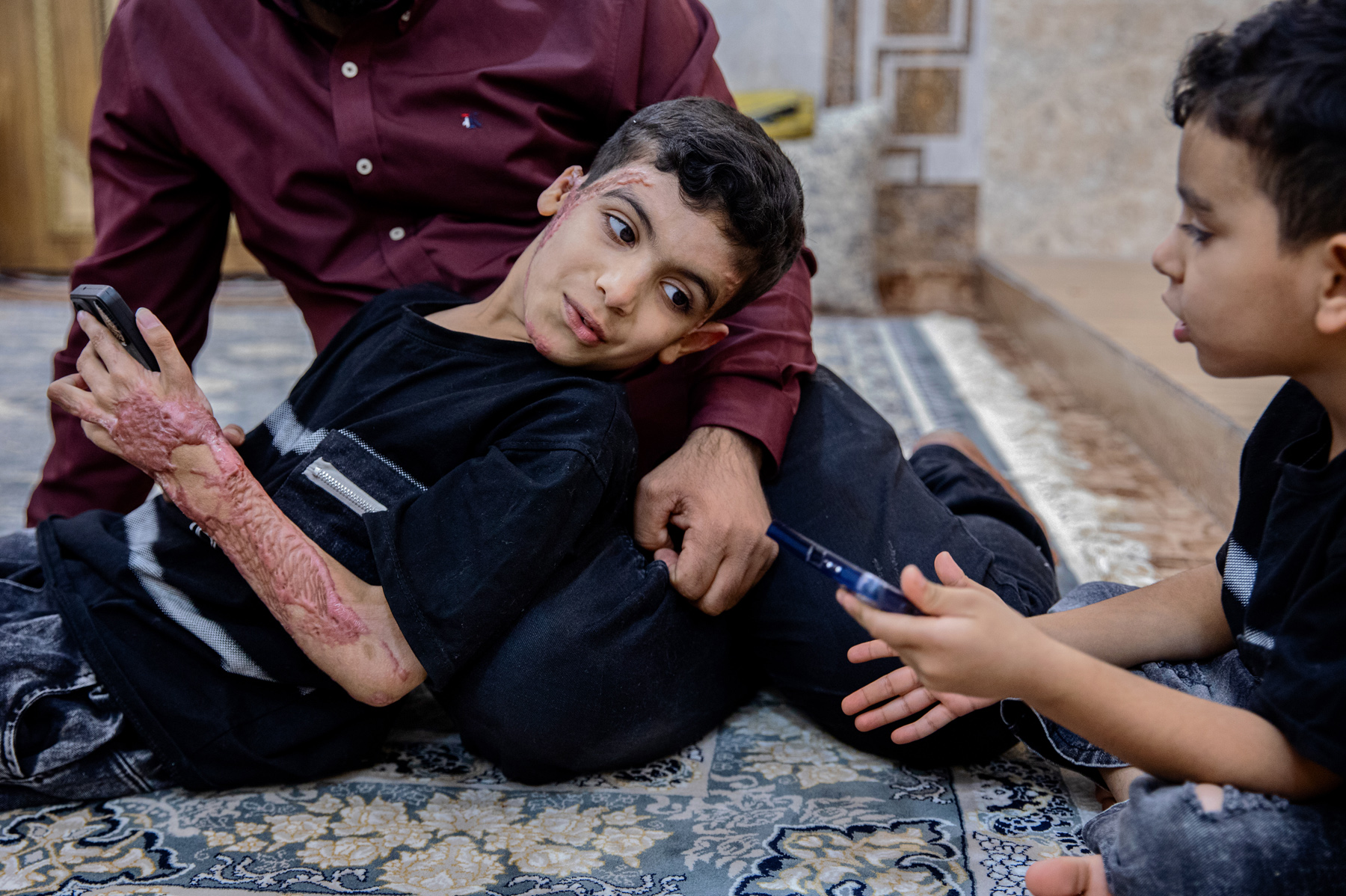
At all three events, Mohammad Sharafi was present alongside his father, Abdulrashid. Most officials briefly stroked his head and passed on. A timid 8-year-old boy, with a fragile, slender body and a subtle smile hiding the gaps of his missing milk teeth, he has a truly inquisitive gaze. But what strikes one at first sight are two massive hypertrophic burn traces on either side of his face, running like horns from the edge of his forehead to beneath the chin, and the missing upper half of his right ear. The scars continue over his neck in a checkered pattern, similar to crocodile leather, to the back of his hands, the mark of a child who survived an inferno.
Later that day, right before dusk, at their family home in the village of Konarju, Mohammad’s father spoke frankly about the trauma his son has been enduring: “About 22% to 25% of his body has been heavily burned. After 11 days, I realized that the hospital in Bandar Abbas lacked adequate means to treat him, so I transferred him with my own car to Yazd, where he spent a further 20 days in treatment.” Sharafi said that in three months Mohammad would have to undergo complex skin surgeries to treat the hypertrophic scars, which currently restrain his motor skills.
By coincidence, the live broadcast of Iranian President Masoud Pezeshkian’s speech at the U.N. General Assembly was running on national television, accusing the U.S. government of killing innocent children, and pledging staunchness on behalf of the Iranian population. Sharafi said: “The minister of health personally promised to cover all of Mohammad’s treatment costs. Afterwards they didn’t even call us.”
He then showed videos on his phone of the who’s who of Iran’s political establishment, including the president, the minister of health and the government spokesperson, meeting Mohammad and making all sorts of promises regarding his recovery and rehabilitation process, which later fell by the wayside.
Mohammad Sharafi’s case may serve as a bitter metaphor for the condition of Iran’s governance, where officials race to take symbolic credit for everything, but groundwork is left to volunteers and the armed forces with meager political support. Yet beyond the symbolic gestures of politicians, it is in places like Kuhestak that the consequences of the war are lived most directly.
The tiny port community of Kuhestak is less than 9 miles away from Konarju. In the early evening, in an unobtrusive house with a garden, sitting on a machine-sewn carpet, an operative with the Islamic Revolutionary Guards Corps (IRGC) described the operations he had witnessed, the difficulties of coordinating between various units of the armed forces, and the situation in the Strait of Hormuz. He explained that he sometimes monitors the strait from the rooftop of the house, and that the Omani exclave of Khasab is visible if there is no haze — when suddenly a massive shock wave slammed the door.
He ran out and up to the rooftop. There he was joined by an unidentified man from the neighboring property. Several miles away, the lights of ships could be seen on the open sea like stars in the sky. He said, “It seems we have been enforcing law!” and called a superior to report the blast. He was told that “tonight there is a party [in the strait],” indicating that many Emirati oil shuttles are trying to sneak through the strait as close to the northernmost Omani settlement of Kumzar and the neighboring islands as the water depth allows. If an explicit warning issued by the IRGC navy is ignored by the shuttles’ crews, their bridge is targeted. Yet in the darkness, some shuttles do manage to sneak past the islands and reach the Gulf of Oman.
The new phase of the cat-and-mouse game that has kept the world’s economy in a chokehold since April is also seen critically by Iranian defense analysts. That is because the Gulf states have shifted to the use of smaller and cheaper shuttles instead of supertankers, making their losses calculable, hence reducing the disruption to the world’s oil markets while still depleting Iranian firepower and military capacity.
On Sept. 1, numerous U.S. strikes ripped through Kuhestak. The U.S. Central Command then said on X that it had struck targets affiliated with the IRGC in retaliation for its attacks on commercial shipping in the strait. A cell tower, the small wharf and a wedding ceremony that was about to start were hit — killing five and wounding at least 68.
A missile ripped through the roof of the house where the wedding was meant to take place, leaving a hole more than 13 feet wide between its beams and decapitating a tall palm tree in the yard. Three weeks later, debris lay all over the place. A stray cat had sought refuge in the shadow of the destroyed building. The bride and groom were not reachable to speak about the attack — they were too crushed and ashamed.
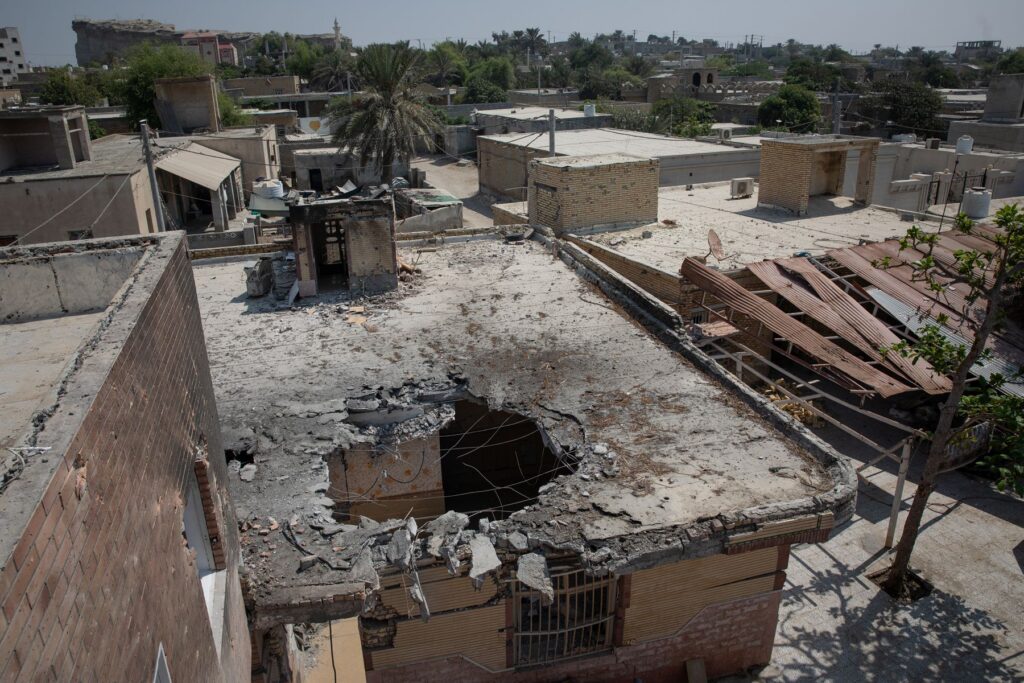
Mohammad Karami and Eliza Ghourchizadeh are distant relatives of the bride. Their 5-year-old son Amir-Mohammad was killed in the attack, and their daughter Kiyana, who is 13, was wounded by a shrapnel fragment in the back, as her father indicates, a fingertip away from the spine. The children had arrived early at the wedding to play with each other.
Three weeks later, on a Friday afternoon, family and friends gathered in their living room to express their sympathy. Clothed in black from head to toe, Karami said, “Three projectiles hit the area of the house. The first one, which hit the cell tower, also caused a power outage, and seeing the flames soaring, I went for help. By then I didn’t know my child was there.”
He then recalled the ordeal he had to go through that night. Given the limited capacity of the local health center, after not finding Amir-Mohammad, he had thought his son might have been transferred among other wounded victims to the hospital in Minab, some 30 miles away. He had gone searching there, to no avail. Back in Kuhestak, his wounded daughter Kiyana had told him, “Baba, don’t search for him!” Shrapnel had cut through his son’s head, causing parts of his brain to fall out.
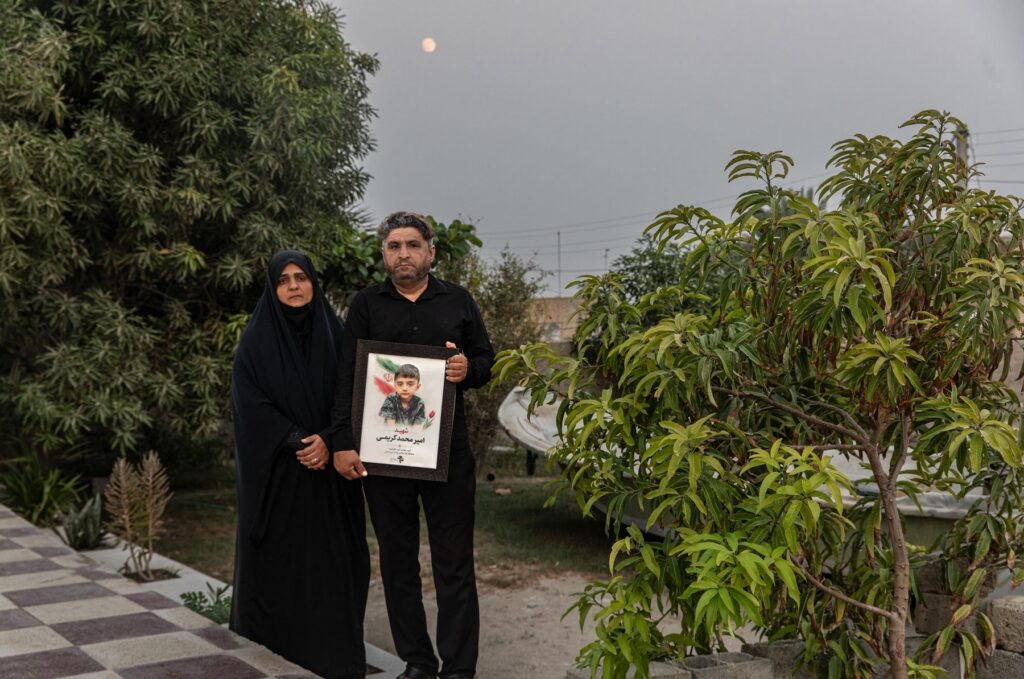
The child’s mother, Ghourchizadeh, added, “Recently, Amir-Mohammad was repeating that he would disgrace Trump,” And, with some gratification, she hinted that the U.N. fact-finding mission on Iran suspects the attacks on Kuhestak to be war crimes. A teacher of ethics herself, she raised concerns about the horror the children of the community have gone through. “Since the wedding was hit, the children are scared despite being used to explosions.”
Beyond military targets, and in addition to the educational and commercial sites that were struck during the war, the civilian infrastructure in Hormozgan province was severely targeted in an escalation on July 17 and 18. Over the course of two days, nine main bridges and two tunnels connecting its capital, Bandar Abbas, with the rest of the country were destroyed by the U.S. military.
Thirty miles north of Bandar Abbas, once the first mountains are passed, the humidity of the coast gives way to an arid steppe climate. A very warm wind stirs the steppe’s sand into the air. As the workers below the bridge pillars bent rebar, the temperature of the metal could easily reach 120 degrees in the sun.
Kianoush Galleh is in charge of reinstating the bridge between Hajiabad and Bandar Abbas. He said, “They have hit all land connections with Bandar Abbas, and they have done so with precision.” He then pointed to the provisional detour that makes an abrupt turn — hard to see in the dark — and said, “Every night we witness two to three accidents here.”
At 10.30 a.m., a blast was heard from the direction of the coast, but the workers took it in stride. Two partitions of the concrete bridge, including a set of columns, were destroyed in the strike here. Yet the debris was cleared; the new pillars now stood steadfast. Yaser Pournasiri, one of the metal workers, said, not without humor: “We poured 4 meters of concrete foundation and used 32-millimeter rebar for the mold. This time no missile can do anything!”
Pournasiri continued, “Depending on the form of the molds and how difficult to bend they are, we shape up to six or seven tons of rebar per day.” The team estimated that it would take 50 days of work to reopen the bridge to traffic, though they did not know how long it would last. Before his team retreated for their four-hour-long break to escape the excessive heat, Galleh had a cynical take: “As Pezeshkian has said, they hit, and if we rebuild, they’ll hit again!”
Back in Bandar Abbas, in a cozy cafe with retro decoration, Massoumeh Biglari and her son had arrived for an early evening get-together with a few other friends. Biglari has been a resident of the southern province’s capital for the past 21 years. In an informal conversation, she said, “We live here at the sea, but the people cannot afford seafood anymore!”
The rapid inflation and loss of purchasing power over the past few months, and the effects of the siege on imports and thus the health and medicine sector, are pressing issues for her. “We haven’t experienced any ceasefire, only the frequency of bombings has slowed down since April,” she said. As she spoke, in an absurd twist of ambience, the playlist of the cafe shifted to the joyous melody of Shostakovich’s Second Waltz.
Biglari expressed her concern for the economic situation, since “the shipyard of Bandar Abbas and the port were the major employers of the city.” The shipyard was hit, and the port suffered heavily under the U.S.-imposed siege.
Her son Hirad nodded and added that they were used to the constant threat of the war by now, to not panicking with every explosion, to collecting food and water for emergencies. They were stuck in a never-ending limbo.
Southern Iran is paying a hefty price in a prolonged conflict it did not choose, but while the possibility of a further escalation looms, its people remain defiant. Karami, the father of Amir-Mohammad, who was killed by the strike on the wedding, concluded: “Since the attacks, not a single person has left Kuhestak for good. We hear blasts and missiles every day, but nobody leaves their land. Our land is our dignity.”
Become a member today to receive access to all our paywalled essays and the best of New Lines delivered to your inbox through our newsletters.