


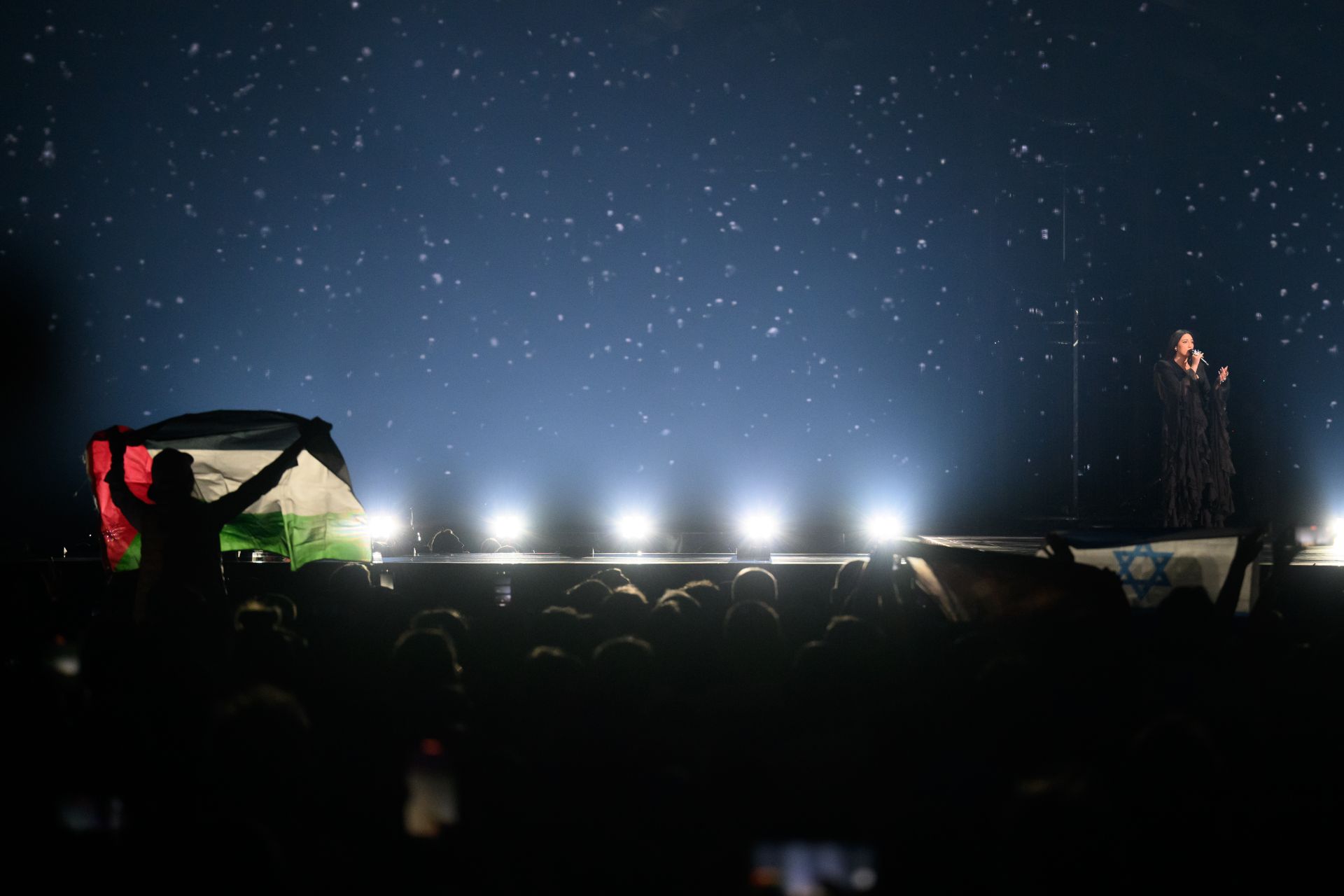
Bashar Murad grew up in a household where Eurovision was not merely the guilty pleasure of a thousand sequined outfits, power ballads belted into spangled microphones and millions of European eyeballs gleefully glued to their screens. For Murad, whose parents had founded the wildly popular Palestinian band Sabreen, known for jazz-inflected songs and lyrics drawn from the poems of Mahmoud Darwish, Eurovision embodied a chance to represent Palestinian culture on their own terms. In 2007, the family traveled to Helsinki to lobby the delegates of the European Broadcasting Union — the Geneva-based body that oversees the contest — to let Bashar, who was born and raised in Jerusalem, compete for Palestine.
Unlike many Palestinian artists at the time, the members of Sabreen held Israeli-issued documents that allowed them to tour places as far-flung as Japan and made them understand what it meant to represent their culture directly, on their own terms. Eurovision seemed like an obvious fit for reframing Palestine after the brutality of the Second Intifada. “There was just this huge potential for countries or nations who are usually just seen as victims or terrorists, or only talked about when they are being killed,” Murad said.
The push to get Murad involved representing Palestine was not entirely out of left field. While the official requirement for Eurovision participation is membership in either the European Broadcasting Union (EBU) or the Council of Europe — Palestine has neither — it did briefly hold observer status, and the rules seemed to have some elasticity. Australia, another decidedly non-European observer member, located in an entirely different hemisphere where dedicated fans watch the live broadcasts at 5 a.m., was allowed to participate after being invited by the EBU and Austrian host broadcaster ORF.
The campaign by the Murad family to include Palestine in the competition ultimately failed; Bashar would have to find another way to make it onto Europe’s biggest musical stage. But his example serves as a potent illustration of how Eurovision, with its lofty ideals expressed in mottos like “United by music,” “Celebrate diversity” and “Building bridges,” can gently bend the rules to favor certain countries and not others.
If the contest’s quirks and inconsistencies had been poked at in previous years, the lead-up to the 70th-anniversary 2026 competition exposed them completely. At the center of it all is Israel, one of the contest’s most consistently well-performing countries, having been the first to win back-to-back, in 1978 and 1979 — two of its four total wins — and the first non-European country to compete. For a long time, Israel’s participation was widely supported. If anything, it reflected “the feeling among certain countries, certainly Germany, that they owe a certain debt to Israel,” said Adam Dubin, a professor of international public law at Comillas Pontifical University in Madrid, who has covered the human rights angle of Eurovision.
That change reached a head in 2024, as Israel’s retaliation for the Hamas attacks on Oct. 7, 2023, grew in brutality, and the tally of lives lost mounted. At both Malmo in 2024 and Basel in 2025, Israel won the public vote and finished second overall — performing strongly even in countries where polls showed it was deeply unpopular. Ahead of the Basel contest, Israeli Prime Minister Benjamin Netanyahu himself posted on social media urging people to use all 20 of their votes for Israel’s entry. Journalists at the Finnish broadcaster Yle, using Google’s ad library, revealed that the Israeli government had bought online advertisements in multiple languages making the same request. Several broadcasters demanded the full voting data to see if there had been fraud. The EBU claimed the results were fair, but the controversy led to a rule change that halved the number of votes any one person could make to 10.
Five countries pulled out of this year’s event, including Spain, one of the “Big Five” group of countries that make the greatest financial contributions to the event, and Ireland, which holds the record for the most wins. Over a thousand artists, among them high-profile figures such as Massive Attack and Paul Weller, as well as the reigning Eurovision champion, Austria’s JJ, signed an open letter demanding Israel’s exclusion. A counterpetition was signed by leading Hollywood figures such as Helen Mirren and Mila Kunis, demanding that Israel stay. The EBU has declined to move for Israel’s exclusion despite the motion being put forth in the EBU’s general assembly. Their stance has consistently been that Eurovision is not political.
“It’s sort of the big joke, right, when they talk about it being apolitical,” Dubin said. “The politics of it play out on so many levels, from who’s included, who is not included, the songs themselves, you know, it’s extremely political,” he continued. In 2024, Israel’s original entry, a song titled “October Rain” that was supposedly about the massacre at the Nova Music Festival during the Oct. 7 attacks, was initially rejected by the EBU for its blatantly political overtones. Even after the lyrics were rewritten, the politically charged sentiment remained.
The controversy around Israel’s participation isn’t new. In fact, it stems from a wider and older problem — one that predates the Gaza war by decades and goes beyond affecting potential members with tricky statehoods, such as Palestine. Seven Arab countries are full EBU members, and in 70 years of Eurovision, only one of them has competed — exactly once.
The EBU was set up in 1950 by a group of European and Mediterranean countries that included Egypt, Lebanon and Tunisia as founding members, in order to foster collaboration among radio and television broadcasters after the destruction of World War II. The first Eurovision Song Contest was organized in 1956, primarily as a means to test the ability of these public broadcasters to air a cultural program simultaneously. “People often see it in the context of European integration or postwar peace, but this is not true,” said Dean Vuletic, a Vienna-based Eurovision historian. “Eurovision started out as a largely technical experiment.”
Yet when Israel joined the EBU in 1958, Egypt and Syria resigned from the contest in protest. Tunisia drew fourth in the 1977 running order and pulled out days before the show, unwilling to broadcast Israeli content on its airwaves. When Israel won in 1978, Arab state broadcasters that were airing the contest cut to advertisements when Israel performed, and when it became clear Israel would win, many cut the feed entirely before the end of the voting. Jordan went further, showing flowers placed on top of the Israeli entry and announcing Belgium had won.
Morocco managed the sole Arab appearance in the 70-year history of the contest in 1980, the one year Israel withdrew because the contest fell on Yom HaZikaron, Israel’s military remembrance day. But since Israel’s return the following year, Morocco has not participated again. Lebanon was the most recent to come close in 2005, when Tele Liban selected a singer, recorded a song and made it onto the official Eurovision CD cover, before withdrawing because Lebanese law prohibits broadcasting Israeli content. “If you’re participating in Eurovision, you have to broadcast the whole show,” Vuletic said, highlighting that censorship is not allowed.
The EBU’s response was to ban Lebanon for three years. A founding-era member ended up being penalized for a legal prohibition that exists because of a war in which Israel was a belligerent.
Today, Algeria, Egypt, Jordan, Lebanon, Libya, Morocco and Tunisia remain full EBU members, yet none of them compete. According to Dubin, the reasons for this exclusion are manifold and inseparable from much larger, unresolved debates in Europe that stretch from the Holocaust to the present day. “There’s historically been a lot of taboo around that in Europe, and criticizing Israel is viewed as antisemitic,” he said. European countries believe they are repaying that debt through an “unspoken rule that countries don’t criticize Israel.”
He argues that the debate around Israel’s inclusion also intersects with Europe’s entrenched Islamophobia, sharpened during periods of high migration such as the 2015-2016 refugee influx set off by the war in Syria. “By promoting Israel, it’s an indirect way of distancing yourself from — or almost maintaining a proxy war against — Arab states,” Dubin said. “Excluding Israel takes away from the way in which it is used as a sort of counter to Arab or Muslim countries.”
According to Gad Yair, a sociologist at the Hebrew University of Jerusalem who has spent three decades studying the contest, the politics of Eurovision’s relationship with Israel cannot be separated from what the contest actually is and always has been: a platform for what he calls “nation branding” — one that matters more for certain countries than others. For small nations, it is a way not only to signal their unique identity, but to launch soft-power campaigns for bids at real power, like potential NATO or EU membership. Major Western European powers, he argues, have never invested in Eurovision the way Israel, Azerbaijan or Turkey once did, because they do not need to.
“It’s mostly peripheral countries, the wannabes, the ones that want to be European,” that are going all-out on Eurovision, he said. No country has deployed this more deliberately than Ukraine, which has used Eurovision repeatedly to plant a flag in the Western imagination and remind European capitals, as Yair put it, that “we are facing West.”
Yair also noted that Israeli public reaction to threats of exclusion from the contest runs deeper than Eurovision itself, touching on something more fundamental to Israeli national identity. “We feel that we are musically, legitimately at the center of Europe,” Yair said, so attempts to exclude Israel from Eurovision are therefore seen as a betrayal. “Feeling persecuted is a constant feature of Israeli culture,” he continued. “Doesn’t matter if it’s during war, not war, peace, whatever.”
Yair shared an anecdote from his classroom, which features both Jewish and Palestinian students, noting that excitement for this year’s competition was almost nonexistent among half the room in the week before the contest. “The Palestinian students had no idea what I was talking about. Eurovision is not part of their world. We are living a hundred meters apart, Israelis and Palestinians. We are sitting in the same classroom. They hear the same professors, yet they live in a different media world.”
Some researchers point to other factors hampering participation by the EBU’s Arab members. Vuletic, who has spent thousands of hours combing EBU archives, argues that the Arab member states’ interest in participating in Eurovision was never particularly strong to begin with. There was “some interest in Egypt, in the early 1980s, after its peace treaty with Israel,” he said, but it ultimately came to nothing because the government didn’t think the payoff would be worth the high cost of entry into the contest.
The boycott of the EBU led to the formation of the ASBU, an Arab counterpart founded in 1969, but it has functioned less as a genuine counterpart, and actual cooperation has been largely symbolic. “Arab broadcasters that are state-controlled basically only want the facade of legitimacy that comes from interacting with international bodies,” explained Naomi Sakr, a veteran media scholar who spent decades studying Arab broadcasting and its relationship with European institutions.
For Bashar Murad, the path to Eurovision came through Hatari, an Icelandic avant-garde band. During a performance in Tel Aviv in 2019 — a year after Israel won its fourth Eurovision title — band members of Hatari unfurled Palestinian flags on live television. Murad had found a potential partner.
They co-wrote a political protest track, titled “Klefi/Samed” (roughly translated, “Cell/Steadfast”), about the Palestinian resistance. The music video was filmed in the Palestinian desert, and the band organized a series of performances with Murad in Iceland and across Europe. After its success, Murad decided to try to compete in Eurovision himself through Iceland in the 2024 contest. He co-wrote his entry, “Wild West,” with Einar Stef of Hatari. While he decided to enter before the Gaza war began, by the time the competition came around, it was well underway.
“I felt an even more pressing need to be there,” he said. “I was seeing how Palestinians were being dehumanized on a more extreme level than ever before.”
He came second in the Icelandic final, close enough to make the point. “It was about highlighting how many hoops we have to jump through just to be heard — that I have to fly all the way to Iceland, learn Icelandic, do all of this, just to show how excluded Palestinian voices are from the mainstream.”
Become a member today to receive access to all our paywalled essays and the best of New Lines delivered to your inbox through our newsletters.